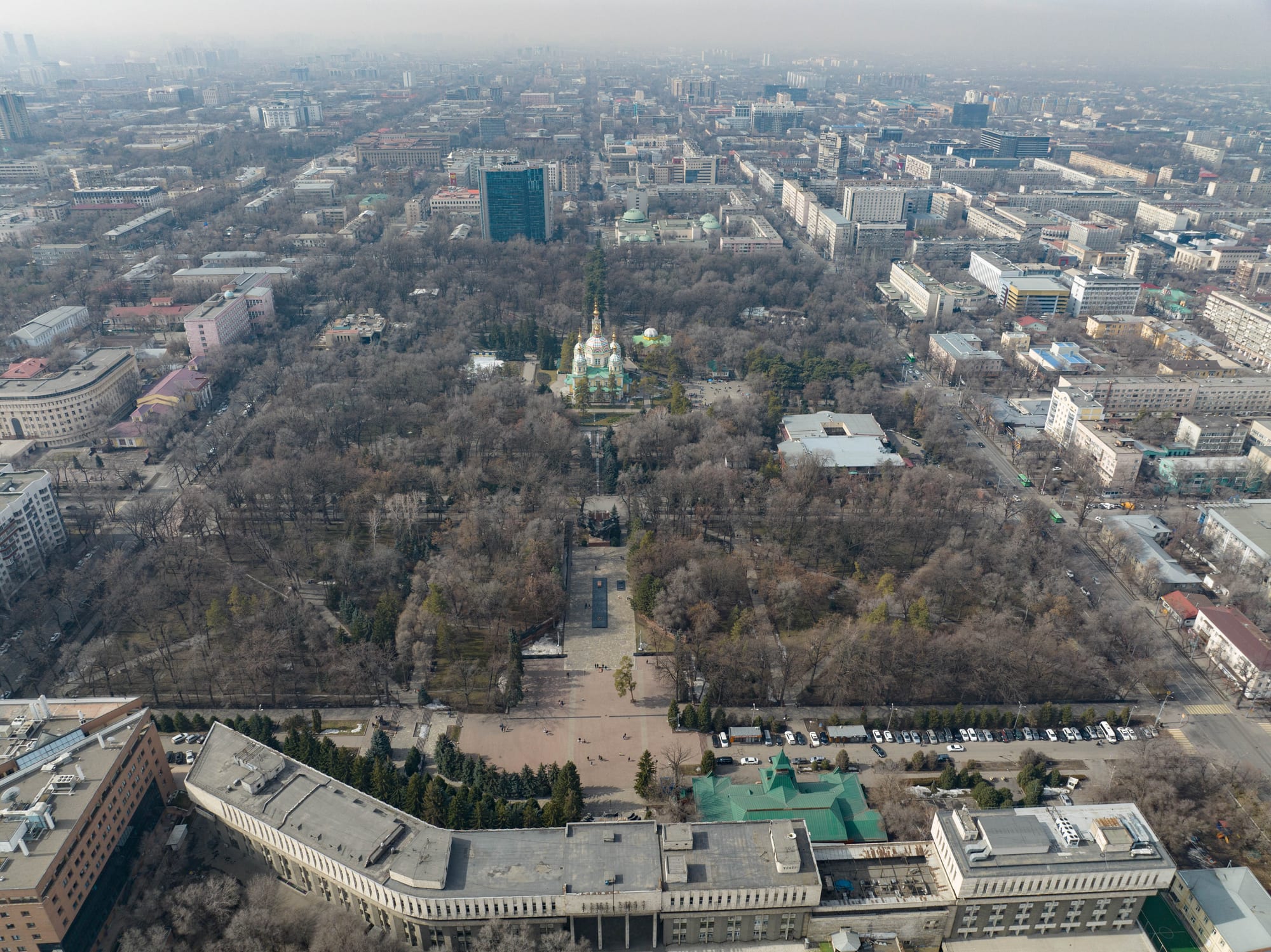
Almaty from the air, with the wooded Panfilov Park and its yellow-domed cathedral in the middle of a grid of streets and low blocks

Almaty & the Southeast, Kazakhstan

Almaty

The Park of 28 Panfilov Guardsmen and the Ascension Cathedral in the middle of central Almaty. (Nikolai Bulykin / Wikimedia Commons · CC BY-SA 4.0)

Kazakhstan's largest city, built on a sloping plain at the foot of the Trans-Ili Alatau in the south-east. Founded as the Russian fort of Verny in 1854 and capital of Soviet Kazakhstan from 1929, it lost that role to Astana in 1997 but remains the country's commercial and cultural centre, a grid of tree-lined streets with snow peaks at the end of them.

Neighbourhoods

  • The central grid and the Golden Quarter
    • First-time visitors
    • Best for food
    • Close to public transport

    The blocks between Abay and Gogol streets, where the shops, restaurants, galleries, hotels and metro stations are concentrated. The streets run straight uphill towards the mountains, shaded by trees and irrigation channels, and the area is known for its cafés and nightlife.

    Open in Maps
  • Around Panfilov Park and Zhibek Zholy
    • Historic district
    • Walking
    • Markets

    The oldest part of the city, with the wooden Ascension Cathedral in its park, the Green Bazaar a few blocks away and a pedestrianised stretch of Zhibek Zholy street full of stalls and buskers.

    Open in Maps
  • The upper city and Medeu district
    • Views
    • Quiet and residential
    • Mountain access

    Above Al-Farabi Avenue the streets climb into the foothills among villas, newer apartment complexes and embassies, with cooler, cleaner air and the roads to Medeu, Shymbulak and Kok Tobe leading out of it.

    Open in Maps
  • Bostandyk and the university belt
    • Students and nightlife
    • Local life

    West of the centre, an area of Soviet apartment districts, institutes and universities, parks and everyday markets, cheaper than the middle of town and well served by the metro.

    Open in Maps
  • The lower city and the railway stations
    • Transport connections
    • Budget stays

    North of the centre, where the ground flattens, the industrial districts and Almaty-1 and Almaty-2 stations lie among older housing. Air is worse and streets plainer, but trains, buses and cheaper hotels are here.

    Open in Maps

Things to do

Famous landmarks

  • Ascension Cathedrallandmark

    A brightly painted Russian Orthodox cathedral of 1907 built almost entirely of wood, which survived the 1911 earthquake that destroyed much of the town.

    Open in Maps
  • Kok Tobeviewpoint

    A hill of 1,100 metres on the south-eastern edge of the city, reached by cable car or road, with a recreation area at the top and a view across the whole grid to the plain; the 372-metre Almaty Tower stands at its foot.

    Open in Maps
  • Republic Squarelandmark

    The city's main ceremonial square, opened in 1980 and used for public events, with the Independence Monument and its golden warrior at the centre.

    Open in Maps
  • Almaty Central Mosquelandmark

    One of the largest mosques in the city and the country, completed in 1999 and designed for 7,000 worshippers, with a blue-tiled dome and a minaret of 47 metres near the Green Bazaar.

    Open in Maps

Museums and the arts

  • Central State Museum of Kazakhstanmuseum

    The largest museum in Almaty, holding the country's most significant historical and archaeological collection, from steppe finds and a reconstruction of the Golden Man's costume to ethnography and the Soviet century.

    Open in Maps
  • Kasteyev State Museum of Artsmuseum

    Kazakhstan's largest art museum, opened in 1976 and named after the painter Abylkhan Kasteyev, with Kazakh, Russian and Western collections and applied art from the steppe.

    Open in Maps
  • Abay Opera Houseattraction

    The colonnaded opera and ballet theatre of 1941 in the centre, named after the poet Abay Qunanbaiuly.

    Open in Maps

Parks and markets

  • Park of 28 Panfilov Guardsmenpark

    The central park around the cathedral, named for a Soviet unit raised in Almaty, with a war memorial, an eternal flame and avenues of old trees.

    Open in Maps
  • Green Bazaarmarket

    The city's main covered market, with horsemeat and dairy rows, mountains of dried fruit and nuts, Korean salads and Aport apples in autumn.

    Open in Maps
  • Almaty Botanical Gardenpark

    A large research garden founded in 1932 in the south of the city, with collections of trees and shrubs from across Kazakhstan and beyond.

    Open in Maps
  • First President's Parkpark

    A formal park of fountains, avenues and lawns in the southern foothills, opened in 2010 with the mountains as its backdrop.

    Open in Maps
  • Almaty Zooattraction

    One of the oldest and largest zoos in Kazakhstan, opened in 1937 in the north-east of the city.

    Open in Maps

Mountains above the city

  • Medeuattraction

    A high-altitude outdoor speed-skating rink at about 1,700 metres in the gorge above the city, used for skating since the early 1950s, given artificial ice in 1972 and long famous for the records set on it.

    Open in Maps
  • Shymbulakattraction

    The ski resort above Medeu, reached by a gondola from the rink, with pistes and walking routes among the Trans-Ili Alatau peaks.

    Open in Maps
  • Big Almaty Lakeattraction

    A turquoise glacial reservoir at about 2,500 metres in the Ile-Alatau National Park, an hour's drive up a mountain road south of the city.

    Open in Maps
  • Ile-Alatau National Parkpark

    The protected mountain belt that begins at the city's upper streets, with spruce forest, gorges, trails, alpine meadows and glaciers.

    Open in Maps

Short trips from the city

  • Charyn Canyonattraction

    A deep red sandstone canyon east of Almaty whose Valley of Castles is a walkable gorge of eroded towers leading down to the Charyn river.

    Open in Maps
  • Turgen Gorgeattraction

    A gorge east of the city in the Ile-Alatau range, known for waterfalls, hot springs and alpine meadows.

    Open in Maps

Seasonal events

  • Nauryzlate March

    The spring new year, marked with yurts and stages in the squares and parks, concerts, horse games and cauldrons of the grain dish nauryz kozhe.

  • Ski season at ShymbulakDecember to March

    Skiing above the city and skating at Medeu draw weekend crowds through the winter, when the slopes are snow-covered and the city below is often under smog.

  • Apple harvestSeptember and October

    Autumn brings the apple crop, including the large Aport variety for which Almaty was once known, to the bazaars and roadside stalls.

  • Almaty Marathonlate September

    A road race through the central streets, run on the last Sunday in September, and one of the largest mass sporting events in Central Asia.

Eat and drink

Long-standing places and food districts in Almaty. Hours, ratings and directions come from your maps app, always current.

Almaty classics

  • Kazakh national restaurantsneighborhood

    Restaurants across the centre serve beshbarmak, kazy and shuzhuk horsemeat sausage, kuyrdak and sorpa broth, usually in rooms built for large family gatherings.

    Open in Maps
  • Uyghur lagman cafésneighborhood

    The region's Uyghur community gives Almaty its everyday dish — hand-pulled lagman noodles with fried meat and vegetables — alongside manty, tandoor samsa and polu.

    Open in Maps
  • Dungan and Korean kitchensneighborhood

    Cold spiced noodles and steamed buns from Dungan cooks, and from the Korean community deported in 1937 dishes such as kuksi soup and morkovcha, spiced grated carrot.

    Open in Maps

Markets and food districts

  • Green Bazaarmarket

    The central market for horsemeat, kurt and irimshik, honey from the mountain valleys, dried fruit, nuts, Korean salads and autumn apples, with eating counters upstairs and around the edges.

    Open in Maps
  • Zhibek Zholy and the central cafésneighborhood

    The pedestrian street and the blocks around it hold the densest run of cafés, coffee roasters, bakeries and bars in the country.

    Open in Maps
  • Shashlyk in the mountain gorgesneighborhood

    Grill restaurants along the roads into the gorges above the city are where residents take visitors at weekends, for skewered meat, salads and tea in the cooler air.

    Open in Maps

Experience Almaty

History

The city stands on a site used for centuries: a medieval settlement called Almatu lay on a northern branch of the Silk Road here, on ground watered by streams coming down from the mountains, and Saka burial mounds are scattered across the plain below. Russian expansion reached the foothills in the middle of the 19th century, and in 1854 a fortification was built that was named Verny. Cossacks, peasants and traders settled around it, and the town grew on a grid of wide streets planted with trees and supplied by irrigation channels known as aryks.

Earthquakes shaped it. Shocks in 1887 and 1911 destroyed most of the buildings, and the survival of the wooden Ascension Cathedral became part of local legend; afterwards the town rebuilt low and in timber. Renamed Alma-Ata in 1921, it was made the capital of Soviet Kazakhstan in 1929; the Turkestan–Siberia railway and the road links to the city were finished by 1930, and it grew quickly through the 1930s. The Second World War brought evacuated factories, institutes and film studios. Post-war decades added apartment districts, the Medeu rink, the opera house and the ceremonial Republic Square.

In December 1986 young Kazakhs demonstrated on that square against the appointment of an outsider as party leader, protests suppressed with force and now commemorated as Zheltoqsan. The Alma-Ata Protocol, signed here on 21 December 1991, confirmed that the Soviet Union had ceased to exist and founded the Commonwealth of Independent States. The city was renamed Almaty in 1993, and in 1997 the capital moved to Astana, taking the ministries but not the banks, universities or businesses; Almaty kept growing, absorbing surrounding villages. In January 2022 it was the centre of the country's worst unrest since independence, with the city hall and other buildings set on fire.

Culture & Customs

Almaty is Kazakhstan's cultural capital in practice if not in title. The country's film industry, publishing, galleries, theatres, music scene and most of its universities are here, and the city produced much of the Kazakh New Wave cinema of the late Soviet years. Its café and coffee culture is the most developed in Central Asia, and the pedestrian part of Zhibek Zholy, the parks and the terraces of the central grid carry an evening life that few other cities in the region match.

It is also the country's most mixed city. Kazakhs, Russians, Uyghurs, Dungans, Koreans, Tatars, Germans and Caucasians have all left their mark, and the languages, festivals and food overlap constantly; Russian remains dominant on the street while Kazakh grows steadily, especially among younger arrivals from the south. Nauryz, Kurban Ait, Orthodox Easter and Victory Day are all public occasions here.

Mountains are part of the identity. Residents ski, skate, hike and picnic in the gorges, climbers have used the Trans-Ili Alatau for generations, and the skyline of snow peaks appears in the city's logos, films and songs. So does the apple: the wild apple forests of these foothills are regarded as the ancestral home of the cultivated apple, the large Aport variety was a local speciality, and the name Almaty is popularly linked to the fruit. Kazakh custom governs hospitality — tea served immediately, a loaded table before guests sit, respect shown to elders — even in the most cosmopolitan households.

Daily Life

About two million people live in Almaty, making it by far the largest city in the country, and the population continues to grow through migration from the south and the villages. It is the financial centre — banks, insurance, the stock exchange, trading companies — as well as the base for technology businesses, media, retail and tourism, and salaries and rents are the highest in Kazakhstan.

The city reads by altitude. The upper districts, cooler and cleaner, hold villas, new apartment complexes and the wealthier households; the central grid mixes Soviet blocks, offices and restaurants; and the flatter north has older housing, industry, markets and the railway stations. Families spend weekends in the gorges, at dachas, at Medeu or in the shopping centres, and the working day is shaped by heavy traffic on Al-Farabi and the main north–south avenues.

Three issues dominate local argument. Winter air pollution, caused by coal-fired heating, traffic and the basin's trapped air, is the most visible. Building in the foothills, which blocks the airflow and eats into the national park, is the most contested. And the earthquake risk beneath the whole city keeps construction standards, and the fate of ageing Soviet blocks, permanently in the news.

Food

Almaty has the most varied food in Kazakhstan. The Kazakh table is served at celebrations and in national restaurants: beshbarmak, boiled horsemeat or mutton with squares of pasta, onion sauce and sorpa broth; kazy and shuzhuk, cured horsemeat sausages; kuyrdak, fried offal with potato; and baursak, fried dough puffs, with tea. Autumn sogym, the slaughter for winter meat, still shapes many families' cooking.

Uyghur cooking supplies the everyday dishes. Lagman — hand-pulled noodles topped with stir-fried meat, peppers and tomato — is the city's default lunch, beside manty, large steamed dumplings, samsa baked on the wall of a tandoor and polu, the Uyghur form of plov. Dungan cafés, run by descendants of Chinese Muslims who came in the 1870s, serve spiced cold noodles and steamed breads, and Korean food from the community deported in 1937 is so familiar that morkovcha, spiced grated carrot, counts as a local salad.

The Green Bazaar is the place where all of it meets: horsemeat rows, dairy counters selling kurt and irimshik, honey from the mountain valleys, dried apricots and walnuts, and in autumn the big red Aport apples. Kymyz, fermented mare's milk, is sold in summer at roadside stalls on the mountain roads, and shubat comes from camel's milk. A few wineries in the foothills east of the city make Kazakh wine, local brandy and beer are widely drunk, and the central streets hold the country's best-developed run of coffee houses and bakeries.

Planning tools

Budget

Almaty is Kazakhstan's most expensive city for hotels, restaurants and nightlife, though canteens, the metro, buses and the bazaars remain very cheap. The big costs for most visitors are accommodation in the central grid and transport to the mountains and canyons, where a shared tour is usually cheaper than a private driver.

Daily Budget Midrange
USD 90–180 (mid-range hotel, restaurant meals, a private driver for the canyons and lakes)
Daily Budget Shoestring
USD 35–55 (hostel, canteen and bazaar food, metro and buses, shared tours)

Medeu, the parks, Panfilov Park and the bazaars cost little or nothing; the expensive days are the ones spent travelling out to Charyn or the Kolsai lakes.

Best Time to Visit

Late May to early October. June to September is the season for the mountain lakes and hiking, with warm days in the city and cool nights higher up; spring brings blossom and wild tulips to the foothills, and September and October the apple harvest and autumn colour. December to March suits skiing and skating, though winter smog can settle over the city for days.

Suggested Number of Days

Two or three days cover the city itself and the mountains immediately above it. Five to seven allow the canyons, the lakes east of the city and the steppe parks, which involve long drives. Season matters: mountain roads and trails are limited outside summer.

First Visit
2–3 days
With Surroundings
5–7 days

Transportation

A single metro line runs under the central axis, with an extensive and cheap bus network above it and ride-hailing apps used by almost everyone. Buses and taxis reach Medeu, and a gondola climbs from there to Shymbulak; Big Almaty Lake, Charyn and the further lakes need a car, driver or organised tour. Traffic on the main avenues is heavy at peak times.

Pay bus and metro fares with a transport card or contactless bank card, and set out early for mountain trips to avoid both traffic and afternoon cloud.

Airport & Station Connections

Almaty International Airport, about 15 kilometres north-east of the centre, is the country's busiest, with flights across Central Asia, Turkey, the Gulf, Russia, China, South Asia and Europe, and a half-hour taxi or bus ride into town. Trains run to Astana, Shymkent and Taraz and onward into Uzbekistan and China, using the Almaty-1 and Almaty-2 stations, and long-distance buses and shared cars serve the region and the Kyrgyz border, with Bishkek about four hours away.

Walkability

The central grid is one of the most walkable in Central Asia: flat enough, shaded by trees, lined with irrigation channels and laid out in regular blocks, with the mountains as a constant orientation — uphill is south. Distances are long, so walking usually combines with the metro or a taxi, and the gradient is noticeable on the upper streets. Winter ice and summer heat both make the middle of the day harder.

Safety

Almaty is generally safe, with pickpocketing in markets and on buses, taxi overcharging and traffic the everyday risks. The city lies in an active seismic zone and has been destroyed by earthquakes in the past, so buildings carry evacuation instructions. Unrest in January 2022 centred on the city and left the main square and public buildings damaged; the situation has since been calm. In the mountains the hazards are altitude, sudden weather changes, mudflows after heavy rain and ticks in spring.

Use ride-hailing apps rather than unmarked cars, keep valuables close in the bazaars, carry warm layers and water in the mountains, check for ticks after spring walks, and ask locally about permits near the Chinese border. Check current official travel advice before travelling.

Climate

Continental but milder and wetter than the steppe, thanks to the mountains. Summers are hot and dry in the city and much cooler a few hundred metres higher; winters are snowy but not extreme by Kazakh standards. Cold air trapped in the basin causes winter smog, and spring and autumn are the pleasantest seasons.

Summer
hot — typically 25–33°C by day in July, with warm evenings and cooler air in the gorges above the city
Winter
cold and snowy — usually around -1 to -5°C by day from December to February and colder at night, with deeper snow in the mountains and periods of smog

Local Customs

Russian is heard constantly and Kazakh increasingly so, and the city is the country's most cosmopolitan. Hospitality follows Kazakh form: tea poured only part way and refilled often, food pressed on guests, elders greeted and served first, and shoes removed in homes. Modest dress and a headscarf for women are expected at mosques, and it is polite to ask before photographing people at markets or in the mountains.

Tipping is not obligatory, though about 10 per cent is usual in restaurants; alcohol is sold in shops only within set hours, and drinking in public places is prohibited.

Common Payment Methods

The currency is the Kazakhstani tenge. Card and phone payment is close to universal, including at many bazaar stalls and on public transport, and instant bank transfers by phone number are the local habit. ATMs are everywhere in the centre; small cash amounts are useful for mountain stalls, taxis in villages and bazaar bargaining.