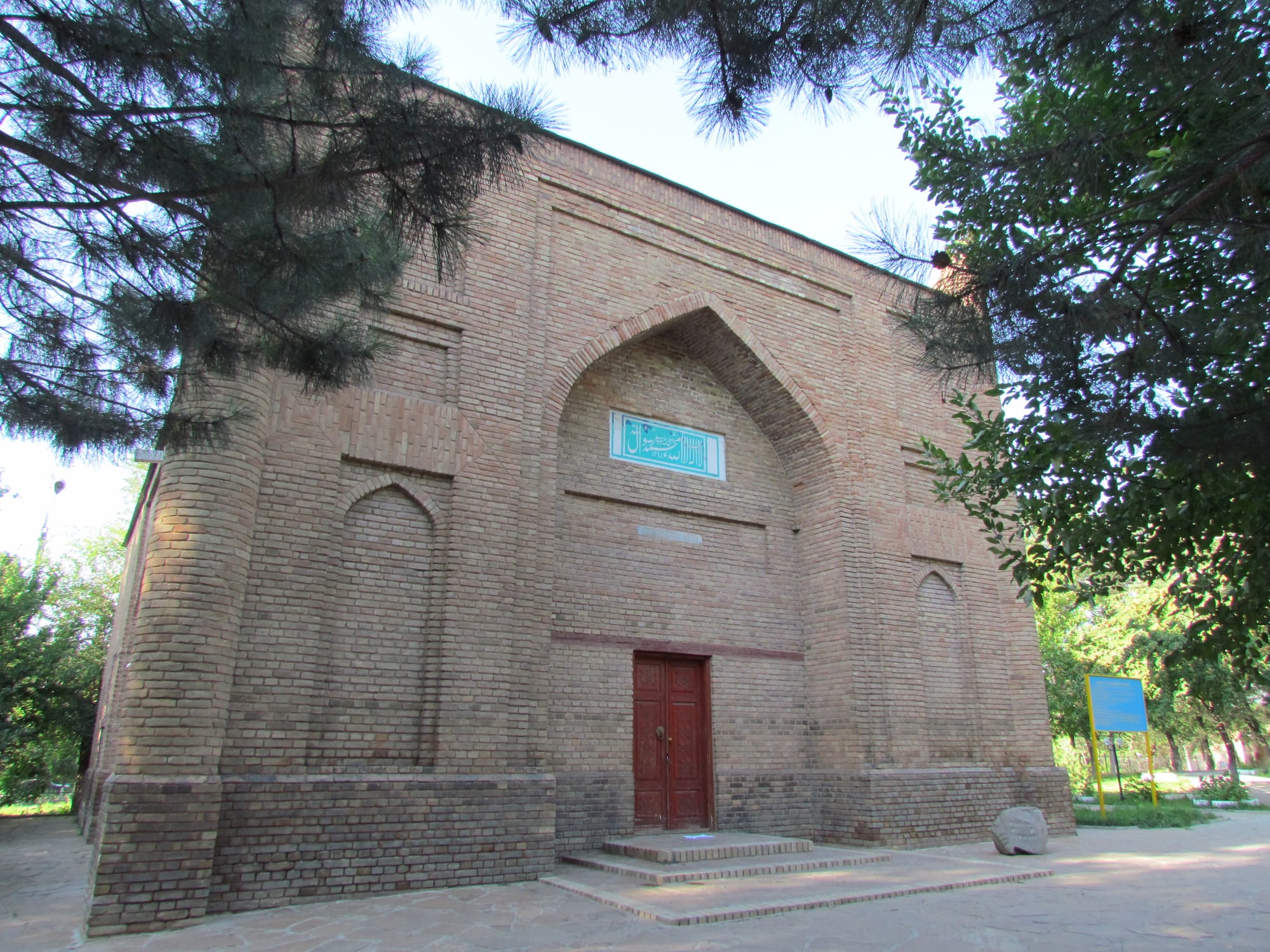
A square brick mausoleum with a tall pointed arch over its doorway, framed by pine branches on a paved plaza

Almaty & the Southeast, Kazakhstan

Taraz

The Karakhan Mausoleum in the centre of Taraz. (Yakov Fedorov / Wikimedia Commons · CC BY-SA 3.0)

One of the oldest continuously settled places in Kazakhstan, on the Talas river in the far south-west of the country's southeast. A Silk Road town recorded from the 6th century and a Karakhanid centre, it was destroyed by the Mongols and rebuilt under Russian and Soviet rule as Aulie-Ata and then Zhambyl. Today it is a provincial capital of low streets, large bazaars and medieval brick mausoleums.

Neighbourhoods

  • The centre
    • First-time visitors
    • Historic district
    • Close to public transport

    The blocks around the main square and the Karakhan Mausoleum, where the administration buildings, the drama theatre, hotels, parks and the excavated ground of the ancient city stand close together. Almost everything a short visit needs is within walking distance.

    Open in Maps
  • The bazaar quarter
    • Best for food
    • Local life
    • Shopping

    The trading heart of the city, a dense area of covered rows, wholesale halls and street stalls beside the central market. Tandoor bakeries, tea stalls and cheap canteens fill the surrounding streets, and it is busiest in the morning.

    Open in Maps
  • The Talas riverside and Tekturmas
    • Walks and viewpoints
    • Quiet and residential

    The green strip along the river east of the centre, with paths, bridges and picnic ground, rising to the shrine hill of Tekturmas on the far bank. It is the city's usual place for an evening walk.

    Open in Maps
  • The microdistricts
    • Quiet and residential
    • Everyday shopping

    Soviet-built blocks of flats, schools and small markets spreading north and west of the centre, where most residents live. There is little for a visitor here, but buses run in from them all day.

    Open in Maps
  • Aisha Bibi and the western villages
    • Historic monuments
    • Day trips

    The road west towards Shymkent passes through farming villages, among them Aisha Bibi, where the region's most admired medieval tomb stands with a second mausoleum beside it in a walled garden.

    Open in Maps

Things to do

Medieval monuments

  • Aisha Bibilandmark

    An 11th- or 12th-century mausoleum for a noblewoman in a village 18 kilometres west of the city, its walls covered in carved terracotta tiles in dozens of patterns, and the subject of a well-known local legend.

    Open in Maps
  • Akyrtaslandmark

    The stone foundations of an eighth-century palace complex about 45 kilometres east of the city, built of dark-red sandstone and inscribed as a UNESCO World Heritage Site in 2014 within the Silk Roads Chang'an–Tianshan corridor.

    Open in Maps

Museums and the ancient city

  • Ancient Taraz archaeological siteattraction

    The excavated layers of the medieval town beneath the central bazaar, opened up as an archaeological park showing streets, walls and a bath house.

    Open in Maps

Parks and the river

  • Talas Riverattraction

    The river that gave the city its position and its water, flowing from the Kyrgyz mountains past Taraz and out into the desert.

    Open in Maps

Seasonal events

  • Nauryzlate March

    The spring new year, marked with yurts and stages in the city's squares, horse games, music and the ceremonial soup nauryz köje.

  • Kurban Aitvaries with the Islamic calendar

    The feast of sacrifice, widely observed in this traditionally Muslim city with mosque attendance, family visits and the sharing of meat.

Eat and drink

Long-standing places and food districts in Taraz. Hours, ratings and directions come from your maps app, always current.

Bazaars and food streets

  • The central bazaarmarket

    The city's main market, where dried fruit, nuts, melons, horsemeat, dairy and spices are sold in long rows, with stalls frying and baking food all morning.

    Open in Maps
  • Tandoor bakeries around the marketmarket

    Clay ovens turning out flat lepyoshka loaves and samsa, meat pastries baked against the oven wall, sold hot from the doorway.

    Open in Maps

Taraz classics

  • Lagman and manty canteensrestaurant

    Everyday canteens serving hand-pulled lagman noodles, steamed manty dumplings and shurpa broth, the ordinary lunch of southern Kazakhstan.

    Open in Maps
  • Shashlyk grills in the centrerestaurant

    Charcoal grills and beer gardens around the central squares and parks, busiest on warm evenings.

    Open in Maps

Experience Taraz

History

Taraz appears in written sources in the 6th century, when Byzantine envoys travelling to the Turkic khagan recorded a town on the Talas, and it grew as a staging post on the northern branch of the Silk Road where caravan routes met the pastures of the steppe. In 751 the armies of Tang China and the Abbasid Caliphate fought the Battle of Talas somewhere in this river valley, a defeat that ended Chinese expansion westwards and left Central Asia within the Muslim world.

Under the Karakhanids, from the 10th to the 12th century, the town became a regional capital of mosques, bath houses and brick tombs, and it was in this period that the mausoleums which still stand were built. The Mongol invasion of 1220 destroyed it, and for centuries afterwards it was a lesser settlement under successive steppe powers and finally the Khanate of Kokand, whose fort of Aulie-Ata — "holy father" — was taken by Russian forces in 1864.

Russian and then Soviet rule rebuilt the place as a provincial town of grid streets, sugar refineries and, from the 1940s, chemical works using the phosphate deposits of the Karatau mountains nearby. It was renamed Mirzoyan and then, in 1938, Zhambyl, after the Kazakh folk poet Zhambyl Zhabayev, and grew quickly with industry and migration. In 1997 the city recovered its ancient name of Taraz. Excavations in the 2010s beneath the central market exposed streets and buildings of the medieval town, which were preserved as an open archaeological site.

Culture & Customs

Taraz presents itself as the country's oldest city, and antiquity is part of everyday civic identity: the monuments appear on signs and souvenirs, and the Karakhanid tombs are treated as much as living shrines as historic buildings. Pilgrims come to Tekturmas and to Aisha Bibi, and the legend attached to Aisha Bibi — a young woman who died on her way to her beloved, who then raised the tomb over her — is known to every resident and retold at weddings.

The region is named after Zhambyl Zhabayev, the akyn, or improvising folk poet, who lived into the Soviet period and became a national figure. Sung poetry contests, the dombra and horse games remain part of celebrations here, and the south's reputation for large weddings, strict seniority and generous hospitality holds in the city as much as in the villages around it.

Kazakh is the dominant language, more so than in Almaty, and Islam is a visible part of life, with well-attended mosques and a considerable observance of Ramadan and the two Eids. The population also includes long-settled Russian, Uzbek, Dungan, Kurdish and Turkish communities, the legacy of Soviet deportations and of a border town's trade, and their cooking and customs are part of the mix. Life is lived outdoors in the warm months, in parks, teahouses and courtyards.

Daily Life

About 490,000 people live in Taraz, making it one of Kazakhstan's larger cities and the capital of Zhambyl Region. Most residents live in Soviet-era blocks in the microdistricts or in single-storey houses behind fences in the older quarters, and the working day starts early, pauses in the worst of the afternoon heat and ends with families out in the parks and along the river in the evening.

The economy rests on chemicals and phosphate processing, drawing on the deposits in the Karatau range to the north-west, together with sugar refining, food processing, construction and the trade that fills the bazaars. Agriculture in the surrounding irrigated districts supplies sugar beet, grain, vegetables and livestock. Wages are lower than in Almaty, and many families depend on remittances from relatives working there or in Russia, while the bazaar economy employs a large share of the city informally.

The problems are those of a mid-sized provincial city: ageing infrastructure, water supply in a dry region, air quality around the industrial plants and the steady departure of young people for the bigger cities. Against that, the border with Kyrgyzstan a short drive to the south keeps cross-border trade and family ties active, and the excavation and presentation of the ancient city has given Taraz a role in domestic tourism that it did not have before.

Food

Taraz eats the food of the Kazakh south, with Uzbek and Dungan influence from the border districts. Plov — rice cooked with mutton, carrot and onion in a heavy kazan — is the dish for guests and celebrations, and beshbarmak, boiled meat and broth over wide sheets of pasta, remains the ceremonial meal. Samsa, pastries filled with meat and onion and baked against the wall of a clay tandoor, are sold hot all over the city, as are flat lepyoshka loaves from the same ovens.

Noodles are everywhere: lagman, hand-pulled and served either in broth or under a stir-fry of meat and peppers, is the standard cheap lunch, and Dungan cafés in the region make their own sharper, spicier versions. Manty, large steamed dumplings of minced meat and onion, and shashlyk grilled over charcoal complete the everyday repertoire, with kuyrdak, a fry of liver, heart and potato, for those who want something more traditional.

The bazaars are the best of the city's food: melons and watermelons from the irrigated fields in late summer, apricots, grapes and tomatoes, mountains of dried apricots and nuts, horsemeat and kazy sausage, and dairy in every form — ayran, kurt, irimshik and, in summer, kymyz and shubat. Tea, black and taken with milk, accompanies everything, served with baursak, small pieces of fried dough, and jam.

Planning tools

Budget

Taraz is markedly cheaper than Almaty. Hotels are modest and inexpensive, canteens and bazaar food cost very little, and city transport is minimal. The main extra expense is a car and driver, useful for Akyrtas and worth the money for anyone combining the monuments outside the city in a day.

Daily Budget Midrange
USD 55–110 (mid-range hotel, restaurant meals, a driver for the monuments outside the city)
Daily Budget Shoestring
USD 20–40 (simple hotel or guesthouse, canteen and bazaar food, buses and shared taxis)

Taxis inside the city are cheap and usually arranged through ride-hailing apps; agree a price in advance for anything ordered from the street.

Best Time to Visit

April to early June and September to October, when the heat is bearable for walking among open ruins and the countryside is green or in harvest. Nauryz in late March is a good time to see the city celebrating. July and August are very hot, and the winter, though short and only moderately cold, is grey and muddy with little to do outdoors.

Suggested Number of Days

A day or two covers the city itself comfortably. Adding the monuments and archaeological sites in the surrounding steppe, which need a car, brings the total to two or three. Travellers crossing between Almaty and Shymkent often stop for a single night.

First Visit
1–2 days
With Surroundings
2–3 days

Transportation

The city is spread out but flat, and buses, minibuses and cheap taxis cover it; ride-hailing apps work well. The central monuments and bazaar are close enough to walk between, while the outlying sites need a taxi or a hired car. Long-distance buses and shared taxis leave from the bus station for Shymkent, Almaty and the Kyrgyz border.

Hiring a driver for half a day is the practical way to combine Aisha Bibi with Akyrtas, since public transport does not link them.

Airport & Station Connections

Taraz sits on the main road and railway between Almaty and Shymkent, a long drive west of Almaty and a much shorter one east of Shymkent. Trains on the Almaty–Shymkent line stop here, buses and shared taxis run frequently along the highway, and the city has its own airport. The Kyrgyz border, and the road towards Bishkek, lies a short distance to the south.

Walkability

The centre is walkable and mostly flat: the main square, the Karakhan Mausoleum, the archaeological park and the bazaar are within a few blocks of one another, and the riverside has paths. Beyond that the city is low, wide and built for cars, with long avenues, uneven pavements and little shade, so summer afternoons are hard going on foot.

Safety

Taraz is a quiet provincial city and violent crime is not a common concern for visitors. The everyday risks are petty theft and pickpocketing in the crowded bazaar, traffic on wide roads where crossings are ignored, and summer heat at the exposed archaeological sites. The area near the Kyrgyz border should be treated as a frontier zone.

Keep valuables out of sight in the market, carry water and sun protection at the ruins, dress modestly at shrines and mosques, and use ride-hailing apps rather than unmarked cars. Check current official travel advice before travelling.

Climate

A dry continental climate at the edge of the steppe, hotter and drier than Almaty and milder in winter than the north of the country. Rain falls mostly in spring, and summers are long, bright and dusty.

Summer
hot and dry, typically 30–35°C in July, with cooler evenings and very little rain
Winter
moderate for Kazakhstan, mostly between -5 and 3°C, with patchy snow and damp grey spells

Local Customs

The city is largely Kazakh-speaking, with Russian widely used and a strong southern sense of tradition. Hospitality matters, elders are greeted first and given the place of honour, and shoes are removed indoors. Modest dress is expected at the mausoleums and mosques, and women usually cover their heads inside shrines. Pilgrims visit the tombs, so photography there should be discreet.

Tipping is not expected though rounding up a bill is common, alcohol is sold openly but drunk more quietly than in Almaty, and permission should be asked before photographing people at the bazaar or at prayer.

Common Payment Methods

The currency is the Kazakhstani tenge. Cards work in hotels, supermarkets and larger restaurants, and payment by phone is widespread among locals, but cash is needed at the bazaar, in small canteens and for taxis. Cash machines are easy to find in the centre.