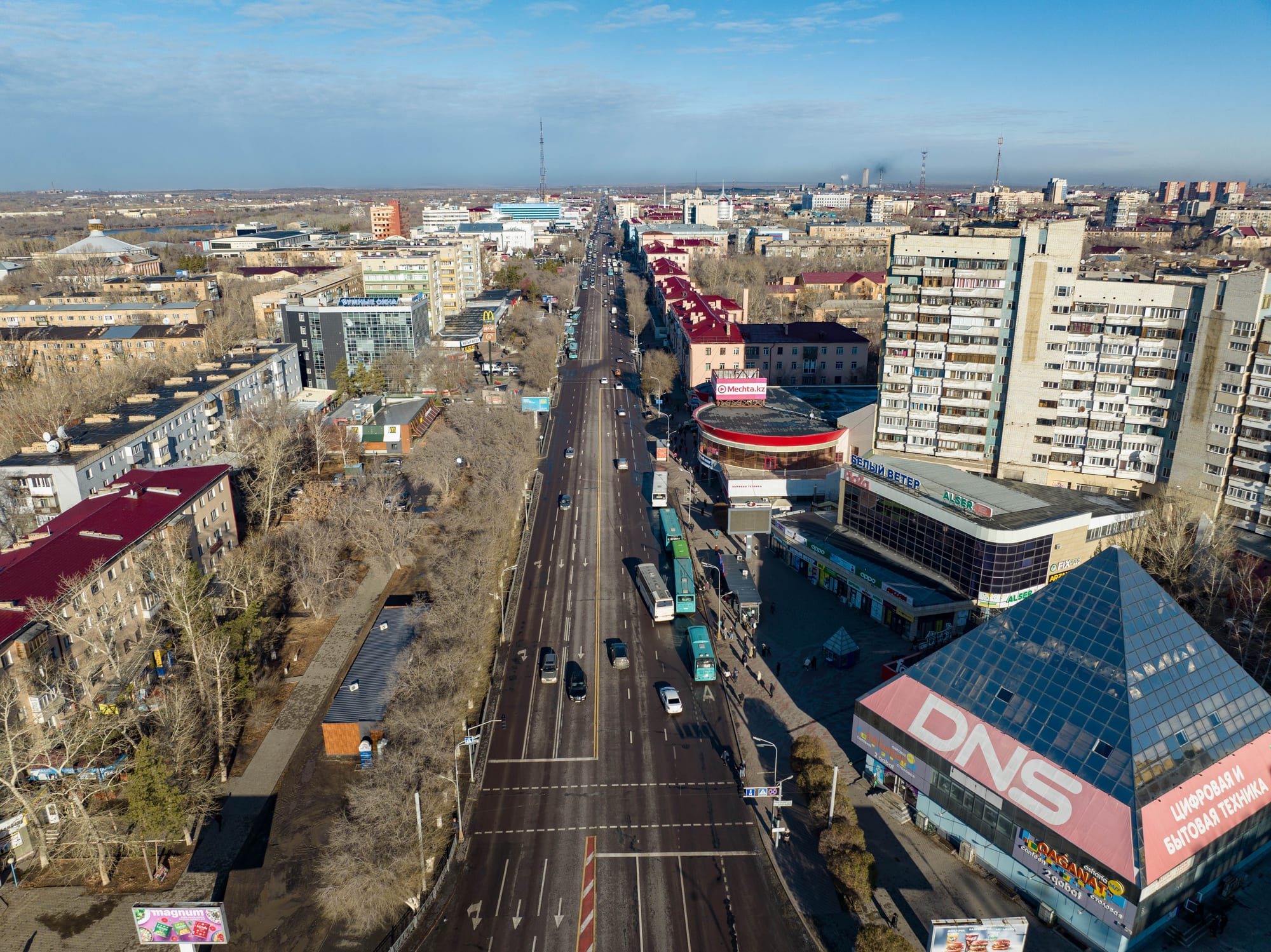
Aerial view along a broad multi-lane avenue in Karaganda lined with low flat blocks, shops and bare trees under a pale winter sky

Karaganda & Central Kazakhstan, Kazakhstan

Karaganda

Bukhar-Zhyrau Avenue, the main axis of central Karaganda, seen from above. (Nikolai Bulykin / Wikimedia Commons · CC BY-SA 4.0)

A coal city on the central Kazakh steppe, laid out by Soviet planners in the 1930s and built in large part by deported families and camp prisoners. Wide avenues, monuments to miners and blocks of flats fill a city of about half a million, and the Karlag museum at Dolinka, south-west of town, records the labour camp system that shaped it.

Neighbourhoods

  • Novy Gorod (the New City)
    • First-time visitors
    • Close to public transport
    • Restaurants

    The planned centre built from the 1930s and 1940s around Bukhar-Zhyrau Avenue, with colonnaded public buildings, theatres, the main squares and most of the hotels, shops and cafés. Almost everything a short visit needs stands within a few blocks of the avenue.

    Open in Maps
  • Yugo-Vostok (the South-East)
    • Quiet and residential
    • Parks
    • Shopping

    The numbered microdistricts laid out from the 1960s south-east of the centre, built as rows of prefabricated blocks around schools, clinics and courtyards. It is the city's largest residential area, with shopping centres, markets and a good deal of open space between the buildings.

    Open in Maps
  • Prishakhtinsk
    • Industrial history
    • Local life

    The northern suburbs that grew directly around the pit heads, several kilometres from the centre and linked by bus. Low houses, mine buildings and spoil heaps show the shape of the original mining settlements from which the city was assembled.

    Open in Maps
  • Mikhailovka
    • Local life
    • Historic district

    An older district north of the centre that began as one of the settlements of the coalfield and housed many of the deported families sent here in the 1930s and 1940s. Streets of single-storey houses and small shops survive between newer blocks.

    Open in Maps
  • Maykuduk
    • Local life
    • Markets

    A large working district in the north-east, built around mines and factories with its own markets and bus routes. It is residential rather than scenic, and gives a clear picture of how most of the city lives.

    Open in Maps

Things to do

Memory and museums

  • Karlag Museum at Dolinkamuseum

    The museum of political repression, opened in 2001 in the former headquarters of the Karaganda Corrective Labour Camp at Dolinka, south-west of the city, with reconstructed cells and the records of prisoners held between 1931 and 1959.

    Open in Maps

Churches and civic landmarks

  • Cathedral of Our Lady of Fatimalandmark

    The Roman Catholic cathedral of Karaganda and the seat of its diocese, a large brick church serving a community descended from Catholics deported to the coalfield.

    Open in Maps
  • Karaganda Buketov Universitylandmark

    The city's main university, founded in 1972 and named after the chemist Yevney Buketov, whose buildings anchor the student quarter of the centre.

    Open in Maps

Sport and getting around

  • Shakhtyor Stadiumattraction

    The city's main football ground, home of FC Shakhter Karagandy, whose name means 'miner'.

    Open in Maps
  • Sary-Arka Airporttransit hub

    Karaganda's airport, on the steppe south-east of the city, with flights to Kazakh cities and a handful of destinations abroad.

    Open in Maps

Short trips from the city

  • Temirtauattraction

    The steel town on the Nura river north-west of Karaganda, whose mill smelted its first steel in 1944 and which took its present name in 1945.

    Open in Maps
  • Shakhtinskattraction

    A coal town west of Karaganda, one of the mining settlements that still work the Karaganda basin.

    Open in Maps
  • Saranattraction

    A small coal town founded in 1954 about 15 kilometres west of the city, on the road towards Dolinka.

    Open in Maps
  • Osakarovkaattraction

    A steppe settlement founded by Ukrainian peasants in 1908, north-west of Karaganda on the railway towards Astana.

    Open in Maps

Seasonal events

  • Nauryzlate March

    The spring new year, marked with yurts, street concerts, horse games and bowls of the grain dish nauryz kozhe on the central squares.

  • Miners' Daylast Sunday of August

    The coal industry's holiday, the city's biggest secular celebration, with awards, concerts and events at the mining companies.

  • Day of Remembrance of Victims of Political Repression31 May

    A national day of mourning, kept on 31 May and observed with particular weight here, with ceremonies at Dolinka and the city's memorials.

  • Victory Day9 May

    Wreath-laying and parades at the war memorials, followed by family gatherings in the parks.

Eat and drink

Long-standing places and food districts in Karaganda. Hours, ratings and directions come from your maps app, always current.

Karaganda classics

  • Beshbarmak and steppe meat dishesrestaurant

    Boiled mutton or horsemeat with sheets of pasta and onion broth, served with kazy sausage and kuyrdak, is the standard celebration meal in the city's Kazakh restaurants.

    Open in Maps
  • Canteens and stolovayasrestaurant

    Self-service canteens across the centre and the microdistricts serve soups, cutlets, plov, manty and salads at low prices, a habit inherited from the mining era.

    Open in Maps

Markets and food districts

  • Bukhar-Zhyrau Avenueneighborhood

    The main avenue and the streets off it hold most of the city's restaurants and cafés, from Kazakh and Russian cooking to Korean, Turkish and Georgian kitchens.

    Open in Maps
  • The city bazaarsmarket

    Covered and open markets sell steppe meat and kazy, Korean-style salads, dairy and kurt, honey, and smoked fish brought up from Lake Balkhash.

    Open in Maps

Experience Karaganda

History

Coal was known on this part of the steppe long before anyone lived here in numbers: tradition credits a young shepherd, Appak Baizhanov, with finding it in 1833, and small mines worked under Russian and then British and French ownership in the nineteenth and early twentieth centuries. Nothing resembling a town existed until the Soviet drive for industry. From 1930 the state developed the Karaganda basin into one of the Soviet Union's principal coalfields, with a dozen mines and a town planned for tens of thousands of workers; the settlement became a village in 1931 and was granted city status in 1934.

Its builders were largely people sent here against their will. Peasant families deported during collectivisation, Volga Germans, Poles, Koreans, Chechens and Ingush, and prisoners of Karlag — the Karaganda Corrective Labour Camp, run from Dolinka between 1931 and 1959 — dug the mines, laid the railways and put up the first settlements. A camp for the wives of men condemned as enemies of the state operated at Akmol to the north. By 1939 the city held about 100,000 people, some half of them prisoners. The mining villages scattered across the coalfield were gradually joined by a planned centre of avenues and colonnaded buildings laid out to the south-east of the old workings.

Coal carried the city through the Soviet decades: Karaganda supplied the steel plant at Temirtau, grew past 600,000 people and gained universities, theatres and a medical school. Independence in 1991 brought closures, emigration — most of the German population left for Germany — and a sharp fall in population, followed by partial recovery as mines and the steel works passed into private and later state hands. Mining accidents, including a fire in 2023 that killed dozens of miners, have kept safety at the centre of public debate.

Culture & Customs

Karaganda's character comes from the mixture of peoples the twentieth century deposited here. Kazakhs and Russians form the majority, but the city also has Ukrainian, Tatar, Korean, Polish, Chechen and German roots, and the German community left behind Catholic and Lutheran churches that still function; Karaganda is the seat of a Roman Catholic diocese, unusual in Central Asia. Russian is the common street language, though Kazakh is taught and used more widely each year.

Mining is the city's shared identity. Monuments to miners stand on the avenues, Miners' Day at the end of August is the largest local holiday, and families measure their history in pits and shifts. Alongside that sits the memory of the camps, which is public rather than hidden: the museum at Dolinka and the memorials around the coalfield draw descendants from across the former Soviet Union and are visited on national days of remembrance.

Everyday manners are Central Asian and Soviet at once. Guests are fed immediately and generously; tea is poured in small amounts so it stays hot and the cup can be refilled; elders are greeted first and given the best seat. Kazakh traditions — the naming of ancestors, the spring feast of Nauryz, horse games at summer gatherings — are practised in a city otherwise built on Soviet lines, and the football and ice hockey clubs give the mining districts something to argue about through the winter.

Daily Life

Just under half a million people live in Karaganda, the fifth-largest city in Kazakhstan and the administrative centre of Karaganda Region. The population is smaller than in the late Soviet years, when emigration and the closure of mines cut it sharply, and it now grows slowly as people move in from surrounding towns and villages.

Coal remains the base of the economy, together with the steel plant at nearby Temirtau, engineering, food processing, and a thick layer of universities, colleges and hospitals that draw students from across central Kazakhstan. Employment has broadened into retail, transport and services, but mining wages and mining risks still set the tone, and the fatal accidents of recent years touched families all over the city.

Life is arranged around the long winter. Flats are heated from district boiler houses, buses run crowded between the microdistricts and the centre, and shopping is done in bazaars and shopping centres rather than on the street. When the weather turns, the city empties towards dachas, fishing on the region's lakes and weekends in the pine hills of Karkaraly to the east. Air quality in winter, driven by coal heating and industry, is a standing complaint, as is the drift of young people to Astana and Almaty for work.

Food

Karaganda eats like the steppe and like the Soviet Union at the same time. The Kazakh table centres on meat: beshbarmak, boiled mutton or horsemeat served over wide squares of pasta with onion broth, is the dish for guests and holidays, often preceded by kazy, a horsemeat sausage, and kuyrdak, offal fried with onions and potatoes. Sorpa, the broth left from the boiling, is drunk from bowls, and baursak, small pieces of fried dough, come with tea.

The deportations left the city with a broader kitchen than most. Russian and Ukrainian home cooking supplies borscht, pelmeni, pickles and pirozhki; Korean families sell morkovcha, the spiced carrot salad invented by Soviet Koreans, and kimchi by the kilogram at the bazaars; Tatar and Uzbek cooks make manty, samsa and plov; and German baking survives in the city's bread and cakes. Canteens inherited from the mining era still serve all of it cheaply at lunchtime.

Drink means tea above all — black, strong and usually with milk, poured repeatedly into small bowls. Kymyz, fermented mare's milk, and shubat, made from camel's milk, are sold in season and treated as tonics. From the south come the products of Lake Balkhash: zander, bream and carp, smoked or salted and sold at market stalls and roadside stands, one of the few things in central Kazakhstan that does not come from a herd or a mine.

Planning tools

Budget

Karaganda is inexpensive by any measure, and cheaper than Astana a few hours north. Hotels in the centre are modest and plentiful, canteens and bazaars keep food costs very low, and city buses cost little. The main expense for a visitor is a taxi or hired driver for Dolinka and the towns around the city, since public transport to them is limited.

Daily Budget Midrange
USD 65–130 (mid-range hotel, restaurants, taxis and a driver for Dolinka or the steppe)
Daily Budget Shoestring
USD 25–45 (simple hotel or hostel, canteen meals, city buses and trains)

Agree a price for a half-day taxi to Dolinka before setting off, and carry some cash for markets and small cafés.

Best Time to Visit

May to September. Late spring turns the steppe green and brings mild days for walking the avenues and parks; July and August are warm and dry, and the season for trips to the lakes and hills of the region. September is settled and clear. Winter is long, windy and very cold, with blizzards that can close steppe roads for a day or two.

Suggested Number of Days

The city centre and its memorials fit comfortably into a day or two. Allow three or four days to add the camp sites south-west of the city and the hills and lakes of Central Kazakhstan, which need a car and long driving hours on steppe roads.

First Visit
1–2 days
With Surroundings
3–4 days

Transportation

Karaganda is spread out, with the mining suburbs several kilometres from the planned centre. Buses and minibuses cover the city and are cheap; trolleybus wires survive on some avenues. Taxis, usually booked through apps, are inexpensive and are how most visitors move between districts. Intercity buses and trains leave for Astana, Balkhash and Almaty from the bus station and the railway station.

Distances within the city are longer than the map suggests — budget time for crossing from the centre to Prishakhtinsk or Maykuduk.

Airport & Station Connections

Sary-Arka Airport lies about 20 kilometres south-east of the centre, with flights to Almaty, Astana and a few cities abroad. Most travellers arrive overland: Astana is around 200 kilometres north, roughly three hours by road, and trains on the main north–south line stop here on the way between Astana, Balkhash and Almaty.

Walkability

The planned centre is flat, gridded and easy to walk, with wide pavements, long avenues and parks between the main squares. Blocks are large and crossings far apart, so distances feel longer than they look. Beyond the centre the city becomes a set of separate districts that are not walkable from one another, and winter ice and wind make walking hard work from November to March.

Safety

Karaganda is generally safe, and violent crime rarely affects visitors. Ordinary caution against pickpocketing in markets and on crowded buses is enough. The real hazards are environmental: extreme winter cold and blizzards, summer heat on the open steppe, and old mine workings and industrial ground outside the built-up areas, which can be unstable.

Dress for severe cold in winter, keep away from mine workings and spoil heaps, and use licensed or app-booked taxis at night. Check current official travel advice before travelling.

Climate

Sharply continental and dry, with a large gap between the seasons and wind across the open steppe in every month. Precipitation is low, most of it falling in early summer, and snow lies from November into April.

Summer
warm to hot and dry — daytime temperatures are usually 25–32°C in July, cooling sharply at night
Winter
long and severe — typically -12 to -20°C by day, with strong winds, drifting snow and occasional blizzards

Local Customs

Russian is the everyday language of the street, with Kazakh used increasingly in official life; a greeting in either is appreciated. Hospitality is taken seriously — guests are given tea at once and pressed to eat more than they want, and the seat of honour faces the door. Shoes come off at the door of a home. The city's history of camps and deportations is discussed openly but with respect; at Dolinka and the other camp sites visitors keep their voices down and ask before photographing mourners.

Accept tea and bread even if only a little, use the right hand or both hands when giving and receiving, and dress modestly in mosques and churches, with a head covering for women.

Common Payment Methods

The currency is the Kazakhstani tenge. Cards and mobile payment through local banking apps are accepted almost everywhere in the city, including small cafés and many market traders, and ATMs are common in the centre. Cash is still useful for bazaars, rural taxis and the villages outside town.