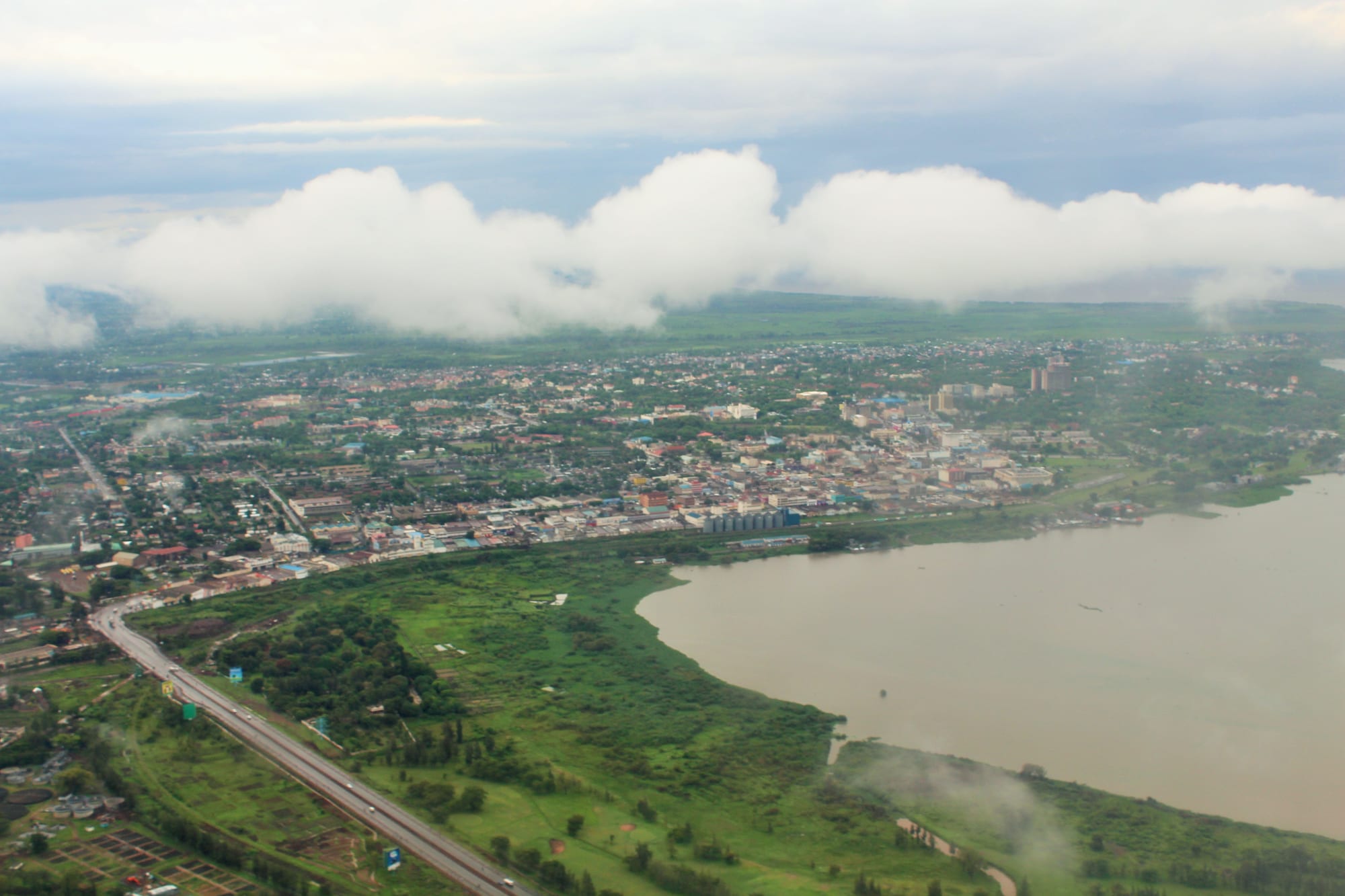
Aerial view of Kisumu, low buildings and green land spreading along the brown water of a lake gulf under cloud

Kisumu, Kakamega & Western Kenya, Kenya

Kisumu

Kisumu seen from the air, spread along the shore of the Winam Gulf of Lake Victoria. (Victor Ochieng / Wikimedia Commons · CC BY-SA 2.0)

Kenya's lake city, on the Winam Gulf of Lake Victoria almost exactly on the equator. It began in 1901 as Port Florence, the terminus of the Uganda Railway, and grew into the port and commercial centre of the Luo west. Fishing beaches, a lakeside sanctuary, a museum of western Kenya and the rock of Kit Mikayi lie within reach of its streets.

Neighbourhoods

  • Town centre
    • First-time visitors
    • Shopping and markets
    • Close to transport

    The grid between Oginga Odinga Street and the old railway and port, holding the banks, hotels, bus stages, cafés and the main shops. It is flat, walkable and busy in the cooler hours, and the lake is only a short ride away.

    Open in Maps
  • Milimani
    • Quiet and residential
    • Hotels and restaurants

    The leafy quarter south-east of the centre, laid out with large plots and mature trees, where many of the city's better hotels, guesthouses and restaurants stand among embassies of aid agencies and family houses.

    Open in Maps
  • Dunga and the lakeshore
    • Lake views
    • Best for food
    • Boats

    The fishing settlement and papyrus shoreline a few kilometres south of the centre, where boats land their catch and fish is fried beside the water. The shore walk and the wetland birds are the reason most visitors come out here.

    Open in Maps
  • Kondele and Manyatta
    • Local life
    • Street food

    Dense, busy neighbourhoods north-east of the centre along the Kakamega road, full of matatu stages, small shops, bars and grilled-food stalls. They are the everyday city rather than a visitor district.

    Open in Maps
  • Mamboleo and Riat
    • Quiet and residential
    • Views over the lake

    Newer housing on the rising ground north of the city, near the Riat hills and the airport road, with wide views down over the gulf and cooler air than the shoreline.

    Open in Maps

Things to do

In the city

  • Kisumu Impala Sanctuarypark

    A small lakeshore reserve inside the city, gazetted in 1992 and covering under a square kilometre, with a resident impala herd, other game and more than 115 recorded bird species.

    Open in Maps
  • Kisumu Museummuseum

    The regional museum of western Kenya, with Luo material culture, a reconstructed homestead, and displays on the lake's fish and birdlife.

    Open in Maps
  • MV Uhurulandmark

    A Lake Victoria railway ferry built in the mid-twentieth century to carry wagons across the lake, associated with the old port at Kisumu.

    Open in Maps
  • Kisumu International Airporttransit hub

    The airport on the northern edge of the city, the main air link with Nairobi and the quickest way in from the capital.

    Open in Maps

Short trips west of the city

  • Kit Mikayilandmark

    A tor of balanced rocks about 120 metres high some 29 kilometres west of the city, long associated with sacrifice and legend, its name given in Dholuo as 'the stone of the first wife'.

    Open in Maps
  • Masenoattraction

    A town on the road north-west through which the equator passes, home to Maseno University and Maseno School.

    Open in Maps
  • Nyang'oma Kogeloattraction

    A village in Siaya County known internationally as the home of the family of Barack Obama's father.

    Open in Maps
  • Kakamega Forestpark

    Kenya's surviving fragment of Guineo-Congolian rainforest, with forest monkeys and several hundred recorded bird species.

    Open in Maps

Short trips around the gulf

  • Ndere Islandpark

    An uninhabited island of about 4 square kilometres in the Winam Gulf, gazetted as a national reserve in 1986, with introduced impala, hippos and grassland above the water.

    Open in Maps
  • Rusinga Islandattraction

    An island joined to the mainland at Mbita Point by a bridge that replaced the old causeway, known for its rich Miocene fossil beds, including the ape Proconsul, and as the burial place of the politician Tom Mboya.

    Open in Maps
  • Ruma National Parkpark

    A grassland park in the Lambwe Valley, the only inland national park in the Nyanza region, protecting Kenya's one indigenous population of roan antelope.

    Open in Maps

Seasonal events

  • Rusinga Cultural Festivalthe last Thursday and Friday before Christmas

    A two-day festival on Rusinga Island south of the gulf celebrating the culture of the Abasuba people, with music, food, sport and art, and working to keep the endangered Suba language alive.

  • Christmas and the December homecomingDecember

    Luo families return from Nairobi and abroad, filling the lakeside villages and the city's markets, restaurants and churches.

  • The long rainsMarch to May

    The heaviest rains of the year bring dramatic afternoon storms over the lake, green countryside and the quietest months for visitors.

Eat and drink

Long-standing places and food districts in Kisumu. Hours, ratings and directions come from your maps app, always current.

Kisumu classics

  • Fried tilapia at the fish landingsrestaurant

    Whole tilapia, fried or stewed in tomato and onion and eaten with ugali and kachumbari, cooked at the lakeshore landings where the boats come in.

    Open in Maps
  • Omena stallsmarket

    Tiny silver fish dried in the sun on the beaches and sold by the basin in the markets, fried with tomato and onion and eaten with ugali.

    Open in Maps

Markets and food streets

  • Kibuye Marketmarket

    The city's biggest market, where fish, vegetables, fruit and grain from the lake region are traded, with cooked-food stalls along its edges.

    Open in Maps
  • Oginga Odinga Street and the town centreneighborhood

    Cafés selling chai, mandazi and chapati from dawn, canteens with fish, ugali and stews at lunchtime, and Indian restaurants that date from the railway era.

    Open in Maps
  • Dunga lakeshoreneighborhood

    Simple fish kitchens and open-air bars along the water south of the city, where a fish is chosen and cooked while customers wait.

    Open in Maps

Experience Kisumu

History

The city is a creation of the railway. In December 1901 the line from Mombasa reached the pier on the Winam Gulf, and the new terminus took the name Port Florence. The township later reverted to its original name, Kisumu, from a word for a place of barter trade, and steamers were carrying goods and passengers across the lake to Uganda and Tanganyika. The town was transferred with the rest of the region from the Uganda Protectorate to the East Africa Protectorate in 1902.

A port, a customs house, workshops and an Indian commercial quarter grew around the station, and Kisumu became the outlet for cotton, sugar, fish and hides from the lake basin and the funnel through which people from the west travelled to work in Nairobi and Mombasa. Missions and schools around the gulf made the area a centre of education, and trade unions and nationalist politics took root among its workers.

After independence the port's fortunes followed those of the East African Community: traffic across the lake collapsed when the community broke up in 1977, and the town's industries struggled for decades. Kisumu was also at the centre of national politics as the home city of Luo leaders, from Oginga Odinga to his son Raila Odinga, and saw deadly unrest during the disputed elections of 2007–08 and again in 2017. The town was raised to a municipal board in 1940 and a municipal council in 1960, and investment in the port, the airport and the waterfront has continued since.

Culture & Customs

Kisumu is the cultural capital of the Luo, and Dholuo is the language of the street, the market and the radio. Funerals are the great communal events, drawing relatives home from Nairobi and abroad for days of mourning, speeches and food, and the obligation to be buried at the ancestral home remains strong. Age, kinship and lengthy greetings order everyday encounters.

The city has a particular place in African music. Benga, the fast, bright, guitar-led dance style whose bass lines imitate the plucked rhythms of the Luo nyatiti lyre, evolved in Nairobi between the late 1940s and the late 1960s and spread across East Africa; the lyre and the orutu fiddle are still played, and live bands are a fixture of the bars along the main roads. Football is followed passionately, with Gor Mahia commanding the city's loyalty.

Kisumu is also a mixed trading town. Indian families who came with the railway built much of the old commercial centre and left temples, a mosque and a taste for samosas and curry in the city's kitchens; Luhya, Kisii and Nandi traders work the same markets; and international aid and research organisations, drawn by decades of public-health work around the lake, have given the city a sizeable expatriate population and a lively restaurant scene in Milimani.

Daily Life

Kisumu is Kenya's third city. The 2019 census counted about 398,000 people in the city itself and some 457,000 across the wider urban area with Maseno and Ahero, in a county of more than 1.1 million. Life turns on the lake and on trade: fishing crews go out at night and land tilapia, Nile perch and omena at the beaches at dawn, traders and transporters move the catch inland, and the markets, the sugar mills of the hinterland and the rice schemes of the Kano plains supply the rest.

The port and the railway, long quiet, have seen renewed investment, and the city works as the service centre for western Kenya, with a referral hospital, universities and colleges, banks and the offices of aid and research agencies. Many families also farm small plots just beyond the built-up area.

Days begin early to avoid the heat, with markets busiest in the morning and the lakeshore at its most pleasant in the late afternoon. Poverty is widespread in the crowded settlements of Nyalenda and Manyatta, and the lasting local concerns are falling fish stocks, water hyacinth that periodically chokes the bays, flooding when the lake rises, and high rates of HIV in lakeside communities, where long-running treatment and research programmes are based.

Food

Fish and ugali make the city's plate. Tilapia is the classic, fried whole until crisp or simmered in a tomato and onion stew, served with ugali — kuon in Dholuo — and kachumbari salad; Nile perch is filleted and fried; and omena, the tiny silver fish dried in the sun on the beaches, is cooked with tomato and onion into a strong, cheap everyday dish. The fish landings at Dunga and along the gulf are where it is eaten fresh, chosen from the morning's catch and cooked to order.

Around the fish come the greens the lake region prizes: osuga (African nightshade), apoth (jute leaves), mito and dek, boiled and often finished with milk or groundnut paste, alongside beans, sweet potato, cassava and green grams. Aliya, sun-dried meat, is a traditional Luo preparation, and chicken remains the dish of honour for guests.

The railway left an Indian legacy of samosas, bhajia and curries in the old commercial streets, and breakfast across the city is chai with mandazi or chapati. Street grills sell roast maize and mutura sausage in the evening, fresh juices and sugar cane are sold from stalls in the heat, and traditional brews are still made in the villages beyond the city alongside the ubiquitous bottled lager.

Planning tools

Budget

Kisumu is one of the cheaper Kenyan cities. Guesthouses, matatus and lakeside fish meals cost little; the main expenses are a hotel in Milimani or on the lakeshore, a hired boat for the gulf or an island, and park entry at Ndere or Ruma. Flights from Nairobi save a long road day but add to the budget.

Daily Budget Midrange
USD 70–150 (good hotel, restaurant meals, a boat or park day)
Daily Budget Shoestring
USD 25–45 (guesthouse, local food, matatus and boda-bodas)

Agree boat prices and check that life jackets are provided before leaving a landing site, and carry cash for markets and matatus.

Best Time to Visit

December to February is the driest and hottest period and June to September the coolest, with showers but easier roads; both suit the lake and the countryside. The long rains from March to May are heavy here and can make rural tracks and boat trips difficult, though the region is at its greenest.

Suggested Number of Days

Two days are enough for the city and its lakeshore. Four or five allow the countryside west of the city, a boat on the gulf and the forests and islands of the wider region, and travellers heading on to Uganda often use the city as a stop of one or two nights.

First Visit
2 days
With Surroundings
4–5 days

Transportation

Matatu minibuses, tuk-tuks and boda-boda motorbike taxis cover the city and its lakeshore, with stages in the centre for the estates and for towns across the west. Ride-hailing apps and taxis work in the city. Long-distance coaches run to Nairobi, Kakamega, Kisii and the Ugandan border crossings at Busia and Malaba, and boats from the beaches serve the gulf and its islands.

Tuk-tuks are the easy way to reach Dunga and the sanctuary; agree the fare first, and wear a helmet on a boda-boda.

Airport & Station Connections

Kisumu International Airport is on the northern edge of the city, a few kilometres from the centre, with frequent flights from Nairobi taking about an hour. By road the journey from Nairobi through Nakuru and Kericho takes most of a day by coach or shared vehicle, Kakamega is about an hour away and the Ugandan border at Busia two to three hours to the north-west.

Walkability

The centre is flat and compact, and the main streets, market, stages and lakefront park can be covered on foot, though the heat and humidity near the lake make midday walking hard work. Dunga, the impala sanctuary and the outer estates are too far to walk comfortably and are usually reached by tuk-tuk or boda-boda. Pavements are uneven and unlit in places after dark.

Safety

The city is generally calm for visitors, with petty theft in markets, around matatu stages and on the lakefront after dark the usual risk. Political demonstrations have brought unrest and heavy-handed policing at times of disputed elections, as in 2007–08 and 2017. The lake carries risks of its own: bilharzia in the water, hippos and crocodiles near the shore, sudden squalls and overloaded boats. Malaria is common at this altitude.

Do not swim in the lake, travel on boats only with life jackets, take malaria precautions, and avoid political rallies at election time. Keep valuables out of sight in crowded markets and use a taxi or a tuk-tuk after dark. Check current official travel advice before travelling.

Climate

Hot, humid and equatorial, with the lake moderating the extremes and feeding afternoon thunderstorms. Rain is possible in any month; the long rains fall from about March to May and a second wetter spell comes late in the year. Nights stay warm.

Summer
January and February are the hottest and driest, with days around 30–32°C
Winter
June to September is a little cooler and still showery, with days around 28°C

Local Customs

This is the heart of Luo Kenya, and Dholuo is heard everywhere alongside Swahili and English. Greetings matter and are unhurried, elders are greeted first, and funerals are large communal occasions that bring families home from across the country. Churches are full on Sundays and services are long. Dress is smart in town and modest at the lakeside villages.

Ask before photographing fishermen, boats or people at markets; tipping is not expected but small change is welcome; buy fish at recognised landing sites and treat the lake's water as unsafe for swimming.

Common Payment Methods

The currency is the Kenyan shilling. Mobile money is used for almost everything, including boat and matatu fares and market purchases, and cards work in hotels, supermarkets and larger restaurants. ATMs are plentiful in the centre; small cash notes are needed at the beaches and stalls.