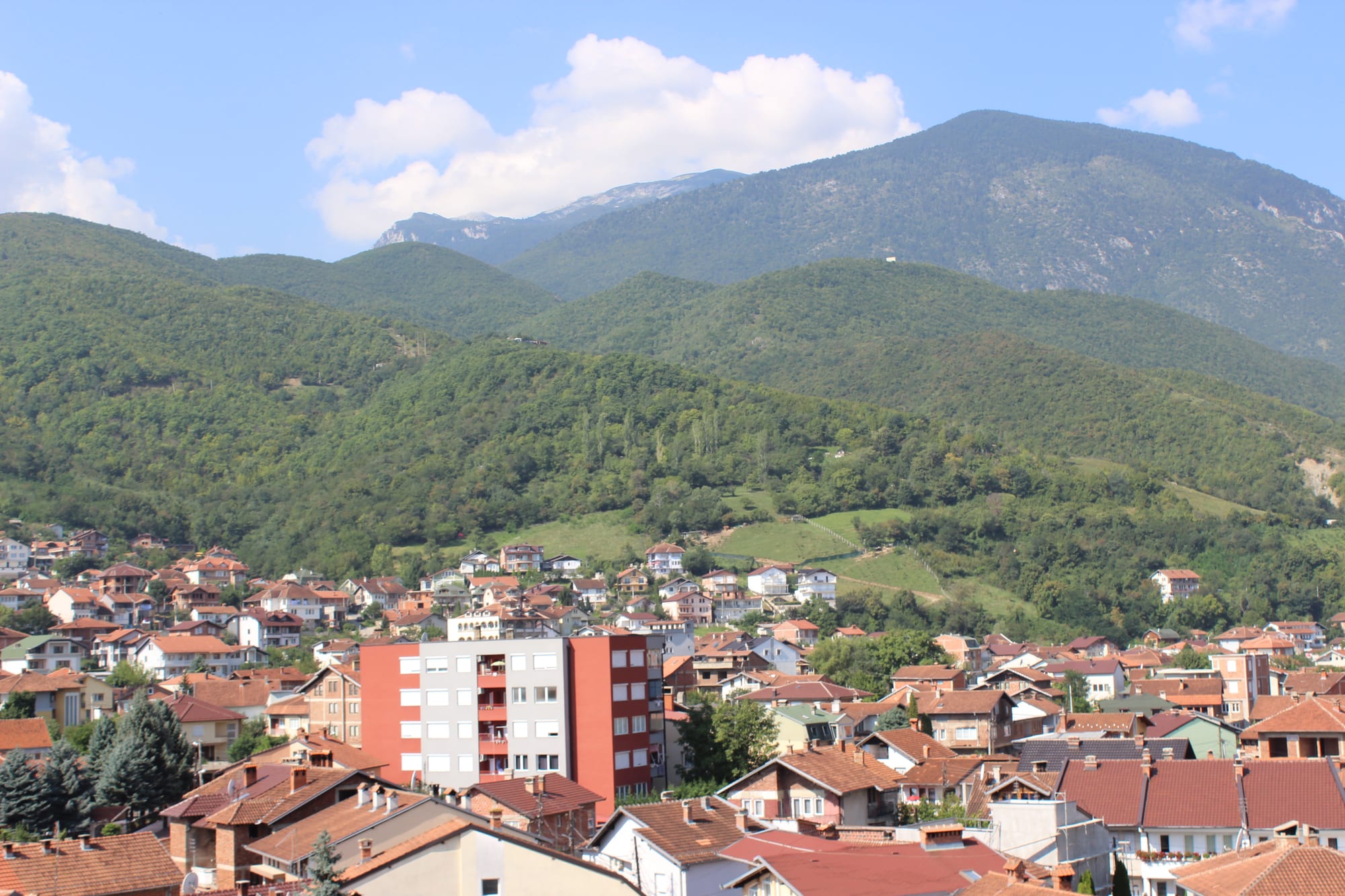
Red-roofed houses and a block of flats in Peja below steep forested hills, with a higher rocky mountain behind under a blue sky

Kosovo

Peja

Peja with the mountains of Rugova rising behind the town. (Shkurte ramushi / Wikimedia Commons · CC BY-SA 4.0)

A town in western Kosovo, known in Serbian as Peć, where the Lumbardhi river leaves the Rugova Canyon at the foot of the Accursed Mountains. Seat of the Serbian Orthodox patriarchs from 1346 and later an Ottoman district capital, it was heavily damaged in the 1998–99 war and is now a base for mountain trails, via ferratas and a rebuilt Ottoman bazaar.

Neighbourhoods

  • The old bazaar
    • First-time visitors
    • Historic district
    • Shopping

    The Ottoman market at the centre of town, destroyed in 1943 and again in the war of 1998–99 and rebuilt afterwards in its historic style. The Long Bazaar Street (Çarshia e Gjatë), with an old fountain at its circular centre, leads past the Bajrakli Mosque, the ethnographic museum and stone tower houses.

    Open in Maps
  • Karagaç and the Big Park
    • Parks
    • Quiet and residential

    A district around the town's Big Park, which has an artificial lake ringed by flowers and trees and is popular for walks and jogging in summer; much of the park was a graveyard in earlier times.

    Open in Maps
  • The road to Rugova
    • Hiking
    • Close to the mountains

    The north-western edge of town, where the Lumbardhi leaves the Rugova Canyon. The Patriarchate of Peć stands about 2 km from the centre, and the road on into the gorge passes waterfalls, a visitors' centre and the starting points for climbs and via ferratas.

    Open in Maps

Things to do

Historic Peja

  • Patriarchate of Pećlandmark

    A complex of Serbian Orthodox churches built in the 13th and 14th centuries, seat of the Serbian patriarchs from 1346 and part of the UNESCO World Heritage Site of the Medieval Monuments in Kosovo.

    Open in Maps
  • Bajrakli Mosquelandmark

    Built for Sultan Mehmed II in the 1460s and 1470s, the largest mosque in Peja, with the oldest and highest dome in the town; it was burned in 1943 and again in 1999.

    Open in Maps
  • Hamam Mosquelandmark

    A mosque of about 1587 near an old hamam and the town's oldest Albanian-language school, rebuilt after fires in 1890 and during the First World War.

    Open in Maps
  • Bazaar of Pejamarket

    The town's main market, rebuilt after the war in its historic Ottoman form and protected as a monument.

    Open in Maps
  • Ethnographic Museummuseum

    The Konak of Tahir Bey near Haxhi Zeka Square, now a museum of traditional handicrafts and costumes of Rugova and the Dukagjini valley.

    Open in Maps
  • Kulla e Pashëslandmark

    A stone tower house in the town where the League of Peja met, with carvings of a lion and a star on its walls.

    Open in Maps

The Rugova Canyon

  • Rugova Canyontrail

    The gorge of the Lumbardhi, about 25 km long, reaching west into the Accursed Mountains, with hiking, rock climbing, caving and four via ferrata routes built between 2013 and 2016.

    Open in Maps
  • Hajlatrail

    One of the Rugova peaks above 2,400 metres, reached by marked trails from the canyon.

    Open in Maps
  • Bukuroshja e Fjetur Caveattraction

    The Sleeping Beauty Cave, a karst cave first discovered in 1968 near the village of Radac, about 11 km from the town.

    Open in Maps
  • White Drin Waterfallpark

    A 25-metre waterfall on the White Drin near Radac, about 11 km from Peja, protected with the nearby cave and the river's spring as a nature monument.

    Open in Maps

Short trips from the town

  • Visoki Dečanilandmark

    The Serbian Orthodox monastery near Deçan founded by King Stefan Dečanski in the 14th century, by far the largest medieval church in the Balkans and part of the same UNESCO World Heritage Site.

    Open in Maps
  • Gjakovaattraction

    The neighbouring town, about 50 minutes away by bus, whose Ottoman marketplace grew up by the Hadum Mosque of 1594.

    Open in Maps

Eat and drink

Long-standing places and food districts in Peja. Hours, ratings and directions come from your maps app, always current.

Peja classics

  • The old bazaarneighborhood

    Cafés, grill houses and bakeries in and around the rebuilt Ottoman market, serving qebapa, burek and coffee.

    Open in Maps
  • Rugova valley restaurantsrestaurant

    Country restaurants along the road into the gorge, a common stop for hikers; trout is common across Kosovo.

    Open in Maps

Cafés and bars

  • Birra Pejaneighborhood

    The beer brewed in Peja and named after the town is found across Kosovo, and in its own town's cafés and bars.

    Open in Maps

Experience Peja

History

Peja grew up on the Lumbardhi, a tributary of the White Drin, where the river leaves the Accursed Mountains. In the Middle Ages the area passed between Byzantine, Bulgarian and Serbian rule. After the monastery of Žiča was burned in the 1290s, the seat of the Serbian archbishops moved to the safer monastery here, and in 1346, when the Serbian Patriarchate was proclaimed, Peć became the seat of the patriarchs. It remained the centre of the Serbian Orthodox Church until the Patriarchate was abolished in 1766.

Under the Ottomans Peja became a district capital, and the Bajrakli Mosque was built for Mehmed II in the 1460s and 1470s. The town's people were largely Muslim by the late 16th century: a tax register of 1582 lists 158 households, only 15 of them Christian. In 1835 local Albanians, supported by rebels from Shkodra, took the town from the Ottomans, and in 1899 the League of Peja, led by Haxhi Zeka, was founded here in the spirit of the League of Prizren to seek autonomy for the Albanians within the empire.

From the late 19th century the town was claimed by both Albanian and Serbian nationalists, and relations were often tense. Austria-Hungary took Peja in January 1916; in 1943 Italian forces burned the bazaar. The tensions came to a head in the Kosovo War of 1998–99, when the town suffered mass killings and more than 80 per cent of its 5,280 houses were heavily damaged or destroyed. More damage followed in the unrest of 2004. The bazaar has since been rebuilt in its Ottoman form.

Culture & Customs

Peja's identity is bound up with the mountains. Rugova, the high region entered from the north-west edge of the town, is known for its villages, pastures and access to peaks above 2,400 metres, and its traditional crafts and costumes fill the ethnographic museum in the bazaar. The town is a base for hiking and climbing, with via ferrata routes and a 700-metre zip line, the longest in the country, in the canyon.

The town also carries heavy symbolic weight for both communities. For Serbs the Patriarchate of Peć is one of the founding places of their church; for Albanians the League of Peja and its leader Haxhi Zeka, whose mill is one of the stops on the town's trail of cultural monuments, are part of the national story. One of the landmark early Kosovar films, Uka of the Accursed Mountains (1968), was shot in the town.

FC Besa Pejë is the main football club and KB Peja the basketball team, with handball, volleyball and judo clubs as well, and the town hosts music festivals including Peja Jazz. Haxhi Zeka University brings students to the town.

Daily Life

At the 2024 census Peja municipality, which includes the town and 95 villages, had about 82,700 people; at the 2011 census about 49,000 lived in the town itself. The population is about 91 per cent Albanian, with Bosniaks the largest minority at about 3.6 per cent.

The centre of daily life is the rebuilt bazaar, which serves as the town's main market, and the cafés and squares around it. People walk and jog in the Big Park in Karagaç in summer, and the Rugova valley begins at the edge of town. The local beer, Birra Peja, is brewed in the town and sold across Kosovo.

Infrastructure still lags behind. Peja's water comes from the White Drin and a spring known as Ujë i bardhë, but the sewage network does not reach parts of the town and most villages, and the Lumbardhi itself has been used to carry waste water. The town's 1930s railway station, a protected heritage building, is served by local trains to Pristina.

Food

Peja eats the hearty food of western Kosovo. Grill houses serve qebapa, small skinless sausages of mixed lamb and beef, with onions, sour cream, ajvar and pitalka bread, and suxhuk, a dry, spicy fermented sausage. Bakeries sell burek filled with minced meat, white cheese or spinach, and pies (pite) and flija appear at home and in traditional restaurants.

Freshwater fish is part of the region's cooking: trout is common across Kosovo, often kept fresh in pools and fried to order, and tavë krapi, carp cooked in a pot, is made in the towns of the Dukagjini valley. Winter tables carry pickled vegetables and ajvar, made in early autumn, and baklava is the classic pastry.

Birra Peja, brewed in the town and named after it, is found all over Kosovo. Rakia, the regional fruit brandy, coffee and drinkable yoghurt (ayran) complete the table. Coffee, above all the macchiato, is sipped for hours in the town's cafés.

Planning tools

Budget

Peja is inexpensive. Grilled meat, burek, coffee, city buses and intercity coaches cost little, and rooms are modestly priced. Guided climbs and via ferratas in the canyon are the main extra costs.

Daily Budget Midrange
USD 70–130 (hotel or mountain guesthouse, restaurant meals, a guided climb or hire car)
Daily Budget Shoestring
USD 35–60 (guesthouse or hostel, grill houses and bakeries, buses)

Walking the old town and the lower canyon road costs nothing; a guide is worth having for the via ferratas and the higher peaks.

Best Time to Visit

Late spring to early autumn is the season for the mountains, for the trails and via ferratas of Rugova. August is the warmest month. Winters are cold, and the old town can be seen at any time of year.

Suggested Number of Days

A day covers the town and its monuments. Allow three to five days for hiking, climbing and a visit to the monastery at Deçan; serious walkers can spend longer in the Accursed Mountains.

First Visit
1–2 days
With Surroundings
3–5 days

Transportation

The town is easily walked, and city buses cover it cheaply. Intercity buses link Peja with Gjakova in under an hour, Pristina in about an hour and a half and Prizren in about two hours, and a train runs to Pristina through some fine scenery. The Rugova Canyon and the mountain villages are easiest by car, taxi or with a guide.

The Çakorr pass through the Rugova Canyon into Montenegro is closed to traffic; the open border crossing is at Kulla.

Airport & Station Connections

The nearest airport is Pristina International Airport, about 65 km away, from where taxis and buses reach Peja. Buses run from Pristina, Prizren and Gjakova, and trains from Pristina. From Montenegro the road crosses the border at Kulla, about 15 km from the centre.

Walkability

Walking is the best way to see Peja: the bazaar, the mosques, the museum and the Big Park are all close together, and the Patriarchate is about 2 km out on the road to Rugova. The canyon itself is for hiking rather than strolling, on marked trails.

Safety

Kosovo is generally safe for visitors, with low levels of violent crime and a NATO-led peacekeeping presence (KFOR) still in the country. In Peja the main risks are in the mountains, on steep terrain far from help.

Keep to marked trails near the borders, hire a guide for via ferratas and high routes, and check the weather before heading into the Accursed Mountains. Check current official travel advice before travelling.

Climate

An oceanic climate, with an average annual temperature of about 9°C.

Summer
mild to warm — August is the warmest month, averaging about 20°C
Winter
cold — January averages around −2°C

Local Customs

The town is overwhelmingly Albanian, with Bosniaks the largest minority, and Albanian is the everyday language; the town is called Pejë or Peja in Albanian and Peć in Serbian, and both names appear on signs. The Patriarchate is one of the most important sites of the Serbian Orthodox Church, and the history of the town is contested by Albanians and Serbs.

Discuss the war and the status question with care, and behave quietly in the monastery and the mosques.

Common Payment Methods

Kosovo uses the euro. Cash is needed for buses, small cafés, bakeries and the mountain villages. Money exchange is available in the town.