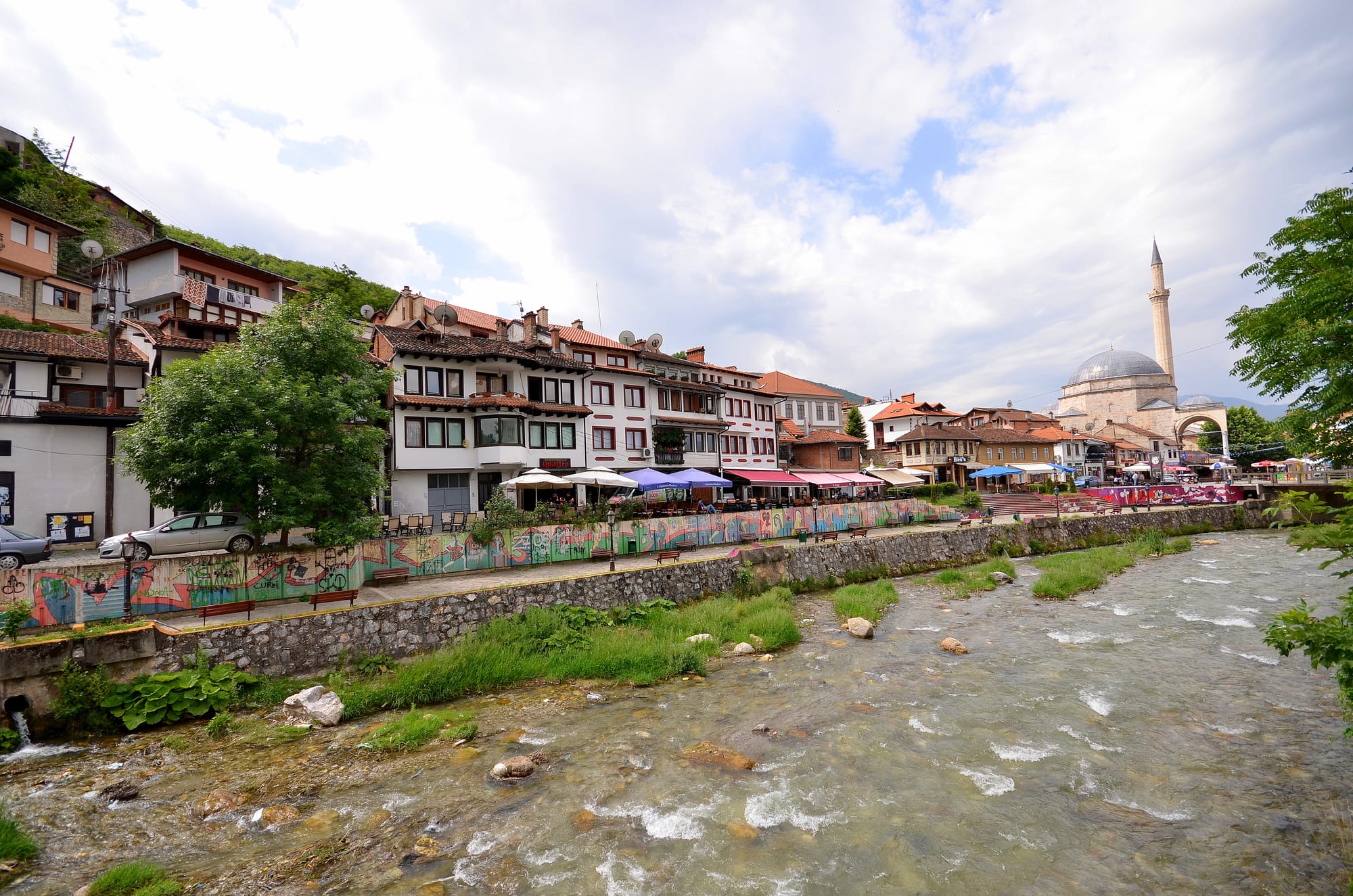
A shallow, fast river below a stone embankment lined with café umbrellas and old houses, with a domed mosque and minaret on the right

Kosovo

Prizren

The Lumbardhi river and Prizren's old town, with the Sinan Pasha Mosque in the background. (Bujar Imer Gashi / Wikimedia Commons · CC BY-SA 3.0)

Kosovo's second city, on the Prizren River at the foot of the Sharr Mountains in the south of the country. A medieval Serbian capital, then an Ottoman seat of government and the birthplace of the League of Prizren, it keeps an old town of mosques, churches, a hammam and a stone bridge below a hilltop fortress, and hosts the DokuFest film festival.

Neighbourhoods

  • Shadërvan and the old town
    • First-time visitors
    • Historic district
    • Cafés

    The heart of Prizren, around the Shadërvan fountain square on the left bank of the river, with the Sinan Pasha Mosque, the hammam, the Old Stone Bridge and lanes of cafés and grill houses. On summer nights the streets around Shadërvan fill with people walking the evening corso.

    Open in Maps
  • The fortress hill
    • Views
    • Walks
    • Historic district

    The steep streets that climb from the centre towards the fortress, with the Orthodox cathedral on the way. The upper streets once held the town's Serb quarter, which was destroyed in 2004; the walk up from the main mosque takes 15–20 minutes.

    Open in Maps
  • Marash and the river valley
    • Quiet and residential
    • Riverside walks

    The district upstream along the Lumbardhi, with a riverside park and an old maple tree said to have been planted by the founder of a Sufi lodge that once stood here. A path follows the river valley out of town and loops up to the fortress.

    Open in Maps

Things to do

The old town

  • Old Stone Bridgelandmark

    The arched Ottoman bridge over the Lumbardhi, built in the 16th century, swept away by a flood in November 1979 and rebuilt by 1982.

    Open in Maps
  • Sinan Pasha Mosquelandmark

    The largest mosque in the city, built by Sofi Sinan Pasha in 1615, whose dome and minaret dominate the centre.

    Open in Maps
  • Shadërvanlandmark

    The square around an old fountain at the centre of the old town, the meeting point of the city and the scene of the summer evening walk.

    Open in Maps
  • Prizren Hammamlandmark

    An early Ottoman bathhouse with two large and nine small domes and separate men's and women's sections, used as a bath until 1944.

    Open in Maps
  • League of Prizren Complexmuseum

    The memorial complex where the League of Prizren was founded in 1878; destroyed during the war of 1998–99 and later rebuilt.

    Open in Maps
  • Archaeological Museummuseum

    A museum in a former Turkish bathhouse built in 1498, holding finds from antiquity to the 19th century from Prizren and the surrounding districts.

    Open in Maps

Churches and the fortress

  • Prizren Fortressviewpoint

    The hilltop fortress above the river, used since the Bronze Age and with much of the present fortress dating from an 18th-century reconstruction, and views over the town's roofs and minarets.

    Open in Maps
  • Our Lady of Ljevišlandmark

    A Serbian Orthodox church built in the early 14th century for King Stefan Milutin on the site of a Byzantine church, part of the UNESCO World Heritage Site of the Medieval Monuments in Kosovo since 2006.

    Open in Maps
  • Monastery of the Holy Archangelslandmark

    The monastery founded by Emperor Stefan Dušan between 1343 and 1352 in the river canyon about 2.5 km south-east of the town, where he was buried.

    Open in Maps
  • Saint George Cathedrallandmark

    The Serbian Orthodox cathedral in the centre, begun in 1856 after long negotiations with the Ottoman authorities and completed in 1887.

    Open in Maps
  • Cathedral of Our Lady of Perpetual Succourlandmark

    The neoclassical Catholic cathedral at the top of the stone street from Shadërvan, built over the walls of a 12th-century church.

    Open in Maps

Short trips from the town

  • Mirusha Waterfallspark

    A series of waterfalls in central Kosovo, where the Mirusha River has carved a 10 km canyon with 13 lakes between the falls.

    Open in Maps
  • Prevallaattraction

    A ski resort and mountain village about 30 km from Prizren, popular with hikers in summer and skiers in winter.

    Open in Maps
  • Rahovecattraction

    A small town known for its vineyards and wines, a short trip from Prizren.

    Open in Maps

Seasonal events

  • DokuFestearly August

    An international documentary and short film festival founded by a group of friends in 2002, with screenings across the town, including open-air ones.

Eat and drink

Long-standing places and food districts in Prizren. Hours, ratings and directions come from your maps app, always current.

Prizren classics

  • Grill houses by the riverrestaurant

    Grill houses along the river and in the old town serve qebapa, small grilled sausages of lamb and beef, with onions, sour cream and ajvar.

    Open in Maps
  • Tavë Prizrenirestaurant

    The town's own casserole, served in traditional restaurants in the old town.

    Open in Maps

Cafés and bars

  • Shadërvanneighborhood

    The cafés around the fountain square and along the river embankment, busiest late on summer evenings.

    Open in Maps

Experience Prizren

History

The hill above Prizren has been occupied since the Bronze Age, and the town has traditionally been identified with Theranda in Roman Dardania, although recent research suggests other locations. The fort was rebuilt under the emperor Justinian in the 6th century, when it appears in the writings of Procopius as Petrizen. Byzantine rule ended in 1219–20, when the Serbian Nemanjić dynasty took the fort and the town, and under Stefan Dušan in the 14th century Prizren served as a capital of the Serbian Empire and flourished as a centre of trade. Dušan founded the Monastery of the Holy Archangels in the gorge above the town and was buried there.

The Ottomans captured Prizren in 1455 and made it the seat of a sanjak almost at once. Mosques, baths and bridges followed, among them the stone bridge of the 16th century and the Sinan Pasha Mosque of 1615, and by 1857 more than 70 per cent of the people were Muslim. In 1878 the town gave its name to the League of Prizren, which sought the unity and autonomy of the Albanians within the Ottoman Empire and made the town a focus of the Albanian national awakening.

Serbian forces took Prizren in 1912 at heavy cost in Albanian lives. The town itself suffered little physical damage in the war of 1998–99, though most Albanians were forced or intimidated into leaving and returned in June 1999; the League of Prizren building was destroyed and later rebuilt. In the unrest of March 2004 Serbian Orthodox churches were damaged or burned and the Serb quarter near the fortress was destroyed, and all the remaining Serb population was evicted from the town.

Culture & Customs

Prizren is designated by Kosovo's constitution as the country's historical capital, and its old town of minarets, church towers and Ottoman houses grew up below the fortress along the left bank of the river. Its mix of peoples is also the most varied in the country. Albanians are the large majority, but Bosniaks, Turks and Roma remain, the Turkish community is socially prominent, and the Turkish language is heard well beyond it.

DokuFest, a documentary and short film festival started by a group of friends in 2002, is among the largest publicly attended film festivals in the Balkans and fills the town every year in early August, drawing support from the community and agencies within Kosovo. The town's public university, the University of Prizren, teaches in Albanian, Bosnian and Turkish.

Religion is visible everywhere. Most people are Muslim, and mosques dominate the skyline, but the Catholic cathedral and the Serbian Orthodox churches — including Our Lady of Ljeviš, part of a UNESCO World Heritage Site — stand within a few streets of them. On summer evenings the old town turns out for the corso, a slow walk and talk around Shadërvan that runs until about midnight.

Daily Life

At the 2011 census Prizren municipality had about 178,000 people, making it the second city and municipality of Kosovo after Pristina, with about 94,500 in the urban area and the rest in the surrounding villages. It is among the most densely populated municipalities in the country.

Life in the centre revolves around the old town and the river, where cafés line the embankment and grill houses fill the old town, and the town's football club plays in Kosovo's First Football League. The streets above the centre climb steeply towards the fortress, and the Marash district upstream has a riverside park and a path into the valley.

Albanians form the large majority of the municipality, with Bosniaks and Turks the largest minorities, and besides Albanian and Serbian, Turkish and Bosnian are official languages of the municipality. Summer is the busiest time, when DokuFest and the evening crowds fill the old town, and the Sharr Mountains above the town draw hikers in summer and skiers to Prevalla in winter.

Food

Prizren's best-known dish is tavë Prizreni, a traditional regional casserole from the town. Like the rest of Kosovo, the town eats a great deal of grilled meat: qebapa, small skinless sausages of mixed lamb and beef, served with onions, sour cream, ajvar and pitalka bread, and suxhuk, a dry, spicy fermented sausage. Grill houses (qebaptore) cluster along the river and in the old town.

Pastry is the other staple. Burek, filled with minced meat, white cheese or spinach, is often eaten with yoghurt or ayran, and pies (pite) and flija appear at home and in traditional restaurants. In winter meals come with pickled vegetables and ajvar, made in early autumn. Among the sweets are baklava, filo layered with chopped nuts and sweetened with syrup or honey, and tulluma.

Coffee is the daily ritual, drunk in the cafés around Shadërvan, and wine comes from around Rahovec. Rakia, the regional fruit brandy, and local beers are found everywhere.

Planning tools

Budget

Prizren is inexpensive. Grilled meat, burek, coffee and buses cost little, and guesthouses and small hotels in and around the old town are modestly priced.

Daily Budget Midrange
USD 70–130 (small hotel in the old town, sit-down dinners, a hire car or taxi for day trips)
Daily Budget Shoestring
USD 35–60 (hostel or guesthouse, grill houses and bakeries, buses)

Walking up to the fortress and around the old town costs nothing, and the bus station is within walking distance of everything in the centre.

Best Time to Visit

Late spring and early autumn are the most comfortable seasons for walking the old town and climbing to the fortress. August is the warmest month and the month of DokuFest and the long evening corso. Winters are cold, with ski runs at Prevalla in the mountains above the town.

Suggested Number of Days

The old town can be seen in a day, but one night allows the evening walk and the fortress in better light. Three or four days leave time for the waterfalls, the wine country and the Sharr Mountains.

First Visit
1–2 days
With Surroundings
3–4 days

Transportation

The old town is walked; streets around the fortress are steep and cobbled. Buses link Prizren with most of Kosovo, usually via Pristina or Gjakova, and with North Macedonia and Albania; the road to Tirana runs on a motorway via Kukës. A hire car is the easiest way to reach the mountains.

A riverside path from the town up to the fortress makes a circular walk of about 4.5 km.

Airport & Station Connections

Most visitors fly into Pristina International Airport and continue by bus via Pristina. Coaches also arrive from Tirana, Skopje and Istanbul, and the motorway from Albania via Kukës makes the drive from Tirana straightforward. Kukës airport in Albania is closer, but Pristina is usually the better choice.

Walkability

Excellent in the old town, where everything from the bus station to the mosques, churches and riverside cafés is within walking distance. The climb to the fortress is short but steep, and a riverside path through Marash makes a longer walk.

Safety

Kosovo is generally safe for visitors, with low levels of violent crime and a NATO-led peacekeeping presence (KFOR) still in the country. The sensitive area is the Serb-majority north around Mitrovica, not the south of the country.

Wear good shoes for the cobbles and the fortress paths, and keep to marked trails in the mountains near the borders. Check current official travel advice before travelling.

Climate

A climate on the boundary between subtropical and continental, with some Mediterranean influence and an average annual temperature of about 12°C. The town lies in the foothills of the Sharr Mountains.

Summer
warm — August is the warmest month, averaging about 22°C
Winter
cool to cold — January averages around 0°C

Local Customs

Prizren is the most mixed town in Kosovo: alongside the Albanian majority live Bosniaks, Turks and Roma, Turkish is widely spoken even by people who are not Turkish, and Turkish and Bosnian are official languages of the municipality alongside Albanian and Serbian. Most people are Muslim, and mosques are a dominant feature of the town; Catholic and Orthodox churches stand nearby.

Prizren's Serbian Orthodox churches and their recent history are sensitive, so discuss the war and the status question with care.

Common Payment Methods

Kosovo uses the euro. It is wise to carry cash for grill houses, bakeries, buses and small shops. Money exchange is available in the town.