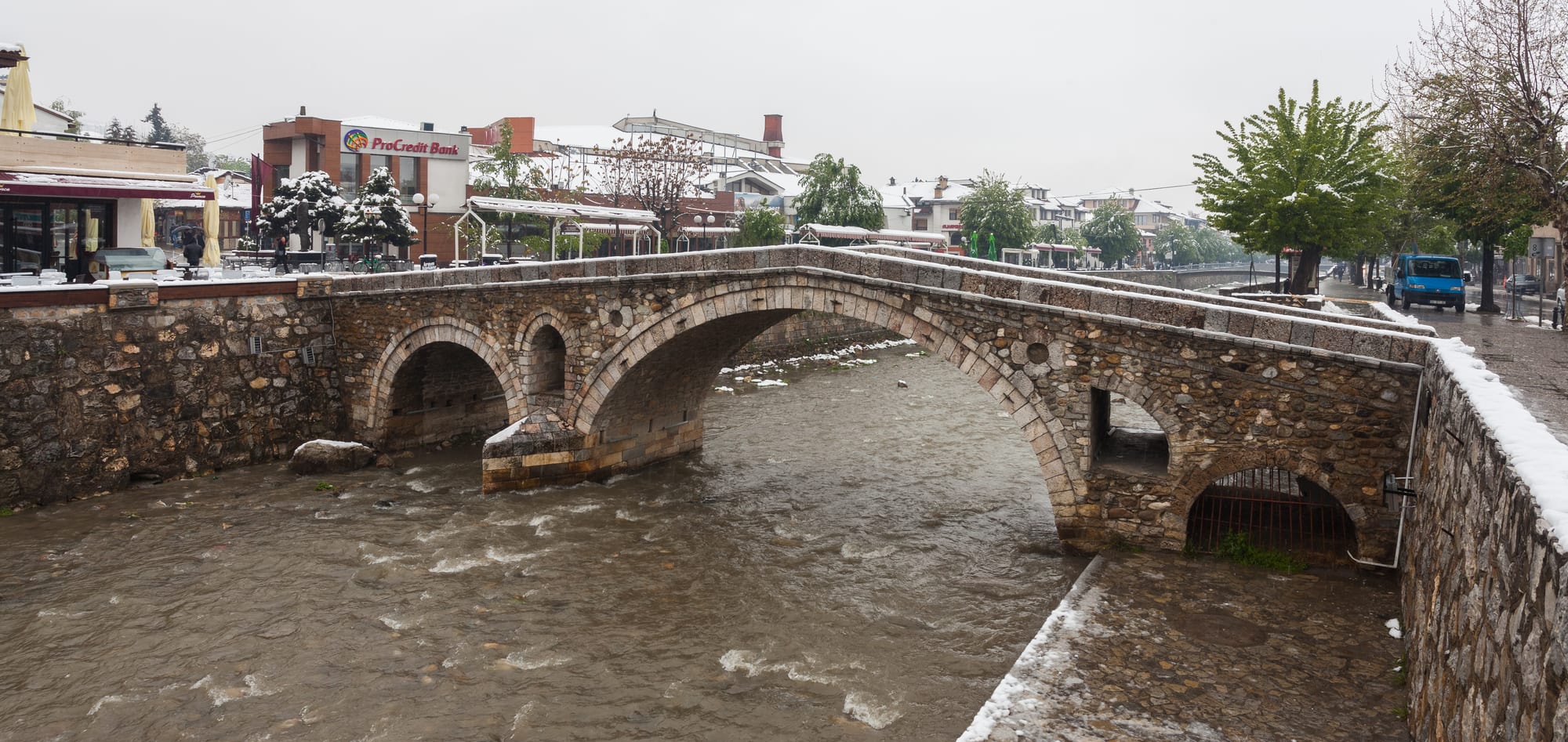
An arched Ottoman stone bridge over a shallow river, with minarets and red-roofed houses climbing a hillside behind

Kosovo

The Ottoman stone bridge over the Bistrica in Prizren, beneath the town's hillside fortress. (Diego Delso / Wikimedia Commons · CC BY-SA 3.0)

Europe's youngest country — a small, mostly Albanian-populated, partially recognised state that declared independence from Serbia in 2008, an independence Serbia does not recognise, with Ottoman-era towns, medieval Serbian monasteries, and a young, pro-Western population.

Explore Kosovo

History

Kosovo was a heartland of medieval Serbia, and the 1389 Battle of Kosovo against the advancing Ottomans became central to Serbian national memory; the region holds major Serbian Orthodox monasteries at Peć, Dečani, and Gračanica, which UNESCO lists, with Our Lady of Ljeviš in Prizren, as World Heritage in Danger. Nearly five centuries of Ottoman rule followed, during which the population became predominantly Albanian and Muslim.

In the twentieth century Kosovo was an autonomous province within Serbia inside socialist Yugoslavia. Serbia's leader Slobodan Milošević stripped that autonomy in 1989, and through the 1990s Kosovo Albanians built parallel institutions in resistance. War broke out in 1998 between Serbian forces and the Kosovo Liberation Army; a campaign of killings and mass expulsion of Albanians followed, and in 1999 NATO bombed Serbia for eleven weeks until it withdrew. The territory was placed under UN administration with NATO troops.

Kosovo declared independence in 2008. It is a partially recognised state: around 110 UN member states, including the United States and 22 of the 27 EU members, recognise it, but Serbia, Russia, China and five EU members do not, and it is not a UN member. An EU-brokered dialogue with Belgrade has produced agreements but no final settlement, and the Serb-majority north remains a recurring flashpoint.

  • Kosovo: The Contested Country — A small Balkan territory that is a heartland of Serbian Orthodoxy and has an overwhelming Albanian majority — five centuries under the Ottomans, a decade of repression, a war, NATO's intervention, and a disputed independence

Culture & Customs

Kosovo's culture is Albanian, closely tied to that of Albania and North Macedonia's Albanians, and shares the values of besa (a pledge of honour and hospitality), strong family and clan bonds, and a tradition of protecting guests. The population is majority Sunni Muslim but markedly secular and relaxed, with Catholic and Orthodox minorities.

Pro-American sentiment is unusually strong — Pristina has a Bill Clinton Boulevard and a statue of him — a legacy of the 1999 intervention. The country has a strikingly young population, a large diaspora in Germany and Switzerland whose remittances and summer visits are central to the economy, and a lively contemporary music and arts scene alongside older traditions of filigree, stone tower houses (kulla), and epic songs sung to the lahuta and çifteli.

Coffee culture is serious — long sessions over macchiatos are a social institution — and the day slows for it. In the Serb communities, the Orthodox calendar and the slava family feast structure life.

  • Kosovo: Hand on Heart — A young country of several communities, constitutionally secular and largely Muslim, where the guest is honoured above almost everything, a hand laid on the heart signals respect, and two Christmases share the calendar with two Bajrams

Daily Life

Pristina, home to about 227,000 of Kosovo's roughly 1.6 million people, is a fast-growing, chaotic young capital of cafés, construction, and a famously eccentric public library. Prizren, Peja (Peć), Gjakova, and Mitrovica are the other main towns, and much of the country is farming villages in the plains and foothills.

The economy is one of the poorest in Europe, with unemployment that the IMF has called the highest rate in Europe, especially among the young, and a heavy reliance on remittances, aid, and public spending. Electricity, generated largely from ageing lignite plants, is a recurring problem, and emigration for work is a constant.

Daily life revolves around the extended family, the café, and — for hundreds of thousands of households — the money and the visits from relatives abroad, with the diaspora's return each August briefly transforming the towns.

  • Kosovo: A Country That Waits for August — A young, close-knit country where an hour over a macchiato is a daily fixture, a great many households lean on money sent home by relatives abroad, and the whole calendar seems to build toward the diaspora's summer return

Food

Kosovan cooking is Balkan and Ottoman-influenced, hearty and meat-forward. Flia (or flija) is the signature dish: thin crêpe-like layers brushed with cream one at a time and baked in the shape of the sun, served with sour cream and butter, or with white cheese and pickles. Grilled meats — above all qebapa, small skinless sausages of lamb and beef — appear everywhere, with ajvar pepper relish, raw onion, and fresh bread.

Byrek (pastry layers filled with cheese, minced meat, or spinach), stuffed peppers, sarma (minced meat wrapped in cabbage or vine leaves), tavë baked dishes such as tavë Prizreni, and the pies known as pite fill out home cooking. Village cheese, cured meats, and pickles start most meals.

Turkish coffee and macchiato are the daily rituals; rakia (fruit brandy) and, increasingly, local wines from the Rahovec area, the heartland of Kosovo's wine industry, accompany meals; and boza, a soft drink made from maize and wheat flour, is traditional.

Attractions & Natural Wonders

Prizren is the country's most attractive town: an Ottoman old quarter of stone bridge, hammam, and the domed Sinan Pasha Mosque, with the League of Prizren museum, silver and filigree workshops, and a fortress on the hill above for the view. It hosts the Dokufest documentary festival each summer, drawing international and regional audiences.

Pristina is more about atmosphere than monuments — the Newborn typography monument unveiled on independence day in 2008, the Bill Clinton statue, the domed National Library, the Grand Hotel, and a dense café and nightlife scene. Gjakova has a long restored çarshia bazaar, and Peja sits at the mouth of the dramatic Rugova Canyon.

For nature, the Accursed Mountains (Bjeshkët e Nemuna) rise along the borders with Albania and Montenegro, with the 192 km cross-border Peaks of the Balkans trek, a via ferrata in the Rugova gorge, and skiing at Brezovica. The Mirusha waterfalls, the Marble Cave at Gadime near Lipjan, and the Serbian Orthodox monasteries — Visoki Dečani, visited under KFOR guard, and Gračanica — complete a short but varied circuit.

  • Kosovo: Eight Attractions and Natural Wonders — A partially recognised state that declared independence in 2008 — an Ottoman hill town of mosques and hammams, frescoed medieval monasteries under armed guard, a canyon road into the Accursed Mountains, and a very young, very sociable capital

Planning basics

Budget

Kosovo is one of the cheapest countries in Europe. Meals, coffee, buses, and guesthouses cost very little, and even Pristina's better restaurants and hotels are inexpensive by Western standards. Cards are accepted in cities; carry cash for buses, villages, and the mountains.

Macchiato
EUR 1–1.50
Daily Budget Midrange
EUR 60–110 (hotel, restaurants, a rental car, guided hikes)
Daily Budget Shoestring
EUR 30–50 (guesthouse or hostel, local food, buses)

Visa Requirements

Citizens of the EU/Schengen area, the UK, the US, Canada, Australia, and many other countries enter visa-free for up to 90 days in any six-month period. Holders of a multiple-entry Schengen visa or residence permit may enter without a visa for up to 15 days. Kosovo is not in the EU, Schengen, or the UN, though its own citizens have been able to travel visa-free to the Schengen area since 1 January 2024.

Typical Stay
90 days in any 180-day period, visa-free, for most Western passports

If you plan to continue into Serbia, note that Serbia does not accept entry stamped only at a Kosovo border with Albania, North Macedonia, or Montenegro.

Safety

Kosovo is generally safe for visitors, with low levels of violent crime and a NATO-led peacekeeping presence (KFOR) still in the country. The one caution is the Serb-majority north around Mitrovica, where tensions with Serbia periodically flare into barricades and unrest, and some remote border areas still have uncleared mines from 1999.

Source
US Department of State and UK FCDO travel advisories — check for the latest wording.

Avoid demonstrations and the northern flashpoints around Mitrovica, stay on marked paths near the borders, and be measured when discussing Serbia and the status question.

Source: US Department of State and UK FCDO travel advisories — check for the latest wording.

Climate

Continental, with warm-to-hot summers and cold winters. The basins around Pristina and Prizren can be hot and hazy in July and August and cold and grey in winter; the surrounding mountains hold snow well into spring and have a winter ski season.

Summer
hot, often 28–35°C in the lowlands
Winter
cold, around -3 to 4°C, snow in the mountains

Transportation

Pristina International Airport is the country's main airport. Passenger rail is minimal: a local train runs twice a day between Pristina and Peja, while the once-daily international service to Skopje has been suspended for construction work on the line. Intercity buses are frequent and cheap, linking Pristina, Prizren, Peja, and Gjakova and running to Tirana, Skopje, and other regional cities. A rental car is best for the Rugova valley and the mountains.

Buses to Prizren and Peja from Pristina run roughly hourly and take under two hours.

Best Time to Visit

May–June and September–October for mild weather, green hills, and open mountain trails. July and August are hot in the towns; December to March is ski season at Brezovica. Independence Day (17 February) and the Dokufest documentary festival in Prizren (summer) are notable dates.

Currency

Kosovo uses the euro, adopted unilaterally in 2002, though it is neither an EU nor a eurozone member. Cards work in cities; ATMs are common.

Symbol
€
Currency Code
EUR — euro

Language

Albanian and Serbian are both official. Albanian is the language of the large majority; Serbian is spoken in the Serb communities, chiefly in the north and a few enclaves. English is widely spoken by younger people and in the tourism trade, and German is common because of the large diaspora.

English
Widely spoken by the young; German also common
Official Languages
Albanian, Serbian