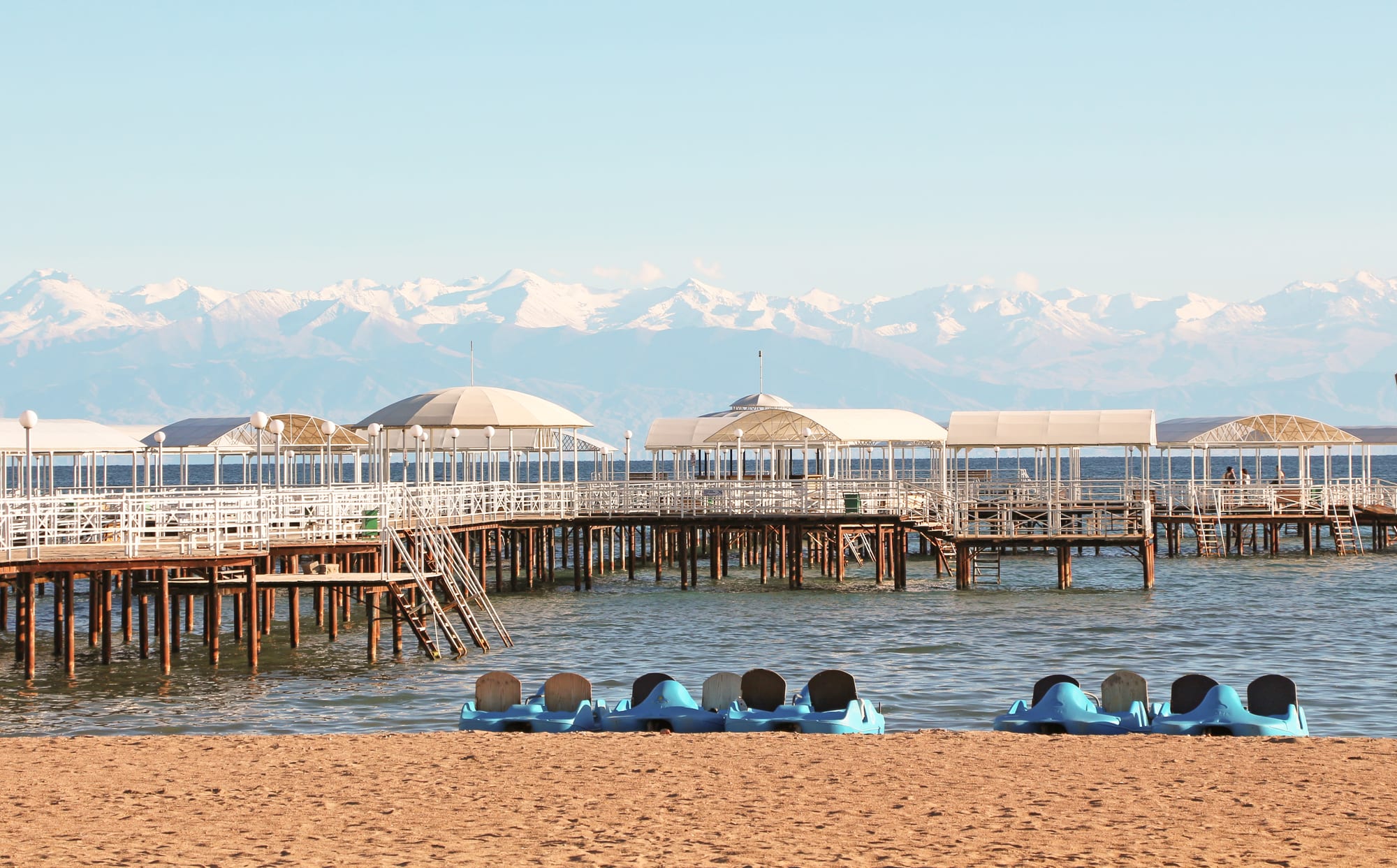
A sandy lake beach with pedalos drawn up on the sand and a long wooden pier of white pavilions, snow-covered mountains across the water

Bishkek, Issyk-Kul & Naryn, Kyrgyzstan

Cholpon-Ata

A beach and pier pavilions on Issyk-Kul's northern shore near Cholpon-Ata. (Bgag / Wikimedia Commons · CC0)

The main resort town on the northern shore of Lake Issyk-Kul, set on a shelf of land between the water and the Kungey Ala-Too. Soviet planners filled it with sanatoria and holiday camps, and it still fills each July and August with families from Kyrgyzstan, Kazakhstan and Russia. Above the town lies an open-air field of ancient rock carvings.

Neighbourhoods

  • The shore and the sanatorium belt
    • Beaches
    • First-time visitors
    • Families

    The strip between the main road and the water, where Soviet-era sanatoria, holiday camps and newer hotels each hold a stretch of sand behind gates. Piers, pedalos and beach cafés run along it, and this is where the town's summer population actually stays.

    Open in Maps
  • The main road and town centre
    • Markets
    • Close to public transport
    • Local life

    The Bishkek–Karakol highway doubles as the high street, lined with shops, small restaurants, guesthouses, a bazaar and the stands where minibuses and shared taxis pick up. It is busy and dusty in season and very quiet out of it.

    Open in Maps
  • Bosteri and the eastern shore
    • Beaches
    • Families
    • Nightlife

    A neighbouring resort village a few kilometres east, with more holiday complexes, a water park and beach bars. It runs into a near-continuous line of camps along the shore in July and August.

    Open in Maps
  • The upper town and the hillside
    • Quiet and residential
    • Mountain views

    Residential streets of single-storey houses and orchards rising towards the Kungey Ala-Too, with the petroglyph field on the stony slope above. Cooler, quieter, and where most year-round residents live.

    Open in Maps

Things to do

Lake and beaches

  • Lake Issyk-Kulattraction

    One of the largest and deepest mountain lakes in the world, slightly saline and warm enough to swim in from late June to early September; it rarely freezes.

    Open in Maps
  • The Cholpon-Ata beachesbeach

    Sand and fine shingle along the town shore, much of it attached to sanatoria and holiday complexes, with public stretches, piers, pedalos and boat trips in season.

    Open in Maps

History and culture

  • Cholpon-Ata petroglyphsattraction

    An open-air site of about two thousand carvings on glacial boulders above town, showing ibex, deer and hunters, made from the second millennium BC onwards, with stone circles, tombs and later balbal stones among them.

    Open in Maps
  • Ruh Ordoattraction

    A lakeside cultural complex of small chapels representing five world religions, along with statues and sculpture in a garden by the water.

    Open in Maps
  • Issyk-Kul Regional Museummuseum

    A small local museum covering the archaeology of the lake, nomadic life and the region's Soviet century.

    Open in Maps

Short trips from the town

  • Grigorievka Gorgetrail

    A green alpine valley of pines, meadows and small lakes running up into the Kungey Ala-Too east of town, used for day walks, horse riding and yurt stays.

    Open in Maps
  • Tamchyneighborhood

    A quieter lakeside village west along the shore, known for guesthouses, its beach and the regional airport just outside it.

    Open in Maps
  • Semyonovka Gorgetrail

    A wooded valley of spruce and summer pastures east of the town, often visited on the same day as its neighbour Grigorievka.

    Open in Maps

Seasonal events

  • Beach seasonJuly and August

    The two months when the resort is full, with concerts, funfairs, boat trips and a population many times the winter figure.

  • Nowruzlate March

    The spring new year, marked with communal cooking of the wheat pudding sumalak, horse games and concerts.

  • Independence Day31 August

    The national day, which falls at the close of the beach season and fills the shore for a final holiday weekend.

Eat and drink

Long-standing places and food districts in Cholpon-Ata. Hours, ratings and directions come from your maps app, always current.

Lakeside classics

  • Smoked and fried lake fishrestaurant

    Fish from Issyk-Kul, smoked or fried, is sold along the shore road and in beach cafés in summer; it is the food most associated with a holiday here.

    Open in Maps
  • Shashlik and laghman cafésrestaurant

    Charcoal-grilled mutton and beef skewers, hand-pulled laghman noodles and steamed manty are the staples of the cafés strung along the highway and the beachfront.

    Open in Maps

Markets and streets

  • Cholpon-Ata bazaarmarket

    The town market, at its fullest in summer, selling apricots, apples, honey, kurut cheese balls, bread from tandyr ovens and preserved fruit from the shore villages.

    Open in Maps
  • The shore roadneighborhood

    Seasonal cafés, ice-cream stands, kymyz sellers and beer terraces line the road and the beach approaches through July and August, and mostly shut by October.

    Open in Maps

Experience Cholpon-Ata

History

The shore here has been occupied far longer than the town. Herders carved about two thousand images of ibex, deer, hunters and big cats into the glacial boulders scattered on the slope above the present centre, from the second millennium BC onwards, and later Turkic peoples left balbal memorial stones among them. The lake lay on a northern branch of the Silk Road, and the shallows off this coast hold the remains of settlements now under water, investigated by divers and archaeologists since the nineteenth century.

The modern settlement dates from Russian colonisation of the Issyk-Kul basin in the late nineteenth century, when Slavic settlers founded villages along the north shore. Its name, Kyrgyz for 'father of the morning star', belongs to older local tradition. Under Soviet rule the town's purpose changed entirely: from the 1950s planners developed the north shore as a health resort, building sanatoria, pioneer camps and trade-union holiday homes along the beaches, with treatment programmes based on the lake's climate, mineral waters and mud. Holidaymakers came by train and bus from across the Soviet Union, and the town grew around the season.

Independence in 1991 cut those subsidised holiday flows and many complexes fell idle, but the traffic returned in a different form as Kazakh, Kyrgyz and Russian families began driving to the lake in their own cars. Cholpon-Ata became the country's resort capital again, with new hotels, a water park along the shore at Bosteri and a hippodrome. It hosted the first three World Nomad Games, in 2014, 2016 and 2018, and was the main venue again in 2026, when Bishkek held the opening and closing ceremonies; the games brought international attention to the lake and left sports venues behind.

Culture & Customs

Cholpon-Ata is a holiday town, and its culture is shaped by the season. For ten months it is a quiet Kyrgyz shore settlement of about fourteen thousand people; for two it hosts many times that number, with Russian the common language on the beach, Kazakh cars filling the car parks and open-air concerts running along the front. That contrast — a working village and a resort occupying the same streets — is the strongest thing about the place.

The lake itself carries considerable weight in Kyrgyz culture. Legends of a city drowned beneath the water and of a princess whose tears filled the basin are told along the shore, and Issyk-Kul appears in songs and in the writing of Chinghiz Aitmatov. The petroglyph field above town is treated as a heritage site rather than a curiosity, and the balbal stones standing among the boulders are a reminder that the shore was sacred ground long before the sanatoria.

Nomadic tradition is put on display here more deliberately than elsewhere. The World Nomad Games brought kok-boru, eagle hunting, horseback archery and traditional wrestling to the hippodrome and to a yurt village in the nearby Kyrchyn gorge, and demonstrations of horse games, felt-making and komuz playing continue through the summer. Off the beach, ordinary Kyrgyz manners hold: guests are fed generously, bread is handled with care, and elders are served first.

Daily Life

About 14,000 people live in Cholpon-Ata year-round, and the town is the administrative centre of Issyk-Kul District. Most residents occupy single-storey houses with orchards and vegetable plots on the streets between the highway and the hillside, while the shore below is taken up by sanatoria, holiday complexes and guesthouses. Apricot, apple and sea-buckthorn growing, smallholding livestock and fishing supplement wages, and many families let rooms in their own homes through the summer.

The economy is almost entirely seasonal. Building work, hotel jobs, taxi driving, beach concessions, cafés and market trading all crowd into June, July and August, and much of the town lives through the winter on what those months bring, topped up by money sent home from relatives working in Russia and Kazakhstan. The lack of year-round work drives young people to Bishkek, and lengthening the season is a constant local ambition.

Life in season starts early and runs late, with deliveries and market trade before the beach fills and cafés busy until midnight. Out of season the same streets are almost empty by dusk, shutters go up on half the shopfronts, and the town turns back to school, livestock and orchards. Pressure on the lake is the main public issue: unregulated building along the shore, sewage and rubbish, and fluctuating water levels are argued over locally and nationally, and Issyk-Kul's status as a biosphere reserve is regularly invoked in the debate.

Food

Holiday food here is simpler and more Russian-influenced than in the mountains inland. Fish from the lake, smoked or fried and eaten with bread and beer, is the taste most associated with Issyk-Kul, sold from stalls along the shore road and in beach cafés through the summer. Shashlik, mutton or beef grilled over charcoal and served with raw onion and vinegar, is the other constant, cooked in the open air at almost every roadside café.

The Central Asian staples are all present: laghman, hand-pulled noodles fried with peppers and mutton or served in broth; manty, large steamed mutton dumplings; samsa baked on the walls of a tandyr oven; plov, rice with lamb and carrot; and the Dungan cold noodle dish ashlan-fu, which travels along the shore from Karakol. Kyrgyz feast food — beshbarmak of boiled meat over broad noodles, kuurdak of fried meat and potatoes — appears at celebrations and in the larger dining halls.

The shore's own produce fills the bazaar: apricots, apples, plums and sea buckthorn from the orchard villages, honey from hives in the gorges, walnuts, and kurut, hard salty balls of dried yoghurt eaten as a snack. Kymyz, fermented mare's milk, is brought down from the summer pastures and sold by the roadside, alongside maksym and chalap, the fizzy fermented grain and yoghurt drinks drunk everywhere in Kyrgyzstan in hot weather. Tea follows every meal.

Planning tools

Budget

Prices here swing with the season more than anywhere else in Kyrgyzstan. In July and August rooms on the north shore cost several times their spring rate and fill weeks ahead; in May, September and October the same guesthouses are cheap and half empty. Sanatoria sell package stays that include meals and treatments.

Daily Budget Midrange
USD 55–110 (lakeside guesthouse or hotel, restaurant meals, boat trips or a driver for a day in the gorges)
Daily Budget Shoestring
USD 25–45 (guesthouse room or a bed in a holiday camp, bazaar food, shared minibuses)

Book well ahead for the July and August weekends, when Kazakh and Kyrgyz families arrive together; many beaches belong to a hotel or sanatorium and charge for entry.

Best Time to Visit

Late June to early September for swimming, when the lake water is warm enough and everything is open; the last two weeks of July and the first of August are the busiest and most expensive. May, June and September are pleasant for walking in the gorges and seeing the petroglyphs without crowds. Winter is very quiet, with much of the shore closed.

Suggested Number of Days

Two days cover the beach, the petroglyph field and the lakeside sights. Three or four allow the gorges behind the town and the shore villages. Beach holidays here often run to a week, and a stay out of season needs less time because much is shut.

First Visit
2 days
With Surroundings
3–4 days

Transportation

Minibuses and shared taxis run the shore highway all day between Balykchy, Cholpon-Ata and Karakol, and direct services link the town with Bishkek in about four hours. Everything in town lies along or just off that one road, and local taxis are cheap. Reaching the gorges and the higher pastures needs a hired car or a driver.

Shared taxis fill up and leave when full rather than to a timetable, and seats are scarce on summer Sunday evenings when holidaymakers return to Bishkek.

Airport & Station Connections

Most visitors drive or take a minibus from Bishkek, roughly 250 kilometres to the west, by the Chüy valley and the lake's western end, taking about four hours. Issyk-Kul International Airport at Tamchy, some 35 kilometres west of the town, handles domestic and international flights and is busiest in the summer season. Kazakh visitors arrive by car over the border crossings north of Bishkek.

Walkability

The town is flat and small, and the beach, the bazaar and the main road are within easy walking distance of most guesthouses. The petroglyph field is an uphill walk of a kilometre or two from the centre. Distances along the shore to Bosteri and the outer holiday complexes are better covered by taxi or minibus, and pavements thin out beyond the centre.

Safety

The resort is quiet and safe, and problems are mostly seasonal: crowded beaches, petty theft from bags left on the sand, drink-related trouble around late-night bars in high summer, and traffic on the shore highway. The lake itself deserves respect — it is deep, cold below the surface, and afternoon winds can get up quickly, which matters for inflatables and small boats.

Keep valuables off the beach, swim near the guarded stretches rather than alone, take care with pedalos and inflatables when the wind rises, and walk facing traffic on the shore road at night. Check current official travel advice before travelling.

Climate

The lake moderates the climate of its shore, giving milder winters and cooler summers than the Chüy valley, at about 1,600 metres. Issyk-Kul means 'hot lake': it holds enough heat and salt that it rarely freezes. Afternoon winds off the water are a regular feature.

Summer
warm rather than hot — July days usually around 22–28°C, with water temperatures of roughly 18–20°C and cool evenings
Winter
cold but milder than inland — January averages around -3°C, with some snow and a largely closed shore

Local Customs

The resort is more relaxed than the rest of the country, and swimwear is normal on the beach but not in the town or the bazaar. Russian is widely spoken alongside Kyrgyz, especially with the many Kazakh and Russian holidaymakers. Shoes come off at the door of a home or a yurt, guests are pressed to eat, and elders are greeted first.

Dress modestly away from the sand, ask before photographing families on the beach, treat the petroglyph boulders as a protected site and do not climb on the carvings, and expect alcohol to be served openly but drunk discreetly.

Common Payment Methods

The currency is the Kyrgyzstani som. Hotels, larger sanatoria and supermarkets take cards, and QR payment by phone is common, but beach cafés, the bazaar, minibuses and guesthouses often want cash. There are ATMs along the main road; they can run dry at busy summer weekends.