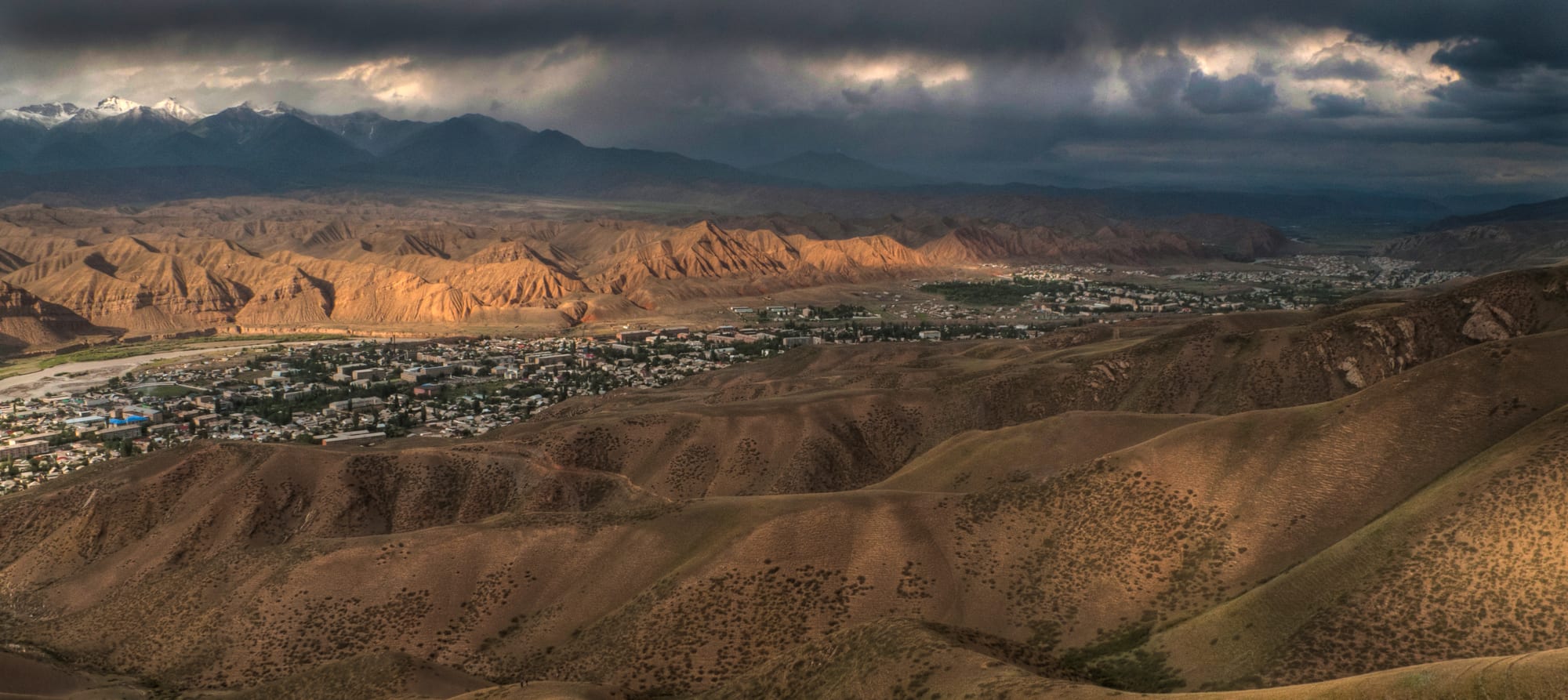
A town spread in a long strip along a river valley between bare brown hills, with snow-covered ranges and storm clouds beyond

Bishkek, Issyk-Kul & Naryn, Kyrgyzstan

Naryn

Naryn stretched along its valley, seen from the hills to the south. (Pmelton87 / Wikimedia Commons · CC BY-SA 4.0)

A long, narrow town strung for kilometres along the Naryn river in a bare valley at about 2,000 metres, the administrative centre of Kyrgyzstan's largest region. Founded as a Russian garrison on the caravan road to Kashgar, it is now a herding and university town and the usual base for Son-Kul and Tash Rabat.

Neighbourhoods

  • The central strip
    • First-time visitors
    • Close to public transport
    • Local life

    The administrative core around the main avenue, with the regional government building, the bazaar, the bus stand, guesthouses and most of the town's restaurants. Everything a visitor needs sits within a few hundred metres of the main road.

    Open in Maps
  • The university quarter
    • Students and cafés
    • Quiet and residential

    The eastern end of the town, where the University of Central Asia's campus stands above the river. It has brought students, staff and a handful of newer cafés to a town that had few before.

    Open in Maps
  • The riverside and the western approaches
    • Quiet and residential
    • Mountain views

    Single-storey houses with yards and vegetable plots run along both banks towards the road out to Kochkor and Bishkek, with the Naryn river and the bare ridges above it always in view.

    Open in Maps

Things to do

In and around the town

  • Naryn Riverattraction

    The river the town is built along, one of the main headwaters of the Syr Darya, running fast and grey-green through the valley.

    Open in Maps
  • University of Central Asialandmark

    A regional university founded by the governments of Kyrgyzstan, Tajikistan and Kazakhstan with the Aga Khan Development Network, whose first campus opened at Naryn in 2016.

    Open in Maps
  • Salkyn-Tör Nature Parkpark

    A protected valley of spruce and rocky gorges about 20 kilometres east of the town, set aside in 2001, and the closest place for a walk, a picnic or a short ride.

    Open in Maps
  • Naryn bazaarmarket

    The town market on the main street, selling meat, bread, dairy, felt goods and warm clothing for the long winter.

    Open in Maps

Short trips into the mountains

  • Son-Kulattraction

    A treeless alpine lake at about 3,000 metres, ringed in summer by herders' yurts and grazing horses, reached over rough passes north-west of the town.

    Open in Maps
  • Tash Rabatlandmark

    A well-preserved stone caravanserai with a domed central hall, set in a side valley off the road to the Torugart pass, dated to the 10th or the 15th century.

    Open in Maps
  • At-Bashyneighborhood

    The district town south-west of Naryn on the road towards China, with a large Sunday animal market and the turning for Tash Rabat.

    Open in Maps
  • Koshoy Korgonlandmark

    The mud-walled ramparts of a fortress of uncertain date on the At-Bashy plain, named after Qoshoy, one of the hero Manas's generals, with a small site museum.

    Open in Maps

Seasonal events

  • Nowruzlate March

    The spring new year, marked with communal cooking of the wheat pudding sumalak, horse games and concerts in the central square.

  • The move to the jailooJune

    Families across the region drive their herds up to the summer pastures, and yurt camps go up around Son-Kul and the high valleys until September.

  • Independence Day31 August

    The national day, marked in Naryn with horse games, wrestling and concerts.

Eat and drink

Long-standing places and food districts in Naryn. Hours, ratings and directions come from your maps app, always current.

Mountain classics

  • Beshbarmak and kuurdak canteensrestaurant

    Naryn is herding country and its cooking is meat-based: boiled mutton over flat noodles, and kuurdak of fried meat, offal and potato, served in the canteens along the main street.

    Open in Maps
  • Laghman and manty cafésrestaurant

    Hand-pulled noodles and steamed mutton dumplings are the everyday meals, usually with a pot of tea and a plate of boorsok on the table.

    Open in Maps

Markets and pastures

  • Naryn bazaarmarket

    Bread from tandyr ovens, kurut cheese balls, butter, honey and cuts of mutton and horsemeat, with cheap canteens along the edge of the market.

    Open in Maps
  • Yurt-camp meals at the summer pasturesrestaurant

    Herding families at Son-Kul and the jailoo feed guests on fresh bread, kaymak cream, boiled mutton and kymyz as part of a stay.

    Open in Maps

Experience Naryn

History

The valley has been a corridor for as long as people have crossed these mountains: the road from the Fergana valley to Kashgar runs through it, and caravans, armies and herders all used the Naryn river's course as the easiest line east. Kyrgyz clans grazed the high pastures around it, and the fortress ramparts at Koshoy Korgon on the At-Bashy plain, tied in local tradition to the epic of Manas, show that the plain was fortified long ago.

The town itself was founded by the Russian Empire as a garrison and customs post. A fort was established here on the caravan route in 1868, after the Kyrgyz tribes of the region came under Russian rule, to watch the caravan route and the approaches to the Chinese frontier. A small settlement of soldiers, officials and traders grew along the single road beside the river, hemmed in by the valley walls, which is why the town still stretches for kilometres and is barely a few streets deep. The 1916 revolt against conscription reached this region, and its suppression drove many families over the passes into China.

Under Soviet rule Naryn became the centre of an oblast covering the country's highest and emptiest country, with collective farms based on sheep and wool, apartment blocks, schools and a wool-processing industry. It was a closed border zone for much of that period. The end of subsidies after 1991 hit the region hard, and Naryn became known as one of the poorest parts of Kyrgyzstan. Since then the opening of the Torugart road to Chinese trade, a growth in trekking and yurt-stay tourism, and the opening of the University of Central Asia's campus in 2016 have given the town new roles.

Culture & Customs

Naryn Region is the most thoroughly Kyrgyz part of the country. Kyrgyz is the language of daily life, Russian is heard much less than in the north, and the population is overwhelmingly Kyrgyz and Muslim. The region is often described within Kyrgyzstan as the keeper of nomadic tradition, and it is a common source of musicians, manaschi reciters of the Manas epic, and wrestlers and horsemen who compete nationally.

Herding shapes the calendar and the manners that go with it. Families still move animals to the jailoo, the summer pastures, and set up yurts there from June to September, and the skills that support that life — felt-making, saddlery, dairying, breaking horses — remain ordinary rather than nostalgic. Naryn is known for shyrdak and ala-kiyiz felt carpets, worked in bold cut-out patterns by women's co-operatives that now sell to visitors as well as locally. Horse games are taken seriously: kok-boru matches, races and displays of horseback wrestling fill holidays.

Hospitality here follows older rules than in the cities. A guest is fed whatever the household has, refusing outright is an insult, and the seat of honour opposite the door of a yurt belongs to the eldest or the visitor. The threshold and the hearth are not stepped over. Conservative dress is usual, alcohol is less visible than in Bishkek, and the extended family, with its obligations at weddings, funerals and memorial feasts, is the centre of social life.

Daily Life

About 40,000 people live in Naryn, which makes it a small town spread very thin: houses with yards, Soviet apartment blocks and public buildings line a single avenue for several kilometres between the river and the hills. Water, heating and road repair are perennial municipal problems, and coal smoke settles over the valley on still winter days.

Livestock is the economy. Sheep, horses, yaks and cattle from the surrounding pastures supply meat, wool and dairy, and trade in animals at the district markets is the main source of household cash. Public-sector work — administration, schools, the hospital — employs much of the rest, alongside transport and trade on the Torugart road to China and, since 2016, the university. Tourism is a growing seasonal earner through guesthouses, drivers, guides and yurt camps. Money sent home by relatives working in Russia and Kazakhstan matters here as much as anywhere in the country, and outward migration of young people is the region's long-running problem.

The year is organised around the animals: lambing in spring, the drive up to the jailoo in June, haymaking through the summer, and the return before the first snow, which can fall in September. Winter is long, dark and very cold, and households lay in coal, flour and meat for it. Daily life is early and unhurried, the bazaar is the social centre as much as the commercial one, and the arrival of students has slightly changed the rhythm of the eastern end of town.

Food

Naryn eats the food of herders. Mutton, horsemeat, yak and dairy dominate, and vegetables are fewer than in the valleys below. Beshbarmak, the national dish, is made here for every important occasion: mutton or horsemeat boiled and shredded over broad flat noodles, moistened with the cooking broth and onion, eaten with the hands. Chuchuk, a sausage of horsemeat and fat, is served in slices at feasts, and kuurdak, fried meat, offal and potato, is an everyday dish.

Dairy from the summer pastures is central. Kymyz, fermented mare's milk, is drunk in quantity from about May to August and is regarded locally as a cure as much as a drink; kaymak, a thick clotted cream, is spread on bread; ayran and suzma thicken soups; and kurut, hard salt-dried balls of strained yoghurt, keep for a winter and are eaten as a snack or crumbled into broth. Yak's milk and meat appear in the higher valleys.

Bread is baked in tandyr ovens and in pans, and boorsok, small squares of fried dough, are piled in the middle of any table set for guests, often with honey from the gorges. Laghman and manty are the reliable restaurant meals, and shorpo, a plain mutton and potato soup, is the standard lunch. Tea, green or black and sometimes with milk and salt, accompanies everything and is poured in small amounts as a sign of attentiveness.

Planning tools

Budget

Naryn is inexpensive even by Kyrgyz standards, with simple guesthouses and homestays, cheap canteens and a small bazaar. The real spending is on transport: the roads to Son-Kul and Tash Rabat need a hired vehicle or a horse, and those trips cost more than several nights in the town itself.

Daily Budget Midrange
USD 55–110 (guesthouse or small hotel, restaurant meals, a shared driver to Son-Kul or Tash Rabat, or a horse trek with a yurt stay)
Daily Budget Shoestring
USD 20–35 (homestay bed, canteen meals, shared minibuses)

Arrange mountain trips through a guesthouse or a community-based tourism office and share the cost of the vehicle; carry enough cash, as card payment is unreliable outside the town.

Best Time to Visit

Late June to early September, when the passes are clear, the yurt camps at Son-Kul are up and the high pastures are green. May and late September are cold at night but quiet and clear in the valleys. From October to April the region is deep in winter, the high roads close with snow, and Son-Kul is effectively out of reach.

Suggested Number of Days

The town itself is a short stop, and most visitors stay one night. Three or four days allow the high lake, the caravanserai and the valleys around them, with the number depending on the weather and on whether the travel is done by vehicle or on horseback.

First Visit
1 day
With Surroundings
3–4 days

Transportation

Shared taxis and minibuses run to Bishkek in roughly six hours by way of Kochkor and the Dolon pass, and south-west to At-Bashy and the villages along the road towards the Torugart pass. The town is long and thin, so local minibuses run its length along the main avenue. Son-Kul, Tash Rabat and the pastures need a hired four-wheel-drive, a driver or horses.

Transport thins out sharply in the afternoon and in winter; agree the price of a hired vehicle before setting off, and allow for weather closing the passes.

Airport & Station Connections

Almost everyone arrives by road. Shared taxis and minibuses leave Bishkek's eastern bus station for Naryn, about six hours away over the Dolon pass, and the same road carries traffic on towards the Torugart crossing into China. Travellers coming from Issyk-Kul change at Kochkor. There is no passenger rail, and the airport regained a scheduled flight from Bishkek in September 2025, after twelve years without one.

Walkability

The centre is flat and small enough to cross on foot in twenty minutes, but the town as a whole is strung out for several kilometres along one avenue, so a minibus or taxi saves time between the ends. Altitude makes walking harder work than the gentle gradients suggest, and pavements are icy for much of the winter.

Safety

Naryn is quiet, with little crime beyond occasional petty theft, and visitors are uncommon enough to attract friendly curiosity. The real risks are environmental: altitude at Son-Kul and on the passes, severe cold and sudden snow even in summer, long unlit drives on rough roads, and shepherds' dogs in the pastures. The Torugart pass beyond At-Bashy is a controlled border crossing into China with its own rules.

Carry warm layers and a sleeping bag liner for nights above 3,000 metres, tell a guesthouse the planned route, do not count on a mobile signal in the valleys, and check road conditions before crossing a pass. Check current official travel advice before travelling.

Climate

A severe continental climate at high altitude, with a short warm season and a long, hard winter. The valley is dry, the air is thin, and the swing between day and night temperatures is large in every month.

Summer
warm days and cold nights — July days usually around 22–26°C, often dropping close to freezing after dark in the high pastures
Winter
long and very cold — January averages well below -15°C, with night frosts below -25°C and snow lying for months

Local Customs

Naryn Region is among the most traditional and most strongly Kyrgyz parts of the country, and Kyrgyz is the everyday language, with less Russian spoken than in Bishkek. Hospitality is close to obligatory: a guest is fed, tea is poured in small amounts so the cup can be refilled, and elders are greeted and served first. Shoes come off at the door of a house or a yurt, and bread is never placed face down.

Dress modestly, accept at least some of what a host offers, ask before photographing people or inside a yurt, step around rather than over the threshold and the hearth, and bring a small gift for a homestay family. Tipping is not expected.

Common Payment Methods

The currency is the Kyrgyzstani som. There are ATMs and bank branches in the centre, and some shops and hotels accept cards or QR payment, but yurt stays, drivers, horsemen, homestays and the bazaar work in cash only. Draw what is needed before heading into the mountains, where there is nothing.