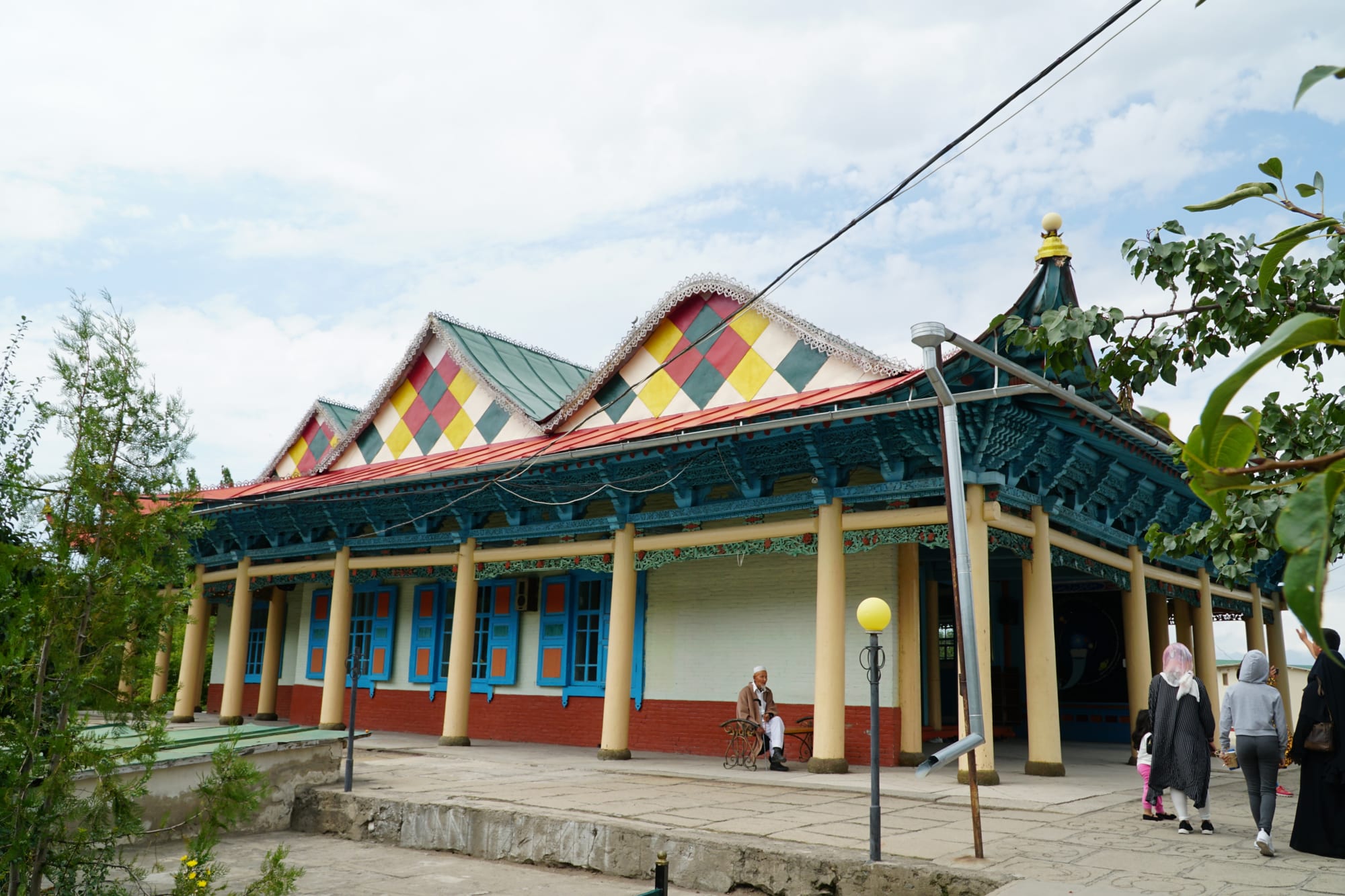
A low wooden mosque with three brightly painted gables in red, yellow and green, carved eaves and a colonnade of yellow pillars

Bishkek, Issyk-Kul & Naryn, Kyrgyzstan

Karakol

The Dungan Mosque in Karakol, built by Chinese craftsmen in the style of a temple. (Adam Harangozó / Wikimedia Commons · CC BY-SA 4.0)

A low-built town of tree-lined streets near the eastern end of Lake Issyk-Kul, where the Tian Shan closes in. Founded in 1869 as a Russian garrison and settled afterwards by Dungan and Uyghur Muslims, it keeps a wooden Orthodox cathedral and a mosque built like a Chinese temple, and serves as Kyrgyzstan's main base for trekking and skiing.

Neighbourhoods

  • The old Russian grid
    • First-time visitors
    • Historic district
    • Close to public transport

    The centre laid out by the garrison surveyors, a flat grid of wide streets with irrigation channels, poplars and single-storey wooden houses with carved window frames. The cathedral, the mosque, the museums, the guesthouses and most restaurants are within a few blocks of each other.

    Open in Maps
  • Around the bazaar and bus station
    • Markets
    • Local life
    • Best for food

    The town's working quarter to the north-west, where the covered market, the animal market and the minibus stands cluster. Sunday morning is the busiest time, when herders bring sheep, horses and cattle in from the villages.

    Open in Maps
  • The southern approaches and the ski road
    • Mountain views
    • Quiet and residential

    Newer houses and guesthouses on the rising ground where the town runs out towards the Karakol gorge. The road south leads to the ski base and the trailheads, and the mountains fill the view from almost every street.

    Open in Maps

Things to do

Landmarks and museums

  • Dungan Mosquelandmark

    A wooden mosque built between 1904 and 1910 without nails, by a Beijing architect and Chinese craftsmen working for the Dungan community, painted in red, green and yellow and shaped like a Chinese temple.

    Open in Maps
  • Holy Trinity Cathedrallandmark

    A Russian Orthodox church built in wood between 1894 and 1895, replacing the garrison's brick church, which an earthquake destroyed in 1889.

    Open in Maps
  • Przhevalsky Memorial Museummuseum

    A memorial park, grave and small museum at Pristan'-Przheval'sk about nine kilometres north of town, overlooking the lake, devoted to the Russian explorer who died here in 1888 and after whom the town was long named.

    Open in Maps
  • Karakol animal marketmarket

    A livestock bazaar held on Sunday mornings on the edge of town, where sheep, horses and cattle are traded much as they have been for generations.

    Open in Maps

Short trips into the mountains

  • Altyn-Arashantrail

    A high valley of hot springs and summer pastures reached by a rough track east of town, a long day's walk or a jolting drive.

    Open in Maps
  • Ala-Kultrail

    A turquoise glacial lake at about 3,500 metres, the goal of the best-known multi-day trek in the country, crossed by a high pass above Karakol.

    Open in Maps
  • Karakol Ski Baseattraction

    Central Asia's highest ski resort, with about 20 kilometres of slopes on the forested mountainside some twenty minutes above town, and a season running roughly from December to March.

    Open in Maps

Short trips around the lake

  • Jeti-Ögüzlandmark

    The Seven Bulls, a line of red conglomerate cliffs at the mouth of a green valley south-west of Karakol, with the split Broken Heart rock beside them.

    Open in Maps
  • Lake Issyk-Kulattraction

    The great saline mountain lake whose eastern shore lies a short drive from town, with quiet beaches and reed beds rather than resorts at this end.

    Open in Maps

Seasonal events

  • Nowruzlate March

    The spring new year, marked with public concerts, horse games and communal cooking of the wheat pudding sumalak.

  • Independence Day31 August

    Kyrgyzstan's national day, when the town holds concerts and sports in the central square and park.

Eat and drink

Long-standing places and food districts in Karakol. Hours, ratings and directions come from your maps app, always current.

Karakol classics

  • Ashlan-fu stallsrestaurant

    The town's signature dish, a cold and sharply vinegary Dungan noodle soup with starch jelly and chilli, sold from a row of stalls near the market and usually eaten with a fried potato pastry.

    Open in Maps
  • Dungan family dinnersrestaurant

    Several households in and around Karakol cook multi-course Dungan meals for visitors, with cold salads, noodles and mutton dishes served in sequence.

    Open in Maps

Markets and streets

  • Karakol bazaarmarket

    The covered market in the north-west of town, with bread, honey, apricots, kurut cheese balls, Korean salads and pickles, and cheap canteens along its edges.

    Open in Maps
  • The central streetsneighborhood

    Cafés, shashlik grills and Kyrgyz and Uyghur dining halls are spread across the grid around the main square, with several catering to trekkers.

    Open in Maps

Experience Karakol

History

Karakol was founded on 1 July 1869 as a Russian military and administrative post in newly annexed territory, on a site chosen where the Karakol river leaves the mountains near the eastern end of Lake Issyk-Kul. Surveyors laid the streets on a grid with water channels along them, and settlers from Russia and Ukraine built single-storey wooden houses with carved frames, many of which still stand. A caravan road to Kashgar crossed the passes behind the town, and Karakol became a supply point for expeditions into the Tian Shan.

Two waves of migration shaped it. Dungans — Chinese-speaking Muslims — fled the Qing empire after the failure of a revolt and settled in and around the town from the 1880s, followed by Uyghur families; between 1904 and 1910 a Beijing architect and Chinese craftsmen built the wooden mosque that is now the town's emblem. After an earthquake destroyed an earlier brick church, the Orthodox community rebuilt its cathedral in wood in 1895. The explorer Nikolai Przhevalsky died at Karakol in 1888 while preparing an expedition to Tibet, and was buried above the lake; the town was renamed Przhevalsk in 1889. It recovered its old name in 1921, was renamed Przhevalsk again in 1939, and became Karakol once more in 1991.

In Soviet times it was a closed regional centre with light industry, a military presence on the lake and a sanatorium economy along the shore. Those factories largely closed after independence, and the town turned instead to what surrounds it: the trekking valleys, the hot springs, the ski slopes and the lake, which have made it the centre of mountain tourism in Kyrgyzstan.

Culture & Customs

The town is a study in coexistence. A Russian Orthodox cathedral of wood and a mosque built like a Chinese temple stand a short walk apart, and Kyrgyz, Russian, Dungan, Uyghur, Kazakh and Tatar families share the same streets. Russian remains the common language between communities, while Kyrgyz dominates in the villages around. Orthodox Easter and the Muslim holidays are both visible in the town's calendar, and mixed neighbourhoods mean neighbours attend one another's weddings and funerals.

Dungan culture is the most distinctive strand. Brought from north-west China in the nineteenth century, it survives in a spoken dialect of Mandarin written in Cyrillic, in elaborate weddings with dozens of dishes served in strict order, and in a cuisine unlike anything else in Central Asia. Uyghur families contribute their own music and food. Kyrgyz tradition is strongest in the valleys above the town, where families still move animals to summer pastures and where felt-making, horse games and the epic of Manas remain part of ordinary life.

Since independence Karakol has also become an outdoor town. Mountain guides, ski instructors, horsemen and guesthouse families make up a large part of the working population, and community-based tourism organisations have given herding families a stake in it. Hospitality follows Kyrgyz rules: a guest is fed first, tea is poured in small amounts as a sign that it will be refilled, and elders are served and greeted before anyone else.

Daily Life

About 85,000 people live in Karakol, making it the largest town of Issyk-Kul Region and its administrative centre. The population is mixed and the town is low-built, with most families in single-storey houses on large plots where fruit trees, potatoes and a cow or a few sheep supplement wages. Soviet apartment blocks stand in a few districts, and new guesthouses have gone up along the roads towards the mountains.

The economy rests on agriculture, public administration, trade and tourism. The lake shore produces apricots, apples and honey; the surrounding valleys are grazing country; and the Kumtor gold mine in the mountains to the south is the region's largest industrial employer, drawing workers on rotation from the town. Summer trekking and winter skiing now support hundreds of households directly, and remittances from relatives working in Russia and Kazakhstan reach many more.

Days begin early, with the bazaar busy soon after dawn and the animal market filling the edge of town on Sunday mornings. School, work and errands are done by mid-afternoon, and evenings are spent at home or in the parks. The seasons govern everything: the move of herds to the jailoo in June, the harvest and preserving in late summer, and a long winter when the snow closes the high roads and coal smoke hangs over the streets. Emigration of young people to Bishkek and abroad is a constant concern, as is pressure on the lake from unregulated building.

Food

Karakol's best-known dish is ashlan-fu, a cold, sour noodle soup that belongs to the Dungan kitchen: wheat noodles and squares of firm starch jelly in a vinegary, chilli-spiked broth, eaten with a flat fried potato pastry on the side. It is a market food, sold from stalls by women who have made nothing else for years, and it has spread from Karakol across the country.

Dungan cooking goes far beyond it. A formal Dungan meal runs to a long sequence of small dishes — cold salads of shredded vegetables dressed with vinegar and garlic, funchoza noodles, fried mutton with peppers, dumplings and soups — and several families in town serve such meals to visitors in their homes. Uyghur laghman, hand pulled and either fried or in broth, is the other staple, alongside manty, samsa baked on tandyr walls and shashlik grilled over charcoal.

Kyrgyz food appears at celebrations and in the valleys: beshbarmak, boiled meat shredded over flat noodles with onion broth; kuurdak, fried offal and meat with potatoes; boorsok, fried dough squares heaped on the table; and kymyz, fermented mare's milk, drunk in the summer pastures above town. The bazaar sells kurut, hard salty balls of dried yoghurt, mountain honey, apricots and Korean-style salads left by the deportations of 1937. Tea, green and salted or with milk, accompanies everything.

Planning tools

Budget

Karakol is one of the cheapest bases in Kyrgyzstan. Guesthouses and homestays are plentiful, meals cost very little, and the real expenses are guides, horses, a hired driver to the trailheads, and ski passes and hire in winter.

Daily Budget Midrange
USD 55–110 (guesthouse or small hotel, restaurant meals, a driver or a day with a guide and horses)
Daily Budget Shoestring
USD 25–40 (homestay or hostel bed, bazaar and canteen meals, shared minibuses)

Trekking permits are not needed for the main valleys, but a guide, a horse or a transfer to the trailhead is worth budgeting for; carry enough cash for the mountains.

Best Time to Visit

Late June to mid-September is the trekking season, when the high passes to Ala-Kul are clear of snow and the yurt camps are up. May and early October suit the town itself and the lower valleys. From December to March the ski base draws visitors, and the lake shore stays milder than the interior.

Suggested Number of Days

Two days are enough for the town's buildings, museums and markets. Four to six allow the valleys and hot springs around it, and longer if a multi-day trek or a ski trip is part of the plan. Weather in the mountains often dictates the length of a stay.

First Visit
2 days
With Surroundings
4–6 days

Transportation

Shared minibuses and taxis link Karakol with Bishkek by either the north or the south shore of the lake, taking roughly six to seven hours, and with Cholpon-Ata, Balykchy and the villages of the eastern shore. Within town, marshrutkas run along the main streets and taxis are cheap. Reaching the trailheads, the ski base and Altyn-Arashan needs a hired car, a share taxi or a high-clearance vehicle.

Transport to the mountain valleys is easiest to arrange through a guesthouse or a community-based tourism office in town; roads to the high valleys can close with early snow.

Airport & Station Connections

Most visitors arrive by road from Bishkek, about 400 kilometres away, by shared taxi or minibus from the capital's eastern bus station. Karakol's own international airport, about 2.5 kilometres north-east of the town, reopened after reconstruction in December 2024 and has scheduled flights to Bishkek and Osh, while Issyk-Kul International Airport at Tamchy serves the north shore. Overland travellers also come from Kazakhstan and, when open, over the Tian Shan passes.

Walkability

The centre is flat and gridded, and almost everything a visitor wants is within a twenty-minute walk, with the cathedral and the mosque about a kilometre apart. Streets are wide, shaded by poplars and lined with irrigation channels, though pavements are uneven and unlit in places and turn to mud after rain or a thaw.

Safety

The town is quiet and safe, with petty theft the main risk in the bazaar and on crowded minibuses. The real hazards lie in the mountains above it: altitude on the Ala-Kul pass, sudden storms and snow even in summer, fast river crossings, and unbridged tracks. Shepherds' dogs guard flocks in the valleys and should be given a wide berth.

Tell a guesthouse the route and expected return before a trek, take warm layers for nights above 3,000 metres, do not rely on a mobile signal in the valleys, and consider a guide for Ala-Kul. Check current official travel advice before travelling.

Climate

A continental mountain climate softened by the lake, at about 1,700 metres. Summers are warm rather than hot and often bring afternoon rain; winters are cold but milder than in the interior valleys, and snow lies for months on the slopes above town.

Summer
warm and changeable — July days usually around 22–26°C, with cool nights and frequent afternoon showers
Winter
cold and snowy — January averages roughly -6°C, with sharper frosts at night and reliable snow on the ski slopes

Local Customs

Karakol is a mixed town of Kyrgyz, Russians, Dungans, Uyghurs and Kazakhs, and both Kyrgyz and Russian are spoken everywhere. Shoes come off at the door of a home or a yurt, guests are fed generously and bread is handled with care. Modest dress is expected at the mosque and the cathedral, and women cover their heads inside both.

Ask before photographing people at the animal market or inside religious buildings, accept at least a little of what a host offers, and greet elders first. Tipping is not expected, though rounding up is common.

Common Payment Methods

The currency is the Kyrgyzstani som. Larger hotels, supermarkets and some restaurants take cards and QR payments, but guesthouses, the bazaar, minibuses, guides and horse hire are cash businesses. There are ATMs in the centre, and it is worth drawing enough before heading into the valleys, where there are none.