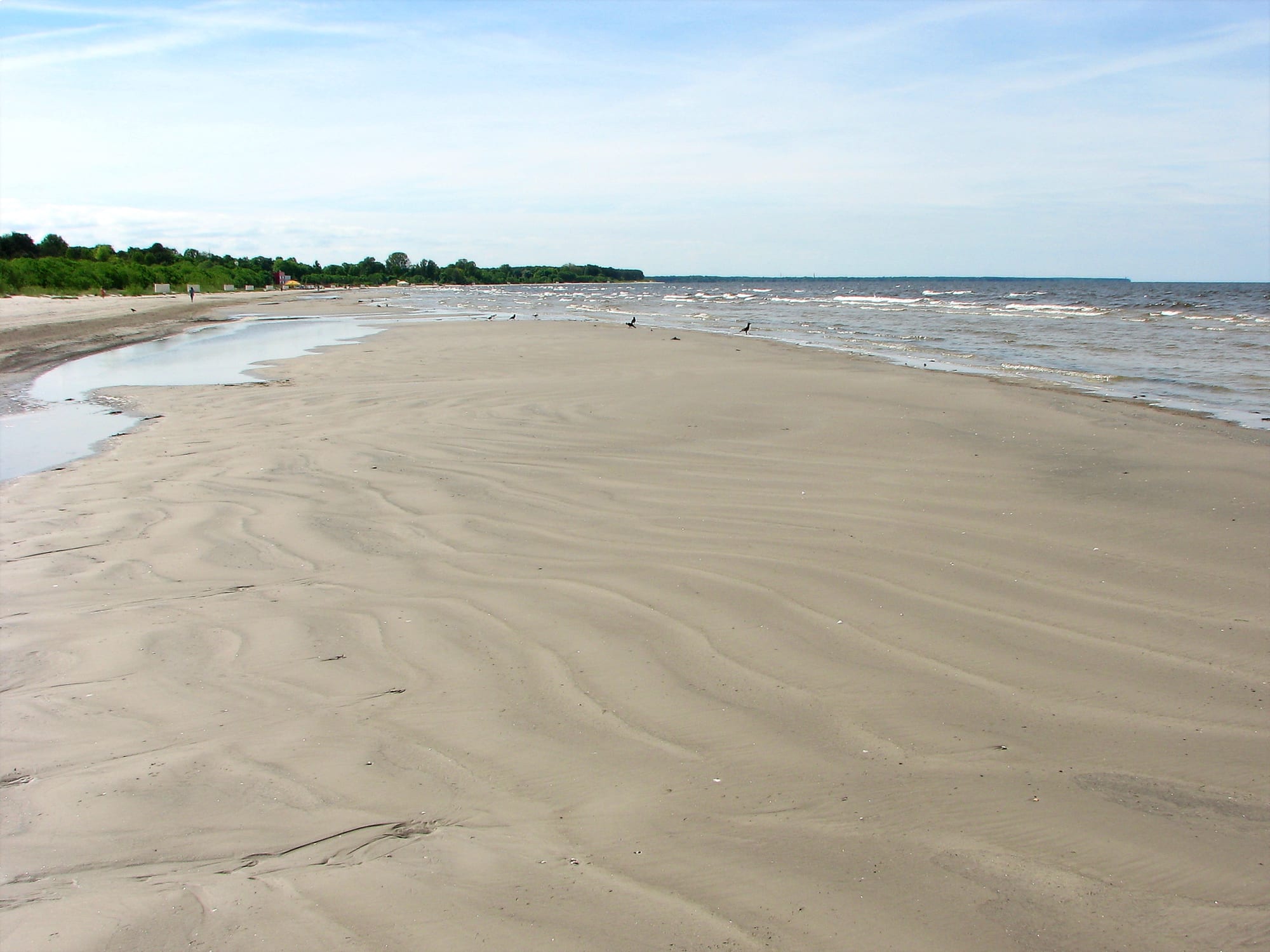
A wide, empty beach of rippled pale sand beside the grey-blue Gulf of Riga, with a line of green trees along the shore

Riga & Western Latvia, Latvia

Jūrmala

The long sandy beach at Jūrmala on the Gulf of Riga. (Егор Журавлёв from Smarde, Latvia / Wikimedia Commons · CC BY-SA 2.0)

A resort city about 25 km west of Riga, strung for over 30 km along a strip of land between the Gulf of Riga and the Lielupe River. A chain of small resorts joined by the railway, it grew on sea air, mineral springs and mud baths, and keeps a white-sand beach, pine woods and thousands of wooden buildings.

Neighbourhoods

  • Majori
    • First-time visitors
    • Beaches
    • Best for food

    The central district, with a Blue Flag beach, spa hotels and historic Art Nouveau wooden summer houses. The pedestrian Jomas iela runs through it, lined with craft shops and restaurants, and Majori station is the most central stop on the line from Riga.

    Open in Maps
  • Dzintari and Bulduri
    • Concerts
    • Quiet and residential
    • Beaches

    Two residential neighbourhoods east of Majori. Dzintari, called Edinburgh until 1922, has the Dzintari concert hall and a forest park of old pines; Bulduri, once known as Bilderlingshof, has a Blue Flag beach and, to its east, the open-air museum of fishing life.

    Open in Maps
  • Dubulti
    • Historic district
    • Close to public transport

    The administrative centre and oldest part of Jūrmala, beside the Lielupe. Its Lutheran church of 1907–09, an Orthodox church of around 1860 and the Modernist concrete shell of Dubulti Station stand close together.

    Open in Maps
  • Ķemeri
    • Spa history
    • Nature

    The western resort, a separate town from 1928 to 1959, famous for sulphur springs, healing mud baths and grand interwar buildings. It sits on the edge of Ķemeri National Park, with forest and bog all around.

    Open in Maps
  • Kauguri
    • Local life
    • Quiet beaches

    A western neighbourhood with the town's largest concentration of Soviet-built high-rise apartment blocks, where much of the year-round population lives, a long way from the summer crowds of Majori.

    Open in Maps

Things to do

Beaches and the seafront

  • Majori beachbeach

    The central stretch of the 33 km beach of white quartz sand, flying the Blue Flag, with beach cafés and water bicycles in summer.

    Open in Maps
  • Pumpuri beachbeach

    The part of the shore used for kite surfing and windsurfing.

    Open in Maps
  • Jomas ielaneighborhood

    One of the oldest and most central streets in Jūrmala, a pedestrian street of shops and restaurants running parallel to the beach through Majori.

    Open in Maps

Museums and landmarks

  • Jūrmala Open Air Museummuseum

    A 19th-century coastal fishing homestead east of Bulduri, with family house, barn, fish smokehouse and sauna, celebrating the coast's fishing heritage.

    Open in Maps
  • Jūrmala City Museummuseum

    The history of the resorts in Majori, with collections of historic swimwear, old postcards, paintings and finds from underwater archaeology.

    Open in Maps
  • Dubulti Stationlandmark

    A railway station on the narrow isthmus between the Lielupe and the sea, an example of sculptural concrete-shell Modernist architecture.

    Open in Maps
  • Dzintari Forest Parkpark

    A park among pine groves around 200 years old near the centre, with a 33.5-metre watchtower whose platform looks out as far as Riga.

    Open in Maps
  • Līvu Akvaparksattraction

    The largest indoor water park in the Baltic states, beside the Lielupe, with about 20 slides, a wave pool and saunas.

    Open in Maps

Short trips from the town

  • Ķemeri resortattraction

    The western resort founded in 1838 around sulphur springs, famous for its mud baths and sulphur-water treatments, on the edge of Ķemeri National Park.

    Open in Maps
  • Ķemeri National Parkpark

    Latvia's third-largest national park, founded in 1997 and mostly forest and mire, with boardwalk loops of 1.4 km and 3.4 km across the Great Ķemeri Bog.

    Open in Maps

Seasonal events

  • Jomas Street FestivalJuly

    A traditional midsummer street festival along Jūrmala's central pedestrian street.

  • Fishermen's FestivalJuly

    A summer festival celebrating the coast's fishing traditions.

  • Rendezvoussummer

    An international music festival organised by the singer Laima Vaikule at the Dzintari concert hall since 2015.

Eat and drink

Long-standing places and food districts in Jūrmala. Hours, ratings and directions come from your maps app, always current.

Food districts

  • Jomas ielaneighborhood

    The town's main pedestrian street, where most of its restaurants and cafés are concentrated, a short walk from the beach at Majori.

    Open in Maps
  • Beach cafés of Majori and Buldurineighborhood

    Beach cafés at the two Blue Flag beaches, Majori and Bulduri.

    Open in Maps

Experience Jūrmala

History

Jūrmala began as a string of fishing villages on the sandy strip between the Gulf of Riga and the Lielupe. Its life as a resort started in the late 18th and early 19th centuries, when wealthy landowners began spending summers by the sea and Russian army officers came to rest after the Napoleonic Wars, returning later with their families. In German the shore was known as the Rigasche Strand and advertised as part of the Baltic Riviera. At Ķemeri, mineral springs known for their curative properties from 1796 led to the founding of a spa resort in 1838.

The opening of the Riga–Tukums railway in 1877, which still runs through the town, brought a great increase in visitors. Villas, guesthouses and sanatoriums spread along the line, drawing on the sea breeze, the pine woods, the mineral springs and the mud baths. A Jewish community formed in Bulduri, Dubulti and Majori from the late 19th century; in July 1941, shortly after the German invasion, the Bulduri synagogue was set on fire with people inside.

In 1959 the resorts were separated from Riga and merged with Sloka and Ķemeri to form the City of Jūrmala. In the Soviet decades it was a favourite holiday place for senior Communist Party officials, among them Brezhnev and Khrushchev, and holidays here were handed out as rewards; concrete hotels and high-rise blocks went up beside the wooden villas. After 1991 some of the Soviet buildings fell into disrepair, while restored villas, spas and summer festivals brought visitors back.

Culture & Customs

The town's identity is its architecture: wooden houses from the 19th and first half of the 20th century, many in Art Nouveau style, built mostly by Baltic German and Latvian architects. Jūrmala has an official list of 414 protected historical buildings and more than 4,000 wooden structures, and a few railway stations, among them Lielupe, Pumpuri, Melluži, Vaivari and Sloka, keep their old wooden buildings.

Music fills the summer. The Dzintari concert hall, which grew from an outdoor stage of 1878 and gained an indoor hall in 1936, hosts concerts through the season, and since 2015 the singer Laima Vaikule has organised the Rendezvous festival there. From the early 2000s the town hosted New Wave, a contest for young pop singers; in July the Jomas Street Festival and the Fishermen's Festival are the traditional highlights.

Sport follows the water and the sand: beach football and volleyball at Dubulti and Dzintari, kite surfing and windsurfing at Pumpuri, and rowing, sailing and waterskiing on the Lielupe. The Baltic Open, a WTA tennis tournament, was played at Lielupe in July 2019. Many Russian celebrities and businessmen have bought houses near the beach, and the summer festivals draw larger crowds each year.

Daily Life

About 52,000 people lived in Jūrmala in 2024, making it Latvia's fifth-largest city. The population rose quickly after the Second World War with the building of apartment blocks in Kauguri and Dubulti, reached 61,000 in 1979, and has since fallen with low birth rates and emigration. Kauguri, in the west, has the town's largest concentration of Soviet-era high-rise blocks, while the eastern districts are mostly wooden houses and villas among the pines.

The economy is tourism and health: hotels, spas, sanatoriums, restaurants and the summer trade on Jomas iela. The town's rhythm follows the seasons sharply. In July and August the beaches, trains and streets are full and residents of Riga arrive for weekends; in winter many summer houses stand empty, in some winters the gulf freezes over, and life shrinks to the year-round neighbourhoods. The beach stays in use all year: it is equipped with playgrounds, benches, football pitches and volleyball courts, walkers look for pieces of amber washed up in spring and autumn, and in January 2012 the town hosted the Winter Swimming World Championships.

Food

Jūrmala grew from fishing villages, and smoked fish belongs to that coastal heritage. The open-air museum's fishing homestead keeps a fish smokehouse beside the house and sauna, and smoked fish goes with dark rye bread, rupjmaize, made from coarse rye flour, malt and caraway seeds.

The cafés and restaurants of Jomas iela and the beach serve the usual Latvian repertoire. Cottage cheese, biezpiens, comes with boiled potatoes, lightly salted herring, spring onions and sour cream; potato pancakes are served with smoked salmon and sour cream; and in summer cold borscht, made with kefir or soured milk, boiled beets, cucumber, radish, egg and herbs, is a favourite on warm days. Speķrauši, buns filled with finely cut streaky bacon and onion, are a popular Latvian pastry.

Beer is the most consumed alcoholic drink in Latvia, with a growing craft scene, and kvass, brewed from fermented rye bread, remains popular. Riga Black Balsam, a bitter herbal liqueur, is often called the national drink.

Planning tools

Budget

Jūrmala is one of the most expensive places in Latvia in July and August, when seaside rooms fill and prices rise, especially on weekends and during festivals. Out of season the same rooms cost much less. A day trip by train from Riga keeps costs close to the capital's.

Daily Budget Midrange
USD 120–230 (spa or mid-range hotel, restaurant meals on Jomas iela, water park or spa tickets)
Daily Budget Shoestring
USD 55–90 (guesthouse room or a day trip from Riga, cafés and picnics, suburban trains)

Book summer weekends well ahead, or stay in Riga and come for the day by train.

Best Time to Visit

June to August is beach season, with the festivals, the concerts at Dzintari and the longest days. May and September are quieter and good for walking in the pines and in Ķemeri National Park. In some winters most or all of the Gulf of Riga freezes over.

Suggested Number of Days

Many visitors come for a single day by train from Riga. One or two nights allow time for the beach and the old wooden streets; three or four suit a seaside holiday that includes the national park. Summer weather decides much of the length of a stay.

First Visit
1–2 days
With Surroundings
3–4 days

Transportation

Suburban trains on the Riga–Tukums line stop at thirteen stations across the town, from Priedaine and Lielupe in the east to Sloka and Ķemeri in the west; ten of them are within easy walking distance of the beach. Local buses fill the gaps, and cycling along the flat streets parallel to the sea is easy in summer.

Majori is the station for the centre; the town is long, so the nearest station to each address is worth checking in advance.

Airport & Station Connections

Trains leave Riga Central Station roughly every half hour and take about 30 minutes to Majori. Riga International Airport is about 18 km from central Jūrmala. Drivers reach the centre over the Lielupe on the road from Riga, and non-residents pay a toll to enter the town.

Walkability

Majori, Dzintari and Dubulti are easy on foot, with Jomas iela, the beach and the pine woods close together, and the flat beach itself makes a long walking route. The town stretches for more than 30 km, so the train or a bicycle is needed to move between distant districts.

Safety

Latvia is a safe country with low levels of violent crime. In Jūrmala the main risks are natural ones: rip currents and cold water on the open Baltic beaches and ticks in the coastal forests.

Swim at supervised beaches and check for ticks after walks in the pines and the national park. Check current official travel advice before travelling.

Climate

A cool coastal climate on the border between oceanic and humid continental, moderated by the Baltic. Summers are mild, winters cold and grey, and the sea breeze keeps the shore cooler than inland on warm days.

Summer
mild — in nearby Riga summer averages around 18°C, with the hottest days above 30°C
Winter
cold — in nearby Riga January and February average about −2°C, and in some winters the gulf freezes over

Local Customs

Tipping is modest: rounding up or adding around 5–10 per cent is usual but not required. Latvian and Russian are both widely heard, and English is common in places that serve visitors.

Check the bill for a service charge before tipping, and keep to marked paths in the national park's bogs.

Common Payment Methods

The currency is the euro. Cards are widely accepted.