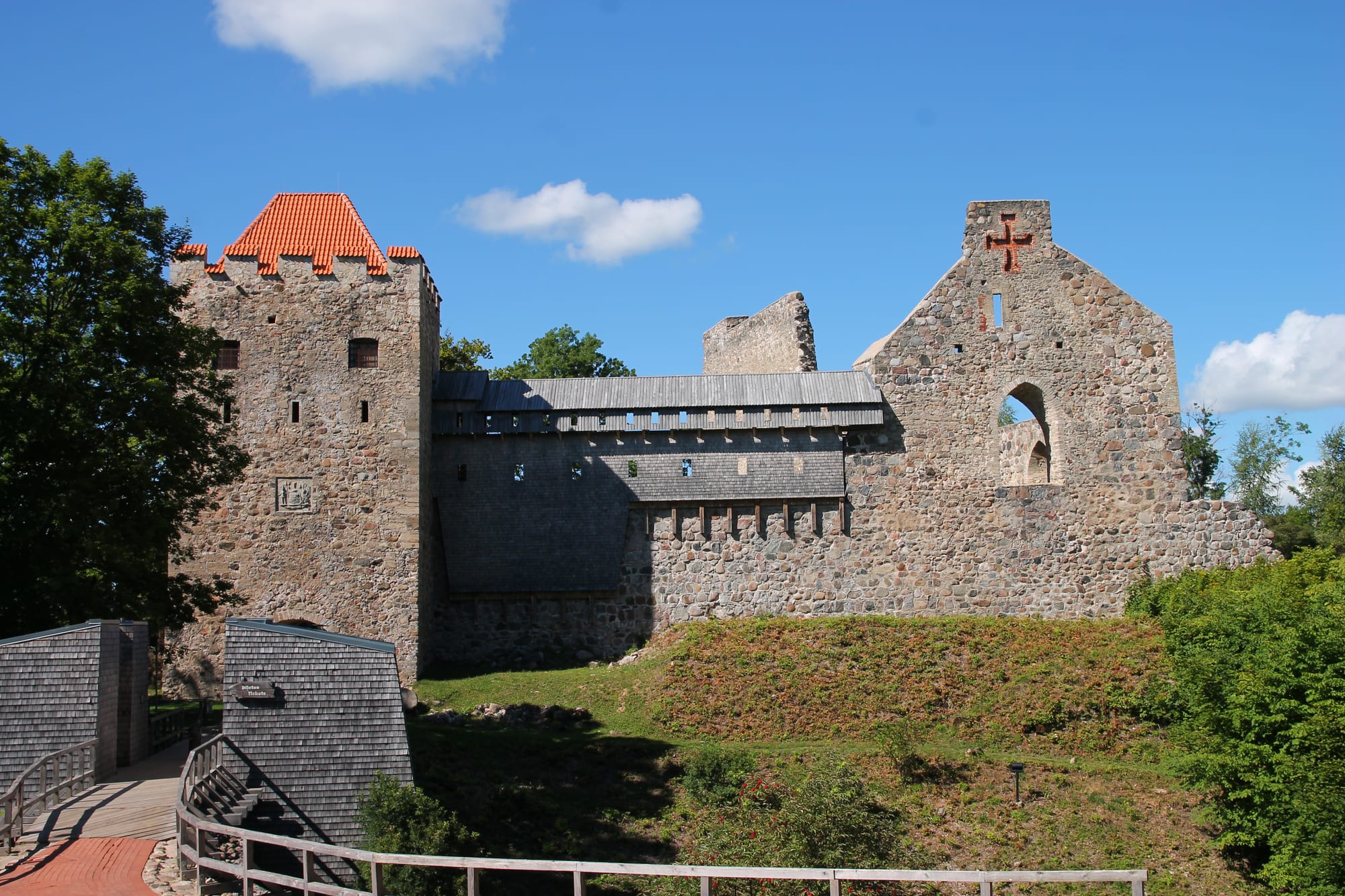
Stone walls and a red-roofed gate tower of Sigulda's medieval castle ruins under a blue sky, with a wooden walkway in front

Riga & Western Latvia, Latvia

Sigulda

The ruins of Sigulda Medieval Castle, built by the Livonian Brothers of the Sword from 1207. (Draceane / Wikimedia Commons · CC BY-SA 4.0)

A small town on the edge of the Gauja valley, about 50 km north-east of Riga, with its surroundings inside Gauja National Park. Its red Devonian sandstone cliffs and caves earned it the name 'Switzerland of Vidzeme'; crusader castles at Sigulda and Turaida, a cable car over the river and a bobsleigh track make it one of Latvia's important tourist centres.

Neighbourhoods

  • Sigulda town centre
    • First-time visitors
    • Close to public transport

    The town on the plateau above the south side of the valley, around the railway station, which was rebuilt in 2012 and also houses the tourist information centre. The medieval castle ruins and the Neo-Gothic New Castle stand at its edge, above the drop to the Gauja.

    Open in Maps
  • Turaida
    • Historic district
    • Views

    The ancient Livonian centre across the river, now part of Sigulda, where a peace treaty was signed in 1212. Its red-brick castle rises over the valley within the Turaida Museum Reserve, and a local bus links it to the town centre.

    Open in Maps
  • Krimulda
    • Nature
    • Quiet

    The wooded north bank opposite the town, reached by the cable car or by road. The ruins of a 14th-century castle stand near a manor house built in the classical style for Prince Lieven.

    Open in Maps

Things to do

Castles

  • Sigulda Medieval Castlelandmark

    The ruins of a fortress begun in 1207 and the seat of the Livonian Order's Land Marshal from 1432; visitors can climb the North Tower and the Main Gate Tower.

    Open in Maps
  • Sigulda New Castlelandmark

    A Neo-Gothic manor house built in 1878 for the Kropotkin family, owners of the estate, and since 1993 the seat of the local council.

    Open in Maps
  • Turaida Castlelandmark

    A red-brick castle begun in 1214 on the site of a Livonian wooden fort, largely reconstructed, with exhibitions on the castle and the Gauja Livonians and views over the valley from its main tower.

    Open in Maps
  • Krimulda Castlelandmark

    The ruins of a 14th-century castle destroyed in war in 1601, beside a later manor complex with a steward's house, coach house and Swiss cottage.

    Open in Maps

The Gauja valley

  • Gutman's Caveattraction

    The widest and highest cave in the Baltic countries, carved from sandstone by meltwater, with inscriptions from the 17th century and the setting of the legend of the Turaida Rose.

    Open in Maps
  • Gauja National Parkpark

    Latvia's largest national park, following the Gauja valley from Sigulda towards Cēsis, with sandstone outcrops, springs, forests and historic sites.

    Open in Maps
  • Cable carviewpoint

    Latvia's only cable car, crossing the Gauja valley between Sigulda and Krimulda at a height of 45 metres, with views of the castles and the bobsleigh track.

    Open in Maps

Sport

  • Sigulda bobsleigh and luge trackattraction

    A track completed in 1986 for Soviet bobsledders and lugers, now Latvia's training centre for sliding sports and a stop on the luge and skeleton World Cup circuits.

    Open in Maps

Seasonal events

  • Sigulda Town FestivalMay

    The town's own festival, held when the cherry trees blossom.

  • Midsummer at TuraidaJune

    The summer solstice celebration held in the Turaida Museum Reserve, the best known in the area.

  • Sigulda Opera Festivalsummer

    A traditional opera festival on an open-air stage built in the ruins of the medieval castle.

  • Luge World Cupwinter

    World Cup races on the bobsleigh and luge track, held in Sigulda each season.

Eat and drink

Long-standing places and food districts in Sigulda. Hours, ratings and directions come from your maps app, always current.

Food in Sigulda

  • Cafés of the town centreneighborhood

    Cafés and restaurants around the station and the castle quarter, the places most visitors eat between walks in the valley.

    Open in Maps

Experience Sigulda

History

Livonians began to settle the lower Gauja in the 11th century, and the valley was a Livonian heartland when German crusaders arrived. In 1206 the crusaders and their allies defeated the Livonians in a battle at Turaida; one likely origin of the town's German name, Segewold, is "victory forest", recalling that battle. In 1207 the Livonian Brothers of the Sword began a castle on the south bank, and in 1214 the Archbishop of Riga had a castle started at Turaida, on the north bank, where a Livonian wooden fort had stood. A third castle rose at Krimulda in the 14th century.

From 1432 Sigulda Castle was the residence of the Land Marshal of the Livonian Order. The castles suffered in the wars that followed the break-up of Livonia; Krimulda was destroyed in 1601, and Turaida lost its strategic importance during the 17th century, until by 1900 only fragments were left. The estate later passed to the Kropotkin family, who built the Neo-Gothic New Castle in 1878 beside the old ruins.

The legend of the Turaida Rose tells of a young woman named Maija, murdered in Gutman's Cave; a court record of the case dated 1620 came to light in the archives in the middle of the 19th century, and her grave by Turaida church can still be visited. Sigulda received town rights in 1928. In the Soviet period a bobsleigh and luge track was built for Soviet bobsledders and lugers, completed in 1986, and the Gauja valley became the heart of Gauja National Park, founded in 1973. Since independence it has become an important tourist centre.

Culture & Customs

Sigulda's culture is bound up with its castles and its landscape. Every summer a traditional opera festival is held on an open-air stage built in the ruins of the medieval castle, and the town festival in May is timed for the cherry blossom. Midsummer is celebrated at the Turaida Museum Reserve, where the restored castle buildings hold exhibitions on the castle's history and on the Gauja Livonians.

The legend of the Turaida Rose is the town's best-known story. Long thought a legend and taken up by many artists, it tells of Maija, a young woman murdered in Gutman's Cave — the oldest tourist attraction in Latvia, whose walls carry inscriptions from as early as the 17th century. Drinking the water of the stream that flows from the cave is said to be healthy.

Winter sport is a point of pride. The bobsleigh and luge track is the training centre for Latvia's sliding athletes and hosts World Cup races in luge and skeleton, and the town's two short ski slopes make Sigulda the country's main winter sports centre. The track's manager, the former brakeman Dainis Dukurs, is the father of the skeleton racers Martins and Tomass Dukurs. In the warmer months bungee jumping from the cable car draws thrill-seekers.

Daily Life

About 14,600 people lived in Sigulda at the beginning of 2024, making it Latvia's 15th-largest settlement, and the town's population has grown every year since 2000. Around 86 per cent of residents are Latvian, 9 per cent Russian and 3 per cent Belarusian. In 2020 the town's territory was enlarged by adding Pelte and Ķipari and some surrounding countryside.

Tourism is the main business: castles, the national park, adventure attractions, guesthouses and cafés. Trains on the Riga–Valga line and the A2 road link it with the capital. Schools include the state gymnasium, and an art school and a music school share the building known as the White Grand Piano.

The rhythm of the year follows the seasons and the visitors. Summer weekends bring crowds from Riga, sometimes with traffic jams on the road; autumn colour draws walkers to the valley; and winter turns the town towards skiing, sledging and races on the track.

Food

Sigulda's cafés serve the food of Latvia. Dark rye bread, rupjmaize, made from coarse rye flour, malt and caraway seeds, comes with every meal. Grey peas with bacon are a traditional favourite, especially at Christmas, and speķrauši, buns filled with finely cut streaky bacon and onion, are a popular pastry. Cottage cheese, biezpiens, is eaten with boiled potatoes, lightly salted herring, spring onions and sour cream.

Mushroom soup is among the soups Latvians eat, both hot- and cold-smoked meat and fish are common, and potato pancakes with smoked salmon and sour cream are very popular. Summer brings cold borscht, made with kefir or soured milk, boiled beets, cucumber, radish, egg and herbs; and rye bread soup, maizes zupa, with whipped cream, dried fruit and cranberries, is a traditional dessert.

At midsummer the table holds Jāņu siers, a fresh cheese flavoured with caraway, with beer, the most consumed alcoholic drink in Latvia. Kvass, brewed from fermented rye bread, remains popular.

Planning tools

Budget

Sigulda is cheaper than Riga for rooms and meals, and most visitors come as a day trip by train. Castle and museum tickets, the cable car and rides on the bobsleigh track are the main extra costs. Summer weekends and autumn-colour weekends are the busiest.

Daily Budget Midrange
USD 100–200 (mid-range hotel or country guesthouse, restaurant meals, castle tickets, cable car)
Daily Budget Shoestring
USD 45–80 (guesthouse room, café meals, train from Riga and local buses)

Take the train on fine summer weekends, when roads from Riga can be jammed.

Best Time to Visit

Late spring to autumn. The town festival comes with the cherry blossom in May, the opera festival and the walks along the river fill the summer, and Sigulda is known for the colours of its trees in autumn. Winter brings skiing on short slopes, bobsleigh rides and luge races.

Suggested Number of Days

Many visitors come for a single day from Riga. An overnight stay allows a slower pace on the valley paths; two to four days suit those who want to go further into the national park. Hilly paths and the gap between trains both add time.

First Visit
1–2 days
With Surroundings
2–4 days

Transportation

Trains on the Riga–Valga line and buses each take about an hour and a quarter from Riga. In town the sights are spread across both sides of the valley: a local bus runs to Turaida and Krimulda in 10 to 15 minutes, and the cable car crosses between Sigulda and Krimulda. Many people walk the trails between the castles.

Pick up a map at the tourist information centre in the railway station before setting off on the valley trails.

Airport & Station Connections

Sigulda is about 50 km from Riga, on the Riga–Valga railway and the A2 main road. Trains from Riga take about 1 hour 15 minutes and run roughly every 90 minutes; buses take about as long. Riga International Airport is the nearest international gateway.

Walkability

The town centre is small and easy on foot, and the medieval castle is a short walk from the station. Reaching Turaida and Gutman's Cave means descending into the valley and climbing out the other side on steps and forest paths, so good shoes help, and paths are muddy after rain and icy in winter.

Safety

Latvia is a safe country with low levels of violent crime. In Sigulda the risks are natural ones: ticks in the forests, slippery steps on the valley paths, and icy roads in winter.

Check for ticks after forest walks and keep to marked paths on the valley slopes. Check current official travel advice before travelling.

Climate

A cool temperate climate with four clear seasons: mild summers, a colourful autumn, and cold winters with snow that support skiing and sliding sports.

Summer
mild — in nearby Riga summer averages around 18°C, with the hottest days above 30°C
Winter
cold and snowy — in nearby Riga January and February average about −2°C, with continuous snow cover that can last around eighty days

Local Customs

The town is mostly Latvian-speaking, and English is common in places that serve visitors. Tipping is modest: rounding up or adding around 5–10 per cent is usual but not required. Castles and churches are historic sites, and the grave of the Turaida Rose by Turaida church is treated with respect.

Check the bill for a service charge before tipping, and stay on marked paths to protect the sandstone cliffs and caves.

Common Payment Methods

The currency is the euro. Cards are widely accepted.