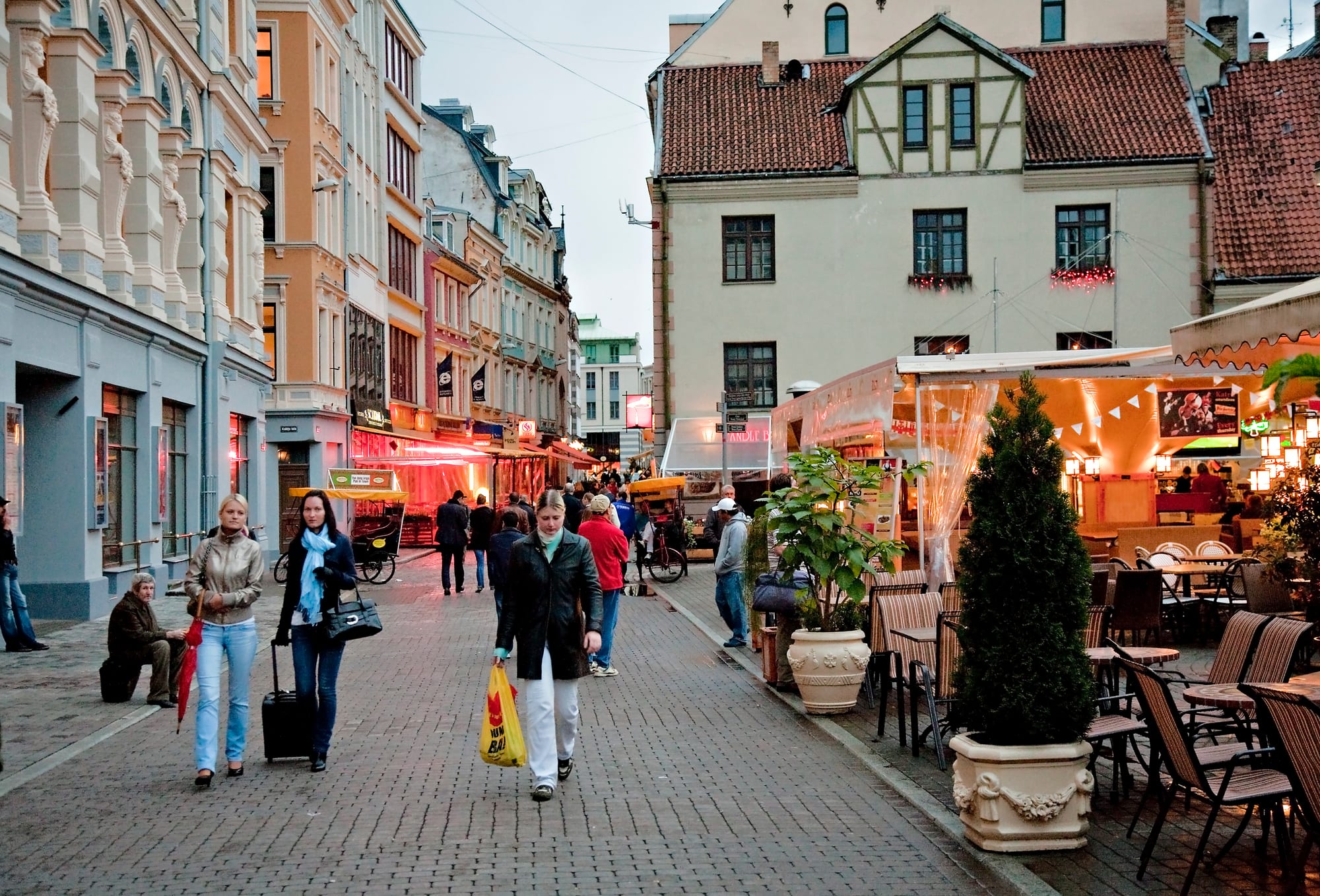
A cobbled pedestrian street in Riga's Old Town with pastel facades, a half-timbered gable and café terraces

Riga & Western Latvia, Latvia

Riga

A pedestrian street in Riga's Old Town, lined with café terraces. (Richardmaackphotography / Wikimedia Commons · CC BY 4.0)

Latvia's capital and the largest city of the Baltic states' middle country, at the mouth of the Daugava on the Gulf of Riga. Founded by German crusaders in 1201 and grown rich as a Hanseatic port, it keeps a medieval old town and one of the world's largest collections of Art Nouveau buildings, and today holds about a third of Latvia's people.

Neighbourhoods

  • Old Riga (Vecrīga)
    • First-time visitors
    • Historic district
    • Nightlife

    The medieval core on the east bank of the Daugava, a tangle of cobbled lanes between Riga Cathedral, St Peter's and St James's. Guild halls, merchants' houses, squares full of café terraces and the city's biggest concentration of bars are packed into a small area best covered on foot.

    Open in Maps
  • Centrs and the Art Nouveau quarter
    • Architecture
    • Close to public transport
    • Best for food

    The 19th- and early 20th-century city beyond the old town's canal and boulevards, part of the UNESCO-listed historic centre. Its grid of apartment blocks holds the Art Nouveau façades of Alberta and Elizabetes streets, embassies, theatres, offices and many restaurants.

    Open in Maps
  • Latgale neighbourhood
    • Markets
    • Local life

    The district south of the old town, called Maskavas forštate until 2024 after the old road to Moscow. The Central Market sits on its edge, and behind it lies a mostly residential district of older streets.

    Open in Maps
  • Āgenskalns
    • Quiet and residential
    • Wooden architecture

    An old neighbourhood across the river on the left bank, mostly built in the late 19th and early 20th centuries and known for its wooden houses. The Kalnciema Quarter, a renovated 19th-century complex of wooden buildings, is the best-known corner.

    Open in Maps
  • Ķīpsala
    • Views of the old town
    • Quiet and residential

    An island on the left bank of the Daugava, joined to the centre by the Shroud Bridge. It lies about 3 km from the old town and holds the city's yacht club.

    Open in Maps
  • Mežaparks
    • Parks
    • Families
    • Quiet and residential

    A garden suburb of early 20th-century villas in the north, on the western shore of Lake Ķīšezers, with a large forest park of the same name beside it. Riga Zoo is here, next to the park.

    Open in Maps

Things to do

Famous landmarks

  • House of the Blackheadslandmark

    A merchants' hall first built in 1334 and later used by the Brotherhood of Blackheads; ruined in 1941, demolished in 1948 and rebuilt in 1996–2000 with its Mannerist gables.

    Open in Maps
  • Riga Cathedrallandmark

    The Lutheran cathedral of Saint Mary, seat of the Archbishop of Riga, whose great Walcker organ was inaugurated in 1884.

    Open in Maps
  • St. Peter's Churchlandmark

    A Lutheran parish church whose octagonal steeple, first added in 1491 and rebuilt after it collapsed in 1666, dominates the old town's skyline.

    Open in Maps
  • Three Brotherslandmark

    Three adjoining houses that together form the oldest complex of dwellings in Riga, each from a different period of building.

    Open in Maps
  • Swedish Gatelandmark

    A gate built in the city wall in 1698 to give access to barracks outside, the only one of the wall's eight gates that remains.

    Open in Maps
  • Riga Castlelandmark

    A castle on the Daugava founded in 1330 and rebuilt many times, now the official residence of the President of Latvia and home to several museums.

    Open in Maps
  • Freedom Monumentlandmark

    A 42-metre granite, travertine and copper monument unveiled in 1935 to the soldiers of the War of Independence, the focal point of national gatherings.

    Open in Maps
  • Albert Streetneighborhood

    A street laid out in 1901 and named after Bishop Albert, lined with Art Nouveau façades, many by Mikhail Eisenstein.

    Open in Maps

Museums

  • Museum of the Occupation of Latviamuseum

    The story of Latvia under Soviet and Nazi occupation from 1940 to 1991, with a new permanent exhibition in its renovated Soviet-era building since 2022.

    Open in Maps
  • Latvian National Museum of Artmuseum

    The national art museum, with more than 100,000 works across six sites.

    Open in Maps
  • Art Museum Riga Boursemuseum

    A collection of world art, from ancient Egyptian art to Asian art of the 21st century.

    Open in Maps
  • National Library of Latvialandmark

    The 'Castle of Light', designed by the Latvian-American architect Gunnar Birkerts in 1989 and opened in 2014.

    Open in Maps
  • Riga Motor Museummuseum

    The largest antique vehicle museum in the Baltic countries.

    Open in Maps
  • Ethnographic Open-Air Museummuseum

    Farmsteads and other buildings brought from across Latvia to a lightly wooded site on Lake Jugla just outside the city, open since 1932.

    Open in Maps

Markets and parks

  • Riga Central Marketmarket

    One of Europe's largest markets, built in 1924–30 with five pavilions reusing the frames of German First World War Zeppelin hangars.

    Open in Maps
  • Mežaparkspark

    A large forest park on Lake Ķīšezers in the north of the city, with Riga Zoo beside it.

    Open in Maps

Music and nights out

  • Latvian National Operaattraction

    The opera and ballet house on Aspazijas boulevard, with almost 200 performances in a season that runs from mid-September to the end of May.

    Open in Maps

Short trips from the city

  • Rumbulaattraction

    The forest near Riga where about 25,000 Jews were murdered in or on the way to the site on two days in 1941.

    Open in Maps
  • Salaspilsattraction

    The site of the largest civilian concentration camp in the Baltic states during the Second World War, south-east of Riga.

    Open in Maps

Seasonal events

  • Riga MarathonMay

    A flat, single-lap road marathon through the city, held every year since 1991.

  • Midsummer (Jāņi)23–24 June

    Two public holidays of bonfires, oak and flower wreaths, caraway cheese and beer, with singing through the night until sunrise.

  • Latvian Song and Dance Festivalsummer, normally every five years

    One of the largest amateur choral and dance events in the world, held almost always in Riga since 1873.

  • Christmas marketDecember

    A small market in the old town's main square with festive food and hot wine.

Eat and drink

Long-standing places and food districts in Riga. Hours, ratings and directions come from your maps app, always current.

Riga classics

  • Riga Central Marketmarket

    Five pavilions of stalls, among them halls for meat, fish, and fruit and vegetables.

    Open in Maps

Food districts

  • Old Riga's café streetsneighborhood

    Café terraces fill the old town's squares and lanes in summer.

    Open in Maps
  • Kalnciema Quarterneighborhood

    A renovated 19th-century complex of wooden houses in Āgenskalns, across the river from the old town.

    Open in Maps

Experience Riga

History

Riga was founded in 1201 by Bishop Albert, who moved the seat of the Livonian bishopric here from Uexküll and used the settlement as a base for the crusade against the Livonians and other pagan peoples of the region. German merchants and craftsmen arrived, and in 1282 the town joined the Hanseatic League, growing rich on trade down the Daugava into Russia. For centuries its German burghers quarrelled with the Livonian Order over who controlled the city, and Rigans destroyed the Order's castle in 1484.

As the Hanseatic League declined, Riga became a prize for its neighbours. Gustavus Adolphus of Sweden took it in 1621, and it remained one of the largest cities of the Swedish crown, with much self-government, until Peter the Great's army captured it in 1710 after a siege during an outbreak of plague. Under Russia it became a major industrial and trading port, and the boom of the decades around 1900 produced the Art Nouveau apartment blocks of the centre — between 300 and 500 new buildings went up each year in 1910–13.

Riga became the capital of independent Latvia after 1918. In June 1940 the Soviet Union occupied the country, and in 1941 Nazi Germany followed; the Jewish community was forced into the Riga Ghetto, and about 25,000 Jews were murdered in the Rumbula forest on two days in November and December 1941. Soviet rule returned in 1944 with deportations and large-scale immigration. Since independence was restored in 1991, Riga has been a European capital, hosting the Eurovision Song Contest in 2003 and the NATO summit in 2006, and serving as European Capital of Culture in 2014.

Culture & Customs

For centuries Riga's leading families were Baltic Germans and German was the language of its administration, and the Soviet decades brought many immigrant workers; in 2017 ethnic Latvians made up about 44 per cent of its residents, and Latvian and Russian are both heard on the streets. The city is the country's cultural centre. The National Opera and Ballet, the organ concerts in the cathedral and a steady calendar of classical music draw audiences through the winter, and the old town fills with visitors in summer.

Singing is central to Latvian identity, and Riga is the stage for the Song and Dance Festival, held almost always here since 1873, normally every five years, with tens of thousands of singers and dancers taking part. In 2014 the city hosted the World Choir Games alongside its year as European Capital of Culture. Midsummer, Jāņi, with its bonfires and wreaths, is celebrated on 23 and 24 June.

Ice hockey and basketball are followed closely: Riga hosted the men's ice hockey world championships in 2006, 2021 and 2023 and the final stages of EuroBasket 2025. The Riga Marathon has been run every year since 1991. Manners are reserved, and people generally respect others' personal space.

Daily Life

About 590,000 people lived in Riga in 2026, roughly a third of Latvia's population, and the wider metropolitan area held an estimated 850,000 in 2025. The city has shrunk from just over 900,000 in 1991, and Vilnius has recently overtaken it as the largest Baltic city. Many Russian-speaking residents who arrived in the Soviet era were not automatically granted citizenship after 1991, an issue that still shapes local politics.

Riga is the centre of the national economy: government, information and communication technologies, business services, manufacturing, tourism and the port, whose cargo turnover had fallen by half by 2024, largely because trade with Russia shrank after the war in Ukraine and the sanctions that followed. More than 1.1 million international tourists visited in 2024. The Rail Baltica railway, a standard-gauge line meant to connect Tallinn and Warsaw through Riga, is expected around 2030, with a station planned at the airport.

Many Rigans live in apartment buildings and get around by tram, trolleybus, bus or car. The city has had a mayor from The Progressives, Viesturs Kleinbergs, since June 2025. Summer weekends pull people out to the coast and to country houses; winters are spent indoors, in cafés and concert halls.

Food

Riga eats like most European capitals, but its markets and older cafés keep Latvian food in view. Dark rye bread, rupjmaize, made from coarse rye flour, malt and caraway seeds, is the staple; cottage cheese, biezpiens, is eaten with boiled potatoes, lightly salted herring, spring onions and sour cream. Speķrauši, buns filled with finely cut streaky bacon and onion, are a popular pastry, and grey peas with bacon are a traditional favourite, especially at Christmas.

Soviet decades left their mark on the menu: pelmeni (pelmeņi) with sour cream, dressed herring (siļķe kažokā), shashlik, solyanka and plov are as familiar here as in Moscow. In spring and summer cold borscht, made with kefir or soured milk, boiled beets, cucumber, radish, egg and herbs, turns bowls bright pink. Rye bread soup, maizes zupa, made from rye bread with whipped cream, dried fruit and cranberries, is a traditional dessert.

The Central Market, in its Zeppelin-hangar pavilions, is the city's larder, with its meat, fish, and fruit and vegetable halls. Beer is the most consumed alcoholic drink, with a flourishing craft scene, and kvass, brewed from fermented rye bread, remains popular. Riga Black Balsam, a dark, bitter herbal liqueur, is often called the national drink.

Planning tools

Budget

Riga is the most expensive place in Latvia, and the old town is the most expensive part of Riga for rooms, meals and drinks. Prices fall a little in the Centrs streets beyond the canal, and the Central Market and simple cafés keep food costs down. Rooms cost most on summer weekends and during big festivals and sporting events.

Daily Budget Midrange
USD 120–220 (mid-range hotel, restaurant dinners, museum tickets, trains to the coast)
Daily Budget Shoestring
USD 50–85 (hostel bed, market food and café lunches, trams and buses)

Eat in Centrs or at the market rather than on the old town's main squares, and agree prices before ordering in old-town bars.

Best Time to Visit

May to September, when the café terraces are open, the beaches are in use and the June nights are light until very late; midsummer itself sees many residents leave for the countryside. Winter is cold, dark and often snowy, but brings the concert and opera season and the Christmas market in the old town.

Suggested Number of Days

Two or three days cover the old town and the Art Nouveau streets at an easy pace. Allow four to six to add the seaside and the river valleys a train ride away. Winter's short days and summer festivals both change how much fits into a stay.

First Visit
2–3 days
With Surroundings
4–6 days

Transportation

The city-owned Rīgas Satiksme runs trams, trolleybuses and buses on an extensive network; trams are generally the quickest after the trains. Suburban trains leave the central station for the coast and the Gauja valley, and intercity buses leave from the main bus station just outside the old town. A car is more trouble than help in the centre, where parking is paid in many streets.

Buy tickets through an app, a ticket machine or a shop and activate them on boarding; tram, bus and trolleybus lines are numbered separately.

Airport & Station Connections

Riga International Airport, the largest in the Baltic states, is in Mārupe Municipality about 10 km west of the centre, linked by city bus line 22 and by taxi. Trains and buses arrive from Lithuania and Estonia, and ferries sail to Stockholm, a journey of about 17 hours.

Walkability

The old town and the Centrs streets around it are compact and best seen on foot, and almost all the main sights and hotels are within them. The old town's rounded cobblestones are hard on thin soles, and winter brings ice and snow on the pavements. Trams cover longer trips to Mežaparks or across the river.

Safety

Latvia is a safe country with low levels of violent crime. In Riga the problems that touch visitors are petty theft and bar scams aimed at tourists. Winter adds icy pavements and roads.

Keep valuables close in old-town crowds, agree drink prices before ordering, and wear shoes with grip in winter. Check current official travel advice before travelling.

Climate

A cool, damp climate shaped by the Baltic. Summers are mild and rainy, with occasional hot spells; winters are long and cold, with continuous snow cover sometimes lasting around eighty days.

Summer
mild and rainy, averaging around 18°C, with the hottest days above 30°C
Winter
cold, with January and February averaging about −2°C and the coldest days falling to −20°C or below

Local Customs

Latvians are generally fairly reserved. Tipping is modest: rounding up or adding around 5–10 per cent is usual but not required, and some places add a service charge to the bill. Latvian and Russian are both heard on the streets, and people in public services are required by law to speak Latvian; English is widely understood by younger people.

Check the bill for a service charge before tipping, dress modestly in churches, and treat the Freedom Monument and memorial sites with respect.

Common Payment Methods

The currency is the euro. Cards are widely accepted, and ATMs are easy to find in the centre. A little cash is useful for market stalls.