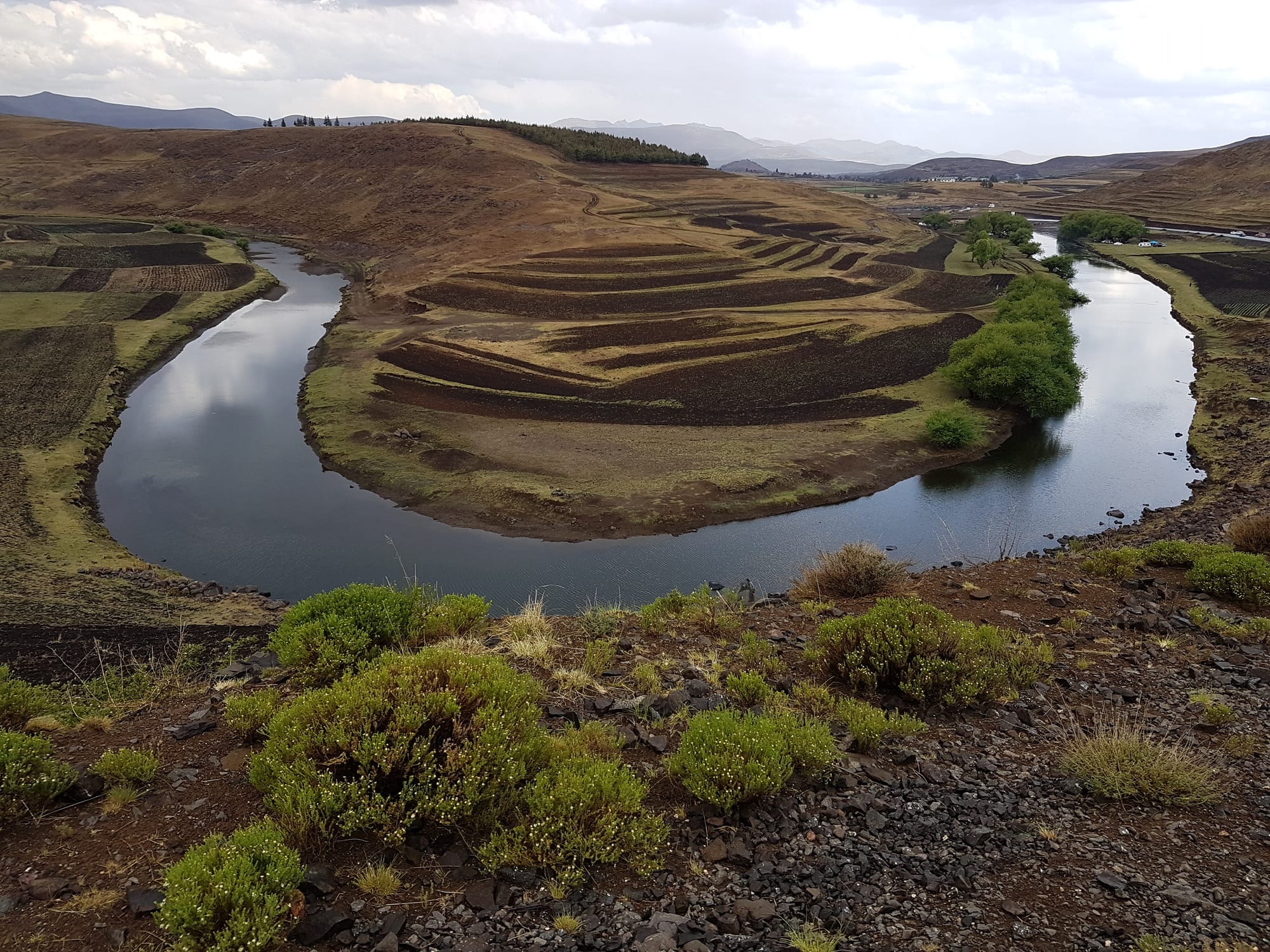
A wide loop of the Maletsunyane River curving around terraced brown fields between bare highland hills under cloud

Lesotho

Semonkong

The Maletsunyane River loops through highland fields north of Semonkong. (Letlhogonolo Ramasilo / Wikimedia Commons · CC BY-SA 4.0)

A highland village in the Maseru district of Lesotho, set high on the Maletsunyane River. Its name means the place of smoke, after the spray of the waterfall a short way downstream. Founded in the 1880s as a refuge for people displaced by the Gun War, it remains a trading centre for the herding country around it, reached by a long mountain road and by pony trails.

Neighbourhoods

  • The village centre
    • First-time visitors
    • Local life
    • Shops and supplies

    A single spread of shops, government offices, a clinic and churches along the dirt streets above the river. Horses are tied outside the stores, and this is where the buses and shared taxis from Maseru end their run.

    Open in Maps
  • The river and the gorge rim
    • Walks and viewpoints
    • Quiet

    South and east of the village the ground falls away into the Maletsunyane gorge, with the waterfall a few kilometres downstream. Paths along the rim pass grazing land and scattered homesteads, and most of the visitor accommodation lies on this side.

    Open in Maps
  • The surrounding villages
    • Pony trekking
    • Village life

    Stone and thatch homesteads are scattered across the ridges and side valleys for hours in every direction, linked by bridle paths rather than roads. Pony treks out of Semonkong stay overnight in them, and their people come in to the village to trade.

    Open in Maps

Things to do

Waterfalls and the gorge

  • Maletsunyane Fallslandmark

    A single drop of 192 metres from a basalt ledge a few kilometres from the village, one of the highest single-drop falls in southern Africa, giving Semonkong its name and often icing over in winter.

    Open in Maps
  • Maletsunyane Riverviewpoint

    The river runs past the village and into a deep gorge below the falls, with rim paths and a steep descent to the pool at the bottom.

    Open in Maps

Rides and walks

  • Pony trekking trailstrail

    Guided rides on sure-footed Basotho ponies leave the village for the falls, the passes and overnight stays in mountain homesteads, the traditional way of moving in this country.

    Open in Maps

Short trips from the village

  • Thaba Putsoaviewpoint

    The Blue Mountain, a 3,096 m peak with some of the coolest temperatures in Lesotho, rising beside the road from Maseru to the Mohale Dam.

    Open in Maps

Eat and drink

Long-standing places and food districts in Semonkong. Hours, ratings and directions come from your maps app, always current.

Semonkong classics

  • Village cook shopsrestaurant

    Small kitchens beside the stores serve papa with mutton stew or moroho, the standard meal of the highlands, and fat cakes fried through the morning.

    Open in Maps
  • Semonkong village shopsmarket

    General stores stocking maize meal, samp, beans, sugar, tea and tinned fish — the supplies both households and self-catering visitors depend on.

    Open in Maps
  • Lodge kitchens by the gorgerestaurant

    The accommodation above the river cooks set meals for guests, usually grilled mutton or beef, vegetables and bread, with beer and tea.

    Open in Maps

Experience Semonkong

History

Semonkong was founded in the early 1880s, during and after the Gun War, the conflict in which the Basotho resisted an attempt by the Cape Colony to disarm them. Basotho refugees displaced by the Cape forces settled in the high country south-east of Maseru, and the new village, lying beyond the passes, became a refuge for people driven from the lowlands. Its Sesotho name, the place of smoke, describes the spray that rises from the waterfall below it.

For most of its existence it was a trading post at the end of a bridle path. Stores and later government services gave it the functions of a small service centre for a scattered population of herders, who came in on horseback to sell fleeces, buy maize meal and paraffin and attend court. The road from the lowlands was built late, and until it was improved the village was effectively cut off for parts of the year.

Tourism came later, drawn by the Maletsunyane Falls and by the ponies that were already the everyday transport of the district. Lodges began offering guided rides through the mountains, and the gorge below the falls became known for a long single-drop abseil described as the longest commercially operated in the world. The village remains small, and wool, livestock and government services still matter more to it than visitors do.

Culture & Customs

Semonkong is one of the places where the horse culture of Lesotho is most visible. Men ride in from the ridges wrapped in Basotho blankets, tie their ponies outside the stores and ride home again at dusk; the pony is transport, status and, at village race meetings, sport. Saddles, bridles and woven grass hats are made and repaired locally.

The herding year shapes the calendar. Boys and young men take sheep, goats and cattle to high cattle posts in the summer months and bring them down before the snow; shearing time is a busy season, and wool and mohair are the main source of cash. Initiation schools still run in the mountains, and their songs and returning initiates are treated with respect and privacy.

Religion is mainly Christian, with Catholic and Protestant missions long established, and Sunday services draw people in from a wide area. Sesotho is the language of everything; English appears in the school, the clinic and the lodges. Music is choral singing, the lesiba mouth-bow played by herders, and famo accordion music at gatherings. Hospitality towards travellers on the trails is part of the district's manners, and pony-trekking parties are still commonly put up in family homesteads.

Daily Life

About 7,800 people lived in the Semonkong community council area at the 2006 count, with many more in the villages within a day's ride. It is the largest settlement for a long way in any direction, which makes it the place for the clinic, the secondary school, the police, the court and the shops, and for the buses out to the capital.

The economy is livestock and the money that comes back from elsewhere. Sheep and goats for wool and mohair are the main product; maize, sorghum and vegetables are grown on small plots where the ground allows; and many households depend on a wage earned in Maseru or South Africa, or on a pension. Tourism provides a modest number of jobs as guides, grooms, cooks and drivers.

Days are shaped by weather, altitude and distance. Water is often carried, fuel is paraffin, gas, dung or wood, and the electricity and mobile signal that have reached the village thin out quickly beyond it. Snow can close the passes in winter, and summer storms cut the tracks; a journey to hospital or to a bank means a long, slow drive. Erosion of the thin mountain soils and the decline of migrant work in South Africa are the pressures most talked about.

Food

Food in Semonkong is mountain food, built on maize and sheep. Papa, the stiff maize porridge, is eaten twice a day with moroho, the cooked greens picked wild or grown in the garden, and with beans or a stew when there is meat. Motoho, a fermented sorghum porridge, is a common everyday dish, and likhobe, a stew of beans and sorghum, is a filling winter dish.

Mutton is the meat of the district, since sheep are what the hills carry; a slaughter for a feast or a funeral is shared out through the village. Pumpkin, wild spinach and dried maize kernels stretch the winter. Village shops sell maize meal, sugar, tea, tinned fish and little else, so lodge kitchens and self-caterers bring supplies up from Maseru.

To drink there is strong sweet tea, taken at any hour against the cold, and home-brewed sorghum beer made in households. Bottled lager comes up by truck from the lowlands. Meals are eaten early, and hot food at the end of a day's riding is the pattern for visitors and herders alike.

Planning tools

Budget

Costs here are low apart from transport and organised activities. A bed in the village or at the lodges beside the gorge, meals cooked on site and guided rides make up most of a budget; a pony trek with a guide, and any abseiling or vehicle hire, are the main extras. There is very little to spend money on otherwise.

Daily Budget Midrange
USD 70–140 (lodge room, meals, a guided pony trek or hike to the falls)
Daily Budget Shoestring
USD 25–45 (dormitory or camping, self-catering from village shops, shared transport from Maseru)

Carry enough cash in rand or maloti for the whole stay: there is no reliable card payment or cash machine in the village.

Best Time to Visit

September to November and March to May give the mildest riding and walking weather. The falls are fullest in the summer rains from December to February, when afternoon storms are heavy and the dirt tracks turn to mud. Winter, from June to August, is bitterly cold with frost, ice on the waterfall and sometimes snow, but the air is clear and dry.

Suggested Number of Days

One or two days are enough for the village and the waterfall. Three or four suit anyone riding or walking further into the mountains, since overnight treks and the more distant falls take whole days. Weather and the state of the road can add time.

First Visit
1–2 days
With Surroundings
3–4 days

Transportation

There is no public transport within the village, which is small enough to cross on foot, and no taxis. Shared minibuses and light trucks run to and from Maseru on a rough schedule. Beyond the village, movement is by horseback, on foot, or in a high-clearance four-wheel-drive vehicle, and river crossings can be impassable after heavy rain.

Ponies and guides are arranged through lodges or through the village; the animals belong to local families and rides are usually accompanied.

Airport & Station Connections

Semonkong lies south-east of Maseru, about 80 km as the crow flies and considerably further by a long, winding mountain road. Shared minibuses cover the same road from the capital, taking longer. A small airstrip, Semonkong Airport, serves the village, and some visitors arrive on multi-day pony treks from other highland villages.

Walkability

The village itself is walked everywhere, on dirt streets that turn muddy in summer and icy in winter. Everything beyond it involves altitude and steep ground: the round trip to the top of the falls takes a couple of hours, and the descent into the gorge is a serious walk. Sturdy boots and warm layers matter more than distance here.

Safety

The village and the trekking country around it are among the safer parts of Lesotho, and the risks are mainly environmental — altitude, cold, lightning on open ground, unfenced cliffs above the gorge and rivers that rise quickly after rain. Medical help is limited to a clinic, with hospitals hours away.

Rural Lesotho and the pony-trekking and lodge circuit are fairly safe, but Maseru has significant crime — muggings, carjacking, and home invasion — so take normal urban precautions and avoid walking after dark. In the mountains, walk the gorge rim with care, carry warm and waterproof clothing in any season, and cross rivers only when they are low. Check current official travel advice before travelling.

Climate

High in the mountains, the climate is cold highland: nights are chilly almost all year, and the weather changes fast. Most rain falls between October and April as afternoon thunderstorms, and snow can settle on the surrounding ridges even outside winter. Summer runs from December to February and winter from June to August.

Summer
mild days and cold nights — December to February days usually in the low 20s °C, with heavy afternoon storms and hail
Winter
cold and dry — June to August days often below 10 °C, nights well below freezing, with frost, ice on the falls and occasional snow

Local Customs

This is a conservative rural village where Sesotho greetings, modest dress and patience are expected, and where the blanket worn by herders is working clothing, not display. Chiefs still have authority in the villages around, and permission is asked before crossing land or photographing homesteads.

Ask before photographing people, herders or their animals; giving sweets or money to children is discouraged locally; tipping guides and grooms after a trek is customary.

Common Payment Methods

The Lesotho loti and the South African rand are used interchangeably and cash is essential: shops, guides and transport work in notes and coins. Card payment is unreliable and there is no dependable cash machine, so money is best drawn in Maseru before the drive up.