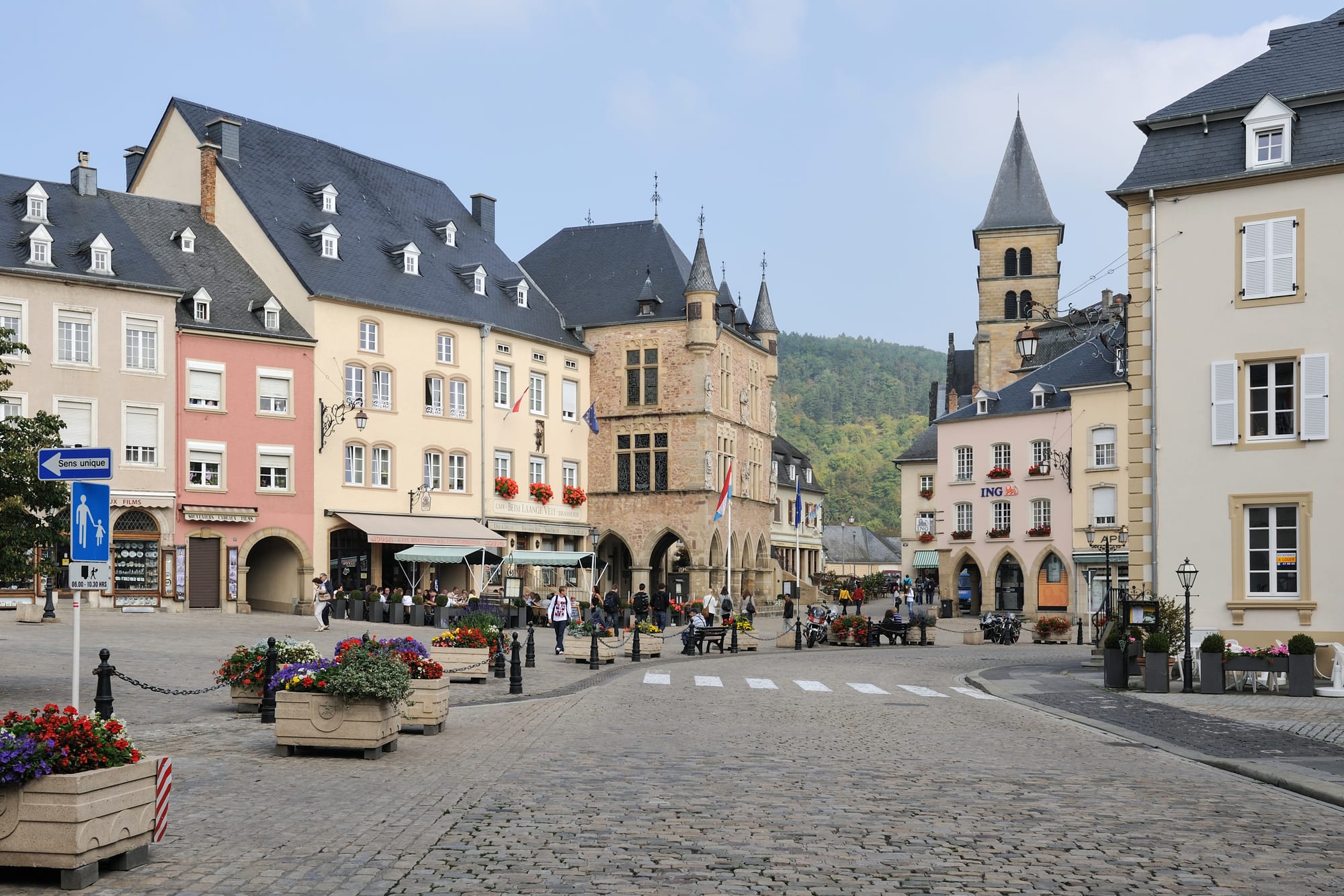
A cobbled market square with flower tubs, pastel houses, an arcaded Gothic town hall and a church tower behind

Luxembourg

Echternach

The Place du Marché in Echternach, with the old town hall known as the Denzelt. (Cayambe / Wikimedia Commons · CC BY-SA 4.0)

Luxembourg's oldest town, on the Sauer river facing Germany, with about 6,000 people. It grew around the Benedictine abbey founded in 698 by the English monk Willibrord, whose tomb lies in the basilica and whose memory draws the hopping procession every Whit Tuesday. Today it is the main town of the Mullerthal, a base for its sandstone gorges and walking trails.

Neighbourhoods

  • Old town and the abbey
    • First-time visitors
    • Historic district
    • Best for food

    The historic centre that grew up around the abbey's outer walls, with the market square, the Denzelt and the parish church of St Peter and Paul. The basilica and the 18th-century abbey buildings, now a secondary school, stand at its heart, and most of the cafés are around the square and the main shopping street.

    Open in Maps
  • The lake and the south of town
    • Outdoor activities
    • Quiet and residential

    South of the centre lies the artificial Lac d'Echternach, with a path around its shore, the remains of the Roman villa beside it and the grounds of the town's lakeside music festival for young people.

    Open in Maps

Things to do

Abbey and old town

  • Abbey of Echternach and Basilica of St Willibrordlandmark

    The Benedictine abbey founded by Willibrord in the 7th century, for three centuries the most powerful institution in Luxembourg; its Romanesque basilica with twin towers holds his tomb in the crypt.

    Open in Maps
  • Abbey museummuseum

    A museum beside the basilica on the abbey's history and the town's Catholic past.

    Open in Maps
  • Denzeltlandmark

    The historic town hall on the market square, an important historic monument of the 15th century.

    Open in Maps
  • Church of St Peter and Paullandmark

    The town's parish church, one of its two great churches, used with the basilica as a concert venue.

    Open in Maps
  • Prehistory museummuseum

    A small museum of prehistory and of the local faience industry on the Rue du Pont.

    Open in Maps

Lake and Roman remains

  • Lac d'Echternachpark

    An artificial lake south of the town, with a footpath around it that takes about two and a half hours to walk.

    Open in Maps
  • Roman villaattraction

    The excavated remains of a Roman villa by the lake, rediscovered in 1975 and reputed to have been the largest north of the Alps.

    Open in Maps

Short trips from the town

  • Mullerthal (Little Switzerland)trail

    The low-lying region around the town, roughly the canton of Echternach, a landscape of craggy rocks, thick forests, caves and small streams crossed by walking and cycling routes.

    Open in Maps
  • Berdorfattraction

    A small town in the hills above Echternach known for the sandstone rocks around it, including the Hohllay, a hollowed-out rock.

    Open in Maps
  • Trierattraction

    Across the border in Germany, the Roman city of Augusta Treverorum, once a capital of the Roman Empire, several of whose Roman monuments and cathedrals are listed as a UNESCO World Heritage Site.

    Open in Maps

Seasonal events

  • Hopping processionWhit Tuesday, May or June

    The last traditional dancing procession in Europe, honouring Willibrord, inscribed on UNESCO's list of intangible cultural heritage in 2010 and drawing many thousands of pilgrims and visitors.

Eat and drink

Long-standing places and food districts in Echternach. Hours, ratings and directions come from your maps app, always current.

Food districts

  • Place du Marchéneighborhood

    The market square and the main shopping street hold most of the town's cafés and several restaurants, with terraces facing the Denzelt.

    Open in Maps
  • Brasserie Aal Eechternoachrestaurant

    A brasserie-restaurant on the market square, in the heart of the old town.

    Open in Maps

Experience Echternach

History

Echternach is the oldest town in Luxembourg. A Roman villa stood here, its traces rediscovered in 1975 and reputed to have been the largest north of the Alps. In 698 Willibrord, an English monk from Ripon in Northumbria who became the first bishop of Utrecht and worked to convert the Frisians, founded a Benedictine abbey on land given by Irmina, daughter of the Frankish king Dagobert II; the Frankish king Pepin the Short added more. Willibrord died in Echternach in 739.

The abbey had a famous library and a productive scriptorium, and around 1030–1050 its monks produced the Codex Aureus of Echternach, a gospel book written entirely in gold ink. Monks were replaced by canons of the bishop of Trier between 859 and 971, and Willibrord's buildings burned in 1017, but the Romanesque basilica that replaced them still holds his tomb in its crypt. The town grew around the abbey's outer walls and received a charter in 1236, and the abbey was rebuilt in Baroque style in 1737.

The French Revolution ended the abbey's life: in 1794 the church was sacked, and in 1797 the monks were dispersed and the famous library sold off. A porcelain factory moved into the buildings and the town declined until the railway brought new life and tourists. On 16 December 1944 Echternach marked the southern end of the German front in the Battle of the Bulge.

Culture & Customs

Willibrord, the patron saint of Luxembourg, is the centre of the town's identity. Every Whit Tuesday the hopping procession, the last traditional dancing procession in Europe, moves through the streets in his honour, and many thousands of pilgrims and visitors come to watch or take part. In 2010 it was inscribed on UNESCO's Representative List of the Intangible Cultural Heritage of Humanity.

The town has two great churches: the abbey basilica, a Romano-Gothic monument now surrounded by the 18th-century abbey buildings, which house a secondary school; and the parish church of St Peter and Paul. Both served as concert halls for the Festival International Echternach, a music festival whose pianist and musical director Cyprien Katsaris shaped it for more than 30 years before it ended in 2017; the open-air Echterlive festival followed in 2019. The Trifolion cultural centre has been a venue since 2008, and the lakeside e-Lake festival of rock, electronic and hip-hop music is organised by the local youth club for young people.

Ciné Sura is the oldest cinema in Luxembourg, and a cultural trail in 15 stages follows the line of the old town walls past the town's monuments and museums.

Daily Life

About 6,000 people lived in the commune at the start of 2026. Echternach is the main town of its canton and the only medium-sized settlement in the Mullerthal, which covers about 7 per cent of the country, and it is the seat of the canton. The old abbey buildings now house a secondary school.

Tourism is a large part of the economy, built around the procession, the abbey and the walking and cycling country around the town; bikes can be hired throughout the Mullerthal, and cycle paths run to the capital, to Vianden and across the border.

The Sauer, which flows past the town, forms the border with Germany, and life here looks both ways. Germany is just over the bridge, and the German city of Trier is a short journey away. Most cafés are around the market square and the main shopping street, which are the town's meeting places, and free buses connect it with Luxembourg City in under an hour.

Food

Echternach eats as the rest of Luxembourg does. Perhaps the most traditional of the country's meat dishes is judd mat gaardebounen, smoked collar of pork with broad beans. Other home dishes include Bouneschlupp, a green bean soup; Träipen, black pudding with apple sauce; liver dumplings with sauerkraut and boiled potatoes; and sausages with mashed potatoes and horseradish. Gromperekichelcher are spiced potato pancakes with chopped onion and parsley, deep-fried.

Kachkéis, a soft cheese spread, is the country's cheese speciality, and Rieslingspaschtéit is a loaf-shaped meat pie made with Riesling wine and aspic, served in slices. Fruit tarts are typical desserts, above all Quetschentaart, made with plums, and Lent brings the pretzel; small sugar-dusted doughnuts called verwurelt Gedanken are another local pastry.

The wines come from the Moselle valley to the south: Riesling, Pinot gris, Pinot blanc, Auxerrois, Rivaner, Elbling and the sparkling Crémant de Luxembourg. The main beers are Bofferding, Mousel, Diekirch and Simon. The cafés and brasseries of the market square are where locals and visitors sit over them.

Planning tools

Budget

Echternach shares Luxembourg's high prices, but it is a small town where the walks, the lake path, the market square and the basilica cost nothing, the town has supermarkets, and the buses to and from the capital are free.

Daily Budget Midrange
USD 185–350 (mid-range hotel, restaurant meals, museum tickets, bike hire)
Daily Budget Shoestring
USD 80–140 (hostel or campsite, bakery and supermarket food, free buses)

Whit Tuesday brings many thousands of visitors for the procession, so a visit on that day means crowds in a small town.

Best Time to Visit

Late spring to early autumn suits walking and cycling in the Mullerthal and evenings on the market square, and Whit Tuesday brings the hopping procession. Winters are cold and quiet.

Suggested Number of Days

The town itself needs a day or two. The walking and cycling routes of the surrounding Mullerthal and the crossing into Germany easily fill several more.

First Visit
1–2 days
With Surroundings
3–4 days

Transportation

The old town is small and best seen on foot. Signposted cycling paths run to Luxembourg City, Diekirch, Vianden and Wasserbillig and across the border to Trier and Bitburg, and bikes can be hired across the Mullerthal. Buses, free like all public transport in the country, link the town with the capital and the surrounding villages.

Germany is simply across the bridge over the Sauer.

Airport & Station Connections

There is no railway station; buses 201, 211 and 212 run from the Municipal Theatre in Luxembourg City via Kirchberg in under an hour, and the trip is free. Cyclists can follow a signposted route from Kirchberg in about three hours. Luxembourg Airport, the country's only international airport, serves the capital.

Walkability

The historic centre is compact and level enough to cross in a few minutes, with the abbey, the market square and the parish church close together. The lake and the Roman villa are an easy walk south, while the rocky trails outside town are steeper and need proper footwear.

Safety

Luxembourg is a very safe, prosperous country with low crime. The main hazards are on the trails, where paths among the rocks can be steep and uneven.

Keep to marked trails in the gorges around town and carry water on longer walks. Check current official travel advice before travelling.

Climate

A mild, damp temperate climate. In nearby Luxembourg City, January averages about 0.8°C and July about 17.5°C, with the warmest weather in July and August.

Summer
warm, with typical temperatures of 15–25°C in nearby Luxembourg City and spells of 30–35°C not unusual
Winter
cold — January averages about 0.8°C in nearby Luxembourg City

Local Customs

Luxembourgish is the everyday language, with French and German widely used and many visitors from just across the border. Willibrord is the patron saint of Luxembourg, and the basilica that holds his tomb is a place of pilgrimage as well as a tourist sight.

The procession is a religious act and the basilica a place of pilgrimage, so visitors keep a respectful distance and quiet behaviour.

Common Payment Methods

The currency is the euro, the same as in Germany across the Sauer.