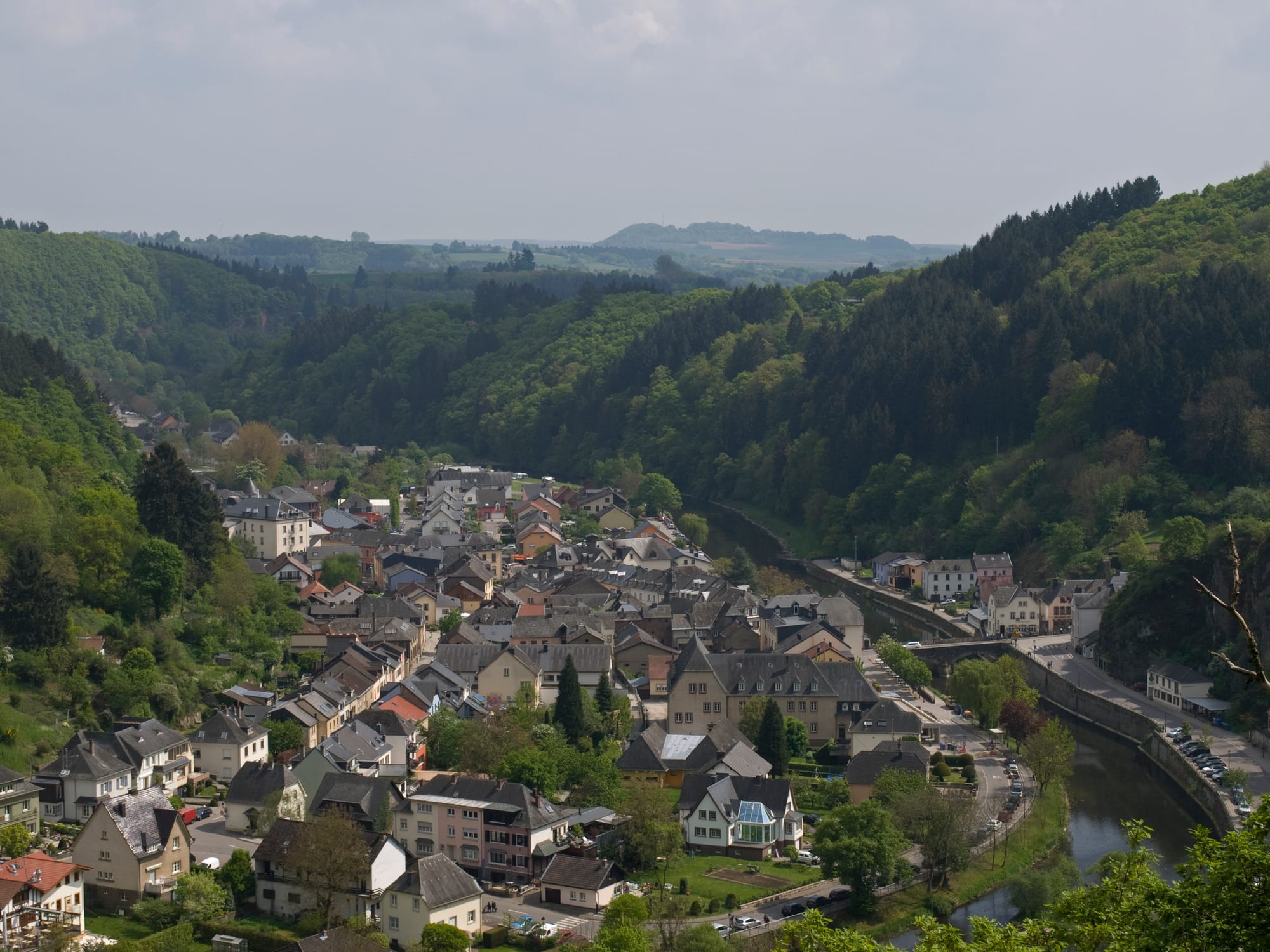
Slate-roofed houses of Vianden filling a bend of the Our river between steep wooded hills

Luxembourg

Vianden

Vianden's left bank on the Our river, seen from the hillside above the town. (Ymblanter / Wikimedia Commons · CC BY-SA 3.0)

A small town of about 2,200 people on the Our river in north-eastern Luxembourg, facing Germany across the water. It grew beneath one of the largest fortified castles west of the Rhine, seat of the counts of Vianden; restored since 1977, the castle has made the town one of the country's main tourist centres, alongside its Victor Hugo museum.

Neighbourhoods

  • Grand-Rue and the upper town
    • First-time visitors
    • Historic district

    The cobbled main street climbs from the river towards the castle between centuries-old houses, past the Trinitarian church, the town museum and the 16th-century town hall. It is both the town's working high street and its main sight, lined with restaurants.

    Open in Maps
  • The riverside and the bridge
    • Riverside walks
    • Close to public transport

    The flat ground along the Our around the bridge, where the Victor Hugo house stands, and the chairlift starts from the riverbank. The road north up the valley leads to the pumped-storage plant.

    Open in Maps

Things to do

Castle and old town

  • Vianden Castlelandmark

    One of the largest fortified castles west of the Rhine, built in Romanesque style between the 11th and 14th centuries on Roman foundations, left to fall into ruin and now fully restored as a museum.

    Open in Maps
  • Victor Hugo Housemuseum

    The house by the bridge where the French writer stayed in 1871, now a small museum of his sketches, letters and manuscripts with a view of the castle.

    Open in Maps
  • Trinitarian church and cloisterlandmark

    The Gothic church of the former Trinitarian friary on the Grand-Rue, with a quiet cloister courtyard, beside the Cross of Justice recalling the town's charter of 1308.

    Open in Maps
  • Hockelsturlandmark

    A belltower of 1603 on a rock near the castle, once part of the town's fortifications.

    Open in Maps
  • Town museummuseum

    A small museum in two adjoining houses on the Grand-Rue, one with 19th-century interiors and the other a bakery museum in the former home of the poet Dicks.

    Open in Maps

The valley and views

  • Chairliftviewpoint

    A summer chairlift from the riverbank up to a point higher than the castle, with views over the town and the Our valley and a steep forest path down to the castle.

    Open in Maps
  • Vianden Pumped Storage Plantattraction

    A hydroelectric plant just north of the town, begun in 1959, with its lower reservoir on the Our and an upper basin on Saint Nicholas Mountain.

    Open in Maps
  • Our valley cycle routetrail

    A signposted cycle route that follows the Sauer and Our valleys north to the town, along the river that forms the border with Germany.

    Open in Maps

Short trips from the town

  • National Museum of Military Historymuseum

    A national military museum in nearby Diekirch, which grew out of a museum of the Battle of the Bulge in Luxembourg.

    Open in Maps
  • Clervaux Castlelandmark

    A castle dating to the 12th century, burned in the Battle of the Bulge and rebuilt, which houses Edward Steichen's photography exhibition.

    Open in Maps

Seasonal events

  • Nut marketsecond Sunday in October

    The town's walnut festival, when the streets fill with music and stalls selling local walnuts, walnut cakes, sweets, brandy and liqueurs.

Eat and drink

Long-standing places and food districts in Vianden. Hours, ratings and directions come from your maps app, always current.

Vianden classics

  • Walnuts and walnut liqueurmarket

    The Vianden area has a long tradition of growing walnuts, sold as nuts, cakes, confectionery, brandy and liqueur, above all at the October nut market.

    Open in Maps

Food streets and cafés

  • Grand-Rue restaurantsneighborhood

    Restaurants and terraces line the main street and the riverside near the bridge, many with views of the castle.

    Open in Maps
  • Buvette du Télésiègecafe

    A refreshment stop at the top of the chairlift, serving beer, coffee and other drinks high above the town.

    Open in Maps

Experience Vianden

History

A Roman fort once stood on the rock where Vianden Castle rises today. The castle itself was built between the 11th and 14th centuries in the Romanesque style, with Gothic additions late in that period, and became the seat of the influential counts of Vianden until the beginning of the 15th century. In 1308 Count Philip II granted the town one of the oldest charters in Europe; from him descended the house of Nassau-Vianden and, in time, William of Orange. Its medieval craftsmen were known for their skills, and leather-making later became the main industry.

A Renaissance mansion was added to the castle in the 17th century, but after its lords left for the Netherlands, fire and an earthquake took their toll. In 1820 the castle was sold off and reduced to a ruin, though its chapel was restored in 1849 by Prince Henry of the Netherlands. Victor Hugo stayed in Vianden in 1862, 1865 and for three months in 1871, drawing and writing about it, and did much to make it known.

In November 1944 the town saw fierce fighting between the Luxembourg Resistance and German forces, and in February 1945 it became the last place in Luxembourg to be freed, when American troops completed the liberation; a memorial west of the town, overlooking the castle, recalls the battle. In 1977 Grand Duke Jean ceded the castle to the state, opening the way for the large-scale restoration that turned Vianden into one of the country's main tourist centres.

Culture & Customs

Vianden's identity is bound up with its castle, its river and its writers. Victor Hugo is remembered in the museum in the house beside the bridge where he stayed, which holds his sketches and letters; he recorded the town in prose, poetry and drawings, including the series of poems L'Année terrible. Edmond de la Fontaine, known as Dicks and regarded as Luxembourg's national poet, wrote the town's first travel guide, and the linguist René Engelmann, who set out the basic grammar of Luxembourgish, is among the notable people linked with the town.

The town's monuments tell of its medieval standing: the Hockelstur belltower of 1603, once part of the walls; the Cross of Justice near the Trinitarian church, recalling the charter of 1308; and towered houses built for the nobility, including the town hall of 1579 and a house of 1475 that now holds the pharmacy.

The biggest day in the local calendar is the nut market each October, a celebration of the walnut growing that the area has long been known for. The winding roads around the town are popular with motorcyclists and cyclists, and walking is a large part of what draws visitors to the hills on both banks of the Our.

Daily Life

About 2,200 people lived in the commune in 2025. Vianden is a commune with city status and part of the canton of the same name. Tourism is the main business, with many tens of thousands of visitors a year, especially from the Netherlands, Belgium and Germany, and the town has 14 hotels, four campsites and a youth hostel.

The hydroelectric pumped-storage plant just north of the town still provides work directly and indirectly, but the closure of the Electrolux factory in 1997 cost many jobs, and the commune has been making land available to attract skilled craft businesses.

Life follows the seasons. Summer brings the chairlift, the tourist train and busy terraces on the Grand-Rue; the quieter months belong to residents, walkers and the autumn nut market. Germany lies just across the river, and Vianden is the one place where the border does not follow the Our. Buses connect the town with Diekirch, Ettelbruck and Clervaux, which have trains to the capital, and with Bitburg in Germany, and all public transport in the country is free.

Food

Walnuts are Vianden's own speciality. The area has a long history of growing them, and at the nut market in October they are sold whole and turned into cakes, confectionery, brandy and liqueur.

The restaurants along the Grand-Rue and by the river serve the dishes found across Luxembourg. Perhaps the most traditional is judd mat gaardebounen, smoked collar of pork with broad beans. Others include Bouneschlupp, a green bean soup; Träipen, black pudding with apple sauce; liver dumplings with sauerkraut and boiled potatoes; and Gromperekichelcher, spiced potato pancakes with chopped onion and parsley, deep-fried. Kachkéis, a soft cheese spread, is the country's cheese speciality.

Fruit tarts are typical desserts, Quetschentaart, made with plums, above all, alongside peach, cherry and pear tarts. To drink there are the wines of the Moselle valley in the south-east, from Riesling and Auxerrois to the sparkling Crémant de Luxembourg, and the national beers, among them Diekirch, brewed in the nearby town of that name.

Planning tools

Budget

Vianden is a busy tourist town with prices to match Luxembourg's high costs, but it has a youth hostel and four campsites as well as hotels, and the free buses and trains make it cheap to reach. The castle, the museums and the chairlift charge for entry; the streets, riverbank and walks cost nothing.

Daily Budget Midrange
USD 185–350 (hotel with a castle view, restaurant meals, castle and chairlift tickets)
Daily Budget Shoestring
USD 80–140 (youth hostel or campsite, bakery and supermarket food, free buses)

The chairlift runs only in the summer months, so a visit in the colder season means walking or driving up to the castle.

Best Time to Visit

Summer brings the chairlift, warm evenings and the busiest streets; the town draws visitors at all times of year, especially from the Netherlands, Belgium and Germany. Autumn colours the wooded valley and brings the nut market in October.

Suggested Number of Days

The town itself fits into a long day or a single night. Two or three days allow time for the walks and cycle routes around it and for other towns in the north of the country.

First Visit
1 day
With Surroundings
2–3 days

Transportation

The old town is small enough to cover on foot, though the castle stands high above it on a rock: visitors can walk up, drive part of the way and park, take the summer chairlift and walk down through the forest, or ride a small tourist train in summer. Buses link the town with Diekirch, Ettelbruck and Clervaux, and with Bitburg in Germany.

Parking in the village is mostly paid and time-limited; the car parks near the castle are the easiest.

Airport & Station Connections

Vianden is a 47 km drive from Luxembourg City, roughly 50 minutes by car. Without a car, take a train to Ettelbruck and a bus from beside the station, about 35 minutes onwards via Diekirch; like all public transport in the country, the trip is free. Many visitors arrive by bicycle along the Our valley.

Walkability

Everything in the town is within a short walk, but the streets are steep and cobbled, and the path between the chairlift's upper station and the castle is rough and steep, so sturdy shoes are worth having.

Safety

Luxembourg is a very safe, prosperous country with low crime. The main hazards are the steep, uneven paths around the castle.

Keep to marked paths on the wooded slopes and take care on wet cobbles. Check current official travel advice before travelling.

Climate

A temperate climate like the capital's, at about 200 m above sea level, with warm summers and chilly winters. Mild winters can be followed by summers with many fruit flies and mosquitoes.

Summer
warm — average daytime temperatures around 24°C, occasionally as high as 35°C, with evenings often around 25°C until late
Winter
chilly — daytime averages around 5°C, with nights sometimes as cold as −15°C

Local Customs

Luxembourgish is the everyday language, with French and German widely used and many visitors from the Netherlands, Belgium and Germany. Victor Hugo, who stayed in the town several times and wrote about it, and the national poet Dicks, who wrote its first travel guide, are local points of pride.

The Trinitarian church is a place of worship; visitors keep quiet inside, especially during services.

Common Payment Methods

The currency is the euro, the same as in Germany just across the river.