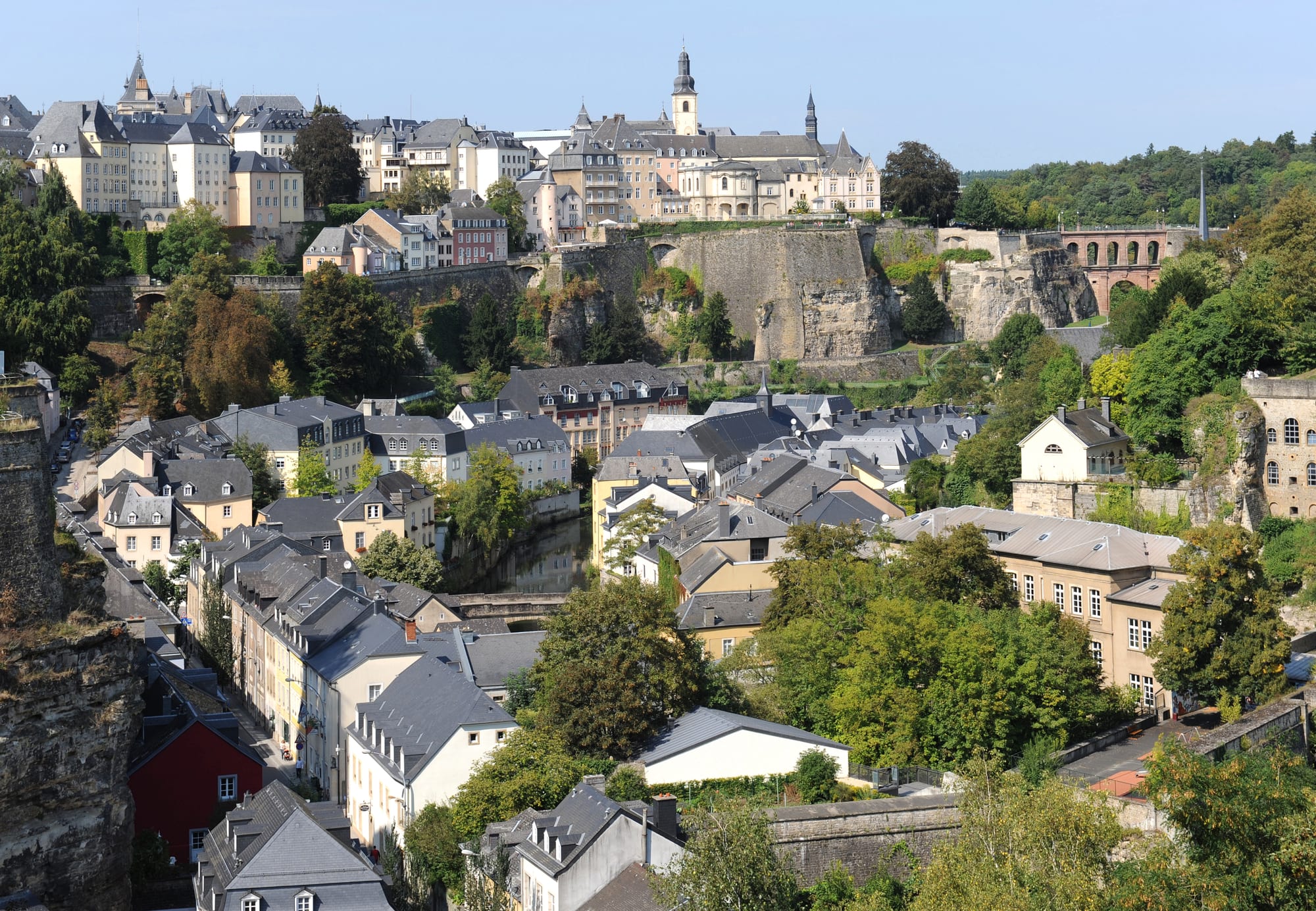
Slate-roofed houses of the Grund in a green river valley below fortress walls and the spires of the upper town

Luxembourg

Luxembourg City

The Grund, the old lower town in the Alzette valley, below the ramparts of the upper town. (Cayambe / Wikimedia Commons · CC BY-SA 3.0)

The capital of the grand duchy, built where the Pétrusse meets the Alzette, on a rock plateau ringed by deep gorges. A castle of 963 grew into one of Europe's great fortresses, dismantled after 1867; its old quarters and fortifications are now a World Heritage Site, while the Kirchberg plateau holds EU institutions and banks.

Neighbourhoods

  • Ville Haute
    • First-time visitors
    • Historic district
    • Shopping

    The historic centre on the plateau, inside the line of the old fortress. The Grand Ducal Palace, the cathedral, the Fish Market and Place Guillaume II are a few minutes apart, and the Corniche rampart walk runs along its eastern edge above the Grund.

    Open in Maps
  • Grund
    • Historic district
    • Nightlife
    • Riverside walks

    A small district in the valley on the banks of the Alzette, below the upper town, with fewer than a thousand residents. Old houses, the former Neimënster Abbey and riverside paths make it a picturesque corner of the city, and its bars make it a nightlife quarter. A public lift runs down through the cliff.

    Open in Maps
  • Clausen
    • Nightlife
    • Bars
    • Historic district

    One of the oldest neighbourhoods, in the valley below the Bock, whose history is tied to brewing from the 12th century. Today it is a nightlife district of bars and restaurants, with the church of St Cunegonde as its parish church.

    Open in Maps
  • Pfaffenthal
    • Quiet and residential
    • Riverside walks

    A valley district once run by a Benedictine abbey and in the Middle Ages home to craftsmen working by the Alzette. A panoramic lift links it to the upper town and a funicular to Kirchberg, so it is a quick way between the two plateaus.

    Open in Maps
  • Gare
    • Close to public transport
    • Budget stays
    • Best for food

    The district around the main railway station on the Bourbon plateau, which expanded rapidly after the fortress came down and is joined to the old town by the Adolphe Bridge and Avenue de la Liberté. It has many restaurants, cafés and international shops.

    Open in Maps
  • Kirchberg
    • Modern architecture
    • Business travellers
    • Museums

    The plateau across the Grand Duchess Charlotte Bridge, the country's central business district and home to most of the EU institutions based in the city. Mudam and the restored Fort Thüngen stand at its south-western edge, with the Philharmonie close by.

    Open in Maps
  • Limpertsberg
    • Quiet and residential
    • Markets

    A residential district north-west of the centre, with about 11,600 people. The Glacis square here holds a monthly market and, in late summer, the Schueberfouer funfair.

    Open in Maps

Things to do

Fortress and old town

  • Bock casemateslandmark

    The rock promontory where Count Siegfried built his castle in 963, with ruins of the castle and a large system of underground passages and galleries cut into the rock.

    Open in Maps
  • Chemin de la Cornicheviewpoint

    A pedestrian promenade along the old ramparts on the rim of the Alzette gorge, looking down over the Grund and the valley.

    Open in Maps
  • Grand Ducal Palacelandmark

    The official residence of the grand duke in the old town, where most of the head of state's duties are carried out.

    Open in Maps
  • Notre-Dame Cathedrallandmark

    The country's only cathedral, begun as a Jesuit church in 1613, late Gothic with Renaissance details, and home of the image of Our Lady of Consolation, patron of city and nation.

    Open in Maps
  • Adolphe Bridgelandmark

    A stone arch bridge of 1900–03 over the Pétrusse valley, an unofficial national symbol, now carrying the tram above and a cycle and footpath slung beneath.

    Open in Maps
  • Neimënster Abbeyattraction

    A former Benedictine abbey in the Grund, now a cultural centre and public meeting place by the river.

    Open in Maps
  • Luxembourg American Cemetery and Memoriallandmark

    A Second World War cemetery in Hamm, on the city's eastern edge, holding 5,074 American war dead, dedicated in 1960.

    Open in Maps

Museums

  • Nationalmusée um Fëschmaartmuseum

    The national museum on the Fish Market, the historic heart of the city, showing art and objects from every period of the country's history.

    Open in Maps
  • Lëtzebuerg City Museummuseum

    The thousand-year story of the city told in permanent and temporary exhibitions, in a museum founded in 1996.

    Open in Maps
  • Mudammuseum

    The Grand Duke Jean Museum of Modern Art, built on the site of Fort Thüngen at the edge of the Kirchberg plateau.

    Open in Maps
  • Musée Dräi Eechelenmuseum

    Fort Thüngen of 1732–33, known for the acorns on its three towers, rebuilt in the 1990s and reopened in 2012 as a museum.

    Open in Maps
  • Villa Vaubanmuseum

    An art museum in the city park showing 18th- and 19th-century paintings from former private collections.

    Open in Maps

Lifts, bridges and the valleys

  • Pfaffenthal Panoramic Elevatorviewpoint

    A public glass lift opened in 2016 between the upper town and Pfaffenthal, with views over the Alzette valley on the way down.

    Open in Maps
  • Pfaffenthal-Kirchberg funiculartransit hub

    An automated funicular opened in 2017, climbing from the valley station to the Kirchberg tram stop beside the Grand Duchess Charlotte Bridge.

    Open in Maps
  • Édouard André Municipal Parkpark

    The city park of about 19 hectares, laid out in the 1870s on the site of demolished fortifications, with sculptures, memorials and the Villa Vauban.

    Open in Maps

Music and nights out

  • Philharmonie Luxembourgattraction

    The concert hall on Kirchberg, opened in 2005, which stages around 400 performances a year.

    Open in Maps
  • Grand Théâtre de Luxembourgattraction

    Inaugurated in 1964 as the municipal theatre, the city's major venue for drama, opera and ballet.

    Open in Maps

Short trips from the city

  • Vianden Castlelandmark

    A large restored hilltop castle above the Our river in the north of the country.

    Open in Maps
  • Mullerthal (Little Switzerland)trail

    The country's smallest sub-region, in the east around Echternach, a low-lying landscape of craggy rocks, thick forests, caves and small streams.

    Open in Maps

Seasonal events

  • EmaischenEaster Monday

    A spring fair in the Fish Market, known for the little earthenware bird-shaped whistles called Péckvillercher, with craft and food stalls.

  • National Day23 June, with celebrations on the evening before

    The grand duchy's national holiday, marked in the capital with official ceremonies and public festivities.

  • Blues'n Jazz RallyeJuly

    A jazz and blues festival held in the city each summer.

  • Schueberfouerlate August to early September

    A 20-day funfair on the Glacis square in Limpertsberg, the largest in the wider region, which held its 681st edition in 2023 and draws around two million visitors.

Eat and drink

Long-standing places and food districts in Luxembourg City. Hours, ratings and directions come from your maps app, always current.

Luxembourg City classics

  • Judd mat Gaardebounenrestaurant

    Smoked collar of pork with broad beans, perhaps the most traditional of the country's meat dishes.

    Open in Maps
  • Mousel's Cantinerestaurant

    A traditional restaurant on the Montée de Clausen, in the old brewing district below the Bock.

    Open in Maps

Food districts and markets

  • Place Guillaume II marketmarket

    The square locals call the Knuedler, in the old town, which holds a market every Wednesday and Saturday.

    Open in Maps
  • Gare quarterneighborhood

    Many restaurants, cafés and international food shops in the streets around the main station, with a twice-weekly market on Place de Paris.

    Open in Maps

Cafés and bars

  • Grund and Clausenneighborhood

    The two valley districts below the old town are the city's main nightlife quarters, with pubs and bars in old houses by the Alzette.

    Open in Maps

Experience Luxembourg City

History

The first settlements within today's city limits were made by Franks in the Alzette valley, around what are now Dommeldange, Pfaffenthal and the Grund. In 963, through an exchange with the abbey of Saint Maximin in Trier, Count Siegfried acquired a small fort called Lucilinburhuc and began building a castle on the Bock, a rock promontory above the river. A town grew up beside it on the plateau, and around 1340, under John the Blind, new walls were built that stood until 1867.

For the next five centuries the town was above all a fortress. Burgundians, Habsburgs, Spaniards, French and Prussians fought over it and rebuilt it; under French rule Marshal Vauban enlarged the defences, and the Austrians added more in the 1730s and 1740s, when Fort Thüngen was built. A vast system of underground passages and galleries, the casemates, was cut into the rock of the Bock.

After the Luxembourg Crisis, the 1867 Treaty of London required the fortifications to be dismantled. Parks such as the city park were laid out on the demolished bastions, the Gare district grew around the railway station, and the Adolphe Bridge of 1903 tied the two together. In 1920 and 1921 Eich, Hamm, Hollerich and Rollingergrund were merged into the city. After the Second World War the capital became a seat of European institutions, most of them built on the Kirchberg plateau, and in 1994 its old quarters and fortifications were added to the UNESCO World Heritage list.

Culture & Customs

The city's identity is bound up with its landscape: the old town on the plateau, the valley districts of the Grund, Clausen and Pfaffenthal below, and the bridges, lifts and paths that link them. Much of that fortress landscape is protected, and large areas inside the city limits are kept as parks, woods and even farmland.

Cultural life is generous for a city of this size. Two municipal theatres, the Grand Théâtre and the Théâtre des Capucins, share the stage with the Philharmonie on Kirchberg, and the main museums include the national museum on the Fish Market, the city museum, Mudam and the Villa Vauban, with galleries such as the Casino Luxembourg. The Villa Louvigny in the city park, long the headquarters of the broadcaster RTL, hosted the Eurovision Song Contest in 1962 and 1966. The largest indoor venue in the country, d'Coque on Kirchberg, holds about 8,300 people.

The calendar mixes old Catholic customs with city fairs. On Easter Monday the Emaischen fills the Fish Market with stalls selling clay bird whistles, and from late August the Schueberfouer funfair takes over the Glacis for 20 days, a tradition that reached its 681st edition in 2023. Luxembourgish, French and German are all in use in public life.

Daily Life

About 138,000 people lived in the city at the end of 2025, more than three times as many as in Esch-sur-Alzette, the next largest commune. Foreigners make up about 70 per cent of residents, drawn from around 160 nationalities, the highest share of any commune in the country.

The economy rests on banking and administration. The Court of Justice of the European Union, the European Court of Auditors, the European Investment Bank, the European Stability Mechanism, Eurostat and other EU bodies are based here, most of them on Kirchberg, which is also the main business district. In 2024 the IMF ranked Luxembourg first in the world for GDP per head.

The city is not densely built, at about 2,600 people per square kilometre. The old valley districts have only a thousand or so residents each, while residential districts such as Limpertsberg and Gare have more than 11,000 each. Free public transport, a tram line completed in 2025 between the airport and the national stadium, and lifts between the plateaus shape the daily commute. Markets on Place Guillaume II, Place de Paris and in Bonnevoie, and a monthly market on the Glacis, are part of the weekly routine.

Food

Perhaps the most traditional of Luxembourg's meat dishes is judd mat gaardebounen, smoked collar of pork with broad beans. Other home dishes include Bouneschlupp, a green bean soup; Träipen, black pudding served with apple sauce; liver dumplings with sauerkraut and boiled potatoes; and sausages with mashed potatoes and horseradish. Kachkéis, a soft cheese spread also known as cancoillotte, is the country's cheese speciality.

Gromperekichelcher, spiced potato pancakes with chopped onion and parsley, are deep-fried. Rieslingspaschtéit is a loaf-shaped meat pie made with Riesling and aspic and served in slices, and fruit tarts such as Quetschentaart, made with plums, can be found in any pastry shop. Lent brings the pretzel, and small sugar-dusted doughnuts called verwurelt Gedanken are another local pastry.

The wines come from the Moselle valley in the south-east: Riesling, Pinot gris, Pinot blanc, Auxerrois, Rivaner, Elbling and the sparkling Crémant de Luxembourg. The main beers are Bofferding, Mousel, Diekirch and Simon. Clausen's brewing history goes back to the 12th century, and its bars and those of the Grund are where much of the city goes out to drink.

Planning tools

Budget

Luxembourg City is an expensive place to stay and eat out. Public transport costs nothing, many of the best sights — the Corniche, the Grund, the lifts and the city park — are free to walk, and bakeries and markets keep lunch costs down.

Daily Budget Midrange
USD 185–350 (mid-range hotel, restaurant meals, museum tickets, day trips)
Daily Budget Shoestring
USD 80–140 (hostel bed, bakery and supermarket food, free public transport)

With every tram, bus and train free, staying near a tram stop outside the old town costs nothing extra in fares.

Best Time to Visit

May to September brings the mildest weather for walking the ramparts and valley paths, the national day in June and the Schueberfouer funfair from late August. Winters are cold and grey but quiet, with the museums and concert halls in full season.

Suggested Number of Days

Two or three days cover the old town, the valleys and the main museums. The whole country is small and its trains and buses are free, so adding a few days for the north and east is easy from a base in the capital.

First Visit
2–3 days
With Surroundings
4–6 days

Transportation

Public transport across Luxembourg, including rail, bus and tram, has been free since 29 February 2020. Tram line T1 runs from the airport through Kirchberg, the old town and the station area to the national stadium, and buses run frequently between the station and the Hamilius stop in the centre. Two free public lifts and a funicular connect the plateaus with the valley districts.

Park-and-ride car parks on the edge of the city link to the tram and buses, which avoids driving into the old town.

Airport & Station Connections

Luxembourg Airport, the country's only international airport and the hub of Luxair, is in Sandweiler, about 6 km from the centre; tram T1 reaches the Hamilius stop in roughly half an hour. Luxembourg station is the terminus of every rail line in the country, with TGV high-speed trains from Paris Gare de l'Est. Brussels is about 213 km away by road.

Walkability

The old town is compact and pleasant on foot, but the city is built on plateaus separated by deep valleys, so walks between districts involve steep paths and steps. The public lifts to the Grund and Pfaffenthal, the funicular and the bridges save most of the climbing, and the walk from the station to the old town takes about a quarter of an hour.

Safety

Luxembourg is a very safe, prosperous country with low crime. The city was placed first for personal safety in a 2019 worldwide survey of 231 cities. Physical threats are rare, but the streets around the main railway station call for extra care, especially late at night.

Keep bags closed in crowds and take a little extra care around the station area late at night. Check current official travel advice before travelling.

Climate

An oceanic climate, mostly mild and damp, with cool to cold winters and warm summers. The warmest weather comes in July and August.

Summer
July averages about 17.5°C across day and night, with typical temperatures of 15–25°C and spells of 30–35°C not unusual
Winter
January averages about 0.8°C, cold and often grey

Local Customs

The city is unusually international: about 70 per cent of residents are foreign nationals, from 160 nationalities. Luxembourgish is the national language, French is used for legislation, and both, with German, are used in administration.

The cathedral and parish churches are places of worship, so quiet behaviour and covered shoulders are appropriate during services.

Common Payment Methods

The currency is the euro, the same as in neighbouring Belgium, France and Germany.