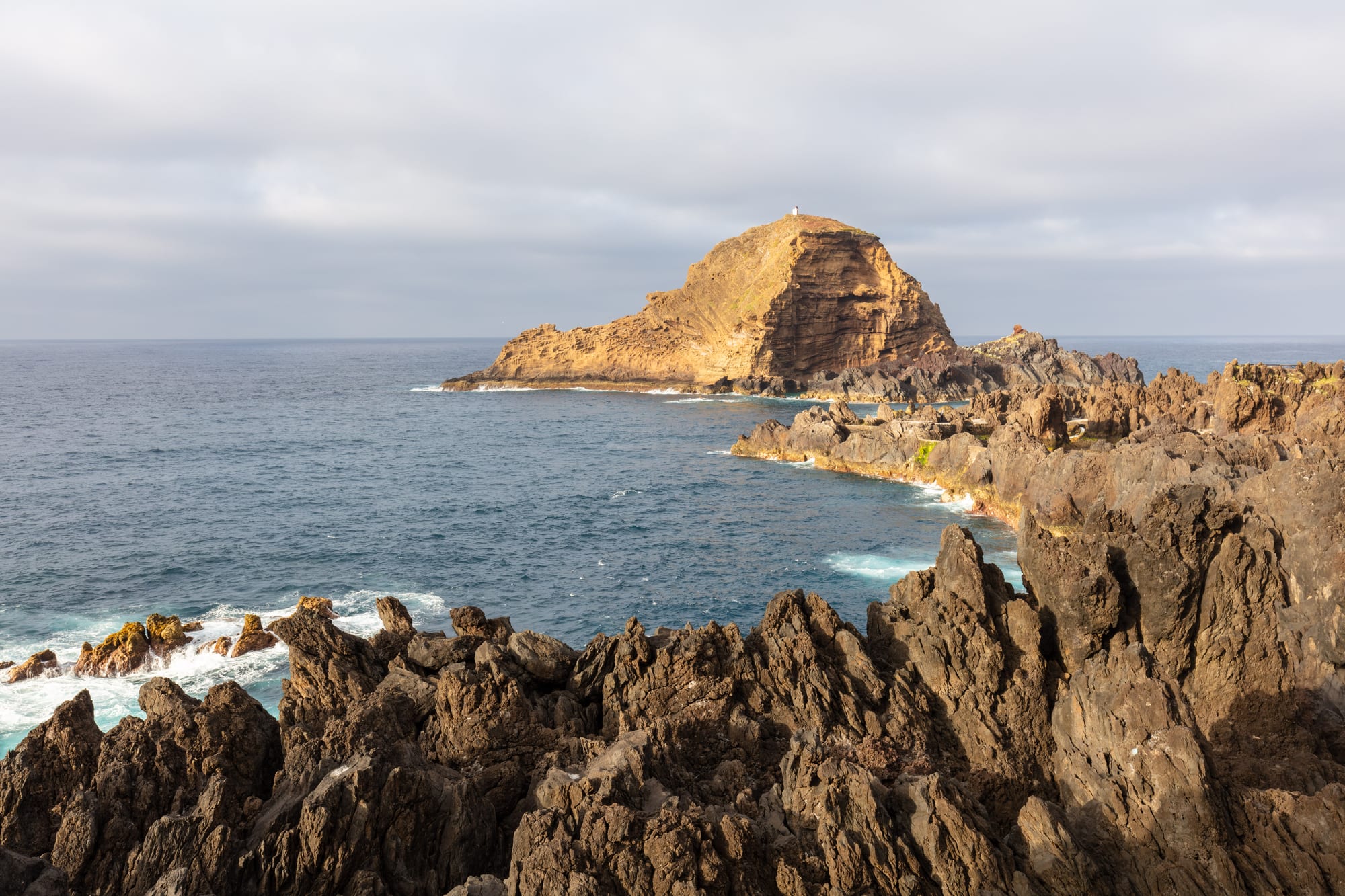
Jagged dark volcanic rocks in front of a blue sea, with a steep islet of layered brown rock beyond under grey cloud

Madeira

Porto Moniz

Volcanic rocks by the natural pools at Porto Moniz. (Diego Delso / Wikimedia Commons · CC BY-SA 4.0)

A village on the north-west corner of Madeira and the seat of a small rural municipality of four parishes, probably settled in the last quarter of the 15th century; among its first settlers was the Algarve nobleman Francisco Moniz. It is best known for its natural seawater pools among the volcanic rocks, and for the steep north coast that runs east from it towards Seixal.

Neighbourhoods

  • Porto Moniz village
    • First-time visitors
    • Swimming
    • Best for food

    The main settlement, on the shore south-east of Ponta do Tristão, the northernmost point of Madeira. The natural pools are in this parish, along with the science centre and the parish church.

    Open in Maps
  • Seixal
    • Quiet and residential
    • Beaches

    The largest parish of the municipality by area, on its eastern edge beside São Vicente, stretching from the sea up into the plateau of Paul da Serra. Its name comes from the pebbles of its beach.

    Open in Maps
  • Ribeira da Janela
    • Nature
    • Walks and viewpoints

    A small, mountainous parish along one of the longest valleys in Madeira, cut by the Janela stream from the plateau of Paul da Serra, with forest in the north and west of the valley. It lost much of its population to emigration in the 1960s.

    Open in Maps

Things to do

The village

  • Natural pools of Porto Monizattraction

    Saltwater pools among volcanic rocks where the sea flows in naturally, with sunbathing terraces and lifeguards through the year; in 2018 CNN named them among the 52 best beaches in the world.

    Open in Maps
  • Centro Ciência Viva do Porto Monizmuseum

    An interactive science centre about the laurisilva, Madeira's laurel forest, with a virtual flight over the forest, a levada exhibit and a garden of aromatic plants.

    Open in Maps
  • Church of Nossa Senhora da Conceiçãolandmark

    The main parish church of Porto Moniz, built in the 18th century.

    Open in Maps

Along the north coast

  • Seixalattraction

    A village east along the coast at the edge of the municipality, named after the pebbles on its beach.

    Open in Maps
  • Ribeira da Janela valleytrail

    One of the longest valleys in Madeira, cut by a stream that springs from the Paul da Serra plateau at about 1,420 metres, with forest in its northern and western parts.

    Open in Maps

Eat and drink

Long-standing places and food districts in Porto Moniz. Hours, ratings and directions come from your maps app, always current.

Porto Moniz classics

  • Espetadarestaurant

    Beef seasoned with salt, pepper, garlic and bay leaf and grilled on bay laurel skewers, Madeira's best-known dish.

    Open in Maps
  • Espada com bananarestaurant

    Black scabbardfish fried in batter and served with fried banana.

    Open in Maps

Experience Porto Moniz

History

It is not known exactly when the area of Porto Moniz was first settled, but it was probably at the beginning of the last quarter of the 15th century. One of the first landholders was Francisco Moniz, known as o Velho, a nobleman from the Algarve who married Filipa da Câmara, a granddaughter of João Gonçalves Zarco, the captain who had led the discovery of the islands. Moniz cleared land, set up a farm and built a chapel. The first settlers grew grain, raised cattle and cut timber.

From the 18th century vines were planted around Porto Moniz, and from the 19th century potatoes. The municipality was created on 31 October 1835 but had an unsettled start: it was abolished between 1849 and 1855, between 1867 and 1871 and again between 1895 and 1898.

The area has lost many of its people. Ribeira da Janela saw a mass departure in the 1960s from which it has never recovered, and in Achadas da Cruz no children were born between 2001 and 2009. Today the natural pools bring visitors from across the island.

Culture & Customs

The village's identity is bound up with the sea and the rocks. Its natural pools, where the Atlantic flows into basins in the volcanic rock, are popular with both Madeirans and visitors, hold a Blue Flag and are watched by lifeguards through the year. In 2018 CNN listed them among its 52 best beaches in the world, one for each week of the year.

The Centro Ciência Viva, created by the regional government, presents the laurisilva, the laurel forest that now covers 16 per cent of Madeira and is listed by UNESCO as a World Heritage Site. It has an auditorium for 120 people and a space for the work of local artists, and it works with schools across the region.

Religious life centres on the parish church of Nossa Senhora da Conceição, built in the 18th century. Outside the summer season the community is small and quiet, made up largely of farming families in a corner of the island far from Funchal.

Daily Life

The municipality had 2,528 people in 2023, spread across four parishes over about 83 square kilometres; the parish of Porto Moniz itself counted 1,584 residents at the 2021 census. Seixal is the largest parish by area and Achadas da Cruz the smallest in both area and population. At the 2011 census the parish of Porto Moniz had 1,668 people, Seixal 656, Ribeira da Janela 228 and Achadas da Cruz just 159. The municipality borders São Vicente to the east and Calheta to the south and south-west, and its whole northern edge is Atlantic coast.

Farming remains the main activity of the parish, alongside the visitors drawn by the pools. The parish of Porto Moniz covers 21 square kilometres, while Seixal, the largest, covers 36.37.

Life runs at a slow pace. The village lies south-east of Ponta do Tristão, the northernmost point of the island, and the main road that circles Madeira links the municipality with Calheta and Funchal.

Food

Porto Moniz eats as the rest of Madeira does. Espetada — cubes of beef seasoned with salt, pepper, garlic and bay leaf and grilled on bay laurel skewers — is the island's best-known dish, served with bolo do caco, a round flatbread traditionally cooked on a flat basalt slab called a caco, and often with milho frito, fried cornmeal cut into cubes, similar to a very firm polenta.

Fish is central to Madeiran cooking. Espada com banana, a traditional dish of the archipelago, is black scabbardfish fried in batter or breadcrumbs and served with fried banana, and fresh tuna is widely eaten in Madeira.

The island's drink is poncha, made with aguardente de cana — a spirit distilled from sugar-cane juice — with honey, sugar and orange or lemon juice. For dessert there is bolo de mel, the "honey cake", traditionally made with molasses, which by custom is torn by hand rather than cut.

Planning tools

Budget

Porto Moniz has Madeira's mid-range prices. The coast and the viewpoints are free. Getting here is the main cost: a hire car, or a long bus ride from Funchal.

Daily Budget Midrange
USD 125–245 (hotel or quinta, restaurant meals, a hire car)
Daily Budget Shoestring
USD 50–95 (guesthouse, café meals, the bus from Funchal)

Most visitors come for a day from Funchal by car or on a tour; staying a night gives the village and the pools a quieter evening and morning.

Best Time to Visit

The pools are most pleasant from June to August, the warm, dry season on the north-west coast. From mid-September to November it is still warm but wetter, and from December to April it is cooler and rainy.

Suggested Number of Days

Most visitors come for a day, usually as part of a drive around the west of the island. Two or three days allow time for the north coast and the valleys around it.

First Visit
1 day
With Surroundings
2–3 days

Transportation

Rodoeste buses link the village with Funchal and the west of the island; a hire car is the most flexible way to explore the coast on either side. Within the village everything is close enough to walk.

The roads of north-west Madeira are steep and winding; many visitors who are not used to them prefer a tour or a taxi.

Airport & Station Connections

Rodoeste buses run from the centre of Funchal to Porto Moniz on routes 80, by way of Calheta and Prazeres, and 139. Many visitors drive themselves or come on a tour. Madeira Airport, east of Funchal, is the nearest airport.

Walkability

The village is small and mostly flat by the sea, so the pools, the church and the restaurants are a few minutes apart on foot. Anything beyond it means steep roads, and the hills behind the village rise quickly.

Safety

Madeira is very safe, with low crime — bag theft in busy parts of Funchal is the main concern. In Porto Moniz the hazards are natural: Atlantic swell on the rocky coast, slippery volcanic rock around the pools, and steep mountain roads.

Swim only in the pools while lifeguards are on duty, keep off the outer rocks when the sea is rough, and take care on wet rock. Check current official travel advice before travelling.

Climate

The north coast of Madeira is generally about 1°C cooler than the south, because of more cloud and less sunshine. In nearby São Vicente the year divides into a warm, dry summer, a warm but wet autumn and a cooler wet season from December to April.

Summer
warm and dry from June to August — in nearby São Vicente average daily highs are 23–26°C
Winter
cooler and wet from December to April, with average daily highs of 18–21°C in nearby São Vicente

Local Customs

Tipping is not generally expected in Portugal: a euro or two after a full meal is appreciated, nothing is needed for a coffee or a snack in a café, and taxi fares are usually rounded up. Porto Moniz is a small Catholic farming community, and life outside the summer season is quiet.

Keep swimwear for the pools and the shore, and dress modestly in the parish church.

Common Payment Methods

The currency is the euro. ATMs marked Multibanco accept international cards and usually charge no extra machine fee; some independent cash machines charge high fees and poor exchange rates. Village cafés and small shops may prefer cash.