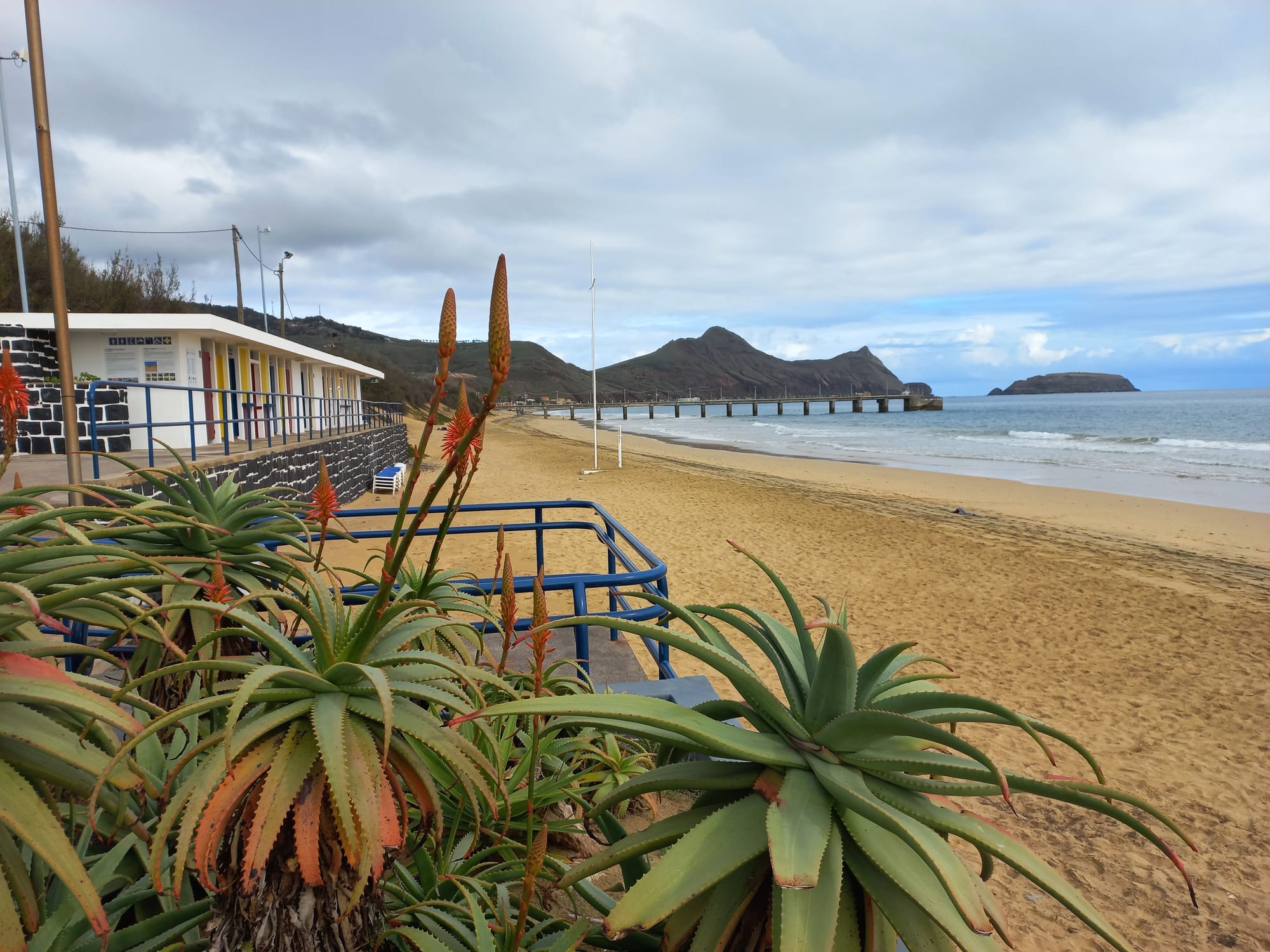
A long golden sand beach with aloe plants in front, a jetty, brown hills and a rocky islet offshore under cloud

Madeira

Porto Santo

The sandy beach of Porto Santo, with the jetty and the islet of Ilhéu de Cima beyond. (Asurnipal / Wikimedia Commons · CC BY-SA 4.0)

A low, dry island 43 kilometres north-east of Madeira, the first of the archipelago reached by Portuguese sailors in 1418 and named the 'Holy Harbour' for the shelter it gave them. Christopher Columbus lived here for a time. Today about 5,000 people live mostly in Vila Baleira, beside a nine-kilometre sandy beach that draws summer visitors.

Neighbourhoods

  • Vila Baleira
    • First-time visitors
    • Historic district
    • Best for food

    The island's main town, a city since 1996. The parish church and the old town hall stand on its central square, Largo do Pelourinho, and the house where Columbus is believed to have lived is now a museum; buses leave from the town centre.

    Open in Maps
  • The beach coast
    • Beaches
    • Quiet and residential

    The flat south-western plain that runs behind the nine-kilometre sand beach, with palms and holiday accommodation. It is the part of the island most visitors come for.

    Open in Maps
  • The north-east hills
    • Walks and viewpoints
    • Nature

    The rugged, mountainous north-east, with rocky ledges, cliffs and a line of volcanic peaks rising to 517 metres at Pico do Facho — little built-up, with a path linking Pico do Castelo to Pico do Facho and the nearby peaks.

    Open in Maps

Things to do

Beach and outdoors

  • Porto Santo beachbeach

    Nine kilometres of sand along the south coast, the feature that sets the island apart from Madeira, whose sand is reputed locally to ease rheumatism.

    Open in Maps
  • Pico do Casteloviewpoint

    A 437-metre volcano-shaped peak covered in conifers, with a panoramic terrace and picnic spot looking over Vila Baleira and the small islands offshore.

    Open in Maps
  • Porto Santo Golfeattraction

    A 27-hole golf club designed by Seve Ballesteros, opened in 2004, which hosted the Madeira Islands Open on the European Tour in 2009.

    Open in Maps

Vila Baleira

  • Casa Colombomuseum

    A museum in the house where Christopher Columbus is believed to have lived, on the Portuguese discoveries, Columbus and the island, and the wreck of a Dutch East India Company galleon off the coast.

    Open in Maps
  • Igreja Matrizlandmark

    The parish church of Nossa Senhora da Piedade, founded in the 15th century, almost destroyed by French corsairs in 1566 and largely rebuilt from 1667, with a bell tower trimmed in dark stone.

    Open in Maps
  • Paços do Concelholandmark

    The 16th-century town hall on the central square, Largo do Pelourinho, used over the centuries as both a jail and a palace.

    Open in Maps

Eat and drink

Long-standing places and food districts in Porto Santo. Hours, ratings and directions come from your maps app, always current.

Porto Santo classics

  • Bolo do cacorestaurant

    The round flatbread of Madeira and Porto Santo, traditionally cooked on a flat basalt slab called a caco.

    Open in Maps
  • Espada com bananarestaurant

    Fillets of black scabbardfish fried in batter or breadcrumbs and served with fried banana, a traditional dish of the Madeira archipelago.

    Open in Maps

Food districts

  • Vila Baleiraneighborhood

    The island's main town, with restaurants, bars, cafés and shops.

    Open in Maps

Experience Porto Santo

History

The islands of the Madeira group appear on European maps from the 14th century, but the first recorded landing came in 1418, when João Gonçalves Zarco and Tristão Vaz Teixeira, captains sent out by King John I, were driven by a storm into a sheltered bay. The sailors took their escape as a divine deliverance and named the island Porto Santo, the "Holy Harbour". Settlers arrived in the 1420s, and in 1445 Bartolomeu Perestrelo was made the first captain of the island. He also released a rabbit and her litter, whose descendants multiplied out of control on the dry island, stripping its native plants and leaving the slopes open to erosion.

Early life was hard: drinking water was scarce, the rabbits ate the crops, and pirates and privateers attacked again and again. French corsairs sacked the island in 1566, almost destroying the parish church, and in 1617 Barbary pirates carried off 663 of its people into slavery. Christopher Columbus married Filipa Moniz Perestrelo, the daughter of the first captain, and lived for a time on the island; the house where he is believed to have stayed is now a museum.

The island remained poor and remote until hotels were built in the 20th century around the beach and the mild climate. Vila Baleira was raised to city status in 1996, and a golf course designed by Seve Ballesteros opened in 2004.

Culture & Customs

Porto Santo shares the Catholic, Portuguese culture of Madeira, but on a smaller and quieter scale. Its main feast honours Nossa Senhora da Graça, whose chapel is counted among the island's heritage buildings. In the heart of Vila Baleira the parish church of Nossa Senhora da Piedade, which still keeps traces of its 15th-century building, displays paintings by Martin Conrad and Max Romer.

The story of Columbus is the island's best-known claim to fame. The Casa Colombo museum tells of his marriage into the family of the first captain and of the island's place in the Portuguese voyages of discovery, alongside the story of the Dutch galleon Sloot ter Hooge, which sank off the coast. The beach is part of local lore as well: its sand has long been credited with easing rheumatism and helping broken bones heal.

Islanders speak of their double insularity: they live on an island that depends on another island, itself far from the mainland, and the strong seasonal swing of tourism shapes the local economy.

Daily Life

The 2021 census counted 5,149 residents, fewer than the 5,483 of 2011; Vila Baleira is the main urban area. Although the island is small it has its own schools, health centre, police, churches, sports hall, congress centre, museum and shops.

Tourism is the main industry, built on the beach and the climate, with many of the hotels and resorts put up during the 20th century, and it is strongly seasonal: the island fills in summer and is very quiet for much of the rest of the year.

The municipality covers the whole island, about 42.6 square kilometres, and its neighbouring islets, with a single parish. As part of Madeira it belongs to one of the European Union's outermost regions. Days follow the sea and the season. The ferry and the short flights to Madeira link families, work and services on the two islands, and in the off-season the town's squares and cafés belong mostly to residents.

Food

Porto Santo eats much as Madeira does. Bolo do caco, the round flatbread traditionally made on both Madeira and Porto Santo, is cooked on a caco, a flat slab of basalt, and served with many meals. Fish is central to the islands' table: espada, the black scabbardfish, is fried in batter or breadcrumbs and served with fried banana, and fresh tuna is widely eaten. Milho frito, fried cornmeal cut into cubes and similar to a very firm polenta, is a common side dish.

For something sweet there is bolo de mel, the traditional "honey cake" of the Madeira Islands, traditionally made with molasses; by custom it is torn into pieces by hand rather than cut.

The islands' drink is poncha, made with aguardente de cana — a spirit distilled from sugar-cane juice — with honey, sugar and orange or lemon juice. Restaurants and cafés are concentrated in Vila Baleira, close to the beach.

Planning tools

Budget

Porto Santo has the same mid-range prices as Madeira, but it is a seasonal resort: most visitors come in summer, when rooms are dearer. The beach and the walks are free; the main costs are the crossing from Madeira by ferry or plane, a hire car or taxis, and golf.

Daily Budget Midrange
USD 125–245 (hotel, restaurant meals, a hire car or taxi tours, a round of golf)
Daily Budget Shoestring
USD 50–95 (guesthouse, café and bakery meals, buses and walking)

The crossing from Funchal is a large part of the cost of a short stay, so many visitors stay several nights rather than coming for the day.

Best Time to Visit

Summer is the beach season, and July and August are the driest months, with August and September the sunniest. The island is quieter for the rest of the year, when November and December bring most of its little rain.

Suggested Number of Days

Two or three days are enough to see the town and the viewpoints and to spend time on the beach. Most people who come for a beach holiday stay a week; the crossing from Madeira makes very short visits poor value.

First Visit
2–3 days
With Surroundings
4–7 days

Transportation

The island has a good road network linking its main points, and several companies hire out cars. A bus service runs from the town centre, and taxis can be found in Vila Baleira. The town itself and the beach close to it are easily covered on foot.

A hire car for a day or two is the simplest way to reach the viewpoints in the hilly north-east.

Airport & Station Connections

A ferry crosses from Funchal in about two hours. Porto Santo Airport, at Vila Baleira, is about 15 minutes by air from Madeira, with flights of roughly an hour and a half from Lisbon and Porto, plus seasonal and charter flights from other European cities.

Walkability

Vila Baleira is small and flat near the sea, and the beach runs straight from the town, so walking covers most daily needs. The peaks of the north-east are reached by road and then by footpath, on open, dry ground with little shade.

Safety

Madeira is very safe, with low crime — bag theft in busy parts of Funchal is the main concern. On Porto Santo crime is rarely a worry; the practical risks are sun on the open beach and hillsides and the sea itself.

Take water and sun protection on the hill paths, which have little shade, and follow local advice on sea conditions before swimming. Check current official travel advice before travelling.

Climate

Unlike mountainous Madeira, which traps rain clouds, low-lying Porto Santo has a dry, semi-arid climate with mild to warm winters and warm to hot summers. Rain is scarce, but humidity stays high, averaging 77 per cent through the year.

Summer
warm to hot and dry — July and August are the driest months; across the water in Funchal, average daily highs from May to September are 22–27°C
Winter
mild to warm, with most of the year's small rainfall in November and December; in Funchal, winter highs average 20–25°C

Local Customs

Tipping is not generally expected in Portugal: a euro or two after a full meal is appreciated, nothing is needed for a coffee or a snack in a café, and taxi fares are usually rounded up. The island's main feast honours Nossa Senhora da Graça.

Dress modestly in the parish church and keep beachwear for the beach and the seafront.

Common Payment Methods

The currency is the euro. ATMs marked Multibanco accept international cards and usually charge no extra machine fee; some independent cash machines charge high fees and poor exchange rates. A little cash is useful on a small island.