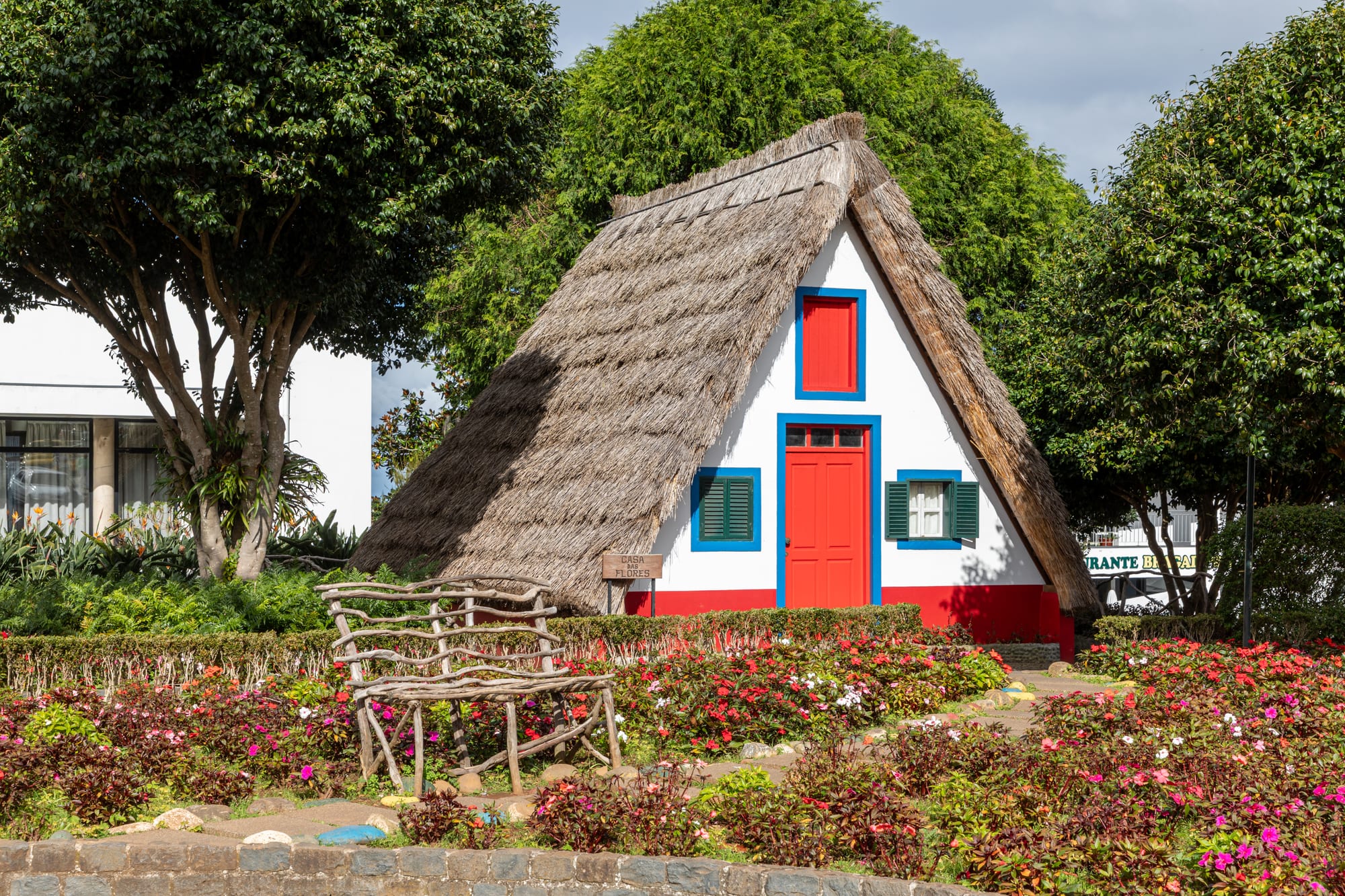
A small triangular thatched house with white walls, a red door and blue-trimmed windows behind beds of flowers

Madeira

Santana

One of the traditional thatched houses preserved in the centre of Santana. (Dietmar Rabich / Wikimedia Commons · CC BY-SA 4.0)

A small town on a high plateau above Madeira's north coast, settled around 1550 by families from Braga in northern Portugal and named after a chapel of Saint Anne. It is known for its triangular thatched farmhouses and as a gateway to Pico Ruivo and the laurel forest, in a municipality that UNESCO lists as a biosphere reserve.

Neighbourhoods

  • Santana town
    • First-time visitors
    • Historic houses
    • Best for food

    The town centre on the plateau, around the town hall, the 17th-century parish church and the group of restored thatched houses beside them. The tourist office is in one of the thatched houses next to the town hall, and a farmers' market is held on Sundays.

    Open in Maps
  • Faial
    • Quiet and residential
    • Coast

    The largest parish of the municipality, on the north coast, a scatter of hamlets that include Penha de Águia, Fajã and Moinhos. Its church was rebuilt in 1966 after a fire destroyed the original in 1960.

    Open in Maps
  • São Jorge
    • Historic church
    • Nature

    A neighbouring coastal parish, about half of it covered by laurel forest. Its Baroque church, completed in 1761, has a richly gilded chancel and an ornate pulpit.

    Open in Maps

Things to do

In the town

  • Casas típicas de Santanalandmark

    The group of traditional houses beside the town hall, with triangular thatched roofs reaching almost to the ground, which can be seen from the inside; the straw is renewed every few years.

    Open in Maps
  • Igreja Matriz de Santanalandmark

    The parish church, built in 1638, with Baroque carving and azulejo tiles in the chancel.

    Open in Maps
  • Madeira Theme Parkattraction

    A park on about seven acres presenting the history and culture of Madeira and Porto Santo, with displays on handicrafts and the thatched houses.

    Open in Maps
  • Rocha do Navio cable carattraction

    A small cable car, built to carry farmers to their fields by the shore, that runs down the cliff to a stretch of coast protected as a nature reserve.

    Open in Maps

Mountains and forest

  • Achada do Teixeiraviewpoint

    A mountain plateau with a car park and a basalt pillar known as the 'standing man', the start of the shortest trail to Pico Ruivo and one of the best places in Portugal for stargazing.

    Open in Maps
  • Pico Ruivotrail

    Madeira's highest peak at 1,861 metres, reached only on foot — most easily from Achada do Teixeira, or along the ridge path from Pico do Areeiro — with a hikers' shelter north of the peak.

    Open in Maps
  • Ribeiro Frioattraction

    A village at 860 metres in the laurel forest, known for its trout farm and as the start of levada walks, one leading to the Balcões viewpoint.

    Open in Maps
  • Caldeirão Verde walktrail

    One of Madeira's best-known levada hikes, starting from the forest house at Queimadas and leading to the Caldeirão Verde and on to the Caldeirão do Inferno; it calls for a head for heights.

    Open in Maps

Seasonal events

  • Festa dos Compadresa week before Shrove Sunday, February or March

    Two straw figures are carried through the town and a mock public hearing is staged with them.

  • Santíssimo Sacramentolate July to early August

    The parish church festival, with mass and a procession with flowers.

Eat and drink

Long-standing places and food districts in Santana. Hours, ratings and directions come from your maps app, always current.

Santana classics

  • Espetadarestaurant

    Beef seasoned with salt, pepper, garlic and bay leaf and grilled on bay laurel skewers, Madeira's best-known dish.

    Open in Maps
  • Trout at Ribeiro Friorestaurant

    A village in the laurel woods of the interior, whose name means 'cold stream', known for its trout farm.

    Open in Maps

Markets

  • Santana farmers' marketmarket

    A Sunday market in the town for produce from the surrounding farms.

    Open in Maps

Experience Santana

History

Santana was settled around 1550 by people from the Minho, around Braga in northern Portugal, and its people are still nicknamed the "Bragados". As elsewhere on the island, the land was divided among nobles and a few merchants under royal grants, under the system of sesmarias. A royal charter of 2 June 1564 created the parish, separating it from São Jorge and placing its seat at the chapel of Santa Ana — Saint Anne — which gave the town its name.

For centuries Santana was a farming community on a plateau that is broad by Madeiran standards. Its people lived in the triangular thatched houses that became the town's emblem, with a loft for storing crops above the living space, while the parish church was built in 1638. Santana became a vila and the seat of a new municipality in 1835.

Almost all of the original houses have since fallen into disrepair or serve as storage sheds, and a group of them is kept in the centre beside the town hall. On 1 January 2001 Santana was raised to the status of a city. The whole municipality, which reaches up into the mountains as far as Pico Ruivo, is recognised by UNESCO as a biosphere reserve.

Culture & Customs

The thatched house is Santana's symbol. Families lived under triangular gable roofs that reached almost to the ground, and most surviving examples are now kept for visitors, their straw renewed every few years. The Madeira Theme Park, on seven acres at the edge of town, presents the history, crafts and daily life of Madeira and Porto Santo.

The calendar mixes satire and devotion. A week before Shrove Sunday the Festa dos Compadres parades two straw figures through the streets and stages a mock public trial over a story of an affair and a murder, with plenty of drink to help the deliberations. At the end of July and the start of August the parish celebrates the Santíssimo Sacramento with a mass and a procession with flowers.

The mountains above the town are part of local life too. Since 2002 the astronomy group of the University of Madeira has held its AstroFesta at Achada do Teixeira, among the best places in Portugal for observing the night sky.

Daily Life

The municipality had 6,553 people at the 2021 census, down from 7,719 in 2011, spread across six parishes; the parish of Santana itself had about 3,300 people in 2011 and is the most populous, followed by Faial, with about 1,600, and São Jorge, with about 1,500; Faial is also the largest parish by area, and Arco de São Jorge the smallest in both area and people.

Agriculture has long been the basis of life here, alongside trade, services, hotels and restaurants. Daily coach tours stop in the town at lunchtime, and rural houses, apartments and quintas take overnight visitors who come to walk.

Santana stands on a plateau high above the sea, with fields close around it and the mountains behind. The weather shapes daily life: summers are the coolest on the island, winter brings heavy rain and frequent fog, and the forest slopes above town are among the wettest places on Madeira.

Food

Santana eats as the rest of Madeira does. Espetada — cubes of beef seasoned with salt, pepper, garlic and bay leaf and grilled on bay laurel skewers — is the island's best-known dish, served with bolo do caco, a round flatbread traditionally cooked on a flat basalt slab called a caco, and often with milho frito, fried cornmeal cut into cubes, similar to a very firm polenta.

Espada com banana, a traditional dish of the archipelago, is black scabbardfish fried in batter or breadcrumbs and served with fried banana. In the forest of the interior, the village of Ribeiro Frio, the "cold stream", is known for its trout farm. Produce from the surrounding farms is sold at a Sunday market in the town.

The island's drink is poncha, made with aguardente de cana — a spirit distilled from sugar-cane juice — with honey, sugar and orange or lemon juice. Bolo de mel, the traditional "honey cake" of Madeira, is traditionally made with molasses, and by custom it is torn by hand rather than cut.

Planning tools

Budget

Santana has Madeira's mid-range prices, with hotels, apartment complexes, rural houses and holiday apartments. The walks, viewpoints and the thatched houses in the centre are free; the theme park, the cable car and a hire car are the main costs.

Daily Budget Midrange
USD 125–245 (quinta or hotel, restaurant meals, a hire car)
Daily Budget Shoestring
USD 50–95 (youth hostel or rural guesthouse, café meals, buses)

The larger restaurants fill with coach tours at lunchtime, so eating earlier or later is calmer.

Best Time to Visit

Santana is at its most comfortable from late spring to early autumn, when walks to Pico Ruivo and in the forest are most often clear. Its summers are the coolest on the island, and its winters are cool, very wet and often foggy.

Suggested Number of Days

A day covers the town and its thatched houses. Walkers who want the highest peak and the forest trails need three or four, partly because cloud often closes in on the mountains and some days are lost to the weather.

First Visit
1–2 days
With Surroundings
3–4 days

Transportation

S.A.M. and Horários do Funchal buses, lines 56 and 129, connect Santana with Funchal and the airport by the east coast or across the eastern hills, and there are buses west to Arco de São Jorge. The trailheads in the mountains are easiest to reach by car or taxi.

West of Santana the old coast road towards Ponta Delgada is very narrow and winding; it is better treated as a scenic drive than a through route.

Airport & Station Connections

By car, Santana is about 40 minutes from Funchal by the coastal highway and around 20 minutes from Madeira Airport at Santa Cruz. Buses from Funchal take longer, running by way of the east coast or the mountains.

Walkability

The centre of town is compact and on a plateau, so the church, the thatched houses, the town hall and the restaurants are easy to walk between. Beyond it the land drops steeply to the sea and rises into the mountains, and the walking becomes real hiking.

Safety

Madeira is very safe, with low crime — bag theft in busy parts of Funchal is the main concern. Around Santana the hazards are the mountains: steep, exposed paths, sudden cloud and fog, and heavy rain on the north slopes.

Check the forecast before heading to Pico Ruivo or the Caldeirão Verde, which needs a head for heights, and carry warm, waterproof clothing even in summer. Check current official travel advice before travelling.

Climate

Santana has the coolest summers on Madeira, and its winters are cool, very wet and often foggy. Higher up, in the forest at Queimadas, rain falls through the year — about 2,300 millimetres annually, with November the wettest month — and the mountains are often wrapped in cloud.

Summer
mild and sometimes rainy, with an average summer temperature of about 17°C, the lowest on the island
Winter
cool, very wet and often foggy, averaging about 10.5°C

Local Customs

Tipping is not generally expected in Portugal: a euro or two after a full meal is appreciated, nothing is needed for a coffee or a snack in a café, and taxi fares are usually rounded up. People from Santana are nicknamed 'Bragados' after the settlers from Braga.

Many thatched houses outside the centre are private homes or sheds, so photograph them from the road and ask before stepping onto a farm.

Common Payment Methods

The currency is the euro. ATMs marked Multibanco accept international cards and usually charge no extra machine fee; some independent cash machines charge high fees and poor exchange rates. Small cafés and the market may prefer cash.