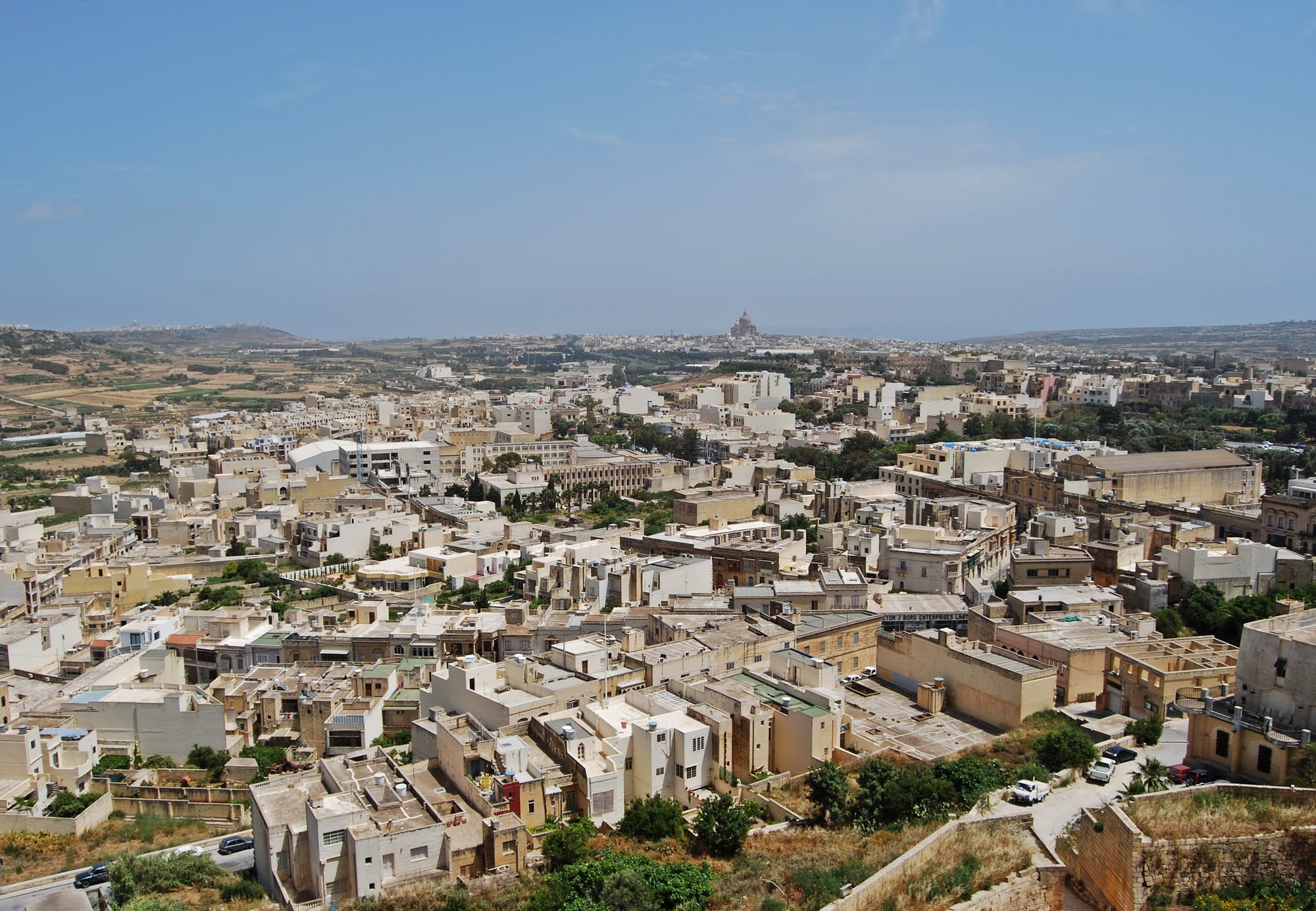
Pale stone houses and flat roofs of Victoria spreading across the Gozo plain, with a domed church on the horizon

Malta

Victoria

Victoria seen from the walls of the Cittadella, with the Gozo countryside beyond. (Felix König / Wikimedia Commons · CC BY 3.0)

The main town of Gozo, Malta's second island, set on a hill near the island's centre beneath the walled Cittadella, a hilltop site inhabited since the Bronze Age. Still called Rabat by many Gozitans, it grew from the medieval suburb outside the castle walls and is today a busy market and administrative town with a cathedral, a basilica and rival band clubs.

Neighbourhoods

  • The Cittadella
    • First-time visitors
    • Historic district
    • Views

    The walled citadel on the hilltop, closed to cars, holding the cathedral, small museums, the old prison and lanes of historic buildings. A walkway along its ramparts gives views over much of Gozo; the northern walls keep their medieval form.

    Open in Maps
  • Old Rabat and Independence Square
    • Local life
    • Best for food
    • Historic district

    The historic core below the citadel, which grew as a suburb outside its walls from the 15th century. Narrow streets wind around St George's Basilica to Independence Square, known as It-Tokk, with the Banca Giuratale, the war memorial and a weekday market.

    Open in Maps
  • Republic Street and Villa Rundle
    • Close to public transport
    • Shopping
    • Quiet and residential

    A street of the newer town below the old quarter, with the Villa Rundle Gardens between it and the main car park.

    Open in Maps

Things to do

The Cittadella

  • Cathedral of the Assumptionlandmark

    The Baroque cathedral inside the citadel, built between 1697 and 1711 to designs by Lorenzo Gafà on a site once occupied by a Roman temple to Juno, and seat of the Diocese of Gozo since 1864.

    Open in Maps
  • Cittadella rampartsviewpoint

    The walls of the old acropolis, whose southern side was rebuilt as a gunpowder fortress between 1599 and 1622 after the Ottoman sack of 1551, with views over much of the island.

    Open in Maps
  • Gozo Museum of Archaeologymuseum

    The island's archaeological collection inside the citadel, including Islamic-period tombstones.

    Open in Maps
  • Old Prisonmuseum

    The citadel's old prison, one of the historic buildings within its walls.

    Open in Maps
  • Gran Castello Historic Housemuseum

    A historic house within the citadel that serves as a folklore museum.

    Open in Maps

Churches and the town

  • St George's Basilicalandmark

    The basilica of Gozo's patron saint in the old town, with a carved wooden statue of St George and the Heart of Gozo: Il-Hagar museum beside it, opened in 2013.

    Open in Maps
  • Independence Square (It-Tokk)market

    The main square of the old town, with the Banca Giuratale, the war memorial and a weekday market.

    Open in Maps
  • Villa Rundle Gardenspark

    Public gardens between Republic Street and the main car park, with busts of the historian Agius de Soldanis and the Gozo-born writer Laurent Ropa.

    Open in Maps

Short trips from the town

  • Ġgantijaattraction

    In Xagħra, a megalithic temple complex of about 3600–2500 BC, the earliest of Malta's megalithic temples and older than the pyramids of Egypt.

    Open in Maps
  • Ta' Pinulandmark

    The basilica and national shrine of Our Lady of Ta' Pinu in open country near the village of Għarb, whose Marian image was crowned in 1935.

    Open in Maps
  • Ramla Baybeach

    A beach of reddish sand on the north-east coast between Marsalforn and San Blas, below the village of Xagħra.

    Open in Maps
  • Xlendibeach

    A small seaside village beside a bay in the south-west of the island.

    Open in Maps

Seasonal events

  • Feast of St Georgethird Sunday of July

    The solemn festivities for the patron saint of Gozo, centred on St George's Basilica; the parish also marks his day on 23 April.

  • Feast of the Assumption (Santa Marija)15 August

    The cathedral's feast of the Assumption of Mary, one of the town's two main feasts.

  • Feast of the Immaculate Conception8 December

    Celebrated by the Franciscan friars at the church of St Francis.

Eat and drink

Long-standing places and food districts in Victoria. Hours, ratings and directions come from your maps app, always current.

Gozitan classics

  • Ġbejnietmarket

    Small round cheeses made from sheep's milk, salt and rennet, which take up most of the sheep's milk produced in Malta.

    Open in Maps
  • Ftira Għawdxijarestaurant

    The Gozitan flatbread, topped or filled with potatoes or ġbejniet, eggs, grated cheese, tomatoes, anchovies, olives, ricotta or Maltese sausage.

    Open in Maps

Squares and markets

  • Independence Squareneighborhood

    The old town's main square, with a weekday market selling mostly goods for visitors.

    Open in Maps
  • Republic Streetneighborhood

    A street of the newer town, beside the Villa Rundle Gardens.

    Open in Maps

Experience Victoria

History

The hill at the centre of Gozo has been inhabited since the Bronze Age, and the site of the Cittadella is believed to have been the acropolis of the Punic-Roman town of Gaulos. In the Middle Ages the acropolis became a castle that served as a refuge for the island's people, and by the 15th century a suburb, Rabat, was growing outside its walls; that suburb is the historic core of the town today. The castle's defences were already obsolete in 1551, when an Ottoman force invaded Gozo and sacked it.

Between 1599 and 1622 the southern walls were rebuilt as a gunpowder fortress, while the northern walls kept their medieval form. Plans to demolish the citadel came up repeatedly in the 17th and 18th centuries but were never carried out, and the cathedral was rebuilt between 1697 and 1711 to designs by Lorenzo Gafà, who also built Mdina's cathedral. During the French invasion of 1798 and the uprising that followed, the fortress surrendered without much of a fight.

The British decommissioned the citadel in 1868. The cathedral became the seat of the new Diocese of Gozo in 1864, and on 10 June 1887, at the request of the Bishop of Gozo, the British government renamed the town Victoria for Queen Victoria's Golden Jubilee. The citadel has been on Malta's tentative list for UNESCO World Heritage status since 1998.

Culture & Customs

The town's culture turns on its parishes and their bands. The cathedral's feast of the Assumption on 15 August and St George's feast on the third Sunday of July are the two main feasts of the year, among five celebrated in the town. Their rivalry has a long history: the Leone Philharmonic Society, founded in 1863, and its first offshoot, La Stella, founded in 1880, fell out, and the Leone band took the Assumption while La Stella took St George. The statue of the Assumption in the cathedral was donated by the Leone society, and arguments between the bands continued for decades before it was handed over in 1956.

St George's is a personal parish rather than a territorial one, serving about half of the town. Its wooden statue of the saint, carved by Pietro Paolo Azzopardi, was the first titular statue on the island, and its Heart of Gozo: Il-Hagar museum, opened in 2013, was the first building in the country built for the purpose of a museum. The season of feasts ends with Our Lady of Divine Grace, kept by the Capuchin friars.

The town keeps two names: Victoria on the maps and Rabat for many Gozitans, especially older ones.

Daily Life

Victoria is the most populous settlement on Gozo, with about 7,500 people in 2024, of whom 1,690 were foreign nationals. Its bus station is about five minutes' walk from Independence Square, and the citadel above draws many of the visitors who come over from Malta for the day. The surrounding countryside is farmland, visible from the walls on every side.

Life in the old town still gathers around Independence Square, It-Tokk, with its weekday market, the old Banca Giuratale and the war memorial, and around the two great churches. In the newer town, the Villa Rundle Gardens lie between Republic Street and the main car park. A war shelter lies beneath the citadel, and the war memorial stands in the square.

Many Gozitans, older ones especially, still call the town Rabat, the name of its old centre, and the cathedral and St George's, with their rival band clubs, remain at the heart of local life. Beyond the town, roads run out through the farmland to the villages of the island, which are a short ride away by bus or car.

Food

Gozo's best-known food is its cheese. Ġbejna, plural ġbejniet, is a small round cheese made from sheep's milk, salt and rennet; the name is a diminutive of ġobna, "cheese", and is rendered in Maltese English as cheeselet. Most of the sheep's milk produced in Malta goes into these little cheeses, which also turn up in Maltese bread fillings and in Lenten fritters.

The other Gozitan speciality is ftira Għawdxija, a flatbread topped or filled with potatoes or ġbejniet, together with eggs, grated cheese, tomatoes, anchovies, olives, ricotta or Maltese sausage. Like the rest of Malta, Gozo eats pastizzi, savoury pastries of ricotta or curried peas, and Maltese bread made into ħobż biż-żejt with tomato, olive oil, tuna, capers and olives.

For a bigger meal there is stuffat tal-fenek, rabbit stew, often called the national dish, and in Lent fish and dishes such as stuffed artichokes, qaqoċċ mimli. Kinnie, the bittersweet soft drink made from bitter oranges and wormwood extracts, has a reputation as Malta's favourite non-alcoholic drink.

Planning tools

Budget

Victoria is a working town rather than a resort, and day-to-day costs are modest. Many visitors come over from Malta for the day; those who stay can use the town as a base for the whole island, which is small enough to cover by bus or hire car.

Daily Budget Midrange
USD 130–260 (comfortable guesthouse or farmhouse rental, restaurant dinners, museum tickets, a hire car)
Daily Budget Shoestring
USD 65–100 (guesthouse room, cheese and bread lunches, buses)

Victoria's bus station is a short walk from the centre, which makes the town a practical base for exploring the island without a car.

Best Time to Visit

Spring and autumn are best for walking the citadel and the countryside. July and August are hot, but they bring the town's biggest feasts, St George in July and the Assumption in mid-August. Winter is mild and quiet, with most of the year's rain.

Suggested Number of Days

The town itself fills a day. Most visitors spend three or four days on Gozo to take in the rest of the island, its temples, villages and bays, using Victoria as the hub; a car or a feast day changes the pace.

First Visit
1 day
With Surroundings
3–4 days

Transportation

The citadel is closed to cars, so walking is the only option there, and the old town is a short walk below it. Victoria bus station is about five minutes on foot from Independence Square; the bus to Xagħra and the Ġgantija temples runs regularly except on Sundays. There are several car parks near the citadel.

A hire car gives the most freedom on Gozo, but parking in the old town is tight; use the main car parks and walk up.

Airport & Station Connections

Visitors fly into Malta International Airport at Luqa and cross on the ferry from Ċirkewwa, on the north-west coast of Malta, to Mġarr harbour on Gozo, or take the fast ferry from Valletta's Grand Harbour; from Mġarr the bus to Victoria takes around 20 minutes, and taxis and hire cars are also available.

Walkability

The centre is compact: the citadel, St George's, Independence Square and Republic Street are all within a short walk of each other, though the climb up to the citadel is steep. Beyond the town, roads run through farmland and are better covered by bus or car.

Safety

Malta is one of the safer countries in Europe, with low levels of violent crime. Victoria is a quiet country town where the main care needed is on the uneven stone of the citadel and its unguarded ramparts.

Watch footing on the ramparts and steep lanes of the citadel, and take care when walking along narrow roads outside town. Check current official travel advice before travelling.

Climate

Mediterranean, with long, hot, dry summers and mild, wet winters. In Valletta, on the main island, August averages highs of about 32°C and January highs of about 16°C.

Summer
hot and dry — in Valletta, August averages highs of about 32°C and lows of about 23°C
Winter
mild and rainy — in Valletta, January averages highs of about 16°C and lows of about 10°C

Local Customs

Parish life is strong, and the town is divided between two band clubs, the Leone and La Stella, attached to the cathedral and to St George's, whose rivalry shapes the summer feasts. Many Gozitans, older ones in particular, still call the town Rabat. Churches are active places of worship.

Dress modestly in the cathedral and basilica, avoid visiting during services, and ask before photographing people during processions.

Common Payment Methods

The currency is the euro, as on the main island of Malta.