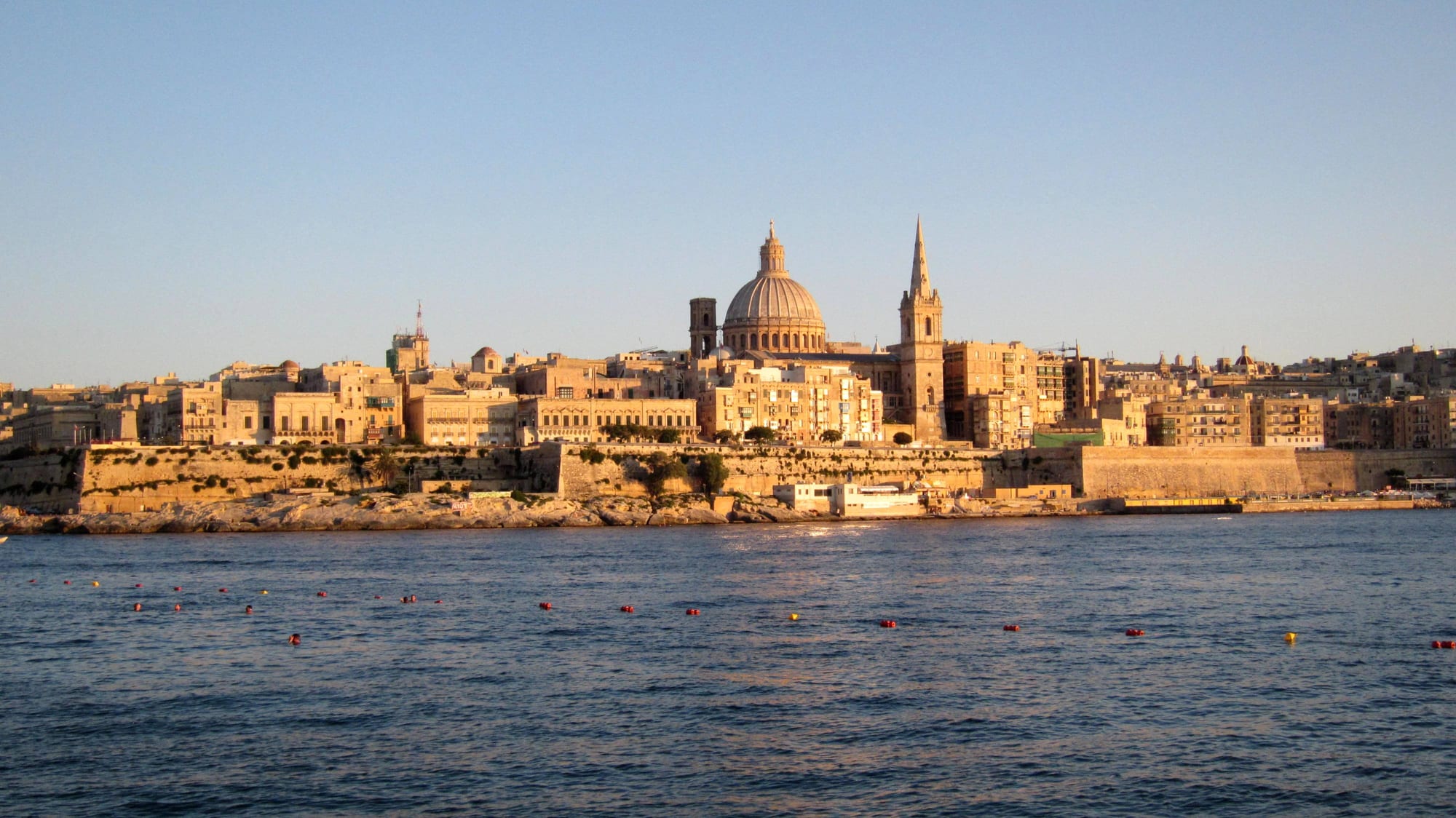
Valletta's golden stone skyline with a large church dome and a tall spire above the bastions, across the calm blue Marsamxett Harbour

Malta

Valletta

Valletta seen across Marsamxett Harbour in the evening light. (Martin Furtschegger / Wikimedia Commons · CC BY 3.0)

Malta's capital, built by the Knights of St John on a narrow peninsula between the Grand Harbour and Marsamxett Harbour after the Great Siege of 1565. A grid of honey-coloured Baroque streets inside massive bastions, it is a UNESCO World Heritage Site, the seat of government and one of the smallest capitals in the European Union.

Neighbourhoods

  • City Gate and Republic Street
    • First-time visitors
    • Close to public transport
    • Shopping

    The spine of the city, running about a kilometre from Renzo Piano's City Gate towards Fort St Elmo. The mostly pedestrianised street passes Parliament House, the ruined Royal Opera House, St John's Square, the law courts and Republic Square, with the Grandmaster's Palace beside it; the island's main bus terminus is just outside the gate.

    Open in Maps
  • Strait Street and the lower city
    • Nightlife
    • Historic district

    The narrow street running parallel to Republic Street, known to generations of Allied sailors as The Gut, where jazz first reached Malta. Today it has wine bars, and the streets beyond lead down towards Fort St Elmo and the area around the Sacra Infermeria, the Knights' old hospital.

    Open in Maps
  • Manderaggio and the Marsamxett side
    • Quiet and residential
    • Local life
    • Harbour views

    The western slope of the peninsula facing Marsamxett Harbour and Sliema. Manderaggio was planned as a small harbour that was never finished, and a crowded quarter grew up in its place; this side of the city is residential, with boċċi and water polo clubs and the ferry landing for Sliema below the walls.

    Open in Maps
  • Valletta Waterfront
    • Best for food
    • Cruise passengers

    A promenade below the bastions on the Grand Harbour, technically in neighbouring Floriana, built around 18th-century warehouses attributed to Andrea Belli. The restored Pinto and Forni stores now hold the cruise passenger terminal, bars, shops and restaurants, and the quay is used for concerts and events.

    Open in Maps
  • Floriana
    • Close to public transport
    • Quieter base

    The town that grew up outside Valletta's walls, inside the Floriana Lines, begun in 1636. It begins at the Tritons' Fountain by the main bus terminus and has wide open spaces and many gardens.

    Open in Maps

Things to do

Famous landmarks

  • St John's Co-Cathedrallandmark

    The Knights' conventual church, built between 1573 and 1578 to designs by Girolamo Cassar and redecorated in high Baroque style by Mattia Preti; it holds the only signed work and largest painting by Caravaggio.

    Open in Maps
  • Grandmaster's Palacemuseum

    The palace of the Grand Masters who ruled Malta until 1798, later the British governors' seat and now the Office of the President; its State Rooms and Armoury reopened to the public in 2024 after a major restoration.

    Open in Maps
  • City Gatelandmark

    The fifth gate to stand at the entrance to the city, designed by Renzo Piano and completed in 2014 on a site where the first gate was built in 1569.

    Open in Maps
  • Parliament Houselandmark

    Renzo Piano's home of the Parliament of Malta beside City Gate, opened in 2015 amid considerable controversy over its modern design and cost.

    Open in Maps
  • Royal Opera Houselandmark

    An opera house of 1866 by Edward Middleton Barry, destroyed by a direct hit from bombing in 1942; its ruins were later turned into an open-air theatre.

    Open in Maps
  • Manoel Theatreattraction

    A 534-seat theatre of 1731 with three tiers of gilded wooden boxes, reputed to be the third-oldest working theatre in Europe and home of the Malta Philharmonic Orchestra.

    Open in Maps
  • Tritons' Fountainlandmark

    Three bronze Tritons holding up a great basin outside City Gate, finished in 1959 and one of Malta's most important Modernist landmarks.

    Open in Maps

Museums and fortifications

  • Fort St Elmomuseum

    The star fort at the tip of the peninsula commanding the entrances to both harbours, best known for its part in the Great Siege of 1565.

    Open in Maps
  • Lascaris War Roomsmuseum

    Underground tunnels and chambers from which the defence of Malta was run in the Second World War, later used by NATO and now a museum.

    Open in Maps
  • MUŻAmuseum

    The national art museum, which opened in 2018 in the Auberge d'Italie as one of the projects of Valletta's year as European Capital of Culture.

    Open in Maps
  • National Museum of Archaeologymuseum

    Malta's prehistoric finds displayed in the Auberge de Provence on Republic Street, one of the original lodgings of the Knights.

    Open in Maps
  • National Library of Maltalandmark

    The Bibliotheca on Republic Square, founded in 1776 and housed in a late 18th-century neoclassical building, keeping the archives of the Order of St John.

    Open in Maps
  • Casa Rocca Piccolamuseum

    A 16th-century palace on Republic Street that is still the home of the noble de Piro family, shown to visitors on guided tours.

    Open in Maps

Gardens and the harbours

  • Upper Barrakka Gardensviewpoint

    Arcaded gardens on the highest point of the city walls, looking over the Grand Harbour, the Three Cities and the shipyard, above the Saluting Battery.

    Open in Maps
  • Lower Barrakka Gardenspark

    A smaller garden overlooking the Grand Harbour and its breakwater, centred on a neoclassical temple to Sir Alexander Ball.

    Open in Maps
  • Barrakka Lifttransit hub

    A lift opened in 2012 inside the ditch of the fortifications, linking Lascaris Wharf on the Grand Harbour with the Upper Barrakka Gardens.

    Open in Maps
  • Merchants Street marketmarket

    A daily street market of inexpensive clothing and goods on Merchants Street, which runs parallel to Republic Street.

    Open in Maps

Short trips from the city

  • Birguneighborhood

    The fortified town across the Grand Harbour, reached by ferry, that was the Knights' base before Valletta was built, with Fort St Angelo at its tip.

    Open in Maps
  • Sliemaneighborhood

    A short ferry ride across Marsamxett Harbour, a shopping and seafront town with a long promenade, rocky beaches and views back to the capital.

    Open in Maps
  • Ħal Saflieni Hypogeumattraction

    In Paola, a Neolithic underground sanctuary and burial place cut into the rock around 3300–3000 BC.

    Open in Maps

Seasonal events

  • Valletta Baroque FestivalJanuary

    A festival of Baroque music held in the city every January.

  • Maltese CarnivalFebruary, in the week before Ash Wednesday

    Valletta is the main stage for the national carnival, with a parade of allegorical floats, fancy dress and masked balls.

  • Feast of St Dominicearly August

    One of the city's parish feasts, celebrated on or before 4 August.

  • Victory Day regatta8 September

    The annual traditional rowing regatta on the national holiday, in which Valletta's Marsamxett team takes part.

Eat and drink

Long-standing places and food districts in Valletta. Hours, ratings and directions come from your maps app, always current.

Valletta classics

  • Pastizzeriecafe

    Small shops selling pastizzi, savoury pastries filled with ricotta or curried peas, found on almost every corner and a popular late-night snack.

    Open in Maps
  • Caffe Cordinacafe

    A café on Republic Street in the middle of the old city.

    Open in Maps

Food districts and bars

  • Strait Streetneighborhood

    The old sailors' street, known as The Gut, which now has wine bars.

    Open in Maps
  • Valletta Waterfrontneighborhood

    Restaurants and bars in the restored 18th-century harbour stores below the bastions, facing the Grand Harbour.

    Open in Maps

Experience Valletta

History

Valletta exists because of the Great Siege of 1565. When the Knights Hospitaller and the Maltese held out against the Ottoman invasion, Grand Master Jean Parisot de Valette resolved to build a fortified city on the bare Sciberras peninsula between the two harbours, and laid its foundation stone on 28 March 1566. He died in 1568 without seeing it finished. The streets were planned wide and straight, running from the land gate to the rebuilt Fort St Elmo at the tip, and the city was mostly complete by the early 1570s; on 18 March 1571 Grand Master Pierre de Monte moved his seat from Fort St Angelo in Birgu, and Valletta became the capital. Seven auberges were built for the Order's national langues by the 1580s.

The Knights went on improving their city. The Manoel Theatre went up in ten months in 1731, the Floriana Lines were added outside the walls, and under Grand Master Pinto many buildings, the Auberge de Castille among them, were remodelled in Baroque style. The French expelled the Order in 1798, and after a Maltese revolt their garrison in Valletta capitulated to the British in September 1800. British rule brought new buildings, a railway to Mdina that ran from 1883 to 1931, and the Royal Opera House.

The Second World War left deep scars: the opera house was destroyed by bombing in 1942. UNESCO listed the city as a World Heritage Site in 1980, and the City Gate project by Renzo Piano, completed between 2011 and 2015, gave Valletta a new gate, a new Parliament House and an open-air theatre in the opera house ruins. In 2018 the city was a European Capital of Culture.

Culture & Customs

Valletta is often called an open-air museum: its 320 monuments are packed into about half a square kilometre, one of the most concentrated historic areas in the world. Benjamin Disraeli, visiting in 1830, called it "a city of palaces built by gentlemen for gentlemen". That inheritance is lived in as well as admired. The Manoel Theatre is the home of the Malta Philharmonic Orchestra, and the Valletta International Baroque Festival is held every January. Jazz first reached Malta through Strait Street, the sailors' quarter of both world wars.

The city is the main stage of the Maltese Carnival in February, a tradition of floats, costumes and masked balls dating back centuries. Its history has a darker side too: in 1823 a crush during the carnival killed at least 110 boys. Parish life remains strong. The feast of St Dominic is celebrated on or before 4 August and that of St Augustine on the third Sunday after Easter, each with its own celebrations.

Neighbourhood loyalties run along old lines that appear on no map — the Arċipierku near the old hospital, the Baviera around the English Curtain, Manderaggio on the Marsamxett side — and the city has boċċi clubs on both the Marsamxett and Arċipierku sides. Rowers from Marsamxett compete in the traditional regatta on Victory Day, 8 September, and a water polo club comes from the Marsamxett side.

Daily Life

About 5,200 people lived in Valletta in 2024, a small population for a capital, while many more come in each day to work. The city is the seat of the state: the Office of the President is in the Grandmaster's Palace, the Prime Minister's office in the Auberge de Castille, and Parliament in its new building by City Gate, with the law courts on Republic Street. It is also a commercial centre for shopping, bars, dining and café life.

Malta's buses run mostly to or from Valletta, so the terminus outside the gate is the hub of the island's bus network. A congestion charge introduced in 2007 aims to reduce long-term parking and traffic in the city. Inside the walls the rhythm changes through the day: office workers and tour groups in the morning, a quieter afternoon, and evenings when the bars of Strait Street and the restaurants along the waterfront fill.

The residential quarters on the slopes towards the harbours are quieter, and their old loyalties live on in the local boċċi clubs, the water polo club and the parish feasts.

Food

The everyday food of Valletta is the pastizz, a savoury pastry filled with ricotta (tal-irkotta) or curried peas (tal-piżelli), sold from small shops on almost every corner and eaten at any hour, late at night included. Maltese bread, a crusty sourdough loaf usually baked in wood ovens, is the base of ħobż biż-żejt: bread rubbed with tomato or tomato paste, drizzled with olive oil and filled with tuna, olives, capers, onion, bigilla or ġbejna, the small Gozitan cheese.

At the table, stuffat tal-fenek, stewed rabbit, is often identified as the national dish, and aljotta is a fish broth with garlic, herbs and tomatoes. Lent brings its own dishes, from fish such as lampuki to stuffed artichokes, qaqoċċ mimli, and fritters of ġbejna and vegetables, and other seasons have their own sweets, such as the figolla and the prinjolata.

To drink there is Kinnie, the bittersweet brown soft drink made from bitter oranges and extracts of wormwood, introduced in 1952 by the Farsons brewery and often called the national soft drink; it is drunk on its own or mixed with alcohol. Restaurants cluster on the Valletta Waterfront and in the side streets, and Strait Street has wine bars.

Planning tools

Budget

Valletta is one of the more expensive places to stay in Malta, because so much of the city is historic and the supply of rooms inside the walls is small. Eating is affordable if pastizzi and simple bread lunches are part of the plan, and many of the sights — the gardens, the streets, the bastion walks and the outside of the palaces — are free.

Daily Budget Midrange
USD 140–280 (small hotel or guesthouse in the old city, restaurant dinners, museum tickets, the occasional taxi)
Daily Budget Shoestring
USD 70–110 (guesthouse or hostel bed nearby, pastizzi and bread lunches, buses and harbour ferries)

Staying across the harbour in Sliema or the Three Cities and using the ferry is often cheaper than a room inside the walls.

Best Time to Visit

Spring and autumn are the most comfortable seasons for walking the streets and bastions. Summer is long, hot and dry, with high humidity by the sea and the parish feasts in full swing. Winter is very mild but brings most of the year's rain; January has the Baroque music festival and February the carnival.

Suggested Number of Days

The city itself is very small and can be seen in one or two days. Allow three or four to add the towns across both harbours, which are a short ferry ride away, and more if Valletta is the base for the rest of Malta.

First Visit
1–2 days
With Surroundings
3–4 days

Transportation

Inside the walls, walking is the way to get around: Republic Street is mostly pedestrianised, and small electric cabs and horse-drawn karozzini are the alternatives. Most of Malta's bus routes start and end at the terminus just outside City Gate, and bus route 133 circles the peninsula. Ferries cross Marsamxett Harbour to Sliema and the Grand Harbour to the Three Cities, and the Barrakka Lift links the Upper Barrakka Gardens with the Grand Harbour quay.

A congestion charge for driving into the city has applied since 2007; the buses that end outside City Gate are the simpler way in.

Airport & Station Connections

Malta International Airport is at Luqa, south-west of the capital, and the X4 bus reaches Valletta in about 20 minutes. Buses from across the island converge on the terminus outside City Gate, and cruise ships berth at the Valletta Waterfront below the walls.

Walkability

Excellent. The whole city covers about 0.6 square kilometres on a grid of straight streets laid out by the Knights, and Republic Street runs the length of it in about a kilometre. Streets rise and fall across the ridge of the peninsula, the Barrakka Lift saves the climb from the Grand Harbour, and the walk around the walls gives views of both harbours.

Safety

Malta is one of the safer countries in Europe, with low levels of violent crime. In Valletta the busiest streets are crowded with cruise passengers and day visitors, which is where bags and phones are most at risk, and the bastion edges and harbour rocks call for care.

Watch bags in the Republic Street crowds and on full buses, and take care near unguarded drops on the bastions and rocks. Check current official travel advice before travelling.

Climate

A hot-summer Mediterranean climate: long, hot, dry summers with high humidity, and very mild, wet winters. Frost and snow are essentially unknown, and the sea keeps winters gentle.

Summer
hot and dry — August averages highs of about 32°C and lows of about 23°C
Winter
very mild and rainy — January averages highs of about 16°C and lows of about 10°C

Local Customs

Valletta is a Catholic city whose churches are places of worship as well as monuments, and modest dress is expected inside them. The city keeps its parish feasts and boċċi clubs, and Maltese and English are both official languages. Government offices, the courts and Parliament all sit in the old city, so weekdays bring office workers as well as visitors.

Cover shoulders and knees for church visits, keep voices down during services, and ask before photographing people at feasts and processions.

Common Payment Methods

The currency is the euro. Bus fares can be paid in cash or with a contactless bank card on board.