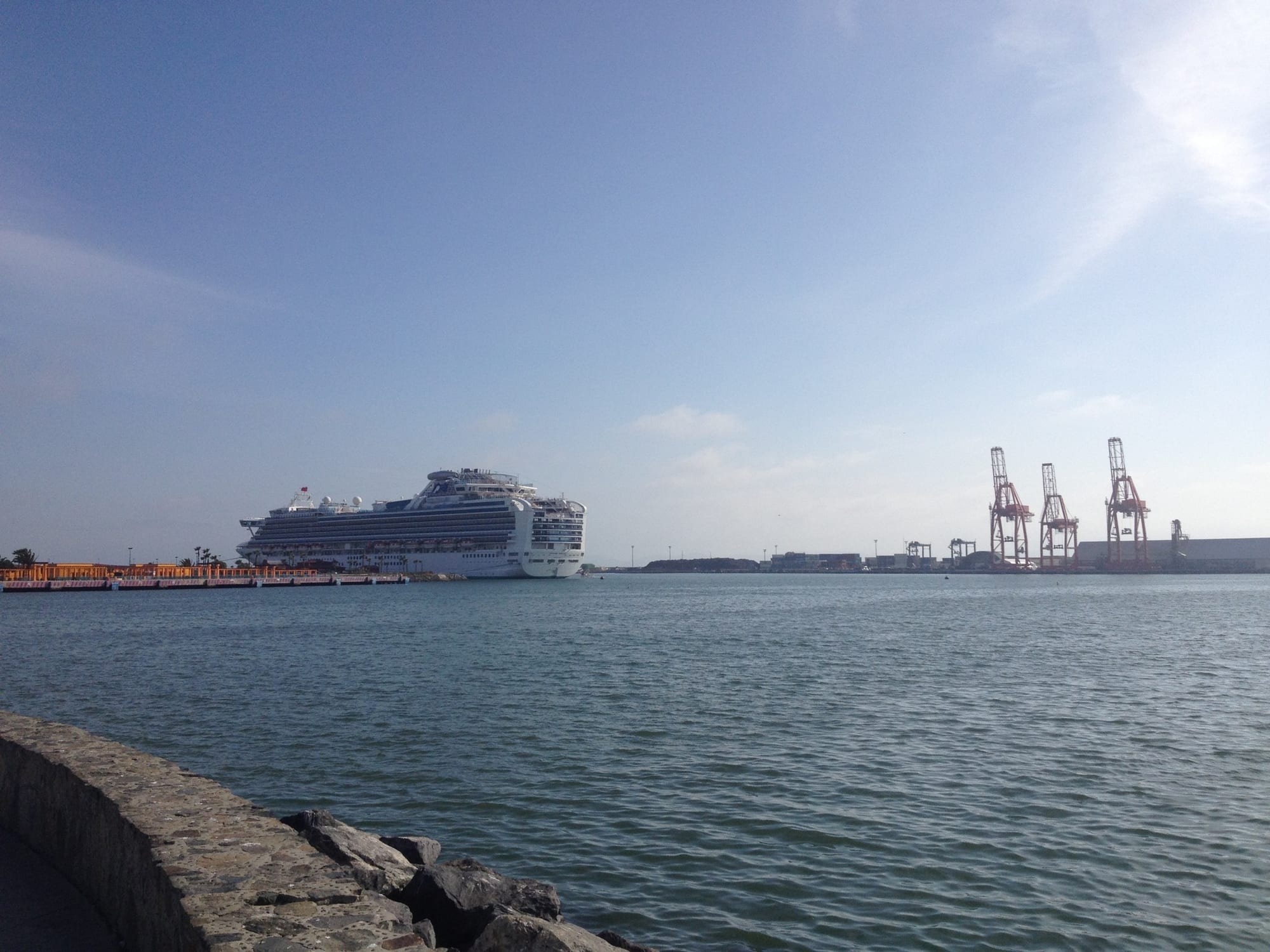
A large white cruise ship moored in Ensenada harbour, with red container cranes to the right, seen from a stone seawall

Baja California, Mexico

Ensenada

A cruise ship at the Port of Ensenada, seen from the seafront promenade. (Dark meme / Wikimedia Commons · CC BY-SA 3.0)

A Pacific port city on the Bahía de Todos Santos in Baja California, about 108 km south of the US border. Made a territorial capital in 1882 and a resort for Americans during Prohibition, it is now a fishing, cruise and science city at the gateway to the Valle de Guadalupe, the source of most of Mexico's wine.

Neighbourhoods

  • Centro and Calle Primera
    • First-time visitors
    • Nightlife
    • Shopping

    The old centre behind the port, where Avenida López Mateos, known as La Primera, is lined with curio shops, restaurants, hotels, bars and clubs. Avenida Ruiz, with its long-established cantinas, crosses it, and the cathedral is a short walk inland.

    Open in Maps
  • The waterfront
    • Walks
    • Boat trips
    • Seafood

    The seafront between the port and the marinas, one block from La Primera, with the Ventana al Mar promenade and its giant Mexican flag, the Mercado Negro fish market, the science museum and the docks where cruise passengers come ashore and fishing boats leave.

    Open in Maps
  • El Sauzal and the north coast
    • Surfing
    • Craft beer
    • Wine-route access

    The coast north of the city towards the turn-off for the wine valley, with the surf breaks of San Miguel Beach and a cluster of young craft breweries around the small community of El Sauzal, where Highway 3 heads inland.

    Open in Maps

Things to do

The port and the town

  • Ventana al Marviewpoint

    The seafront promenade a block from La Primera, known for its enormous Mexican flag and views across the harbour to the cruise terminal.

    Open in Maps
  • Calle Primeraneighborhood

    Avenida Adolfo López Mateos, the busy main street for visitors, with curio shops, restaurants, bars and clubs used by tourists and residents alike.

    Open in Maps
  • Museo Histórico Regionalmuseum

    A small museum of regional history in a former prison in the centre.

    Open in Maps
  • Caracol Museo de Cienciasmuseum

    A modern science museum on the waterfront with floor-to-ceiling windows over the ocean and a large planetarium.

    Open in Maps
  • Cathedral of Our Lady of Guadalupelandmark

    The city's cathedral, built in the Spanish colonial style, seat of the diocese created in 2007.

    Open in Maps

The sea

  • San Miguel Beachbeach

    A public beach on the north coast of the city and one of the area's best-known surf breaks.

    Open in Maps
  • Isla Todos Santosattraction

    A pair of islands about 19 km offshore, reached only by boat, whose big-wave break is among the largest in North America and has hosted international surf contests.

    Open in Maps
  • Whale watchingattraction

    Grey whales pass the coast on their migration to the lagoons of Baja California Sur and can be seen between December and March, and again in April and May on their way back north.

    Open in Maps

Short trips from the city

  • La Bufadoraattraction

    A marine blowhole on the Punta Banda peninsula, about 27 km south, that sends sea water high into the air; the street to the viewpoint is lined with craft stalls, where bargaining is customary.

    Open in Maps
  • Valle de Guadalupeattraction

    The wine valley about 20 km north of the city along Highway 3, which produces most of Mexico's wine and is known for its wineries, tastings and Baja Med restaurants, with small museums kept by families of Russian settlers.

    Open in Maps

Seasonal events

  • Baja 500early June

    An off-road desert race that traditionally starts and ends in the city.

  • Fiestas de la VendimiaAugust

    The wine harvest festival, two weeks of cultural and food events in the Valle de Guadalupe and the city.

  • Baja 1000November

    One of the world's best-known off-road races, founded in 1967; roughly every other year it is a loop starting and finishing in Ensenada, and in the others it runs from Ensenada down the peninsula.

Eat and drink

Long-standing places and food districts in Ensenada. Hours, ratings and directions come from your maps app, always current.

Ensenada classics

  • Mercado Negromarket

    The open-air fish market by the harbour, where the catch of the city's fleet is sold and stands serve fish tacos.

    Open in Maps
  • Calle Primera seafood standsneighborhood

    The main street of the centre, where fish and shrimp tacos and ceviche are sold from stands and small restaurants.

    Open in Maps

Cafés and bars

  • Hussong's Cantinarestaurant

    Established in 1892, the oldest and best-known cantina in Baja California, on Avenida Ruiz.

    Open in Maps
  • El Sauzal craft breweriesneighborhood

    Ensenada's densest cluster of young craft breweries, along the road north towards the wine valley.

    Open in Maps

Experience Ensenada

History

Yuman-speaking hunter-gatherers lived around the bay and in the valleys of the Sierra de Juárez and Sierra de San Pedro Mártir long before Europeans arrived, and the Kumeyaay had a village called Pa-tai where the city now stands. Kiliwa, Paipai and Kumeyaay communities still live in the region. Juan Rodríguez Cabrillo reached the bay by sea in 1542 and named it San Mateo; in 1602 Sebastián Vizcaíno, searching for safe harbours for the Manila galleons, renamed it Ensenada de Todos Santos. Missionaries, first Jesuits and then Dominicans, brought the first permanent settlement.

The modern city dates from 1882, when the small community of Rancho Ensenada de Santos was made capital of the northern part of the Baja California territory. Gold and silver mines in the hills brought growth, and an English land company tried to develop the area, but the Mexican Revolution left it devastated and the capital moved to Mexicali in 1915. By 1930 only about 5,000 people lived here. Early in the century the name was shortened to Ensenada to avoid confusion with Todos Santos in the south.

US Prohibition changed its fortunes, sending Americans south in search of drink and entertainment. A grand hotel and casino opened on the bay in 1930 and briefly put the town on the international map; it closed in 1964 and later became a cultural centre and museum. Ensenada truly began to grow in the 1950s, and by the 1960s it was an established resort. The port, fishing, science and the wine valley have since made it one of the main cities of Baja California.

Culture & Customs

Ensenada calls itself La Cenicienta del Pacífico, the Cinderella of the Pacific, and has a relaxed, outdoor character shaped by the sea and by its closeness to California. Spanish missionaries and Russian settlers both had a part in starting its wine industry: Spiritual Christians from southern Russia settled the nearby Guadalupe valley between 1905 and 1910, and families who remained still keep small museums there. The city is a member of the UNESCO Creative Cities Network.

Its calendar is full of big events. The carnival is one of the largest in Mexico, filling the streets for six days and nights, and in August the Fiestas de la Vendimia celebrate the start of the grape harvest in the city and the valley. Motorsport has a devoted following: the Baja 500 and Baja 1000 off-road races traditionally start or finish here, and the Newport to Ensenada yacht race and the Rosarito–Ensenada bike ride both end in the city. The Marineros de Ensenada baseball team play in the Liga Norte de México.

The city's other identity is scientific. With the research centre CICESE, the Ensenada campus of the Autonomous University of Baja California and research institutes of UNAM, it has been called the City of Science, and is claimed to have more scientists per head than any other city in Latin America.

Daily Life

About 331,000 people lived in the city at the 2020 census, making it the third-largest in Baja California after Tijuana and Mexicali.

The economy rests on the port, fishing, tourism, science and light industry. The Port of Ensenada is the only deep-water port on the peninsula and handles cargo, cruise ships and fishing boats; more than 90 species are fished commercially, from tuna, shrimp and spiny lobster to abalone and sea urchin, much of it exported to East Asia, and the tuna industry has turned to farming fish for the Japanese market. Factories produce electric guitars and marine electronics, and a cluster of medical-device and biotechnology companies works closely with San Diego's.

Daily life follows the rhythm of the port and the weekend visitors from southern California, and cruise days fill the centre. Water is a constant issue in a city without rivers: a dam built in 1976 and, since 2018, a desalination plant help supply it.

Food

Seafood is everywhere, and Ensenada is said to be the birthplace of the fish taco — battered white fish in a corn tortilla, served with cabbage, cream and salsa. Local cooks use white fish, shrimp or a mix of both. Shrimp tacos and ceviche are just as typical, usually with avocado and salsa, and carpaccio is also counted as a dish of the port. The Mercado Negro by the harbour is the place to see the day's catch and eat it.

The surrounding farmland adds grapes, olives, tomatoes and asparagus, and the city's Mediterranean climate means wine and olive oil are part of everyday cooking. Spanish, Italian and French influences sit beside Mexican dishes on the city's menus, and the restaurants of the Valle de Guadalupe are known for Baja Med cooking, which mixes Mexican ingredients with Mediterranean techniques.

To drink, the valley produces most of Mexico's wine, and a second wine area lies south of the city at Santo Tomás. Craft beer has grown fast, with young breweries clustered around El Sauzal north of town, and the cantinas of Avenida Ruiz, Hussong's above all, have served visitors since the 19th century.

Planning tools

Budget

Ensenada is much cheaper than Los Cabos or the wine valley, with taco-stand and market meals for little money. Costs rise on cruise days and weekends, when visitors from southern California arrive, and winery tastings, valley restaurants and tours to La Bufadora are the biggest extras.

Daily Budget Midrange
USD 110–220 (mid-range hotel, seafood dinners, a winery tasting or a hire car)
Daily Budget Shoestring
USD 40–70 (hostel or simple hotel in the centre, fish tacos and market food, local buses)

Visit the wine valley on a weekday if possible, and use local buses rather than cruise-line tours for La Bufadora.

Best Time to Visit

The city is mild all year. August brings the wine harvest festival and the warmest weather; late spring and early summer can be grey under the coastal marine layer, and most of the year's rain falls in winter. Grey whales pass the coast from December to May.

Suggested Number of Days

Two or three days covers the city and the coast nearby. Allow four or five to spend real time in the wine valley as well. Cruise passengers usually have only a single day ashore.

First Visit
2–3 days
With Surroundings
4–5 days

Transportation

The centre and the waterfront are compact. Taxis and local buses serve the rest of the city, and local buses also run out to La Bufadora. A car or tour is the usual way to visit the wineries, which are spread along Highway 3. On cruise days shuttle buses run between the cruise terminal and the town.

Arrange a driver or tour for winery visits rather than driving after tastings.

Airport & Station Connections

Most visitors arrive by road from the US border: the four-lane toll road MX-1D and a two-lane free road follow the coast from Tijuana, and Highway 3 links the city with Tecate and Mexicali. Tijuana International Airport, 112 km north, is the nearest international airport; Ensenada's own small airport has few flights. Cruise ships from Los Angeles and Long Beach call regularly at the port.

Walkability

The centre, La Primera, the waterfront promenade and the fish market are all within an easy walk. The beaches, breweries, blowhole and wineries are out of town and need a car, bus or tour.

Safety

Safety varies enormously by state and even neighbourhood. Baja California has high levels of organised-crime violence, and visitors can be caught up in it. Visitors mostly encounter petty theft and the risks of the road.

Keep to the busy central areas at night, use registered taxis or apps, and avoid driving between towns after dark. Check current official travel advice before travelling.

Climate

A mild semi-arid climate much like southern California's, tempered by the cold California Current. Rain, about 280 mm a year, falls mainly in winter; late spring and early summer often bring grey skies from the marine layer; late summer and early autumn are the warmest times. Hot, dry Santa Ana winds can raise temperatures at any time of year.

Summer
mild and dry — June to September averages about 21°C
Winter
cool — November to February averages about 13°C, with most of the year's rain

Local Customs

Spanish is the everyday language, though English is spoken to a degree in the centre and the tourist areas. A greeting of buenos días or buenas tardes is expected, and tipping is customary in restaurants and bars. Bargaining is normal at curio stalls, including those on the road to La Bufadora.

Ask before photographing people, and drink in moderation at tastings if driving.

Common Payment Methods

The currency is the Mexican peso. US dollars are taken in the tourist areas, usually at a poor rate. Cards are accepted in hotels, larger restaurants and wineries; taco stands, market stalls and buses want pesos in cash. Use ATMs inside banks or shopping centres.