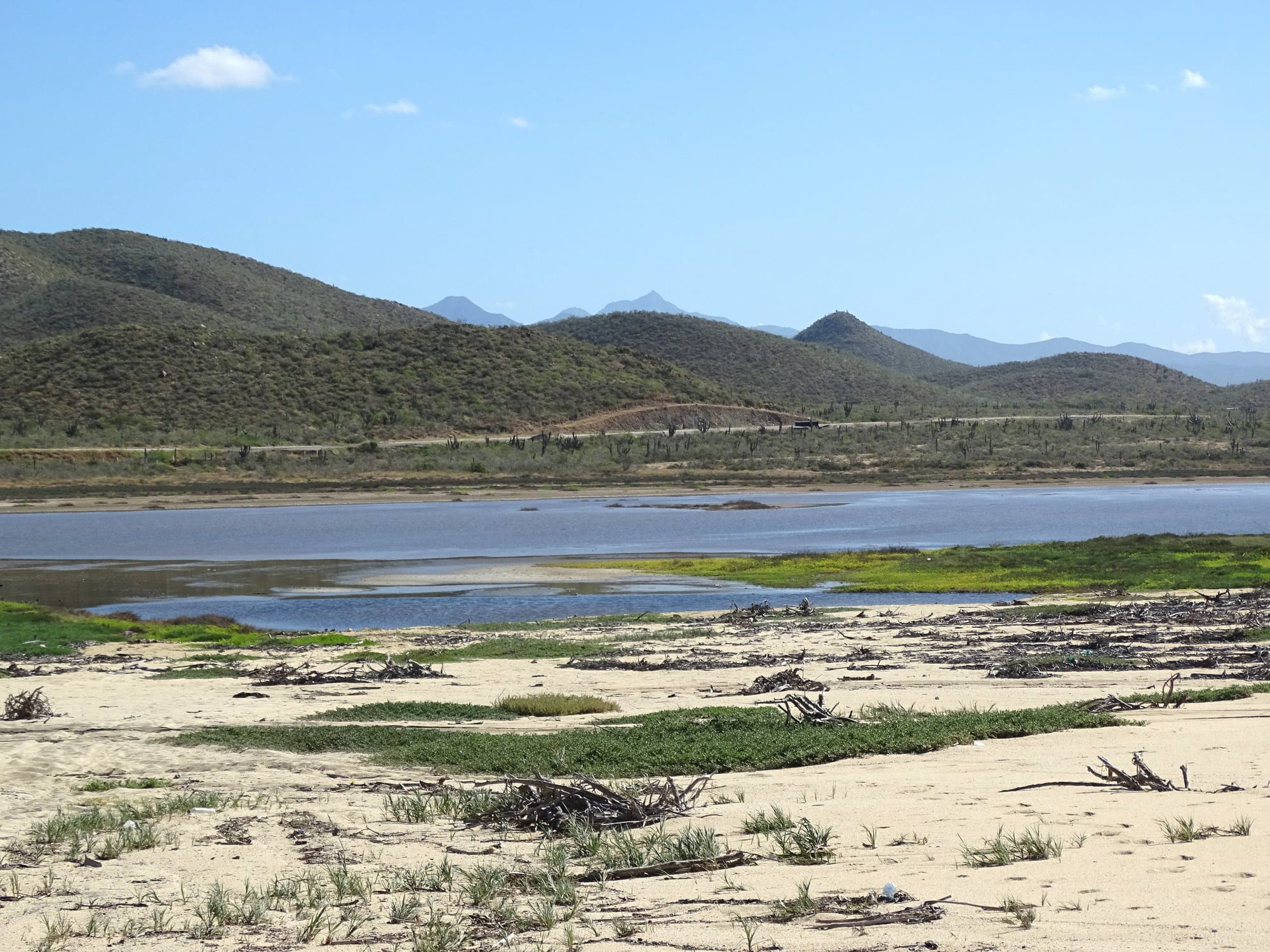
A shallow lagoon behind a pale sandy beach, with green scrub-covered hills and distant mountain peaks under a blue sky

Baja California, Mexico

Todos Santos

Los Cerritos beach on the Pacific coast near Todos Santos. (Adam Jones from Kelowna, BC, Canada / Wikimedia Commons · CC BY-SA 2.0)

A small town on the Pacific side of southern Baja California, in the foothills of the Sierra de la Laguna on the Tropic of Cancer. It grew from an 18th-century Jesuit mission into the peninsula's sugarcane capital, declined when its spring ran dry, and revived as a Pueblo Mágico of galleries, farms and surf beaches.

Neighbourhoods

  • The historic centre
    • First-time visitors
    • Art galleries
    • Best for food

    The old town around the small plaza and the mission church, with brick and adobe buildings from the sugar-boom years, galleries, craft shops, cafés and restaurants. Its streets are quiet by day and many are still unpaved, and the town's oasis of palms and orchards lies at its edge.

    Open in Maps
  • The Pacific beaches
    • Beaches
    • Surfing
    • Quiet stays

    The coast on either side of town, with beaches such as San Pedrito, Los Cerritos, Punta Lobos and La Poza. Their heavy surf makes them good for surfing rather than swimming, and the houses and small places to stay along them are spread out, so a car is needed.

    Open in Maps

Things to do

In town

  • Mission church of Nuestra Señora del Pilarlandmark

    The church across from the town plaza, heir to the Jesuit mission founded here in the 18th century, which holds the statue of the Virgin of El Pilar at the centre of the town's main festival.

    Open in Maps
  • The galleriesattraction

    About twenty art and sculpture galleries, along with shops of Mexican crafts, fill the old centre in a town long known for its painters, sculptors and artisans.

    Open in Maps

The coast

  • Playa Los Cerritosbeach

    One of the beaches near town whose strong waves make it a surfing spot.

    Open in Maps
  • Playa San Pedritobeach

    One of the surf beaches near town, where strong Pacific waves draw surfers.

    Open in Maps
  • Punta Lobosbeach

    A beach near town on the open Pacific, another of the strong-surf beaches of the area.

    Open in Maps

Short trips from the town

  • Sierra de la Lagunapark

    The mountain range whose foothills rise behind the town, known for its unique plant life.

    Open in Maps
  • La Pazneighborhood

    The capital of Baja California Sur on its bay on the Gulf of California, with a seafront promenade and boat trips to Isla Espíritu Santo, about an hour's drive away.

    Open in Maps
  • Cabo San Lucasneighborhood

    The resort town at the southern tip of the peninsula, about an hour's drive south, with its marina, beaches and the rock arch of El Arco.

    Open in Maps

Seasonal events

  • Tropic of Cancer Music FestivalJanuary

    A town-wide music festival with dozens of invited musicians playing in bars, restaurants and other venues.

  • Festival del ArteFebruary

    The town's arts festival, with concerts, dance and exhibitions.

  • Todos Santos Film FestivalNovember

    A three-day festival held for more than twenty years, showing new documentaries, fiction and short films by Latin American, above all Mexican, filmmakers.

  • Fiesta of the Virgin of El PilarNovember

    The town's main festival, centred on the statue of the Virgin of El Pilar in the mission church.

Eat and drink

Long-standing places and food districts in Todos Santos. Hours, ratings and directions come from your maps app, always current.

Todos Santos classics

  • Restaurants of the historic centreneighborhood

    A surprising number of restaurants for so small a town, from Mexican kitchens to Italian places and seafood.

    Open in Maps
  • Cafés of the old towncafe

    Small cafés with coffee and pastries in the streets around the plaza, part of the town's easy daytime rhythm.

    Open in Maps

Experience Todos Santos

History

The Guaycura, nomadic hunter-gatherers whose lands stretched as far as Loreto, lived here before the Spanish. In 1723 the Jesuit Jaime Bravo set up a visiting station called Todos Santos, dependent on the mission at La Paz, to supply it with water, fruit and vegetables. Ten years later Segismundo Taraval made it a mission in its own right, Santa Rosa de las Palmas. The Pericú rebellion of 1734 destroyed it and Taraval barely escaped to Isla Espíritu Santo; it was restored the following year. European diseases devastated the Indigenous population, and in the late 1740s the converts from La Paz were moved here and the mission took the name Nuestra Señora del Pilar.

On 30 March 1848 the Skirmish of Todos Santos, the last battle of the Mexican–American War, was fought near the town. After the missions were secularised, the springs and fertile land made Todos Santos the sugarcane capital of Baja, with eight sugar mills by the end of the 19th century; two theatres built in the boom years gave the town its first reputation for the arts.

The good times ended with the water. Only one mill was left when the spring dried up in 1950, and it closed in 1965. The town's prospects changed again when the spring came back to life in 1981 and the government paved Highway 19 in the mid-1980s, bringing tourists and reviving the farms. In 2006 Todos Santos was named a Pueblo Mágico by Mexico's tourism ministry.

Culture & Customs

Todos Santos is known above all for art. The tradition goes back to the sugar boom, when two theatres made the town a gathering place for artists. The town has produced painters, sculptors, craftspeople, poets and intellectuals, and about twenty galleries of art and sculpture now line its old streets, alongside shops of Mexican crafts. The town attracts artists and surfers, and has a busy calendar: a music festival that fills the town's bars and restaurants in January, an arts festival in February and a film festival in November that has run for more than twenty years and favours Mexican filmmakers.

The older calendar belongs to the church. The statue of the Virgin of El Pilar in the mission church is the focus of the town's main fiesta in November, a reminder that this is a Mexican farming and fishing town before it is a destination. Surfing is the other strand of local life: the heavy waves on the beaches around town draw surfers.

Daily Life

About 7,200 people lived in Todos Santos at the 2020 census, making it the second-largest town in the municipality of La Paz. Félix Agramont Cota, the first governor of Baja California Sur, is counted among its notable residents.

The town lives from farming — vegetables, chillies, avocados, papayas and mangoes grown around the oasis — as well as fishing, ranching and tourism, which grew after the highway was paved. Much of the day revolves around the plaza, the market gardens and the beaches.

Rapid growth has brought real strain. The town's only water source, its aquifer, is being over-pumped and invaded by salt water and by arundo, a non-native grass that soaks up groundwater, and the water system cannot always supply homes. The power line from La Paz runs over capacity, causing frequent blackouts. A residents' coalition, Protect Todos Santos, has taken legal action and organised against overdevelopment and a disputed urban development plan.

Food

Todos Santos cooks from its oasis and the sea. The orchards around town grow mangoes, papayas and avocados, and the farms grow vegetables and chillies; mango and avocado growing took the place of the sugar industry when it faded. From the Pacific come fish and shellfish, served as tacos, ceviche and grilled plates in the town's restaurants and stands.

The ranch cooking of the southern peninsula is part of the table too: machaca, beef cooked, shredded and cooked again in its own juices, with fresh cheese and flour tortillas, and sweets of guava, mango and figs in syrup that are typical of the region around La Paz. Damiana, a wild herb of the south, flavours a traditional liqueur.

For a town of its size, Todos Santos has a striking range of restaurants, from Mexican kitchens and seafood places to Italian cooking and small cafés serving coffee and pastries, many of them in the old buildings of the historic centre.

Planning tools

Budget

Todos Santos is cheaper than Los Cabos but no longer a budget town: restaurants and places to stay are priced with foreign visitors and residents in mind. A hire car is the main extra cost, as the beaches, the airports and the neighbouring cities are all a drive away.

Daily Budget Midrange
USD 120–230 (boutique guesthouse, restaurant dinners, a hire car)
Daily Budget Shoestring
USD 50–80 (simple guesthouse or camping, taco stands, walking in town)

Book rooms well ahead for the January music festival and the November film festival.

Best Time to Visit

November to May is dry and mild across the south of the peninsula and brings the town's festivals of film, music and art. Summer is hot, and late summer and autumn carry a risk of Pacific hurricanes, mostly in September and October.

Suggested Number of Days

Two or three days is enough to settle into the town and its beaches. Allow four to six for a slower stay that also reaches the mountains and the larger towns to the north and south. Surfers often stay much longer.

First Visit
2–3 days
With Surroundings
4–6 days

Transportation

The historic centre is small enough to walk. The beaches are spread along the coast on either side, and most visitors use a hire car. Many local roads are unpaved.

Drive by day outside the town, and keep an eye out for livestock and soft sand on beach tracks.

Airport & Station Connections

The town lies on Highway 19, about an hour's drive from Cabo San Lucas to the south and from La Paz to the north-east. La Paz's airport, about 60 minutes away, is the closer one; Los Cabos International Airport at San José del Cabo, with more international flights, is about an hour and a half away.

Walkability

The old centre is compact, flat and pleasant on foot, with the plaza, church, galleries and restaurants a few blocks apart. Pavements are uneven and many streets are dirt. The beaches are too far apart to walk between comfortably.

Safety

Safety varies enormously by state and even neighbourhood. Baja California Sur is among the safer parts of Mexico, with petty theft and sea and heat hazards the main concerns. The heavy surf on the nearby Pacific beaches is dangerous for swimming.

Swim only where it is known to be safe, ask locally about currents, and leave nothing valuable in a car parked at the beach. Check current official travel advice before travelling.

Climate

A pleasant climate is one of the things the town is known for. The summer range below is for Mexico's coasts in general and the winter range for the south of the peninsula.

Summer
hot and humid — about 25–35°C on Mexico's coasts — with Pacific hurricanes most likely in September and October
Winter
mild and sunny — about 15–27°C across the south of the peninsula in winter

Local Customs

A small Mexican town that attracts artists and surfers; Spanish is the everyday language and a greeting of buenos días or buenas tardes is expected. Tipping is customary in restaurants and bars. Dress modestly in town and in the church, and keep beachwear for the beach.

Ask before photographing people, and treat the oasis and its springs with care — the town's water is scarce.

Common Payment Methods

The currency is the Mexican peso. Cards are accepted in many restaurants, galleries and guesthouses, but taco stands and small shops want pesos in cash. Carry enough cash before heading to the beaches.