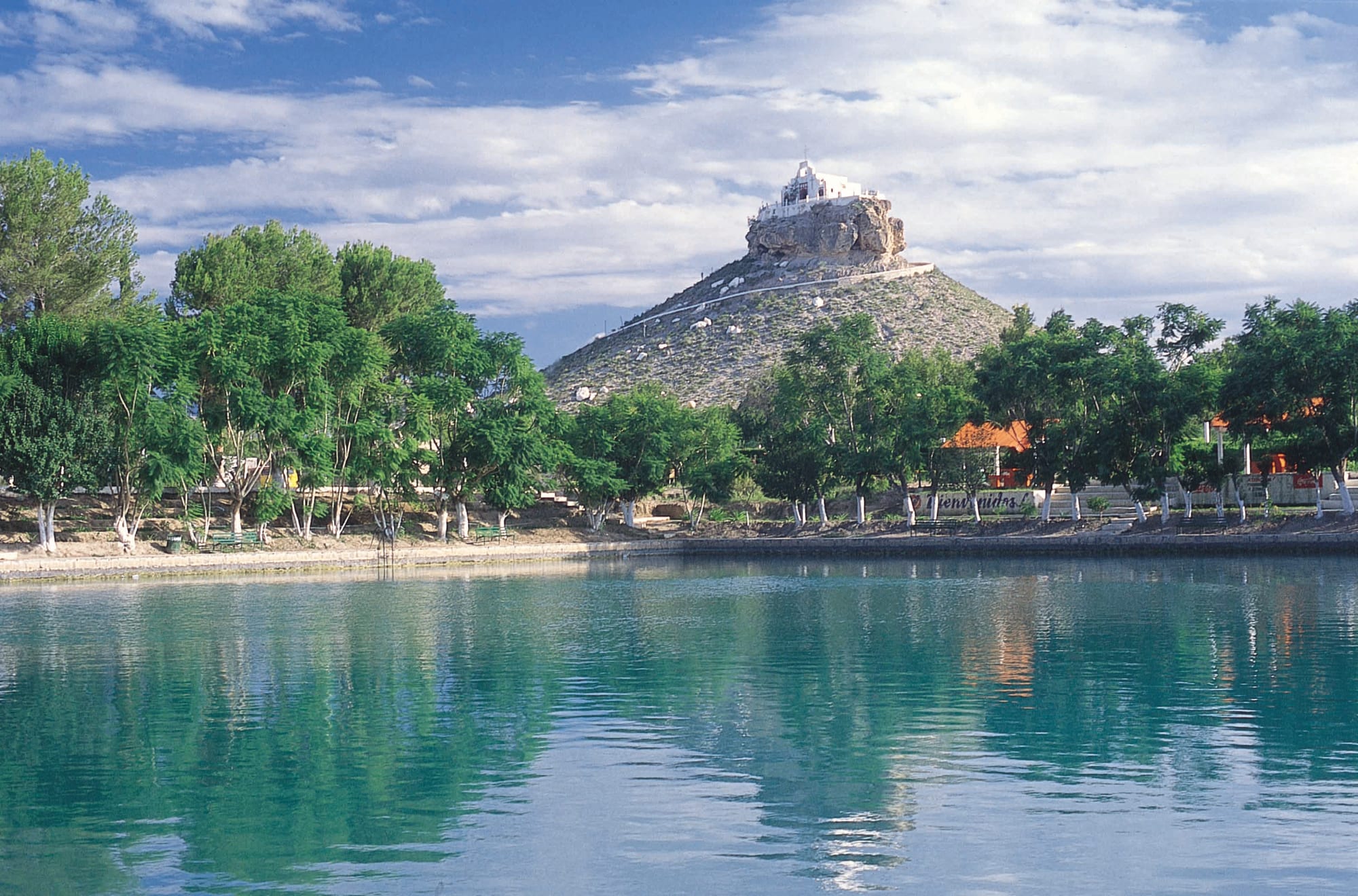
A white chapel on a rocky hilltop rising behind a still green pool lined with trees under a blue sky

Monterrey & the Northeast, Mexico

Parras de la Fuente

The church of the Santo Madero on its hill above a pool at Parras de la Fuente, Coahuila. (Comisión Mexicana de Filmaciones from México D. F., México / Wikimedia Commons · CC BY-SA 2.0)

A spring-fed oasis town in the semi-desert of southern Coahuila, founded in 1598 and known as the first wine-growing region in the Americas. Vineyards, walnut and fruit orchards, colonial churches and spring pools surround a small centre, and the town, birthplace of President Francisco I. Madero, has been a Pueblo Mágico since 2004.

Neighbourhoods

  • The town centre
    • First-time visitors
    • Historic district

    The small grid of streets around the town's plazas, with the municipal palace, the church of San Ignacio de Loyola, the house of culture and museums. Most of the places to stay and eat are here or a short walk away.

    Open in Maps
  • The haciendas and vineyards
    • Wine
    • Countryside

    The old estates and wineries on the edges of the town, including the Hacienda San Lorenzo, home of Casa Madero, and the former Hacienda del Rosario where the town was founded, among vineyards and walnut groves.

    Open in Maps

Things to do

Churches and the old town

  • Santo Maderoviewpoint

    A church set on an extinct volcanic plug just north of the town, shown on the town's coat of arms.

    Open in Maps
  • San Ignacio de Loyolalandmark

    A 17th-century church whose old Jesuit college holds an archive of documents on early winemaking in the valley.

    Open in Maps
  • Presidencia Municipallandmark

    The town hall, a replica of the state government palace in Saltillo.

    Open in Maps
  • Acueducto Los Arcoslandmark

    The stone arches of an old aqueduct, Los Arcos de la Hacienda.

    Open in Maps
  • Museo Morón de Artemuseum

    A small museum of cave paintings and contemporary art.

    Open in Maps

Wine and springs

  • Casa Maderoattraction

    The oldest winery in the Americas, founded by Lorenzo García on 19 August 1597, at the Hacienda San Lorenzo, with a wine museum.

    Open in Maps
  • Estanque de la Luzattraction

    One of the spring-fed open-air pools that give the oasis its name, used for swimming.

    Open in Maps

Walks nearby

  • Cañón de la Limatrail

    A canyon walk in the hills close to the town.

    Open in Maps
  • Cueva de los Murciélagosattraction

    A bat cave in the countryside around Parras.

    Open in Maps

Eat and drink

Long-standing places and food districts in Parras de la Fuente. Hours, ratings and directions come from your maps app, always current.

Parras classics

  • Local sweetsmarket

    Sweets made with walnuts, figs, grapes and pine nuts, and cajeta, a milk caramel, are the town's speciality.

    Open in Maps
  • Wine shopsmarket

    Shops selling table wines, grape liqueurs and brandies from Parras's wineries, among them El Vesubio.

    Open in Maps
  • Regional cookingrestaurant

    Restaurants and gordita stands serve asado de puerco, roast pork in chilli, mole, pork and chicken tamales, barbacoa and cabrito.

    Open in Maps

Experience Parras de la Fuente

History

Spanish explorers crossing from Zacatecas in the 1560s found an oasis of springs and wild grapevines — parras — in the Coahuila desert. The first Spanish ranch was set up by Captain Francisco de Urdiñola, and the town was founded in 1598 by Captain Antón Martín de Zapata and the Jesuit Juan Agustín de Espinosa as the mission of Santa María de las Parras, on the site of what became the Hacienda del Rosario. In 1599, on the viceroy's orders, a group of Tlaxcaltec settlers was moved here from Saltillo.

Wine came almost at once. The oldest winery in the Americas, founded by Lorenzo García on 19 August 1597 as the Vinícola San Lorenzo, is in Parras, and documents in the old Jesuit college show vines grown widely across the valley in the early 1600s. The town became known for wines, brandies and liqueurs, and later also for textiles. During the Mexican–American War American troops held Parras in 1846, and French forces were defeated here in 1866.

In the late 19th century the businessman Evaristo Madero founded Casa Madero at the Hacienda de San Lorenzo, whose winery has carried that name since 1893, and in 1870 he bought a denim mill founded in 1854. His grandson Francisco I. Madero, born here in 1873, launched the Revolution against Porfirio Díaz in 1910 and was president from 1911 to 1913. In 2004 Parras was named a Pueblo Mágico.

Culture & Customs

Wine is the centre of local identity. Parras calls itself the first wine-growing region in the Americas, and its estates range from Casa Madero, with its wine museum, to a younger vineyard first planted in 2000 that grows Cabernet Sauvignon, Shiraz, Malbec and Chardonnay among other grapes. The grape fair, the Feria de la Uva, is held on 9 August each year.

The Madero family is the other great presence. The town's coat of arms carries the date of 20 November 1910, the start of the Revolution, in honour of Francisco I. Madero, and his brothers and relatives, revolutionaries, governors and ministers, appear across the town's history. Houses linked to the family survive in the centre.

The springs shape everyday life and leisure: open-air pools fed by them, once used to generate electricity for industry, are where families swim on hot days. Parras is a devout town, and the Santo Madero on its hill and the colonial church of San Ignacio de Loyola are both places of worship and landmarks.

Daily Life

About 44,000 people lived in Parras at the 2020 census. It is the seat of a very large municipality of more than 9,000 square kilometres, much of it desert and mountain.

Winemaking and denim are the town's best-known industries, and Parras has long been a notable exporter of denim. One of the oldest and most important mills, La Estrella, was founded in 1854 by Colonel Rafael Aguirre and bought in 1870 by Evaristo Madero, who built its international reputation. The irrigated fields and orchards grow grapes, walnuts, quinces, apples, peaches, cotton and fodder. The town lies at about 1,500 metres, which keeps its nights cool.

Life follows a small-town rhythm, with the plazas at its centre and water from the surrounding ranges the precious resource that has made the oasis possible. A summer programme of Humboldt State University in California has brought students to the town to study Spanish language and culture.

Food

The table in Parras is northern and rural. Asado de puerco, roast pork, mole, pork and chicken tamales, barbacoa and cabrito, young goat, are the dishes most associated with the town, along with gorditas, thick corn cakes with fillings, at simple stands.

Sweets are the speciality. The orchards supply walnuts, figs, grapes and pine nuts for candies and pastes, and cajeta, a thick milk caramel, is made here too; shops in the centre sell them alongside local wine.

The drinks are the town's own: table wines, fortified wines and grape liqueurs from the wineries, and brandy, which Parras has long produced. Casa Madero, considered one of the most important wine businesses in the Americas, makes labels such as Casa Grande Gran Reserva and Casa Madero Reserva. Other producers include Rivero González, and wine shops in the town, among them El Vesubio, sell bottles from several producers. Tastings at the estates are part of most visits.

Planning tools

Budget

Parras is cheaper than Monterrey: rooms in the town range from campsites and simple guesthouses to more comfortable hotels, and eating out is modestly priced. Winery tours and tastings, and a car or taxi to reach the estates and springs, are the main extra costs.

Daily Budget Midrange
USD 90–180 (comfortable hotel, restaurants, winery tours and tastings, taxis)
Daily Budget Shoestring
USD 35–55 (guesthouse or campsite, gorditas and tamales, local buses)

Plan Parras as an overnight stay rather than a day trip, and allow time for at least one winery visit.

Best Time to Visit

October to April brings mild, dry days, though winter nights are cold. The Feria de la Uva, the grape fair, is held on 9 August, when the surrounding desert is hot. Rain falls mostly between April and October.

Suggested Number of Days

One night is enough for the town and a winery; two or three allow time for several vineyards, the springs and walks in the hills, or for combining Parras with Saltillo. Visitors without a car need a little more time, as estates lie outside the centre.

First Visit
1–2 days
With Surroundings
2–3 days

Transportation

The centre is small enough to walk. Taxis or a car are needed for the outlying haciendas, vineyards and canyon walks, and some visitors join organised winery tours.

Arrange transport back from wineries in advance if planning tastings, rather than driving.

Airport & Station Connections

Parras is reached by road. Second-class buses run from Saltillo and Monterrey to one bus station, and services towards Torreón use a second. The nearest airports with regular flights are at Monterrey and Torreón; Torreón International Airport serves the La Laguna area to the west.

Walkability

The town centre is flat, compact and easy on foot, with shaded plazas. The climb to the Santo Madero is short but steep. The vineyards, haciendas and pools on the outskirts are better reached by taxi or car, especially in the summer heat.

Safety

Safety varies enormously by state and even neighbourhood. Coahuila, including Saltillo, Parras and Torreón, is considered one of the safer northern states, and Parras is a quiet country town where the main precautions are the usual ones. Roads elsewhere in the wider region, especially in Tamaulipas, carry higher risks.

Travel between towns by day on main roads, carry water and sun protection on walks, and do not drive after wine tastings. Check current official travel advice before travelling.

Climate

A semi-dry climate at about 1,500 metres, with a yearly average of 14–18°C and rain from April to October. Springs from the surrounding ranges keep the oasis green when the desert is dry.

Summer
hot by day in the desert around the town; nights from May to August average about 13°C
Winter
mild sunny days and cold nights, falling to around 5°C

Local Customs

Parras is proud of its wine and of the Madero family, whose most famous son led the 1910 Revolution. It is a small Catholic town, and the churches are working places of worship. Tipping is customary in sit-down restaurants.

Dress modestly in churches, ask before photographing people, and taste wine in moderation if driving.

Common Payment Methods

The currency is the Mexican peso (MXN). There are ATMs in the town, but fewer than in the cities, so carry enough cash for small restaurants, sweet shops and taxis. Larger hotels and wineries accept cards.