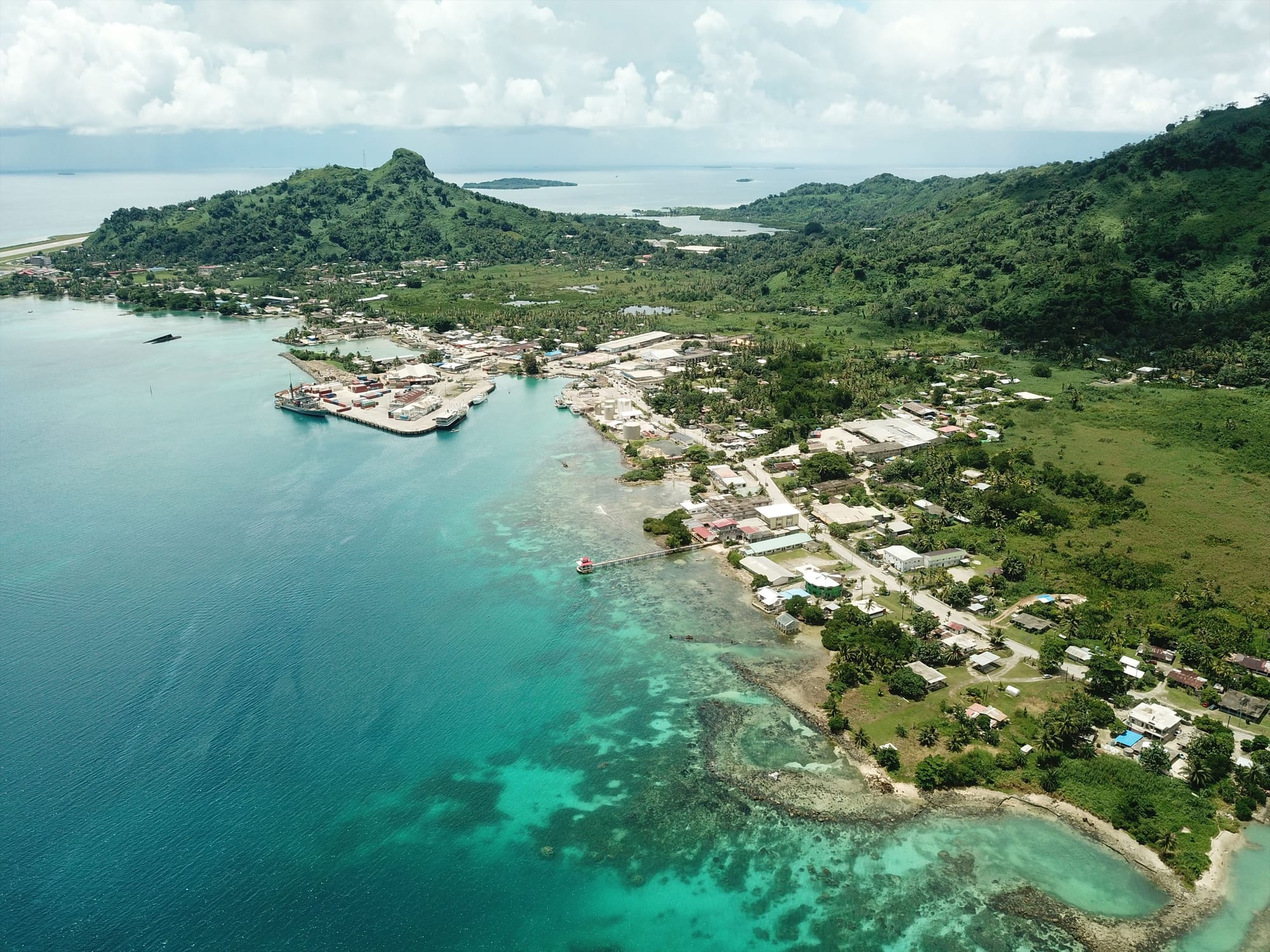
Aerial view of a green island with a harbour, low town buildings and a turquoise reef along the shore, other islands beyond

Federated States of Micronesia

Weno

Weno from the air, with the harbour and the town spread along the lagoon shore and the hills of the island behind. (Motoki Kurabayashi / Wikimedia Commons · CC BY-SA 4.0)

The main island and capital of Chuuk State in the Federated States of Micronesia, a hilly island on the northern rim of Chuuk Lagoon. Once the Japanese airfield island of Moen, it is now the state's port, airport and government centre, and the base from which divers reach the fleet sunk in the lagoon in 1944.

Neighbourhoods

  • Mwan and the harbour
    • First-time visitors
    • Shops and services

    The commercial heart of the island on the west coast, where the shops, the bank and most offices stand along a single busy coast road. Dive boats leave from here, and the town's few hotels and restaurants are within a short drive.

    Open in Maps
  • Iras and the airport
    • Close to the airport
    • Diving bases

    The strip south-east of the town centre around Chuuk International Airport, with several of the island's dive lodges on the water. Convenient for the thin flight schedule and for boats out into the lagoon, though there is little to walk to.

    Open in Maps
  • Nepukos and Peniesene
    • Quiet and residential
    • Local life

    Residential districts beyond the town centre, with houses, churches, schools and state offices among breadfruit and coconut trees. Nepukos holds the island's commercial port and the Chuuk campus of the College of Micronesia, and life here is village-like, quieter than in town.

    Open in Maps
  • Sapuk
    • Quiet and residential
    • Views and walks

    The northern tip of the island, reached by a rough road, with a Japanese-built lighthouse on the ridge above and long views over the lagoon and the reef. Largely farmland, gardens and scattered houses.

    Open in Maps

Things to do

Diving the lagoon

  • Chuuk Lagoonattraction

    One of the world's great wreck-diving sites, a lagoon about 50 miles by 30 holding dozens of Japanese ships and aircraft sunk by American air attack in February 1944.

    Open in Maps
  • Fujikawa Maruattraction

    An armed aircraft transport lying upright and coral-covered, with disassembled Zero fighters still in a forward hold — the lagoon's best-known wreck.

    Open in Maps
  • Heian Maruattraction

    A former ocean liner converted into a submarine tender, lying on its port side in about 110 feet of water — the largest wreck in the lagoon.

    Open in Maps

On the island

  • Mount Tonnachauviewpoint

    The prominent hill rising behind the airport and the town, tied to the tradition of Sowukachaw, the founding figure of Chuuk, with prehistoric earthworks and Japanese wartime remains on its ridge.

    Open in Maps
  • Xavier High Schoollandmark

    A Jesuit secondary school opened in 1952 in a heavy concrete Japanese wartime communications building on Mabuchi hill at Sapuk, one of the island's most substantial wartime structures.

    Open in Maps
  • Japanese lighthouse, Sapuklandmark

    A concrete lighthouse built by the Japanese in 1937 on the ridge at the northern end of the island, with four large coastal guns beside it, reached by a rough road and a short climb.

    Open in Maps

Islands in the lagoon

  • Tonoasattraction

    Known as Dublon, and as Natsushima to the Japanese, when it was the headquarters of the Japanese forces in the lagoon; its overgrown hillsides still hold bunkers, tunnels, guns and concrete ruins.

    Open in Maps
  • Fefanattraction

    The third largest inhabited island of Chuuk Lagoon, south of Weno, hilly in the north and visited on boat trips across the water.

    Open in Maps

Eat and drink

Long-standing places and food districts in Weno. Hours, ratings and directions come from your maps app, always current.

Chuuk classics

  • Sashimi and reef fishrestaurant

    Tuna sashimi, grilled reef fish and rice are the staples of the island's small restaurants, most of them attached to hotels and dive lodges along the coast road.

    Open in Maps
  • Breadfruit and taro dishesmarket

    Boiled and pounded breadfruit, several kinds of taro and coconut cream appear at family meals and church gatherings, and cooked portions are sold from small stalls and shops.

    Open in Maps

Markets and food streets

  • Weno market and roadside stallsmarket

    Fish, bananas, breadfruit, taro and imported goods change hands at stalls and small stores near the harbour and along the main road.

    Open in Maps
  • The coast road through Mwanneighborhood

    Takeaways, bakeries and small Filipino, Japanese and Chinese-run kitchens are spread along the road between the port and the airport.

    Open in Maps

Experience Weno

History

Chuuk Lagoon was settled by Austronesian voyagers more than two thousand years ago, and Weno — long known as Moen — was one of many islands inside the reef held by clans whose land and rank passed through the mother's line. Chuukese society was organised around lineages and district chiefs rather than a single ruler, and the lagoon's islands traded, intermarried and fought with each other across short stretches of water.

Spain claimed the Carolines but barely administered them, and sold them to Germany in 1899. Japan took the islands in 1914 and, under a League of Nations mandate, developed the lagoon into the main forward base of its navy in the central Pacific, with the administrative centre on Tonoas and airfields built on Weno. Chuukese were put to work on construction, and thousands of Japanese settlers, sailors and soldiers arrived. On 17 and 18 February 1944 an American carrier attack, Operation Hailstone, sank dozens of ships at anchor and destroyed aircraft on the ground; further raids followed, and the garrison, cut off and bypassed by the American advance, held out until Japan's surrender.

After the war the islands were administered by the United States as part of the Trust Territory of the Pacific Islands, and Weno replaced Tonoas as the centre of government, drawing people from across the lagoon and the outer islands to its schools, port and offices. Chuuk became a state of the Federated States of Micronesia, which took effect in 1986. From the 1970s the sunken fleet turned the lagoon into a destination for divers, and the wrecks — classified as a Japanese war grave — remain the island's main connection to the outside world.

Culture & Customs

Clan and lineage govern much of life. Land and reef rights descend through women, titles and authority through district chiefs and lineage heads, and obligations to relatives across the lagoon and the outer islands are constant. Big events — funerals, weddings, first-birthday feasts, church anniversaries — bring large gatherings, contributions of food and money, and speeches in which respect and hierarchy are carefully observed.

Christianity is deeply established. Catholic and Protestant congregations, the latter descended from 19th-century mission work, fill churches on Sundays, and choirs, youth groups and church schools structure much of the week. Xavier High School, in a former Japanese communications building on Mabuchi hill, has educated students from across Micronesia since 1952 and is one of Chuuk's best-known institutions.

Chuuk is also known within Micronesia for the strength of its traditional practices: skilled canoe building and navigation on the outer atolls, and a body of chants, dance and oral history tied to particular places such as Mount Tonnachau. Reserve in public, modest dress and avoidance of open confrontation are expected, and attitudes to alcohol are strict, and alcohol has been banned in parts of the state. Baseball and basketball are followed keenly, and many families have close ties to relatives living in Guam, Hawaii and the United States.

Daily Life

Weno is the most populous island in the Federated States of Micronesia, with somewhere in the region of 13,000 to 14,000 residents on about seven square miles, and it functions as the centre of a state of about 34,000 people scattered over the lagoon islands and distant atolls. Government is the largest employer, followed by schools, the hospital, the port, shops and the dive lodges. Money also comes from fishing-licence fees, fish transhipment in the lagoon and remittances from relatives working abroad.

Housing spreads along the coast road and up the hillsides, mixing concrete buildings with tin-roofed timber houses, and families keep breadfruit, banana and taro plots behind them. Electricity, water and road maintenance are recurring problems, and outages are common. People from the outer islands come to Weno for schooling, medical care and shopping, and many stay, which has crowded the island and strained its services.

The day begins early, slows in the heat of the afternoon and ends early too; evenings are for family, church groups and basketball courts. Recurrent concerns are those of Micronesia as a whole — heavy dependence on imported food and fuel, high rates of diabetes and other diet-related illness, emigration of the young to the United States under the Compact of Free Association, and the vulnerability of low-lying land to storms and rising seas.

Food

Chuukese cooking rests on breadfruit, taro and coconut. Breadfruit is boiled, roasted or fermented in pits for storage, taro of several kinds is grown in wet patches, and coconut cream is poured over both; banana, yam and cassava fill out the starch. Fish is the main protein — tuna and reef fish eaten raw, grilled, fried or cooked in coconut milk — along with octopus, clams and, for feasts, pigs and chickens cooked in an earth oven.

Japanese influence is strong and lasting. Sashimi cut from fresh tuna with soy sauce is everyday food rather than a delicacy, and rice, tinned fish, ramen and fried chicken have become staples of the town diet, bought at small stores stacked with imported goods. The island's restaurants, mostly attached to hotels and dive lodges, serve grilled fish and sashimi alongside Filipino, Japanese and American dishes, and bakeries sell sweet rolls and doughnuts in the morning.

Drinks are mostly imported soft drinks and coffee, and alcohol has been restricted or banned in the state at times. Fresh produce depends on the lagoon islands, whose growers bring bananas, taro and vegetables across the water to Weno's stalls.

Planning tools

Budget

Almost everyone who comes to Weno comes to dive, and a package of lodging, meals and boat dives accounts for most of the cost. Everything is imported, so shop prices are high; local food, taxis and shared transport are cheap. The US dollar is used, and cash is needed for nearly everything outside the lodges.

Daily Budget Midrange
USD 160–350 (dive lodge with meals, two or three boat dives a day, transfers)
Daily Budget Shoestring
USD 70–120 (simple guesthouse, store and market food, shared taxis)

Dive packages should be arranged well ahead, since operators and boats are few; technical wrecks require proof of experience.

Best Time to Visit

Diving is possible all year and water temperatures barely change. Roughly January to March is the dry season, drier and calmer, which makes the boat rides across the lagoon easier; the rest of the year is wetter and carries the main typhoon risk. Visibility in the lagoon varies with wind and plankton rather than with season.

Suggested Number of Days

Divers generally stay three or four days at least, and a week to cover the lagoon properly. Non-divers find far less to fill the time. Flight days and the need to leave a gap before flying after diving shape the total.

First Visit
3–4 days
With Surroundings
5–8 days

Transportation

One paved road runs along the lagoon shore from the port through the town to the airport, with rougher roads climbing inland and north. There is no public transport: pick-up trucks and cars act as shared taxis for a flat fare, and lodges send vehicles to the airport. Boats are the way to reach everything else in the lagoon.

Roads are potholed and unlit after dark, so a lodge vehicle or an arranged taxi is the usual way to move around at night.

Airport & Station Connections

Chuuk International Airport is on the island, a couple of miles from the town centre and a few minutes' drive from most lodges. United Airlines' Island Hopper calls a few times a week on the route between Guam and Honolulu, with connections to Pohnpei and Kosrae. Government field-trip ships serve the outer islands but are not a practical option for visitors.

Flights are few, so a missed connection can mean days of waiting; build in spare time at either end.

Walkability

The stretch of the coast road between the port and the airport can be walked, and the town's shops and offices sit close together, but there are few pavements, traffic is close and the sun is fierce. Hills rise steeply behind the road, and most visitors use a vehicle rather than walk, particularly after dark.

Safety

Weno has a rougher reputation than the other state centres in Micronesia, chiefly for alcohol-related trouble and petty theft at night; visitors are rarely affected but caution after dark is sensible. Medical care is very limited and serious cases are flown to Guam or Hawaii. Recompression facilities for divers are limited, so conservative diving matters, and the island lies in the typhoon belt: Typhoon Sinlaku struck Chuuk in early 2026, and relief work followed in villages on Weno including Iras, Nepukos and Sapuk.

Move around by vehicle after dark rather than on foot, dive well within limits and carry insurance covering evacuation. Check current official travel advice before travelling.

Climate

Hot, humid and tropical all year, a few degrees north of the equator, with rain in every month and little variation in temperature. Chuuk is drier than Pohnpei, with a dry season from about January to March, but it carries a real typhoon risk.

Summer
hot and humid, with daytime temperatures in the high 80s°F and heavy showers
Winter
much the same, in the high 80s°F by day, with drier and breezier weather from about January to March

Local Customs

Chuukese society is organised around matrilineal clans and lineage land, and church life — Catholic and Protestant — is central, with Sunday kept for worship. Dress is modest: women's thighs in particular are kept covered, so swimming is done in shorts or a wraparound cloth. Several islands in the lagoon, and Chuuk State itself, have restricted or banned alcohol at times.

Tipping is not customary. Ask before photographing people, houses or wartime relics on private land, ask permission before walking or swimming off someone's shore, and keep shoulders and thighs covered away from the lodges.

Common Payment Methods

The currency is the US dollar. Dive lodges and hotels may take cards, often with a surcharge, but the rest of the island runs on cash. There are bank branches and ATMs in town, and they can run short of notes, so arriving with enough dollars is wise.