History
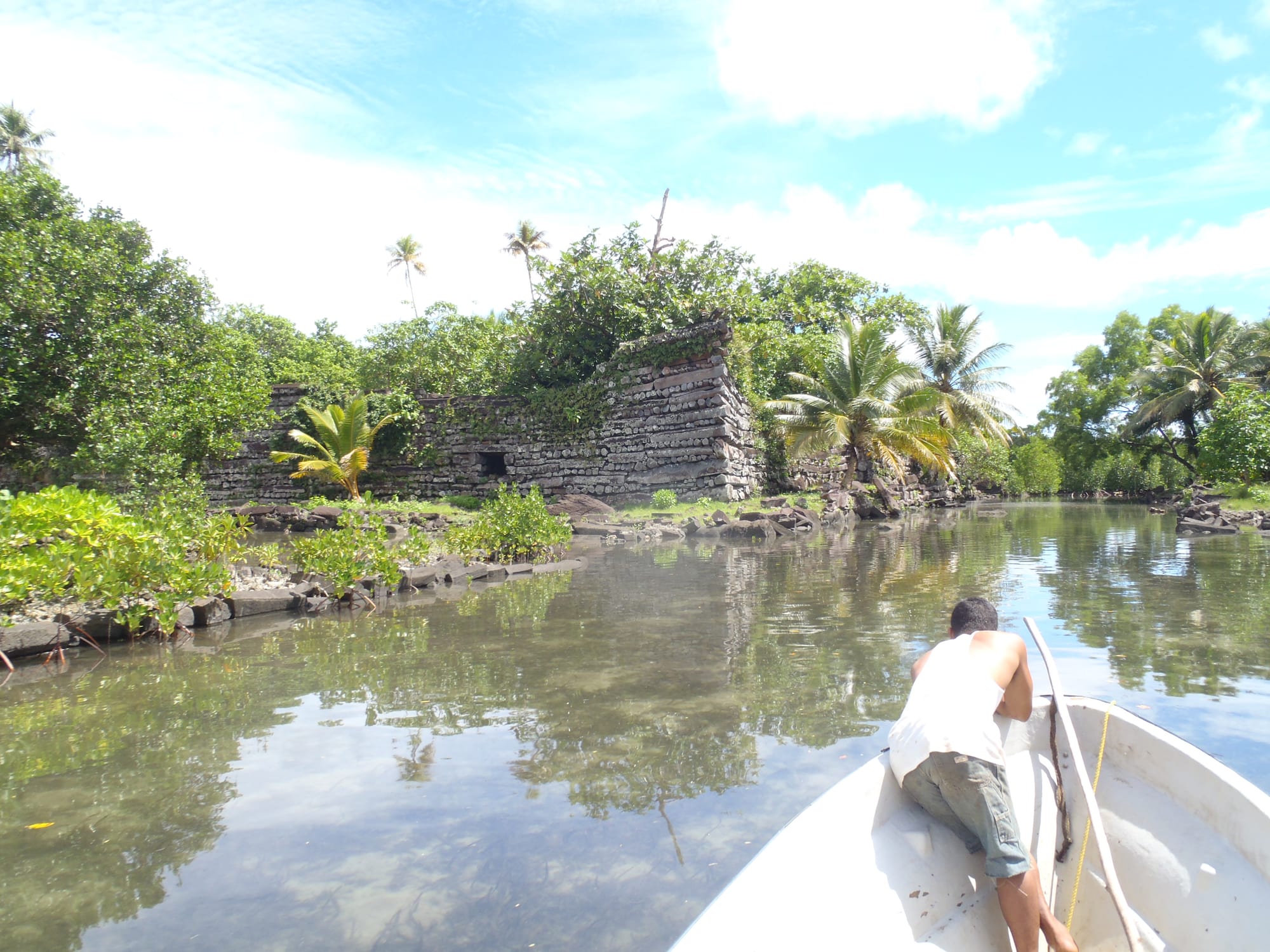
The Caroline Islands were settled more than three thousand years ago by seafaring peoples who spread across the western Pacific and became expert navigators. On Pohnpei, the Saudeleur dynasty built Nan Madol between roughly 1200 and 1600 — a complex of about ninety artificial islets of stacked basalt columns, laid out with canals, that served as a ceremonial and political capital. On Yap, a society developed around "stone money", great limestone discs quarried in Palau and carried home by canoe, still owned and exchanged today.
Spain claimed the Carolines, ruled them lightly, and sold them to Germany in 1899. Japan took the islands in the First World War and colonised them intensively under a League of Nations mandate. Chuuk Lagoon (then Truk) became Japan's main forward naval base in the central Pacific; a US air and sea attack on 17–18 February 1944 sank dozens of ships and destroyed aircraft on the ground there, leaving the wreck field that divers explore today.
After the war the islands were administered by the United States as part of the Trust Territory of the Pacific Islands. The Federated States of Micronesia adopted a constitution in 1979 and became a sovereign state in free association with the United States, effective in 1986, joining the United Nations in 1991. The Compact, renewed in 2023 and signed into US law in March 2024, runs to 2043; it provides US economic support and takes on the country's defence; FSM citizens can live and work in the United States without a visa.
- Micronesia: The Federation of the Carolines — Four island states — Yap of the stone money, Pohnpei of Nan Madol, Chuuk of the great lagoon, and Kosrae — ruled in turn by Spain, Germany, Japan and the US, and now a nation in free association with Washington