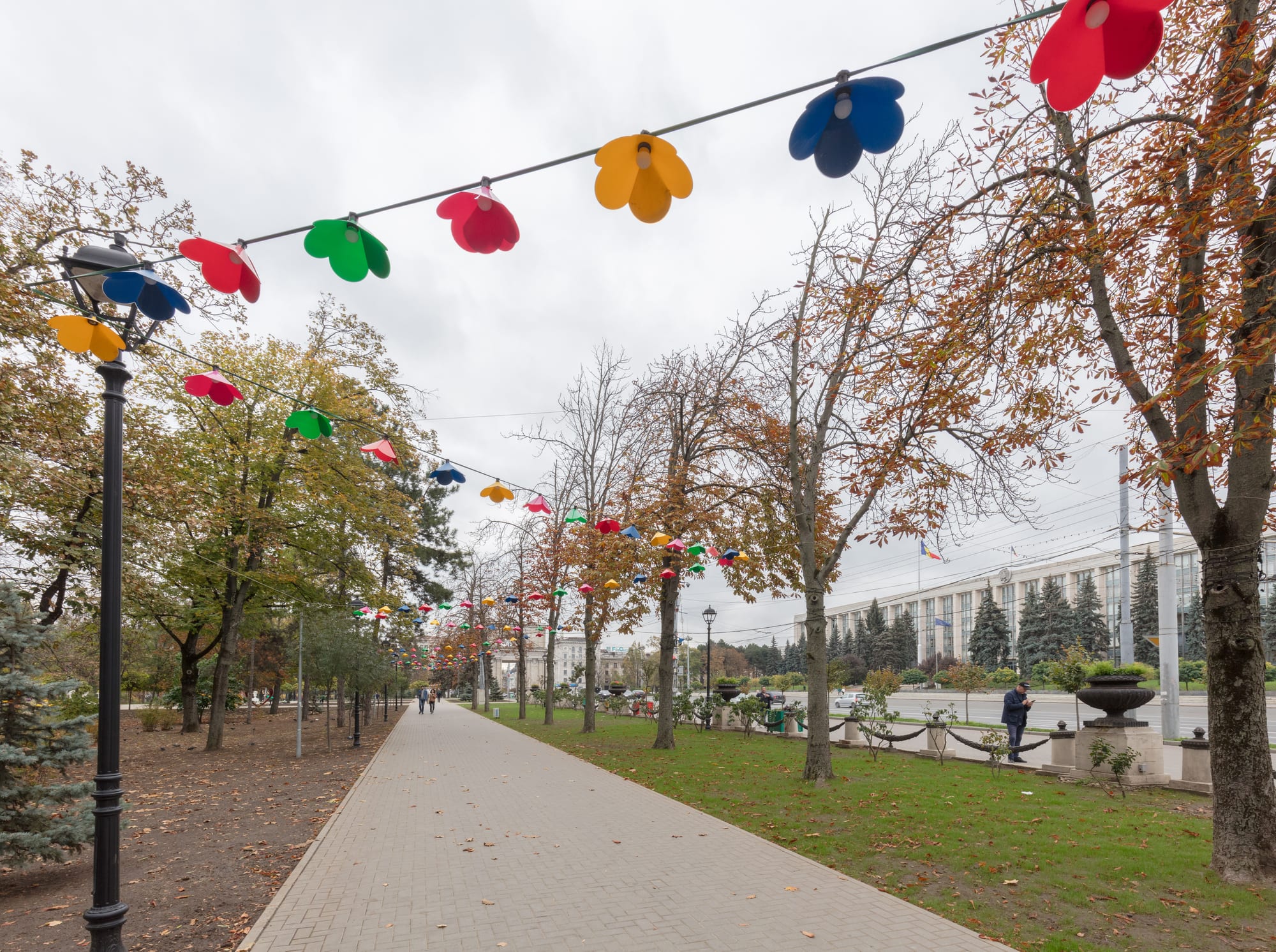
A paved path through autumn trees in Cathedral Park, hung with coloured flower-shaped lights, beside a wide avenue

Moldova

Chișinău

The park around the Nativity Cathedral in central Chișinău in autumn. (Diego Delso / Wikimedia Commons · CC BY-SA 4.0)

Moldova's capital and largest city, on the small river Bîc in the middle of the country. Founded as a monastery village in 1436, it grew under Russian rule, was badly damaged in the Second World War and by earthquakes, and was rebuilt as a Soviet capital. Today it is a green city of parks, wide boulevards and housing blocks, and the base for the great wine cellars nearby.

Neighbourhoods

  • Centru
    • First-time visitors
    • Historic district
    • Close to public transport

    The historic heart of the city around Ștefan cel Mare și Sfînt Boulevard, the main street. The Nativity Cathedral and its park, the Triumphal Arch, Government House, the Stephen the Great Central Park, the national museums and the Central Market all lie within walking distance of each other here.

    Open in Maps
  • Buiucani
    • Quiet and residential
    • Parks

    The sector west and north-west of the centre, described as the city's most affluent. It mixes residential streets with green space, including the small Alunelul Park, laid out in 1958 on part of an old Jewish cemetery.

    Open in Maps
  • Rîșcani
    • Local life
    • Parks

    The north-eastern sector, with several parks, among them a large park of woodland around a lake.

    Open in Maps
  • Botanica
    • Parks
    • Close to the airport

    The southern sector and the most populous in the city, home to the botanical garden, the zoo and the airport, and to the Rose Valley park with its lakes.

    Open in Maps
  • Ciocana
    • Quiet and residential

    The eastern sector, one of the five into which the city is divided and considered one of the most industrialised, with little aimed at visitors.

    Open in Maps

Things to do

Famous landmarks

  • Nativity Cathedrallandmark

    The main cathedral of the Moldovan Orthodox Church, built in 1830 to a design by Abram Melnikov; its bell tower was demolished in Soviet times and rebuilt in 1997.

    Open in Maps
  • Triumphal Archlandmark

    An arch of 1840 beside the cathedral, facing Government House, built to mark the Russian Empire's victory over the Ottomans in the war of 1828–29.

    Open in Maps
  • Stephen the Great Monumentlandmark

    The bronze statue of Moldavia's medieval prince at the gate of the central park, designed by Alexandru Plămădeală and unveiled in 1928; it was moved away and returned more than once during the Second World War.

    Open in Maps
  • Eternity Memorial Complexlandmark

    A memorial of 1975 to the Soviet soldiers who died in the Jassy–Kishinev offensive of 1944, restored in 2006.

    Open in Maps

Museums

  • National History Museum of Moldovamuseum

    Founded in 1983 in a former lyceum in the historic centre, it holds more than 263,000 exhibits, from archaeology to the Soviet period.

    Open in Maps
  • National Museum of Fine Artsmuseum

    The country's main art museum, founded in 1939 from some 160 works by Bessarabian and Romanian artists.

    Open in Maps
  • House-Museum of Alexander Pushkinmuseum

    The merchant's house where the Russian poet lived for three months after arriving in exile in 1820, a museum since 1948.

    Open in Maps

Parks and gardens

  • Stephen the Great Central Parkpark

    The oldest park in Moldova, about 7 hectares in the centre, nicknamed 'the Park of the Lovers'.

    Open in Maps
  • Rose Valleypark

    An urban park planted with roses in the 1950s, whose central section is laid out around several lakes.

    Open in Maps
  • Chișinău Botanical Gardenpark

    A 104-hectare research garden, on its present site since 1965, with a rose garden, rock garden and lakes.

    Open in Maps
  • Valea Morilor Parkpark

    A very large park around a lake close to the centre, with a marked running and cycling circuit of about 2.5 km round the water.

    Open in Maps

Markets

  • Central Marketmarket

    Piața Centrală, the city's main market, spread over more than two blocks of the centre, selling fresh produce and marinated and pickled vegetables.

    Open in Maps

Music and nights out

  • National Opera and Ballet Theatreattraction

    The Soviet-built home of the national opera and ballet on the main boulevard, named in 2012 after the soprano Maria Bieșu.

    Open in Maps

Short trips from the city

  • Cricovaattraction

    A winery about 15 km north of the city whose limestone tunnels, turned into wine cellars in the 1950s, run for about 120 km.

    Open in Maps
  • Mileștii Miciattraction

    A state wine complex founded in 1969 whose cellars were registered by Guinness World Records in 2005 as the largest wine collection in the world.

    Open in Maps
  • Old Orheilandmark

    A historical and archaeological complex on the Răut river, with a cave monastery cut into the limestone cliff.

    Open in Maps

Seasonal events

  • Mărțișor1 March

    The spring custom of giving and wearing small red-and-white tokens from 1 March.

  • National Wine FestivalOctober

    The yearly national wine celebration, held in the capital each October.

Eat and drink

Long-standing places and food districts in Chișinău. Hours, ratings and directions come from your maps app, always current.

Food districts and markets

  • Central Marketmarket

    The big central market, the place for fresh produce and the marinated and pickled vegetables that make a quick meal.

    Open in Maps
  • Restaurants of the centreneighborhood

    The streets around the main boulevard hold most of the city's restaurants and cafés, from places serving zeamă and pancakes to wine bars.

    Open in Maps

Experience Chișinău

History

Chișinău was founded in 1436 as a monastery village in the Principality of Moldavia, which from the 16th century was a vassal of the Ottoman Empire. In 1812 the Ottomans ceded the eastern half of Moldavia to the Russian Empire, and Chișinău grew as the capital of tsarist Bessarabia. The Swiss-Italian architect Alexander Bernardazzi designed many of its public buildings, including the City Hall, and the Nativity Cathedral was finished in 1836. By 1897 almost half the population, more than 50,000 people, was Jewish. In April 1903 the city became known worldwide for the Kishinev pogrom, an anti-Jewish riot that drew protests from abroad, including a petition to the Tsar from US President Theodore Roosevelt.

Between the two world wars the city belonged to Romania, and its centre was extensively renovated. In June 1940 the Soviet Union annexed Bessarabia and made Chișinău capital of the new Moldavian SSR; deportations and executions followed, and a severe earthquake struck that November. Romanian and German forces took the city in July 1941 and confined its Jews in a ghetto; most of those deported from it died. The Red Army recaptured Chișinău in August 1944.

The Soviet administration rebuilt it as a planned capital of Stalinist palaces and, from 1971, a vast programme of housing estates; three quarters of today's homes date from 1951–1990. Another earthquake hit in 1977. Since independence in 1991 many streets have been renamed from Communist themes to national ones, the cathedral bell tower has been rebuilt, and the airport has returned to state ownership and taken the name of the composer Eugen Doga.

Culture & Customs

As the capital, Chișinău holds most of the country's cultural institutions: the national opera and ballet, founded in the mid-1940s and named in 2012 after the soprano Maria Bieșu, the national theatres, the state university and the three national museums of history, fine arts and ethnography and natural history, the last founded in 1889 and the oldest museum in Moldova. Alexander Pushkin's stay here in exile in 1820–23 is remembered in a small house-museum.

The city's identity reflects competing histories, and the large-scale renaming of streets after independence, from Communist themes to national ones, was a deliberate statement. Monuments record the competing memories: the statue of Stephen the Great at the park gate, the Triumphal Arch built for a Russian victory, the Soviet war memorial, and, on Jerusalem Street, a monument of 1993 to the Jews killed in the wartime ghetto.

Wine is central to local pride. The national wine festival is held in the capital every October, and the great cellars of Cricova and Mileștii Mici lie just outside the city. On 1 March people give and wear the red-and-white tokens of Mărțișor to welcome spring, and the Orthodox calendar shapes the year for many families.

Daily Life

The 2024 census counted just over 567,000 people in the city proper and about 720,000 in the wider municipality, which takes in nearby towns and villages; nearly a third of Moldova's population lives in the metropolitan area. The city is divided into five sectors — Centru, Buiucani, Rîșcani, Botanica and Ciocana — and most people live in the Soviet-era apartment blocks that make up the bulk of its housing.

Chișinău is the country's main industrial and commercial centre and its most prosperous place, and it holds the government, the universities and the head offices of most businesses. The airport is the base of the airlines FlyOne and HiSky and a hub for Wizz Air, and the city is the country's largest transport hub.

Most residents get about by trolleybus, on which conductors still walk the aisle collecting fares, or by the cheap taxis ordered through the big dispatch services. Private car numbers keep rising — they were expected to pass 550,000 by 2025 — and traffic grows more congested each year. The large parks, from Valea Morilor to the Botanical Garden, are where the city goes to walk and run.

Food

The capital eats like the rest of the country. Mămăligă, a cornmeal porridge, is the best-known dish, served with brânză, a brined cheese. Zeamă, a chicken soup, is a standby, and friptură is a lamb or goat stew. Holiday tables bring sarmale, cabbage rolls stuffed with minced meat, and a spread of baked goods with cheese, fruit, vegetable and walnut fillings — plăcinte, cozonac, pască and papanași among them.

Piața Centrală, the Central Market, covers more than two city blocks and is the place to see what is in season: fresh produce and the marinated and pickled vegetables that can make a quick meal in themselves. Cheap places serving blini, thin pancakes, and zeamă are found across the city.

Local wine accompanies most meals. Moldova produces large quantities of sparkling wine, the best known from the Cricova winery on the city's edge, and Fetească Albă, a white grape cultivated here since ancient times, is used in still and sparkling wines. Divin, the Moldovan brandy, is the stronger drink, while compot, made from boiled fruit, and kvas, fermented from toasted rye bread, are the traditional non-alcoholic choices.

Planning tools

Budget

Chișinău is one of the cheaper European capitals to visit. Food, public transport and museum entry cost little; accommodation and a driver or tour to the wineries outside the city are the main expenses.

Daily Budget Midrange
USD 70–140 (mid-range hotel, restaurant meals, taxis, a winery tour)
Daily Budget Shoestring
USD 30–55 (hostel or guesthouse, market food and canteens, trolleybuses)

The parks, the cathedral grounds, the main boulevard and the Central Market cost nothing to enjoy.

Best Time to Visit

Late spring and early autumn are the most comfortable seasons, when temperatures are mild and the parks are at their best. October brings the national wine festival. Mid-summer can be very hot, and winters are cold and windy.

Suggested Number of Days

Two days cover the compact centre, its museums and parks. Add two or three more for the wine cellars on the edge of the city and the historic sites further out; without a car or driver, trips outside take longer.

First Visit
2 days
With Surroundings
4–5 days

Transportation

Trolleybuses are the backbone of public transport, backed up by buses and a dwindling number of maxi-taxi minibuses; a conductor walks through the vehicle collecting fares. Taxis are cheap, and the big taxi services include Letz and Yandex Go. Drivers are legally required to use the meter.

Ask for the meter to be switched on before setting off, and carry small notes, as drivers often cannot change large ones.

Airport & Station Connections

Chișinău Eugen Doga International Airport, the only airport in Moldova with regular passenger flights, is about 13 km south-east of the centre; trolleybus 30 and taxis link it to the city. Trains from the central station run to Romania and Ukraine, including an overnight train from Bucharest. Coaches and minibuses arrive from Romania, Ukraine and Transnistria at the city's bus stations.

Walkability

The centre is laid out on a grid of long, straight streets and is easy to cover on foot: the cathedral, the arch, the central park, the museums and the market are close together. The residential sectors are spread out along wide avenues, so trolleybuses or taxis are the practical way to reach outer parks.

Safety

Moldova is generally safe, with low levels of violent crime; the usual issues are petty theft and taxi overcharging in Chișinău. Crime in the city is relatively low, though the usual precautions apply, and online dating and financial scams are a known risk.

Insist on the meter or use an app-based taxi service, and keep valuables close in markets and on crowded trolleybuses. Check current official travel advice before travelling.

Climate

A hot-summer continental climate, with hot summers and cold, windy winters. Spring and autumn temperatures range between about 16 and 24°C, with rain lighter than in summer but more frequent.

Summer
hot — the average maximum is about 28°C, and the centre occasionally reaches 35 to 40°C in mid-summer
Winter
cold and windy — night-time temperatures are often below 0°C, though they rarely drop below −10°C

Local Customs

Romanian and Russian are the languages of daily life, and few taxi drivers speak English. The Nativity Cathedral is the main church of the Moldovan Orthodox Church and a working place of worship. On 1 March people exchange small red-and-white Mărțișor tokens to mark the start of spring.

Few taxi drivers speak English, so it helps to have the destination written down or to ask a hotel or restaurant to call a car.

Common Payment Methods

The currency is the Moldovan leu (MDL). Most restaurants and almost all hotels accept credit cards, and there are hundreds of cash machines across the city. Many taxi drivers take cards, but cash in small notes is still useful for markets, public transport and taxis.