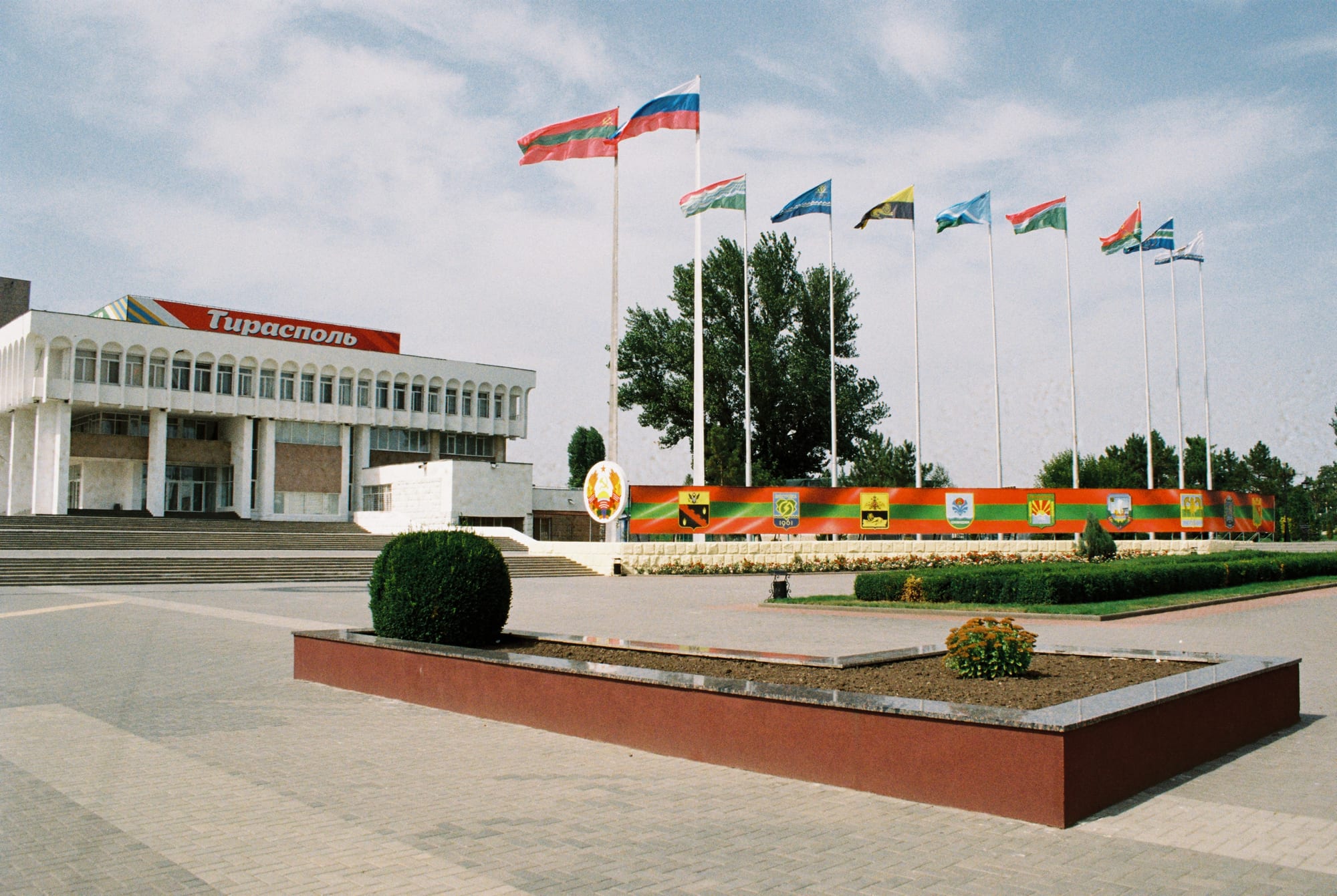
A wide paved square with flower beds, a row of flags on tall poles and a white colonnaded public building under a pale sky

Moldova

Tiraspol

Suvorov Square, the central square of Tiraspol. (Kasproo / Wikimedia Commons · CC BY 4.0)

A city on the east bank of the Dniester, founded as a Russian border fortress in 1792 and now the capital of Transnistria, a breakaway state internationally recognised as part of Moldova. Its wide Soviet-era avenues keep their Lenin statue and war memorials, and it is known for the KVINT brandy distillery and the Sheriff football club.

Neighbourhoods

  • City centre and 25 October Street
    • First-time visitors
    • Historic district
    • Close to public transport

    The long main street runs past the Supreme Council building with its Lenin statue, Suvorov Square and the war memorial with its T-34 tank. The central produce market and the cathedral lie a few blocks away, and the bus and train station is about 1 km from the centre.

    Open in Maps
  • The Dniester embankment
    • Walks
    • Riverside
    • Summer evenings

    A tree-lined promenade along the river, built on reinforced banks running to the city beach, where locals gather in summer. Catherine Park, opened in 2020, leads down to it from the market, and a handful of bars and restaurants stand along the water.

    Open in Maps
  • Western districts
    • Quiet and residential
    • Sport

    Apartment districts on the west side of the city, including the Zapadny microdistrict with its Yubileyny culture and sports complex, opened in 2015. The Sheriff sports complex and its stadium are about 3 km west of the centre.

    Open in Maps

Things to do

Monuments and landmarks

  • Suvorov Squarelandmark

    The central square, named after the city's founder, with the equestrian statue of Alexander Suvorov erected in 1979 for his 250th anniversary and a monument to Catherine the Great.

    Open in Maps
  • Supreme Council and Lenin statuelandmark

    The building of Transnistria's parliament on the main street, with a statue of Lenin in front of it.

    Open in Maps
  • Memorial of Glorylandmark

    A memorial plaza with a Soviet T-34 tank and an eternal flame for those who died defending the city in 1941 and retaking it in 1944, alongside monuments to more recent conflicts.

    Open in Maps
  • Church of the Nativitylandmark

    The Orthodox cathedral of the city, completed in 1999, just east of the central produce market.

    Open in Maps
  • Powder magazine of the fortresslandmark

    The surviving powder store of Tiraspol's earthen fortress, the defences from which the city grew.

    Open in Maps

Museums and theatre

  • Tiraspol United Museummuseum

    The city's museum association, which groups five museums.

    Open in Maps
  • State Theatre of Drama and Comedyattraction

    The Pridnestrovian State Theatre of Drama and Comedy, the oldest theatre of Soviet Moldova; the city theatre opened in 1936.

    Open in Maps

The river and parks

  • Dniester embankmenttrail

    The riverside promenade and city beach, the city's summer gathering place, with short boat trips on the Dniester of about half an hour.

    Open in Maps
  • Catherine Parkpark

    A park opened in 2020, stretching from the entrance of the Green Market to the river embankment, and now one of the main sights of the city.

    Open in Maps

Markets, brandy and football

  • Central produce marketmarket

    The Green Market, the city's busiest market, drawing several thousand shoppers a day and many more at weekends.

    Open in Maps
  • KVINT distilleryattraction

    The winery and distillery on Lenin Street, founded in 1897, which made only vodka until 1938 and is now best known for its brandies, sold in its shops around town.

    Open in Maps
  • Sheriff Arenaattraction

    The home ground of Sheriff Tiraspol, a stadium of about 12,700 seats, the largest in the region; European matches have not been allowed in Transnistria since 2022.

    Open in Maps

Short trips from the city

  • Tighina Fortresslandmark

    A fortress on the right bank of the Dniester in Bender, first built in earth and wood under Stephen the Great and rebuilt after the Ottoman conquest of 1538.

    Open in Maps
  • Noul Neamț Monasterylandmark

    An Orthodox monastery at Chițcani, near Bender and Tiraspol, founded in 1861, closed by the Soviet authorities in 1962 and reopened in 1989.

    Open in Maps

Eat and drink

Long-standing places and food districts in Tiraspol. Hours, ratings and directions come from your maps app, always current.

Tiraspol classics

  • KVINT brandy shopsmarket

    The distillery's own shops and the city's liquor stores sell the brandy that Tiraspol is known for, along with KVINT wines and vodka.

    Open in Maps

Food districts and markets

  • Central produce marketmarket

    The Green Market in the centre, the place for local food and drink.

    Open in Maps
  • Riverside bars and restaurantsneighborhood

    A handful of bars and restaurants along the river in the centre, busiest on summer evenings.

    Open in Maps

Experience Tiraspol

History

The site takes its name from Tyras, the ancient Greek name of the Dniester. The modern city began in 1792, when the Russian army, having pushed its frontier to the river at the Ottomans' expense, built fortifications beside the Moldavian village of Sucleia to guard the new western border. Field Marshal Alexander Suvorov is regarded as the founder of Tiraspol, which received city rights in 1795 and a customs house in 1828.

After the Russian Revolution the city became, in 1929, the capital of the Moldavian Autonomous Soviet Socialist Republic inside Soviet Ukraine, until Bessarabia was annexed in 1940. More than 4,000 people sentenced to death under Soviet rule were executed in the city's fortress in the late 1930s. In 1941 about 12,000 Jews, a quarter of the population, lived here; after Romanian and German forces took the city that August it became a transit point for deportations, and almost all of its Jewish population was killed. The Red Army retook Tiraspol in April 1944.

In January 1990 a referendum declared the city an independent territory, and that September it was proclaimed capital of the new Pridnestrovian republic, the breakaway state on the east bank of the Dniester that is internationally recognised as part of Moldova and whose status remains unresolved. Disputes over Romanian-language schools using the Latin script led to their forced closure in 2004, and an explosion on a minibus, believed to have been caused by a bomb, killed at least eight people in 2006. Since Russia's invasion of Ukraine there have been explosions near the security ministry in 2022 and an explosion at a military unit in 2024, and the energy crisis of early 2025 hit the city hard.

Culture & Customs

Tiraspol keeps more visible Soviet symbolism than almost anywhere else in Europe. The equestrian statue of Suvorov, erected in 1979, dominates the central square, Lenin stands in front of the parliament building, and opposite the square a memorial plaza combines a T-34 tank, an eternal flame for the dead of 1941 and 1944, and monuments to later conflicts, including the Soviet war in Afghanistan.

The city has five museums grouped into a single museum association, a drama and comedy theatre that was the oldest theatre of Soviet Moldova, a symphony orchestra and a state choir. Its music and drama troupe was formed in 1936. The Taras Shevchenko Transnistria State University makes it a student city as well.

Football is the great source of local pride. Sheriff Tiraspol is the most successful Moldovan club of recent times, with 14 league titles since the 2000–01 season, and in September 2021 it beat Real Madrid 2–1 in the Champions League with a last-minute goal. Since 2022 European matches have not been allowed in Transnistria, and the club played its 2022–23 European home games in Chișinău. Language is a sensitive matter: Romanian is official here only in the Cyrillic script, under the name Moldovan.

Daily Life

Almost 129,000 people lived in Tiraspol at the start of 2022, well down from about 190,000 in 1989, after the political and economic upheaval that followed the breakaway and large-scale Jewish emigration in the early 1990s. It is the largest city of Transnistria and its centre of government, culture and light industry, including furniture and electrical goods.

The KVINT distillery, founded in 1897, is the best-known local business, and the Sheriff corporation owns the stadium of the city's leading football club, whose name it shares; the name also appears over supermarkets. Daily shopping centres on the central produce market, the most visited in the city, which draws three to five thousand shoppers on weekdays and seven to ten thousand at weekends.

Restored Soviet-era trolleybuses, shared with neighbouring Bender, and minibuses carry most people around, and in summer the embankment and city beach fill with families. The energy crisis of 2025, during which a woman died of carbon monoxide poisoning from a gas water heater in January, showed how exposed the city is to cuts in supply. Mobile phones with Moldovan SIM cards get little or no reception in much of the region.

Food

Brandy is what Tiraspol is famous for. KVINT — the name is an acronym for "cognacs, wines and beverages of Tiraspol" — has made vodka since 1897 and brandy since 1938, and its bottles are sold in its own shops and liquor stores across the city; the factory on Lenin Street is an attraction in itself. Its products are certified as made in Moldova.

The Green Market, the central produce market, is the place to see what the region grows and makes, and the many shops and markets around town sell local food and drink alongside KVINT. Shawarma is among the cheap quick meals, and a few restaurants offer menus with a picture of every dish, which helps visitors who do not read Russian.

Along the river in the centre, a handful of bars and restaurants stay open until about midnight and are busiest on summer evenings. The traditional drinks of the wider country are found here too: kvas, a fermented drink made from toasted rye bread, and compot, made from boiled fruit, alongside beer and local wine.

Planning tools

Budget

Prices are low by European standards. Everything is paid for in Transnistrian rubles, bought at exchange offices, and foreign cards and cash machines are unreliable, so the budget has to be planned in cash.

Daily Budget Midrange
USD 65–130 (hotel room, restaurant meals, taxis, a brandy tasting or trip to Bender)
Daily Budget Shoestring
USD 30–50 (guesthouse room, market food and cafés, trolleybuses and minibuses)

Change only as much money as is needed: Transnistrian rubles cannot be used or exchanged outside the region.

Best Time to Visit

Late spring to early autumn, when the embankment and city beach are in use and evenings are spent by the river. Winters are cold, with January averaging below freezing.

Suggested Number of Days

One day is enough for the city itself, and many visitors come from Chișinău and return the same evening. Two days leave time for the neighbouring town of Bender and the monastery nearby as well.

First Visit
1 day
With Surroundings
2 days

Transportation

Trolleybuses, many of them restored Soviet-era vehicles, run through the city and on to Bender on a shared network, with tickets sold on board by a conductor; minibuses (marshrutkas) are more frequent and reach areas the trolleybuses do not. From 2026 minibus fares are paid only with prepaid transport cards.

Carry small amounts of local rubles for trolleybus tickets.

Airport & Station Connections

Buses and minibuses run from Chișinău roughly every half hour through most of the day, taking about 90 minutes and passing the checkpoints at Bender; there are also services from Bender, Odesa and other Ukrainian and Moldovan towns. The combined bus and train station is about 1 km from the centre. The nearest airport is Chișinău Eugen Doga International, about 13 km south-east of Chișinău.

Walkability

The centre is spread along one long main street, and the main sights, the market and the river embankment are within walking distance of each other. The stadium and the outer districts are best reached by trolleybus or minibus.

Safety

Moldova is generally safe, with low levels of violent crime; the usual issues are petty theft and taxi overcharging in Chișinău. Tiraspol is the capital of Transnistria, a breakaway state whose political status is unresolved and where a Russian contingent remains; police may stop people who look foreign and ask to see their passport.

Carry a passport and the migration card issued at the checkpoint at all times, and keep the card until leaving. Check current official travel advice before travelling.

Climate

A humid continental climate with warm summers and cold winters.

Summer
warm — July and August average about 21°C
Winter
cold — January, the coldest month, averages about −2.7°C

Local Customs

The breakaway state's official languages are Russian, Ukrainian and Romanian, which is officially written in the Cyrillic script and called Moldovan. On entry, passports are checked and a printed migration card in Russian and English is issued; stays can be extended at the immigration office, with a local address.

Some exchange offices ask to see a passport, so keep it to hand when changing money.

Common Payment Methods

Goods and services are paid for in Transnistrian rubles, printed by the region's own bank, whose rate varies from week to week; exchange offices are everywhere, including inside many shops. MasterCard is not accepted and Visa only in a few private places, and as of June 2025 Western cards were unlikely to work in cash machines, so enough cash for the stay should be brought in to exchange.