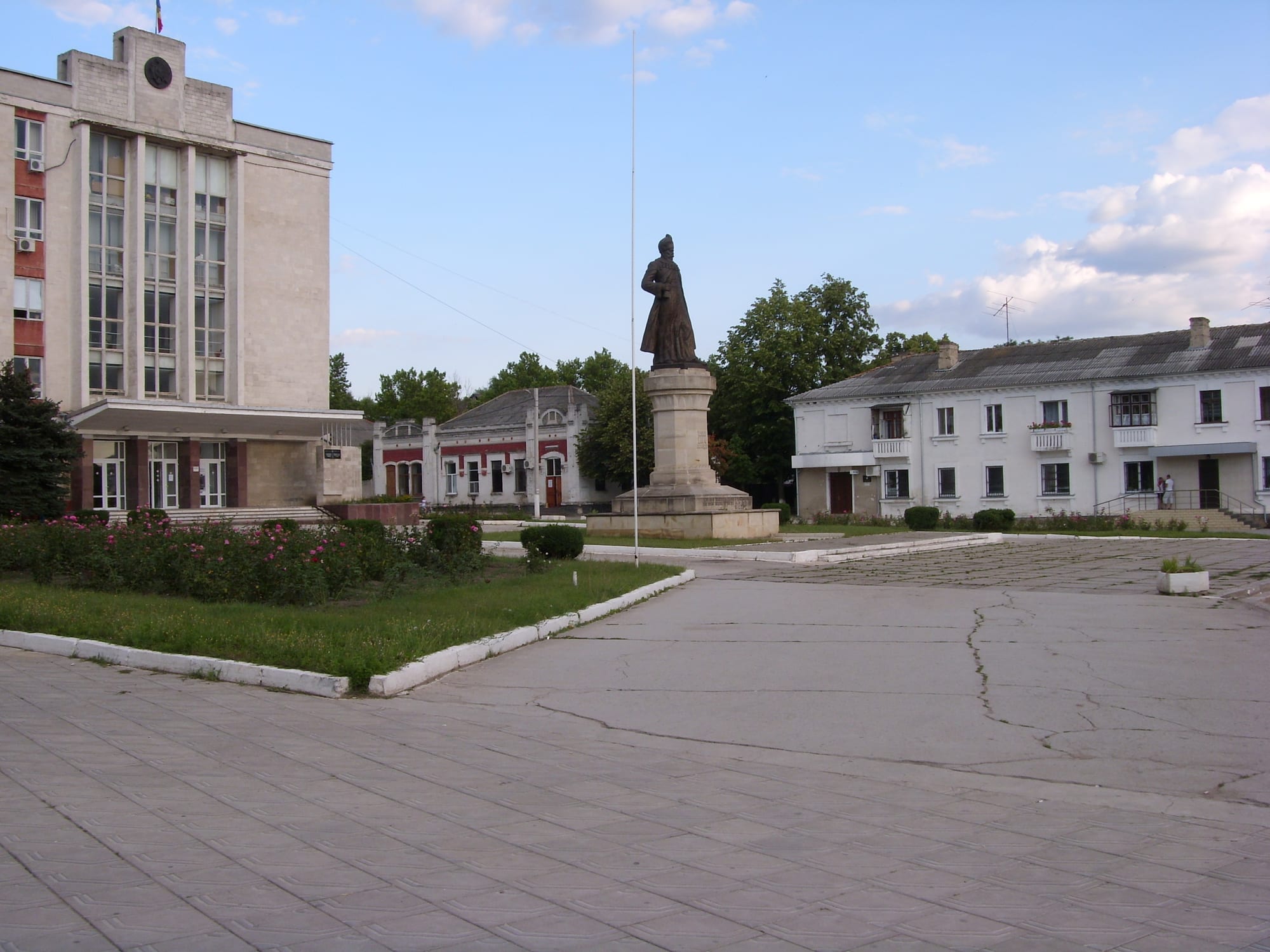
A paved central square with a bronze statue on a stone plinth, an administrative building and low white houses under a blue sky

Moldova

Orhei

The central square of Orhei, with the statue of Vasile Lupu. (BSerg29 / Wikimedia Commons · CC BY-SA 4.0)

A district town on the Răut river roughly 40 km north of Chișinău, first recorded on its present site in 1554 and once home to a large Jewish community. Today it is a modest market and food-processing centre of about 22,000 people, and the gateway to the cave monastery of Orheiul Vechi and Moldova's first national park.

Neighbourhoods

  • Town centre
    • First-time visitors
    • Historic district
    • Best for food

    The central square with the statue of Vasile Lupu and the street named after him, where several of the town's restaurants are. The town's protected churches include the cathedral of St Dumitru.

    Open in Maps
  • Orheiul Vechi and the Răut valley
    • Historic sites
    • Walks
    • Countryside

    About 20 km from the town, the villages of Trebujeni and Butuceni sit beside a loop of the Răut river below the limestone ridge of Old Orhei, with its cave monastery, ruined fortresses and small museums. It is the main reason most visitors come to the district.

    Open in Maps

Things to do

In the town

  • Vasile Lupu Monumentlandmark

    A bronze statue in the central square of Vasile Lupu, prince of Moldavia from 1634 to 1653, under whom the town flourished.

    Open in Maps
  • St Dumitru Cathedrallandmark

    The cathedral founded by Vasile Lupu, one of fifteen churches he endowed, and a monument protected by the state.

    Open in Maps
  • Church of the Assumptionlandmark

    The town's Roman Catholic church, a protected monument and one of several churches that recall the mix of communities in old Orhei.

    Open in Maps
  • Orheilandattraction

    An amusement park in the town.

    Open in Maps

Wine

  • Château Vartelyattraction

    One of the town's largest businesses, a wine estate on Eliberării Street offering tasting tours, with its own restaurant.

    Open in Maps

Short trips from the town

  • Old Orheilandmark

    A historical and archaeological complex on the Răut, with a monastery cut into the limestone cliff by Orthodox monks, remains of Getic and medieval fortresses, and a small pottery museum.

    Open in Maps
  • Orhei National Parkpark

    Moldova's first national park, created in 2013 around the town, covering some 337 km² of forest, valleys and villages.

    Open in Maps
  • Curchi Monasterylandmark

    An Orthodox monastery in Orhei District with several churches, among them a baroque cathedral with the highest dome in Moldova.

    Open in Maps

Eat and drink

Long-standing places and food districts in Orhei. Hours, ratings and directions come from your maps app, always current.

Orhei food and wine

  • Restaurants on Vasile Lupu Streetneighborhood

    The street holds several of the town's restaurants, among them an Italian restaurant and one that doubles as a nightclub.

    Open in Maps
  • Château Vartelyrestaurant

    The wine estate in the town, known for tasting tours of its wines and a restaurant on site.

    Open in Maps

Experience Orhei

History

The first Orhei stood on the loop of the Răut now called Orheiul Vechi, Old Orhei, a site of Getic, medieval and monastic remains. By the early 15th century the area had been taken into the Principality of Moldavia, and the town gradually shifted to its present location, where it is first documented in 1554. It prospered under Vasile Lupu, prince from 1634 to 1653, who restored the town's great pond, built bridges, improved its streets and founded the cathedral of St Dumitru — the period remembered as Orhei's golden age.

In 1812 Orhei was ceded with the rest of Bessarabia to the Russian Empire. It became a market town with a large Jewish population: in 1902 about 7,000 of its 14,800 inhabitants were Jewish, and by the First World War, when the population was estimated at 25,000, about two-thirds were. After the war it became part of Romania; it was annexed by the Soviet Union in 1940, retaken by Romania in 1941 and occupied again by the Soviet army in 1944.

Since 1991 it has been part of independent Moldova, and until 2003 it was the capital of the large Orhei County, before the country was reorganised into smaller districts. In 2015 the businessman Ilan Shor was elected mayor; he later fled the country amid criminal investigations, but the town has remained a political stronghold for his supporters, with his preferred candidates winning large majorities.

Culture & Customs

The town's past as a meeting place of communities is still visible in its churches. Besides the Orthodox cathedral of St Dumitru, protected monuments include the Roman Catholic Church of the Assumption, a Russian Old Believer church of the Kazan Icon of the Mother of God and an Armenian church. Before the Second World War Orhei was home to many Jews, and a large Jewish cemetery survives. Today the main churches are the Romanian Orthodox and Russian Orthodox, with smaller Baptist, Catholic, Adventist and other congregations.

Vasile Lupu is the town's hero: his bronze statue stands in the central square and a street in the town bears his name. Football has a loyal following, as FC Milsami Orhei plays in the top division and won the national championship in 2015 and again in 2025, at the district sports complex.

Orheiul Vechi is the district's cultural landmark — a cave monastery said to have been dug by Orthodox monks in the 13th century, still home to a functioning monastery, set among archaeological sites that include a Getic fortress, a medieval fortress, a bathhouse and an inn. Orhei National Park, created in 2013 as Moldova's first, protects the surrounding landscape of forest, river valleys and villages.

Daily Life

The 2024 census counted 22,183 people in Orhei, making it the ninth-largest town in Moldova and slightly larger than at the 2014 census. As the centre of Orhei District, it holds the district administration, and the rivers Răut and Ivanos and a pond within the town make up its waterways.

The economy rests on food and drink. Large local employers include the Château Vartely wine estate, a bread factory and producers of juices, canned food and dairy products; the town also has a tobacco-fermentation plant and makes household goods and shoes. The population is steadily ageing, as natural growth has fallen with a difficult economic situation and low family incomes. Frequent buses to Chișinău tie the town closely to the capital.

Politics is a frequent subject of national attention, given the town's long loyalty to Ilan Shor's movement, and in 2018 a broadcaster tied to his party launched a station under a name copying the town's existing Radio Orhei.

Food

Orhei eats like the rest of Moldova. Mămăligă, a cornmeal porridge, is the best-known dish, served with brânză, a brined cheese; zeamă, a chicken soup, is an everyday standby; and friptură is a lamb or goat stew. On holidays tables carry sarmale, cabbage rolls stuffed with minced meat, and baked goods such as plăcinte, filled with cheese, fruit, vegetables or walnuts.

Wine is the local speciality. Château Vartely, on Eliberării Street, is one of the town's largest businesses, and offers tasting tours with a restaurant attached. Local wine accompanies most meals across the country, and the stronger choice is divin, the Moldovan brandy. Compot, made from boiled fruit, is the traditional non-alcoholic drink.

Bread, juices, preserves and dairy products are all made in the town, and kvas, a fermented drink of toasted rye bread, is another traditional choice. The restaurants along Vasile Lupu Street include an Italian restaurant and one that doubles as a nightclub.

Planning tools

Budget

Orhei is cheap even by Moldovan standards. The main costs are getting to Orheiul Vechi and the national park — by bus, a hired car or a driver — and a wine tasting.

Daily Budget Midrange
USD 65–130 (comfortable room, restaurant meals, a driver to Orheiul Vechi, a wine tasting)
Daily Budget Shoestring
USD 30–50 (guesthouse room, simple local meals, buses and minibuses)

Many visitors stay in Chișinău and come for the day; staying in the district saves time for the cave monastery and the countryside.

Best Time to Visit

Late spring and early autumn, when the countryside is green or golden and the walk along the ridge at Orheiul Vechi is comfortable. Summers can be very hot and winters are cold.

Suggested Number of Days

The town itself needs only a few hours. A day or two more allows time for the cave monastery, the river valley and the monasteries and villages of the national park, more easily with a car.

First Visit
1 day
With Surroundings
2–3 days

Transportation

The town centre is small and walkable. Buses and minibuses link the town and the villages around it, but services to Trebujeni and Butuceni are infrequent; a car or a driver is the easiest way to see the district.

Buses to Orheiul Vechi are labelled Butuceni or Trebujeni, not Orhei — the town of Orhei is a separate place nearby.

Airport & Station Connections

Orhei is roughly 40 km north of Chișinău, on the road to Soroca, and frequent buses run from the capital, including services heading on to the north of the country. Minibuses from Chișinău's central bus station go direct to Butuceni and Trebujeni for Orheiul Vechi, about an hour's ride. The nearest airport is Chișinău Eugen Doga International, about 13 km south-east of the capital.

Walkability

The centre, around the main square and Vasile Lupu Street, is compact and easy on foot. At Orheiul Vechi a track runs to the top of the cliff, and a path leads down to the cave cells.

Safety

Moldova is generally safe, with low levels of violent crime; the usual issues are petty theft and taxi overcharging in Chișinău. Orhei is a quiet provincial town.

Wear sturdy shoes for the rocky paths at Orheiul Vechi and take care near the cliff edges. Check current official travel advice before travelling.

Climate

A hot-summer continental climate. In nearby Chișinău spring and autumn temperatures range between about 16 and 24°C.

Summer
hot — in nearby Chișinău the average maximum is about 28°C, and mid-summer days occasionally reach 35 to 40°C
Winter
cold and windy — in nearby Chișinău night-time temperatures are often below 0°C, though they rarely drop below −10°C

Local Customs

The monastery at Orheiul Vechi is a working Orthodox monastery, and local children sometimes offer visitors their carvings. The town has Romanian Orthodox, Russian Orthodox and other congregations.

Ask before photographing monks or services at the monastery.

Common Payment Methods

The currency is the Moldovan leu (MDL). Bus and minibus fares are paid in cash, often to the driver, and the small museums at Orheiul Vechi charge entry in lei, so it is worth carrying cash outside Chișinău.