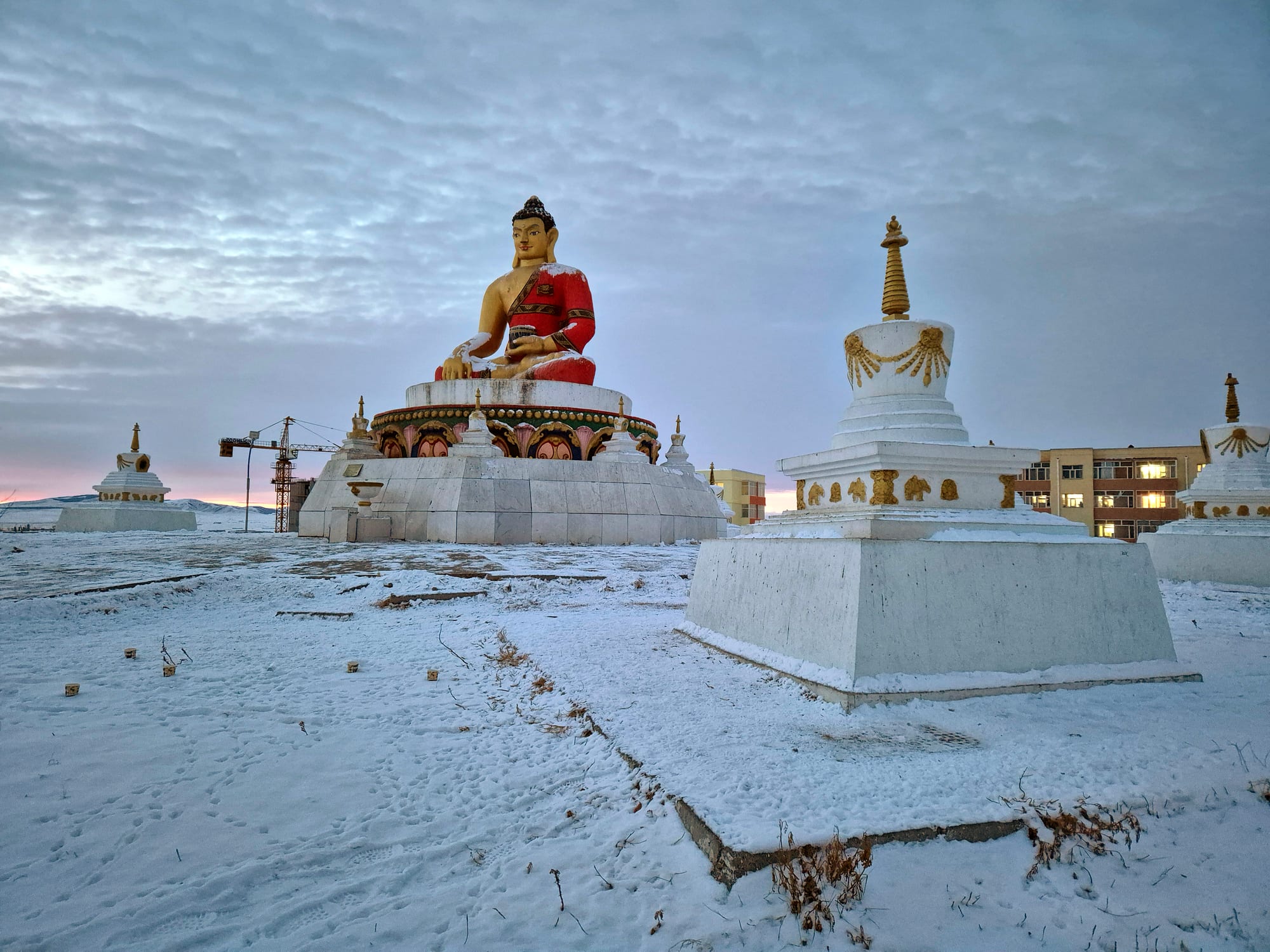
A large seated Buddha statue in red and gold on a stone platform beside white stupas, on snowy open ground at dusk

Ulaanbaatar & Central Mongolia, Mongolia

Darkhan

The great seated Buddha and the stupas beside it on the hill above Darkhan, in northern Mongolia. (Chongkian / Wikimedia Commons · CC BY-SA 4.0)

Mongolia's northern industrial city, founded in 1961 as a planned socialist town on the railway and road between Ulaanbaatar and the Russian border. Built around steel, cement, leather and food processing with Soviet and East European help, it is now the country's third largest city and a usual stop on the way to Amarbayasgalant Monastery.

Neighbourhoods

  • New Darkhan
    • First-time visitors
    • Close to public transport
    • Shops and restaurants

    The main part of the city, laid out from the 1960s in blocks of flats around a central square, with the hotels, shops, restaurants, cinema and administration. Most of what a visitor needs is here, and the newer housing and commercial buildings of the last twenty years have filled in between the older blocks.

    Open in Maps
  • Old Darkhan
    • Local life
    • Historic district

    The original settlement a few kilometres north, closer to the factories and the older railway station, with low housing, workshops and markets. It is quieter and plainer than the new town and shows the industrial origins of the city most clearly.

    Open in Maps
  • The ger districts
    • Local life

    Fenced plots of gers and wooden houses along the edges of both parts of the city, where many families who moved in from the countryside live. Lanes are unpaved and homes are heated by stoves, which cloud the air on still winter days.

    Open in Maps
  • The hill above the city
    • Views
    • Temples

    A rise on the edge of the built-up area holding the large seated Buddha, a ring of white stupas and the city's main monastery. It is the usual place to look out over the blocks, the factory chimneys and the Kharaa valley beyond.

    Open in Maps

Things to do

Monasteries and temples

  • Amarbayasgalant Monasterylandmark

    One of Mongolia's three largest monastic centres, built between 1727 and 1736 by Qing imperial order as a resting place for Zanabazar. Largely Chinese in style, it was partly destroyed in 1937 and restored from the 1970s with UNESCO support.

    Open in Maps
  • Kharagiin Monasterylandmark

    A small monastery housed in a log cabin in the old town, active again as a Buddhist community after the socialist decades.

    Open in Maps

Museums and parks

  • Museum of Darkhan-Uul Provincemuseum

    The provincial museum, also known as the Traditional Museum of Folk Art, with archaeological finds, traditional clothing, religious objects and taxidermy.

    Open in Maps
  • My Mongolia Parkpark

    A park in the middle of the city that serves as its main open space for walking, events and family outings.

    Open in Maps

The river and the valley

  • Kharaa Riverattraction

    The river the city was built beside, running north through farmland and willow thickets to join the Orkhon before the Selenge.

    Open in Maps

Short trips from the city

  • Sükhbaatarattraction

    The capital of Selenge province, a railway town on the Orkhon north of Darkhan, with the road and rail crossing into Russia at Altanbulag just beyond it.

    Open in Maps
  • Kyakhtaattraction

    The Russian town across the frontier from Altanbulag, the border crossing for the Kyakhta trade between Russia and China from 1727, with the churches its tea merchants left behind.

    Open in Maps
  • Erdenetattraction

    Mongolia's second-largest city, founded in 1974 to the west around a large copper and molybdenum mine that still works the deposits found there in the 1950s.

    Open in Maps

Seasonal events

  • NaadamJuly

    Darkhan-Uul province holds its own wrestling, archery and horse racing around the national holiday in mid-July, at grounds outside the city.

  • Tsagaan Sarlate January to March, by the lunar calendar

    The lunar new year, when families visit their elders in order of seniority and steam large batches of buuz; much of the city closes for several days.

Eat and drink

Long-standing places and food districts in Darkhan. Hours, ratings and directions come from your maps app, always current.

Darkhan kitchens

  • Canteens and restaurants in the new townrestaurant

    Dining rooms around the central blocks serving buuz, khuushuur, tsuivan and mutton noodle soup, alongside Korean and Chinese food and a growing number of cafés.

    Open in Maps
  • Darkhan marketmarket

    The city's main market, selling meat, flour, noodles, dried curd and vegetables and flour products from the farms of the Selenge basin.

    Open in Maps

Local specialities

  • Bread and flour from the northern farmsmarket

    Darkhan's food industry mills flour and bakes for much of northern Mongolia, and bread, biscuits and noodles are cheap and widely sold here.

    Open in Maps

Experience Darkhan

History

Darkhan is one of the youngest cities in Mongolia and was built on purpose. In October 1961 the government, with extensive Comecon support, laid the foundation of a planned industrial town at a site on the railway between Ulaanbaatar and the Russian border, in the valley of the Kharaa river. The name means "blacksmith", and the intention was to concentrate heavy industry and construction materials in the north, away from the crowded capital, using coal from nearby deposits and farm produce from the Selenge basin.

Factories followed quickly: a cement works and building-materials plants, a leather and sheepskin industry, flour mills and food processing, a thermal power station, and later a steel plant using scrap and local iron ore. Workers came from all over the country, and specialists from the Soviet Union, Czechoslovakia, Poland and Bulgaria worked on the construction, which is why the older blocks show designs unusual in Mongolia. The population grew from nothing to tens of thousands within two decades, and a new town was laid out several kilometres from the original settlement, which is still called Old Darkhan.

The end of the socialist system in 1990 hit a city built entirely around state industry. Plants closed or shrank, subsidies and technical help ended, and jobs disappeared. In 1994 the surrounding area was made into Darkhan-Uul, a small province of its own with the city as its capital. Since then some industry has revived, notably building materials, metals and food processing, and the city has also grown as a road and rail junction on the trade route between China, Mongolia and Russia.

Culture & Customs

Darkhan's identity is that of a working city. It was assembled from migrants from every province in the 1960s and 1970s, so it has less of a single regional character than older Mongolian towns and more of a shared pride in having been built, quickly and deliberately, as a model industrial town. Buildings and murals from that period, and the names of factories and districts, still carry the socialist-era optimism of its founding.

Buddhism returned openly after 1990, as it did across the country. The monastery on the hill above the city, with its ger-shaped temple, the great seated Buddha and a ring of white stupas, is the focus of religious life, and families come up to make offerings, circle the stupas clockwise and mark the new year. Drivers still stop at ovoo cairns on the passes out of the city.

Sport is important and closely followed. Wrestling is the city's chief passion, along with the horse racing and archery of provincial Naadam in July, and Darkhan has produced wrestlers who have done well at the national festival. Basketball and football are popular with the young, and the cold months move life indoors to sports halls, the theatre and cinema. Ties to the countryside remain strong: many families in the blocks of flats have relatives herding in Selenge or Töv and go out to them in summer, returning with dairy and meat.

Daily Life

About 87,000 people live in Darkhan, making it the third largest city in Mongolia, though a small one by any wider measure. Work is in construction materials, metals, leather, flour milling and food processing, in the power station, on the railway and in road haulage, and in the schools, hospital and provincial administration. Higher-education institutes and colleges train engineers and agricultural specialists, and the surrounding province has some of the country's better farmland, growing wheat, potatoes and vegetables.

The city is unusual in Mongolia for its shape: two separated centres, the newer planned town with its blocks, square and shops, and the older settlement near the factories, with ger districts around the edges of both. Heating comes from the power station for the flats and from coal and wood stoves in the ger areas, which means smoke and poor air on cold, still days, on a smaller scale than the capital's.

Daily rhythms are early and industrial: shift work, school in shifts too where buildings are crowded, markets busiest in the morning, and streets emptying quickly after dark in winter. The city's difficulties are those of an industrial town — an economy tied to a few employers, young people leaving for Ulaanbaatar or abroad, and ageing Soviet-era infrastructure — set against steady traffic on the Russia–China corridor that runs through it.

Food

Darkhan eats the standard Mongolian repertoire with the advantage of being in farming country. Buuz, mutton dumplings steamed in tiers, and khuushuur, the same filling in flat fried pasties, are everywhere; tsuivan, thick noodles steamed over meat and then fried with cabbage, carrot and onion, is the usual lunch; and guriltai shöl, mutton and noodle soup, is the everyday warming dish. Bansh, small boiled dumplings, go into soup or milky tea.

What sets the north apart is flour and vegetables. The Selenge basin is Mongolia's wheat and potato country, and Darkhan's mills and bakeries supply much of the region, so bread, biscuits, noodles and pastries are more prominent here than in the steppe and desert provinces. Potatoes, carrots, cabbage and turnips appear regularly in soups and salads, and Russian influence shows in bread, pickles, smoked fish from the Selenge waters and dishes such as salad dressed with mayonnaise.

Dairy remains central. Aaruul, hard dried curd, is stacked in the market; urum, thick scalded cream, is eaten with bread; and suutei tsai, salted milk tea, is poured constantly at home. Airag, lightly fermented mare's milk, is sold in summer from stalls on the roads out of town. Khorkhog, mutton cooked with fire-heated stones in a sealed churn, belongs to trips into the countryside. Vodka is the usual strong drink and the national brands are sold everywhere, with Russian beers and Mongolian lagers alongside them.

Planning tools

Budget

Darkhan is cheaper than the capital. Hotels are plain and moderately priced, canteen meals cost very little, and the city is small enough to cross by bus or a short taxi ride. The expensive part of a visit is usually the trip out to Amarbayasgalant, which means hiring a vehicle and driver for a long day or an overnight stay.

Daily Budget Midrange
USD 75–160 (mid-range hotel, restaurant meals, a car and driver for a day trip to Amarbayasgalant)
Daily Budget Shoestring
USD 20–40 (guesthouse or basic hotel, canteen meals, local buses, train or bus from the capital)

Cash and a local SIM card are easy to get here, which makes Darkhan a sensible last stop before heading into Selenge province.

Best Time to Visit

June to September, when the Kharaa and Selenge valleys are green, the roads to Amarbayasgalant are passable and Naadam falls in mid-July. September is dry and golden. Winter is long and severe, and stove smoke hangs over the ger districts on still days, though the city stays busy and is easy to reach by train all year.

Suggested Number of Days

The city itself is a half-day to a day. Most people stay longer only to use it as a base for the monastery and the farm country of the Selenge basin, which needs a vehicle and stretches a visit to two or three days.

First Visit
1 day
With Surroundings
2–3 days

Transportation

Buses and shared minivans run frequently to Ulaanbaatar on a paved road, taking around four hours, and to Sükhbaatar and Erdenet. Trains on the Trans-Mongolian line stop here between the capital and the Russian border. Within the city, buses and cheap taxis link the new town, the old town and the industrial areas, which lie several kilometres apart.

The road to Amarbayasgalant ends in a long stretch of unpaved track, so a high-clearance vehicle and a driver who knows the route are worth arranging in the city.

Airport & Station Connections

Darkhan lies about 204 kilometres north of Ulaanbaatar on a four-lane road and the Trans-Mongolian Railway, roughly four hours by bus or minivan and longer by train. It is the last large city before the Russian border at Altanbulag and Kyakhta, rather over 100 kilometres further north, and there are no scheduled passenger flights.

Walkability

The new town is walkable, with the square, hotels, shops and restaurants within fifteen or twenty minutes of each other on wide pavements between blocks of flats. The gap between the new and old towns is too far to walk comfortably, and the ger districts climb unpaved lanes. Winter ice and strong wind make short journeys feel longer.

Safety

Crime levels are low, with petty theft in the market and around bars at night the main concern, and drunken aggression a risk late in the evening. Traffic is the more common danger: crossings are few and drivers fast on the through roads. Winter cold and icy pavements cause more trouble than crime.

Keep valuables out of sight in the market, use a taxi rather than walking between districts after dark, and dress for serious cold from November to March. Check current official travel advice before travelling.

Climate

A dry continental climate in the Kharaa valley, a little milder in summer than the capital and just as cold in winter. Most of the year's rain falls in July and August, the air is clear for much of the year, and stove smoke thickens the air in the ger districts in the cold months.

Summer
warm — 20–28°C by day, cooler nights, with showers and thunderstorms in July and August
Winter
severe and dry — typically −15 to −30°C, with snow cover from November to March

Local Customs

Manners follow the national pattern: objects, cups and gifts are passed with the right hand, or both hands with the left supporting the right elbow; thresholds of gers are stepped over, not on; and offered food or tea is at least tasted. At the monastery and the Buddha statue people move clockwise, dress modestly and leave offerings.

Tipping is not traditional, though rounding up a restaurant bill is becoming common; ask before photographing monks, ceremonies or people at their homes.

Common Payment Methods

The currency is the Mongolian tögrög (MNT). Banks and ATMs are easy to find in the new town, and hotels, supermarkets and larger restaurants take cards, with QR-code payment by phone common among residents. Cash is needed at the market, in small canteens, in taxis and anywhere out in the countryside.