A wide paved square with an equestrian statue on a stone plinth, backed by glass office towers under a clear blue sky

Ulaanbaatar & Central Mongolia, Mongolia

Ulaanbaatar

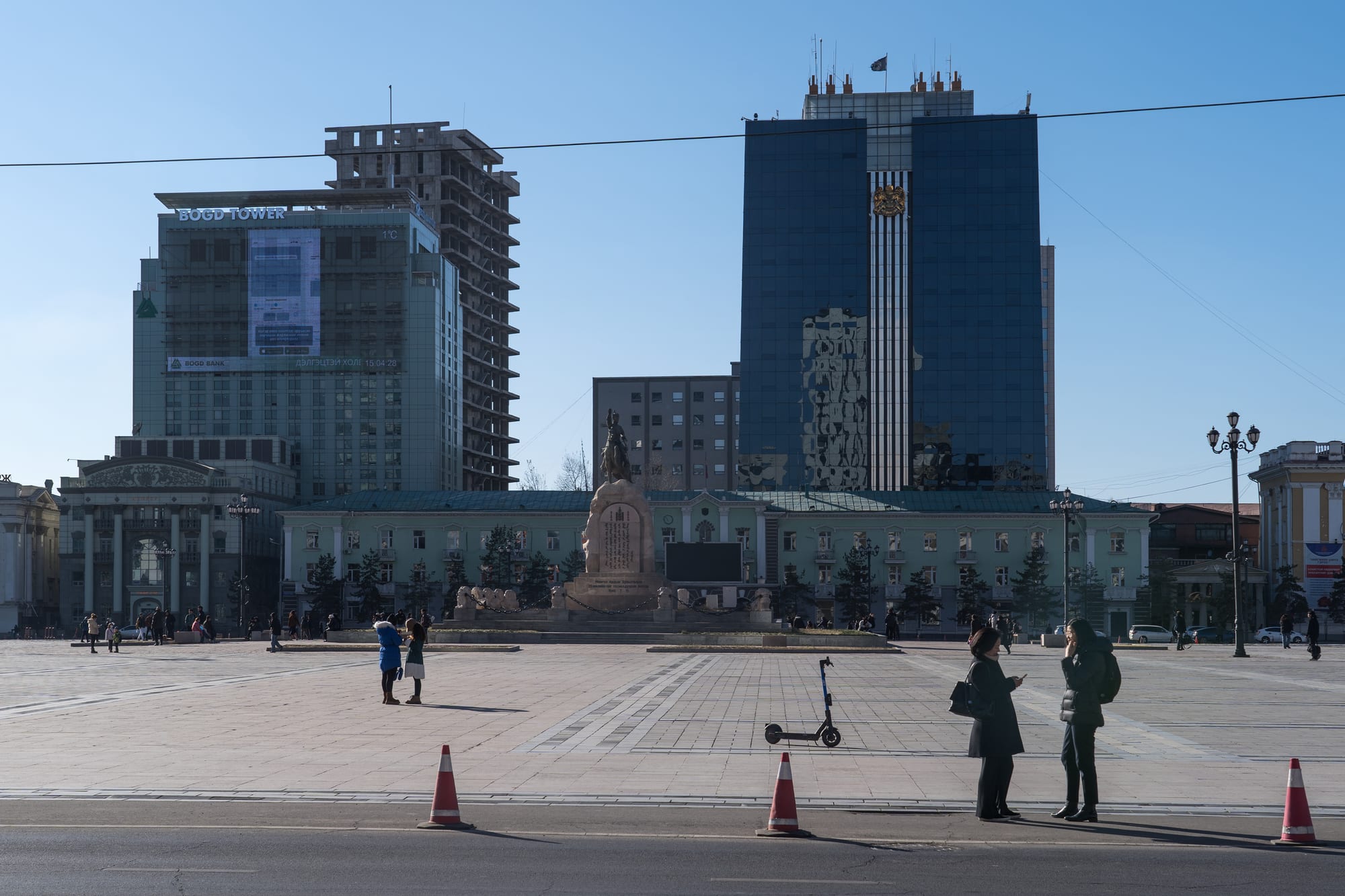
Sükhbaatar Square in central Ulaanbaatar, with the Damdin Sükhbaatar equestrian statue and the towers of the modern centre behind it. (Alexkom000 / Wikimedia Commons · CC BY 4.0)

Mongolia's capital, set in the Tuul river valley at about 1,350 metres between forested hills. It began in 1639 as a mobile monastery camp and became a Soviet-planned city of apartment blocks; today about half of all Mongolians live here, in a centre of glass towers and museums ringed by ger districts on the slopes.

Neighbourhoods

  • The centre around Sükhbaatar Square
    • First-time visitors
    • Museums
    • Close to public transport

    The formal heart of the city, with the Government Palace on the square's north side and the main museums, theatres and hotels within a few blocks. Peace Avenue runs east to west through it, lined with shops, offices and restaurants, and most sights in the centre are within a walk of each other.

    Open in Maps
  • Gandan hill
    • Temples
    • Historic district

    The rise north-west of the centre around Gandantegchinlen Monastery, the seat of Mongolian Buddhism. Lanes of low houses and shops selling incense and prayer goods climb towards the monastery walls, and the area keeps more of the older city's character than the avenues below.

    Open in Maps
  • Zaisan and the southern edge
    • Views
    • Quiet and residential

    South of the Tuul river, below the forested Bogd Khan mountain, where new apartment towers and restaurants have gone up around the hill topped by the Zaisan Memorial. The view from the memorial takes in the whole valley, and trailheads into the mountain start nearby.

    Open in Maps
  • Bayanzürkh and the eastern districts
    • Local life
    • Markets

    The large residential districts east of the centre, a mix of Soviet-era blocks, new estates and the Naran Tuul open-air market. Everyday shopping and the long-distance bus and minivan departures for the provinces happen out this way rather than downtown.

    Open in Maps
  • The ger districts
    • Local life

    Fenced plots of gers and small houses spreading up the hillsides around the built-up centre, home to a large share of the city's population. Most lack piped water and sewerage, and their stoves are the main source of the winter smog that settles in the valley.

    Open in Maps

Things to do

Monasteries and temples

  • Gandantegchinlen Monasterylandmark

    The main working monastery of Mongolian Buddhism, whose temple holds a 26-metre gilded statue of Migjid Janraisig, rebuilt in the 1990s after the original was removed in the Soviet period.

    Open in Maps
  • Choijin Lama Temple Museummuseum

    A temple complex of the early 20th century in the middle of the modern centre, preserved as a museum of religious art, masks and thangkas rather than reopened for worship.

    Open in Maps

Museums and galleries

  • National Museum of Mongoliamuseum

    The country's largest museum, running from prehistory and the pre-imperial period through the Mongol Empire and Qing rule to the twentieth century, with a large display of ethnic dress.

    Open in Maps
  • Winter Palace of the Bogd Khanmuseum

    The riverside palace and temple compound where Mongolia's last theocratic ruler lived, kept as a museum of his possessions and ceremonial objects.

    Open in Maps
  • Zanabazar Museum of Fine Artsmuseum

    An art museum founded in 1966 and named after Zanabazar, the 17th-century sculptor and first head of Mongolian Buddhism, with collections of paintings, thangkas, statues, masks and costumes.

    Open in Maps
  • Mongolian National Modern Art Gallerymuseum

    The national collection of twentieth-century and contemporary Mongolian painting and sculpture, on the south side of the central square district.

    Open in Maps
  • International Intellectual Museummuseum

    A museum in the eastern districts whose collection is built around intricate wooden puzzles and toys that visitors can take apart and put back together.

    Open in Maps

Squares, monuments and views

  • Sükhbaatar Squarelandmark

    The city's central square, named for the revolutionary leader Damdin Sükhbaatar, with his equestrian statue of 1946 at its centre and, on the north side, a colonnade monument in front of the Government Palace holding statues of Genghis Khan with Ögedei and Kublai.

    Open in Maps
  • Zaisan Memorialviewpoint

    A circular Soviet-era monument on a hill south of the river, with a mosaic of Mongolian–Soviet friendship and the widest view over the city.

    Open in Maps
  • Blue Sky Towerlandmark

    The curved glass tower beside the central square, one of the buildings that changed the city's skyline after 2000.

    Open in Maps
  • National Sports Stadiumattraction

    The stadium south-west of the centre where the Naadam opening ceremony and the wrestling are held each July.

    Open in Maps

Short trips from the city

  • Bogd Khan Uulpark

    The forested mountain rising directly south of the city, named in 1709 as one of twelve Mongolian mountains protected from hunting, cultivation and timber felling, with walking routes over the ridge.

    Open in Maps
  • Gorkhi-Terelj National Parkpark

    Granite outcrops, larch slopes and the upper Tuul valley about 60 kilometres north-east, with rock formations such as Turtle Rock and many ger camps.

    Open in Maps
  • Genghis Khan Equestrian Statuelandmark

    A stainless-steel horseman 40 metres high on the steppe at Tsonjin Boldog, about 54 kilometres east of the city, opened in 2008 on a visitor centre with a viewing platform reached through the horse's neck.

    Open in Maps
  • Hustai National Parkpark

    Steppe hills about 100 kilometres west of the capital where the takhi, or Przewalski's horse, was reintroduced from the 1990s.

    Open in Maps
  • Manzushir Monasterylandmark

    The ruins of an 18th-century monastery on the southern slopes of Bogd Khan Uul above Zuunmod, destroyed in the purges of the 1930s and left as walls, rock inscriptions and a small museum.

    Open in Maps

Seasonal events

  • Naadam11–13 July

    The national festival, opening on 11 July with a ceremony at the National Sports Stadium, followed by wrestling and archery in the city and cross-country horse races of 15 to 30 kilometres on the steppe outside it.

  • Tsagaan Sarlate January to March, by the lunar calendar

    The lunar new year, when families visit their elders in order of seniority and households steam large batches of buuz; much of the city closes for several days.

  • Ulaanbaatar MarathonMay

    An international road race through the centre of the city, first held in 2014 and usually run on a Saturday in May, with shorter distances alongside the full marathon.

Eat and drink

Long-standing places and food districts in Ulaanbaatar. Hours, ratings and directions come from your maps app, always current.

Ulaanbaatar classics

  • Buuz and khuushuur canteensrestaurant

    Steamed mutton dumplings and flat fried meat pasties are the staples of the city's small canteens, usually served with milky tea and pickled vegetables.

    Open in Maps
  • Tsuivan and noodle soup hallsrestaurant

    Plain dining rooms along and off Peace Avenue serving tsuivan, steamed noodles fried with mutton and vegetables, and guriltai shöl, a mutton and noodle soup.

    Open in Maps

Food districts and markets

  • Peace Avenue and the central blocksneighborhood

    The main avenue and the streets behind it hold most of the city's restaurants, from Mongolian canteens to Korean, Japanese, Chinese and European kitchens.

    Open in Maps
  • Naran Tuul Marketmarket

    Alongside the saddles and boots, market stalls sell dried curd, aaruul, borts dried meat and other herders' foods brought in from the countryside.

    Open in Maps
  • State Department Store food hallmarket

    The city's best-known shop, whose supermarket floor is the easiest place to find Mongolian dairy products, vodka and snacks to take out of the city.

    Open in Maps

Experience Ulaanbaatar

History

The city began in 1639 as Örgöö, a camp of felt tents built around the young Zanabazar, the first Jebtsundamba Khutughtu and head of Mongolian Buddhism. For well over a century it moved with its monks across the steppe, and it settled on the present site by the Tuul river in 1778. As Ikh Khüree — Urga to foreigners — it grew into a town of temple courtyards, monastic colleges and Chinese trading quarters, and it became the religious capital of the Khalkha Mongols and a stop on the tea caravan route between China and Siberia.

In 1911, as the Qing dynasty collapsed, the Bogd Khan was enthroned here as ruler of an autonomous Mongolia, and the town became a political capital as well as a religious one. The following decade brought Chinese occupation, the brief and violent rule of the White Russian officer Roman von Ungern-Sternberg, and in 1921 the revolutionary forces of Damdin Sükhbaatar, who entered the city with Soviet support. In 1924 it was renamed Ulaanbaatar, "Red Hero".

The purges of the 1930s destroyed most of the monasteries in and around the city and killed thousands of monks; Gandan was among the very few religious sites allowed to reopen. Soviet planners then rebuilt the capital as a city of grid avenues, apartment blocks, factories and a central square, with a theatre, a university and a stadium. Since the democratic revolution of 1990, whose demonstrations filled Sükhbaatar Square, the population has risen steeply as herding families moved in, and mining wealth has added glass towers, shopping centres and new suburbs to the Soviet skeleton.

Culture & Customs

Ulaanbaatar sets the tone of modern Mongolian life. Its universities, theatres, television studios and recording studios reach every province, and its fashions and slang travel outward with students and migrants. The State Academic Theatre of Opera and Ballet on the central square, the national song and dance ensembles and folk groups playing the morin khuur, the horsehead fiddle, and performing khöömei throat singing, all work here, while hip hop and rock grew up in the apartment blocks and ger districts and now dominate the charts.

The city is also the centre of Mongolian Buddhism. Gandantegchinlen Monastery is the seat of the revived monastic community, and families come to temples for blessings, name-giving and readings at the new year. Shamanic practice has returned alongside it, and a Kazakh Muslim minority and small Christian congregations add to the mix. Ovoo cairns on the passes out of the city are still circled three times clockwise by drivers.

Naadam is at its grandest here. The opening ceremony is held at the National Sports Stadium, wrestlers in open-fronted vests and shorts compete through the afternoon, archers shoot at rows of small leather targets, and child jockeys race long distances across the steppe outside the city. In winter, at Tsagaan Sar, households receive visitors in order of seniority, greeting elders with arms held palms-up beneath theirs. Manners are informal but firm about hospitality: food and drink offered to a guest are expected to be at least touched.

Daily Life

About 1.8 million people live in Ulaanbaatar, close to half of Mongolia's population, and the number keeps rising as families leave the countryside after hard winters. The city is two cities in one: a built-up core of Soviet apartment blocks, glass towers, malls and offices in the valley floor, and the ger districts spreading up the surrounding slopes on fenced plots, many without piped water or sewerage. Mining, government, banking, construction, trade and a growing services and technology sector provide most formal jobs, and the country's wealth from copper, coal and gold is managed from offices here.

The two defining problems are traffic and air. Car ownership has grown far faster than the road network, and rush hour clogs the few east–west avenues. From November to February, coal and wood stoves in the ger districts fill the valley with smoke that the surrounding hills trap, making winter air pollution one of the worst in the world despite a ban on raw coal introduced in 2019. Dzud winters in the countryside send more families to the city each spring, adding to both pressures.

Daily rhythms are those of any large Asian city: early starts, long commutes, lunch in canteens, children in crowded schools that often run in shifts, and shopping in supermarkets and open-air markets alike. Summer empties the city at weekends as residents drive out to country cottages, ger camps and relatives' herds in Töv province, and most families keep ties to the countryside that no amount of city living has broken.

Food

The everyday food of the capital is the food of the steppe, cooked indoors. Buuz, mutton dumplings steamed in tiers, are eaten year-round and in enormous numbers at Tsagaan Sar; khuushuur are the same filling in flat pasties fried until blistered. Tsuivan, thick noodles steamed over meat and then fried with mutton and a little cabbage, carrot and onion, is the standard canteen lunch, and guriltai shöl is a plain mutton and noodle soup. Bansh, smaller boiled dumplings, are dropped into soup or into milky tea. Potatoes, carrots and cabbage from the Selenge farms are the usual vegetables.

Dairy runs through everything. Suutei tsai, salted milk tea, is poured for guests at any hour; aaruul, hard dried curd, is stacked in markets and chewed like sweets; urum, a thick scalded cream, is eaten with bread. In summer, airag, lightly fermented mare's milk, arrives from the countryside and is sold by roadside stalls on the roads out of the city. Khorkhog, mutton cooked in a sealed churn with hot stones, belongs to trips out to the camps rather than to restaurants.

The city also eats more widely than anywhere else in Mongolia. Korean barbecue and noodle houses are common in the centre; Chinese, Japanese, Russian, Indian and European restaurants cluster in the centre; and a café culture of espresso, cake and bakery bread has grown quickly in the central blocks. Vodka is the usual strong drink, with Chinggis among the best-known brands, and local lagers are widely sold.

Planning tools

Budget

Ulaanbaatar is the one place in Mongolia with a full range of prices, from dormitory hostels and canteens to international hotels. Food in local canteens and city buses are very cheap; hotel rooms, imported goods and hiring a car with a driver for a day out to Terelj or the Genghis Khan statue are what push a daily budget up. Prices rise around Naadam in July.

Daily Budget Midrange
USD 85–180 (mid-range hotel, restaurant meals, museum entry, a car and driver for day trips)
Daily Budget Shoestring
USD 25–45 (hostel bed, canteen meals, city buses, a shared day tour)

Draw cash, buy supplies and get a local SIM card here before leaving for the provinces, where choice and prices fall away quickly.

Best Time to Visit

June to September, when the hills are green, day trips are easy and the city is at its most open. Naadam in mid-July is the busiest and most expensive week of the year. September is golden and quieter. Winter visits are possible and Tsagaan Sar is a striking time to be here, but the cold is severe and smog settles in the valley on still days.

Suggested Number of Days

Two or three days cover the museums, monasteries and central streets. Allow four to six to add the countryside around the capital, since each trip out means a long drive. Naadam or a winter visit needs extra time for the slower pace of both.

First Visit
2–3 days
With Surroundings
4–6 days

Transportation

City buses cover the whole built-up area cheaply and are paid for with a rechargeable card. Taxis are common, including ordinary cars acting as taxis, and ride-hailing apps are widely used. Traffic congestion is severe at peak hours on the few main avenues, and a journey across the city can take far longer than the distance suggests. Long-distance buses and minivans to the provinces leave from terminals on the edges of the city, and trains north to Darkhan and Russia and south towards China leave from the main railway station.

Agree a fare or use an app before getting into a taxi, and allow generous extra time for crossing the city at rush hour.

Airport & Station Connections

Chinggis Khaan International Airport, which opened in 2021 at Khöshig valley south of the city, is Mongolia's gateway and lies about 50 kilometres from the centre, roughly an hour by road on the expressway. Most visitors fly in from Seoul, Beijing, Istanbul, Tokyo or Moscow. The Trans-Mongolian Railway links the city with Beijing and with Irkutsk and Moscow, and domestic flights fan out to the provincial centres.

Walkability

The central grid around Sükhbaatar Square is walkable, with the main museums, theatres and shops within twenty minutes of each other. Beyond that the city is spread out and built for vehicles: pavements end abruptly, crossings are few, drivers give little way, and the ger districts climb steep unpaved lanes. Winter ice and summer dust both make walking harder, and air quality often discourages it in the cold months.

Safety

Most of Mongolia's petty crime happens in the capital: pickpocketing around Sükhbaatar Square, the State Department Store and the Naran Tuul market, bag snatching on crowded buses, and drunken aggression late at night. Traffic is the more serious everyday risk, and pedestrians need care at crossings. Violent crime against visitors is uncommon.

Keep valuables under clothing in markets and on buses, use a registered taxi or an app at night, and dress for the cold even on autumn day trips. Check current official travel advice before travelling.

Climate

Ulaanbaatar sits in a valley at about 1,350 metres and is the coldest national capital on Earth. The climate is dry and strongly continental, with long hard winters, a short warm summer, and most of the year's rain falling in July and August. Winter smog from ger-district stoves settles in the basin on still days, and a ban on burning raw coal introduced in 2019 has only partly eased it.

Summer
warm and short — around 20–25°C by day, cool nights, showers and thunderstorms in July and August
Winter
severe — January averages around −20°C, nights below −30°C, dry and often sunny, with heavy smog

Local Customs

Mongolians greet visitors simply and value directness. Objects, cups and gifts are passed and received with the right hand, or both hands, with the left hand supporting the right elbow. In a home or a ger, stepping on the threshold is avoided, as is pointing the feet at the stove or at people. At monasteries, temples and ovoo cairns, people move clockwise, dress modestly and ask before photographing monks or ceremonies.

Tipping is not traditional, though rounding up a bill or leaving ten per cent in a tourist restaurant is now common; remove shoes only where the household does; and accept at least a taste of anything offered by a host.

Common Payment Methods

The currency is the Mongolian tögrög (MNT). Cards are accepted in hotels, supermarkets, chain restaurants and many shops in the centre, and QR-code payment by phone is widespread among locals. Cash is still needed for markets, small canteens, taxis and anything outside the city, and ATMs in Ulaanbaatar are the last reliable ones before the provinces. Foreign currency is changed at banks and exchange offices in the centre.