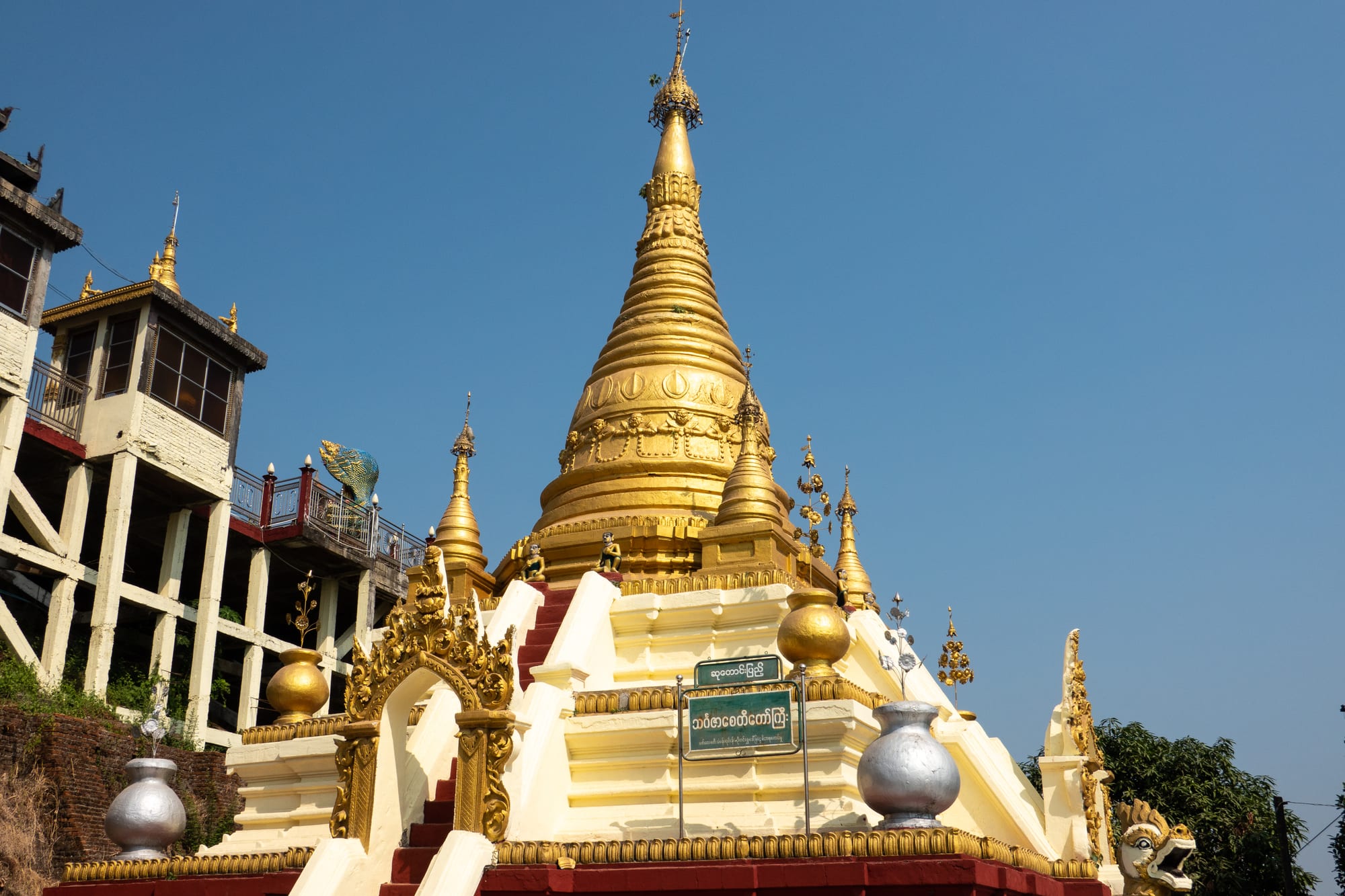
A tall gilded stupa with white terraces, small golden spires and a covered stairway rising beside it under a clear blue sky

Shan, Mon & the Southeast, Myanmar

Mawlamyine

The gilded stupa of the Kyaikthanlan Pagoda on the ridge above Mawlamyine. (PsamatheM / Wikimedia Commons · CC BY-SA 4.0)

The capital of Mon State, on the eastern bank of the Thanlwin estuary in southern Myanmar. As Moulmein it was the first capital of British Burma, from 1826 until 1852, and grew rich on teak and rice; a ridge of pagodas still rises above streets of colonial-era brick and timber. This page is written to explain the city, not to encourage travel.

Neighbourhoods

  • The Strand and the waterfront
    • First-time visitors
    • River views
    • Close to transport

    The road along the Thanlwin is the city's front door, with jetties for the boats to Bilu Kyun, the clock tower, government offices and warehouses of the colonial period, and a line of brick and timber buildings facing the water. Evenings bring stalls and families out along the river wall.

    Open in Maps
  • The pagoda ridge
    • Historic district
    • Views
    • Temples

    A low hill runs the length of the city behind the waterfront, carrying a chain of monasteries and gilded pagodas, Kyaikthanlan among them. The lanes climbing to it are quiet and shaded, and the crest gives a long view over the estuary and the islands.

    Open in Maps
  • The central market quarter
    • Local life
    • Best for food
    • Shopping

    Inland from the Strand, the grid of streets around the main market is the busiest part of town: produce, dried fish and fabric stalls, teashops, goldsmiths, mosques, churches and Chinese and Indian temples left by the port's mixed population.

    Open in Maps
  • The southern outskirts
    • Quiet and residential
    • Day trips

    South of the centre the city thins into rubber plantations, monasteries and roadside villages along the highway towards Mudon and Ye. It is residential and unhurried, and the route to the giant reclining Buddha and the war cemetery.

    Open in Maps

Things to do

Pagodas and landmarks

  • Kyaikthanlan Pagodalandmark

    The tallest pagoda in the city, about 46 metres high on the ridge above the waterfront, traditionally dated to 875 and thought to be the 'old Moulmein pagoda' of Kipling's poem 'Mandalay'.

    Open in Maps
  • Thanlwin Bridgelandmark

    The road and rail bridge across the estuary linking the city with Mottama, the longest in Myanmar until the Pakokku bridge was built.

    Open in Maps

Museums and the colonial town

  • Mon State Cultural Museummuseum

    The state museum on the edge of the centre, with Mon inscriptions, Buddha images, royal furniture and wooden carving.

    Open in Maps
  • Win Sein Tawyalandmark

    A Buddhist complex near Mudon whose reclining Buddha, about 180 metres long, is described as the world's largest free-standing figure of its kind; chambers inside depict scenes from the Buddha's life.

    Open in Maps

Islands and the river

  • Chaungzonattraction

    The main town of Bilu Kyun, the 'ogre island' in the estuary west of the city, among Mon villages whose workshops make blackboards, wooden pipes, rubber bands and cane goods.

    Open in Maps

Short trips from the city

  • Thanbyuzayat War Cemeteryattraction

    The cemetery about 60 kilometres south holding the graves of prisoners of war who died building the Thailand–Burma railway, whose Burmese terminus was at Thanbyuzayat.

    Open in Maps
  • Kyaikkamiattraction

    A small coastal town south of the city, formerly Amherst, with the Yele Pagoda built on sea reefs and joined to the shore by a walkway.

    Open in Maps
  • Hpa-Anattraction

    The Kayin State capital upriver, set among limestone karst peaks and cave shrines, about 45 kilometres north.

    Open in Maps
  • Mount Zwegabinviewpoint

    The limestone peak of about 720 metres above Hpa-An, climbed by a long stairway to a pagoda at the summit.

    Open in Maps
  • Saddan Caveattraction

    A long limestone cave near Hpa-An filled with Buddha images and reliefs, opening onto a lake at the far end.

    Open in Maps
  • Kawgun Caveattraction

    A cave temple near Hpa-An whose walls are covered with thousands of small Buddha votive tablets and reliefs, some inscribed in ancient Mon script.

    Open in Maps
  • Kyaikmarawattraction

    A small town south-east of the city, whose temple was built in 1455 by Shin Sawbu, queen of Pegu and the only female ruler in Burmese history.

    Open in Maps
  • Mottamaattraction

    The town on the opposite bank of the estuary, the Martaban of old trade routes that gave its name to the glazed storage jars shipped across Asia.

    Open in Maps
  • Thatonattraction

    The old Mon royal town about 60 kilometres north, capital of a kingdom conquered by Bagan in 1057, with a large central pagoda.

    Open in Maps
  • Setse Beachbeach

    A broad brown-sand beach on the Gulf of Mottama south of the city, a weekend outing for families from Mawlamyine.

    Open in Maps

Seasonal events

  • ThingyanApril

    The Burmese new year water festival, marked across the city with stages, music and days of water-throwing in the hottest part of the year.

  • ThadingyutOctober

    The festival of lights at the end of Buddhist Lent, when pagodas on the ridge and houses along the Strand are lit with candles and lanterns.

  • Mon National Dayusually February

    A Mon cultural day marked with processions, dance and traditional dress in Mon State, of which Mawlamyine is the capital.

Eat and drink

Long-standing places and food districts in Mawlamyine. Hours, ratings and directions come from your maps app, always current.

Markets and food streets

  • The central marketmarket

    The city's main produce market, stacked with estuary fish and prawns, dried and fermented fish, chillies, betel and the fruit of the Mon orchards in season.

    Open in Maps
  • Strand Road stallsneighborhood

    Evening stalls along the riverfront selling grilled fish and skewers, noodle bowls, fritters and sweets, eaten at low tables facing the water.

    Open in Maps
  • Teashops in the centreneighborhood

    The teashop is the social institution of the town: sweet milk tea, plain green tea, fried snacks and a bowl of mohinga in the morning.

    Open in Maps

Mon country flavours

  • Bilu Kyun village kitchensneighborhood

    Simple places on the island across the water serving Mon-style fish and sour curries with rice and raw vegetables.

    Open in Maps

Experience Mawlamyine

History

The Mon have lived around the mouth of the Thanlwin for many centuries, and the old kingdom centred on Thaton, north of the city, was conquered by Anawrahta of Bagan in 1057. Mawlamyine itself was a modest settlement until the First Anglo-Burmese War of 1824–26, when the Treaty of Yandabo gave Britain the Tenasserim coast. The British laid out a new port on the east bank, called it Moulmein, and made it the capital of British Burma from 1826 until Rangoon took the role after the second war of 1852.

Those decades built the town that survives. Teak floated down the Thanlwin from the interior to sawmills on the waterfront, rice and later rubber followed, and the port drew Mon, Bamar, Karen, Chinese, Indian and Anglo-Burmese families whose mosques, temples and churches still stand a few streets apart. The American missionary Adoniram Judson built the country's first Baptist church here in 1827. Two English writers are tied to the place: the pagoda on the ridge is thought to be the 'old Moulmein pagoda' with which Kipling opens 'Mandalay', and George Orwell was posted to the town as a police officer in 1926, the setting of his essay 'Shooting an Elephant', his mother's family having come from here.

The Second World War brought Japanese occupation, and the Thailand–Burma railway was built inland from Thanbyuzayat, south of the city, at enormous cost in lives. After independence in 1948 the surrounding countryside was contested by Karen and Mon insurgents for decades. Mawlamyine became the capital of Mon State when the state was created in 1974, and remains the fourth-largest city in Myanmar, though the port's importance faded long ago and many of its young people now work in Thailand.

Culture & Customs

Mawlamyine is the cultural capital of the Mon, one of the oldest recorded peoples of mainland Southeast Asia, whose script was the model for written Burmese and whose language is still spoken in the villages around the estuary. Mon National Day, the hamsa bird of Mon heraldry and a strong sense of a separate, older civilisation are part of everyday identity here, alongside the Burmese mainstream. Karen communities, many of them Christian, live in and around the city as well.

Buddhism shapes the year. The ridge of pagodas above the town fills at full moon, novices are ordained in processions of music and finery, and the lights of Thadingyut in October mark the end of the rains retreat, when families visit their elders. Thingyan, the new year water festival in April, is the loudest week of the year. Mon pagoda festivals add their own music, boxing and dance, and village crafts on Bilu Kyun — blackboards, wooden pipes, rubber bands, cane goods — are a source of local pride.

The colonial inheritance is unusually visible: brick warehouses and shuttered timber shophouses, a clock tower, mission churches and schools, and a mixture of faiths in a few blocks. Manners are those of Myanmar generally — quiet speech, deference to age and to monks, modest dress, shoes removed at thresholds — and conversation about politics is something residents must be careful with.

Daily Life

Mawlamyine is the fourth-largest city in Myanmar and by far the biggest in the southeast. The estuary sets the rhythm: fishing boats and ferries cross to the island, the fish and prawns come to the market before dawn, and the working day starts early and pauses in the heat of the afternoon. Rubber from the plantations inland, rice, fruit from the Mon orchards, fishing and small trade make up most of the local economy, along with government offices, the university and the hospital.

Most people live in low houses of brick, timber and corrugated iron spread back from the waterfront and along the roads south and east, with monasteries at the centre of many wards. Remittances matter enormously: hundreds of thousands of Mon and Karen from this part of the country work in Thailand, and money sent home supports whole families and pays for building.

Since the 2021 coup the country's crisis has reached everyday life here as elsewhere — power cuts, fuel queues, rising prices, restricted internet, checkpoints and the fear of conscription — while fighting in the neighbouring states has displaced large numbers of people and cut road links. Schools and markets keep going, but households live with uncertainty and with families split between the town and work abroad.

Food

Mawlamyine has a reputation across Myanmar for eating well, and the reason is the estuary. River and sea fish, prawns and crab reach the market daily, and the kitchens of the town turn them into sour curries with tamarind or roselle leaf, fish grilled over charcoal, and soups thickened with the pungent fermented shrimp and fish paste called ngapi, which is made in quantity along this coast. Dried fish and dried prawns hang in the market stalls and travel inland.

Mon cooking is the local accent: rice served with several small dishes, raw vegetables and a chilli-and-ngapi dip, sour and herbal flavours rather than rich ones, and coconut milk in both curries and sweets. Mohinga, the fish and rice noodle soup eaten at breakfast across the country, is a natural dish in a river city, and noodle bowls dressed with tamarind, garlic oil and coriander are sold from stalls all day. Tea-leaf salad, lahpet thoke, appears on almost every table.

Mon State is orchard country, and in the rains the market fills with durian, mangosteen, rambutan, jackfruit and pomelo. Sweets lean on sticky rice, palm sugar and coconut, and the juice of the toddy palm is drunk fresh or fermented in the villages. The teashop provides the rest of the day's meals: strong tea with condensed milk, fried dough sticks, steamed buns and small plates shared at low tables from early morning until dark.

Planning tools

Budget

Mawlamyine has long been one of the cheaper towns of the southeast, with simple guesthouses, small hotels and food at local prices. Since 2021 inflation, fuel costs and the collapse of tourism have pushed prices up and closed many hotels, and everything must be paid for in cash.

Daily Budget Midrange
USD 70–160 (hotel room, a hired car and driver, boat hire, a guide)
Daily Budget Shoestring
USD 25–45 where travel is possible (guesthouse, teashops and noodle stalls, shared taxis and ferries)

Carry clean, unmarked US dollars and change them at a bank or licensed shop; there is no reliable card access, and hotel and transport prices change with the fuel price.

Best Time to Visit

In climate terms, November to February, when the estuary is dry, clear and comparatively cool and the pagoda festivals fall. The monsoon from about May to October brings some of the heaviest rain in the country. Security is the deciding factor: fighting has affected Kayin, Kayah, parts of Shan and the road links across the southeast since 2021.

Suggested Number of Days

The centre, the ridge and the waterfront are small enough to cover in a couple of days. Three or four allow the island in the estuary and the sights strung along the southern road. Road conditions and checkpoints, not distance, decide how much is actually possible.

First Visit
2 days
With Surroundings
3–4 days

Transportation

The city is the terminus of the railway from Yangon and is served by highway buses, with a small airport handling flights to Yangon. Inside town, motorcycle taxis, tuk-tuks and shared pickup trucks do most journeys, and ferries and small boats cross to the island and the far bank. Hired cars with drivers are the usual way to reach places along the southern road.

Assume overland travel between the southeastern states is unsafe or impossible, and never cross into Myawaddy or Shwe Kokko on the Thai border.

Airport & Station Connections

Mawlamyine lies about 300 kilometres south-east of Yangon. The road crosses the delta and the Sittaung plain and takes most of a day with checkpoints; trains from Yangon are slower still. The Thanlwin Bridge carries road and rail across the estuary from the Mottama side, and the city's airport has flights to Yangon.

Walkability

The centre is flat, compact and easy to walk, with the market grid a few blocks back from the Strand and the waterfront itself a long, level promenade. The pagoda ridge is a climb of stairways and steep lanes. Pavements are uneven, traffic is unregulated at junctions, and the heat and monsoon rain shorten most walks to early morning and evening.

Safety

Myanmar has been at war since the 2021 coup, and the southeast is one of its main theatres; most governments advise against all travel to the country. Mawlamyine itself has seen quieter periods than the surrounding states, but the wider risks apply: checkpoints, arbitrary arrest, conscription, blackouts, internet restrictions and no reliable consular help. Ordinary crime is a lesser concern than the political situation.

Do not travel against official advice, stay away from border areas, and treat any job offer leading to the Thai border as a trafficking risk. Avoid photographing soldiers, police, checkpoints and government buildings, keep away from any gathering, and do not discuss politics with people who could be endangered by it. Check current official travel advice before travelling.

Climate

A tropical monsoon climate, hot all year and among the wettest in Myanmar. The dry season runs from about November to April and the southwest monsoon from May to October, when several metres of rain can fall and the estuary turns brown with silt.

Summer
hot and humid before the rains, about 30–36°C in March and April, then heavy daily rain from late May
Winter
warm, dry and sunny, about 24–32°C, with cooler mornings — the pleasantest season

Local Customs

Mon State is strongly Buddhist, and pagodas and monasteries are treated with care: shoes and socks come off at the entrance to any pagoda platform, shoulders and knees stay covered, and some shrine chambers are closed to women. Many people, women and children included, wear thanaka paste on their faces, and the longyi is everyday dress for both sexes. Greetings are quiet, and money and objects are passed with the right hand.

Tipping is not traditional but small amounts are appreciated; permission should be asked before photographing people, monks or nuns; feet are never pointed at a Buddha image and heads are not touched; and anything connected with the military should not be photographed.

Common Payment Methods

The currency is the Myanmar kyat (MMK). This is a cash economy: foreign cards are effectively unusable, ATMs are unreliable and exchange rates differ widely between official and market rates. Clean, new US dollar notes without folds or marks are the usual way to bring money in.