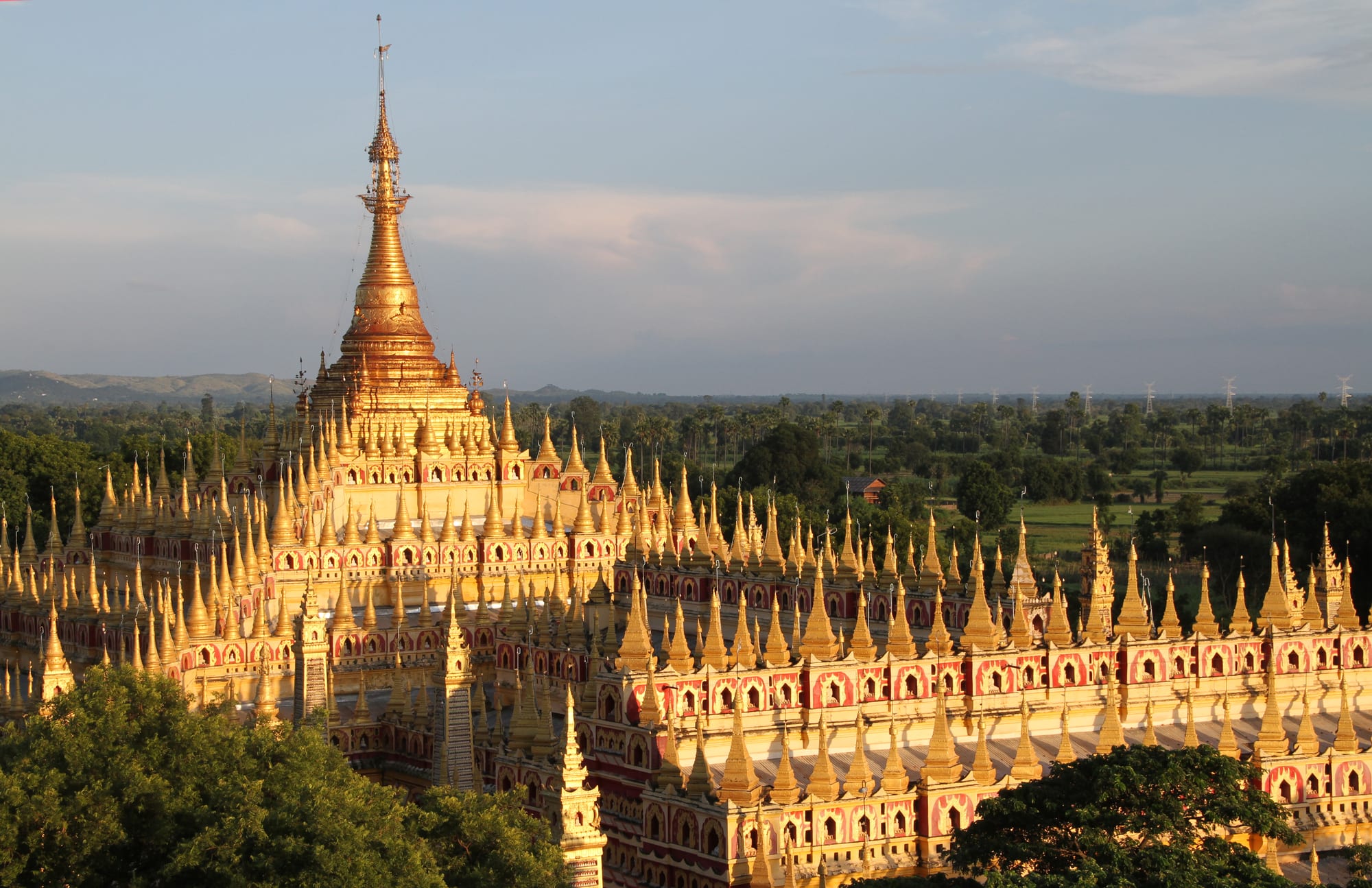
A gilded pagoda covered in hundreds of small spires rising above trees, with flat green farmland and low hills behind

Kachin, Sagaing & the North, Myanmar

Monywa

The Thanboddhay Pagoda and its thousands of small stupas on the outskirts of Monywa. (Gerd Eichmann / Wikimedia Commons · CC BY-SA 4.0)

A trading town on the east bank of the Chindwin in Sagaing Region, about 135 kilometres north-west of Mandalay, long the market for the cotton, bean and palm country between the Chindwin and the Mu. It is best known for the Thanboddhay Pagoda, the giant Buddhas of Bodhi Tataung and the carved cave shrines across the river. This page is written to explain the city, not to encourage travel.

Neighbourhoods

  • Town centre
    • First-time visitors
    • Markets
    • Close to public transport

    The commercial grid around the main bazaar and the clock tower, where the shops, teashops, banks, bus offices and most of the guesthouses are. It is flat, busy and easily walked.

    Open in Maps
  • The Chindwin riverfront
    • Views
    • Local life
    • Sunsets

    The western edge of town, where jetties and sandy banks run down to the Chindwin and boats cross to the villages and caves on the far shore. Tea stalls and small restaurants look over the water.

    Open in Maps
  • The eastern outskirts
    • Temples
    • Quiet and residential

    The road east towards Mandalay, where the Thanboddhay Pagoda and the hill of Bodhi Tataung stand among farmland and toddy palms. Housing here is low and spread out, mixed with fields and monasteries.

    Open in Maps

Things to do

Pagodas and giant Buddhas

  • Thanboddhay Pagodalandmark

    A pagoda complex on the eastern edge of the town, built between 1939 and 1952, its gilded exterior covered in small stupas and its interior lined with more than half a million Buddha images.

    Open in Maps
  • Laykyun Sekkyalandmark

    The standing Buddha at Khatakan Taung south-east of the town, begun in 1996 and completed in 2008; at 116 metres, on a throne of almost the same height again, it is among the tallest statues in the world.

    Open in Maps

Royal towns and river sites nearby

  • Shweboneighborhood

    The town north-east of Monywa where Alaungpaya founded the Konbaung dynasty in 1752, with its palace site, moat and pagodas.

    Open in Maps
  • Sagaingneighborhood

    A former royal capital on the Ayeyarwady whose hills are covered with white and gold monasteries, stupas and nunneries, one of the country's great centres of monastic life.

    Open in Maps
  • Mingunlandmark

    A riverside village upstream of Mandalay with the huge unfinished brick base of the Mingun Pahtodawgyi, one of the world's largest ringing bells and the white terraces of the Hsinbyume Pagoda.

    Open in Maps

Across the Chindwin

  • Phowintaunglandmark

    A sandstone outcrop on the west bank of the Chindwin honeycombed with some 947 cut shrines, their carved Buddha images and wall paintings dating from between the 14th and 18th centuries.

    Open in Maps

Ancient cities

  • Halinlandmark

    The walled remains of a Pyu city about 19 kilometres south-east of Shwebo, among the earliest towns in the country and inscribed in 2014 with Beikthano and Sri Ksetra as the Pyu Ancient Cities World Heritage Site.

    Open in Maps

Seasonal events

  • Thingyan water festivalApril

    The Burmese new year, marked with several days of water throwing in the streets, visits to monasteries and merit-making.

  • Thadingyut festival of lightsOctober

    The end of the Buddhist Lent, when pagodas, monasteries and houses are lit with candles and lamps and elders are paid respect.

  • Tazaungdaing festival of lightsNovember

    A second lighting festival at the full moon, with all-night weaving contests to make robes offered to monks at dawn.

Eat and drink

Long-standing places and food districts in Monywa. Hours, ratings and directions come from your maps app, always current.

Where to eat in Monywa

  • The central bazaarmarket

    The town's main market, selling Chindwin river fish, beans and pulses from the surrounding farmland, palm sugar, pickles and cooked snacks.

    Open in Maps
  • Curry shops and teashops in the centreneighborhood

    Bamar curry houses serve fish and pork curries with rice, soup, pickles and a tray of vegetables, and teashops open before dawn for sweet milk tea and fried snacks.

    Open in Maps
  • Riverside stalls on the Chindwinneighborhood

    Simple stalls and small restaurants near the jetties, known for grilled and fried river fish eaten looking over the water.

    Open in Maps

Experience Monywa

History

Monywa grew up as a river port and market where the trade of the Chindwin valley met the dry farmland between that river and the Mu. Boats brought teak, cotton and goods down from the north-west, and the town's bazaar distributed them inland; the name itself is usually explained as "village near the pile", after a mound beside the river. Nearby Halin, north-east of the town, was among the earliest walled towns of the Pyu, and the Konbaung dynasty was founded at Shwebo, a day's journey away, in 1752, so the surrounding countryside has been settled and farmed for a very long time.

Under British rule, after the annexation of Upper Burma in 1885, Monywa became a district headquarters and a collecting point for cotton, beans, sesame and palm sugar, connected to the Mandalay railway by a branch line. Its position on the Chindwin made it a route towards India, and in May 1942 Japanese troops came up the river to seize it while British and Indian forces withdrew north towards India.

After independence the town became the administrative and commercial centre of its part of Sagaing Region, with a university, a trading economy in pulses and edible oils, and industry on its outskirts. Its religious landmarks are modern: the Thanboddhay Pagoda was begun in 1939, and the giant Buddha images of Bodhi Tataung were completed in stages, the standing figure in 2008. The copper mining development at Letpadaung, south-west of the town, has been a long source of protest. Since the 2021 coup Sagaing Region has been one of the main theatres of the war, and in March 2025 an earthquake centred near Sagaing caused heavy damage.

Culture & Customs

Monywa is a Bamar Buddhist town, and its public life turns on the monastery and the pagoda. Boys are ordained as novices in the shinbyu ceremony, families make offerings on full-moon days, and alms rounds at dawn are part of the ordinary street scene. The scale of local merit-making is unusual even by Burmese standards: the thousands of small stupas at Thanboddhay, the thousand bodhi trees each sheltering a Buddha image at Bodhi Tataung, and the enormous standing and reclining figures on the ridge east of town were all built with donations from lay supporters.

Older devotional traditions survive in the caves across the Chindwin, where generations of donors cut shrines into the sandstone and covered the walls with murals. Pilgrimage rather than tourism has always been the main reason people come to Monywa, and the busiest days at the pagodas are Burmese festival days rather than the European winter.

Domestic crafts are part of local identity: lacquerware is made in villages east of the town, cotton weaving and the pressing of sesame and groundnut oil are old trades, and palm climbers still tap toddy from the sugar palms in the fields. Manners follow the national pattern — quiet voices, no public displays of temper or affection, elders greeted first, and the head treated as the highest part of the body and the feet the lowest.

Daily Life

Monywa is one of the larger towns of Sagaing Region and its commercial centre. The economy is built on trade: beans and pulses for export, sesame and groundnut oil, cotton, rice and palm sugar from the surrounding townships, along with copper from the mines to the south-west and timber and goods moving along the Chindwin. Market days, transport offices and wholesale yards set the working rhythm.

Life starts early. Markets open before dawn, teashops fill at first light, offices and schools run through the morning, and the hottest hours of the afternoon are quiet before the town comes out again in the evening. Most people live in low houses with walled compounds and trees; motorcycles are the way almost everyone moves, and bullock carts still work in the villages around.

Since 2021 daily life has been shaped by the war in the countryside. Hundreds of thousands of people have been displaced across Sagaing Region, electricity, mobile signal and internet are cut for long periods, and the prices of fuel, cooking oil and food have risen sharply. Monasteries, churches and camps shelter families who have fled their villages. Many younger residents have left for Mandalay and Yangon or for work abroad in Thailand and Malaysia, and the money they send home supports households in the town.

Food

Monywa eats the food of the central dry zone. The staple meal is rice with a curry — river fish, chicken or pork stewed slowly in oil with onion, garlic, turmeric and chilli — served with a clear soup, a tray of raw and boiled vegetables and a dish of ngapi yay, a thin dip made from fermented fish or shrimp paste. Pulses are the region's main crop and appear at every meal, in fritters, in soups and boiled as a side.

The Chindwin supplies freshwater fish, which are grilled, fried or dried, and nga baung doke, fish and vegetables steamed in banana leaf, is a river dish of this part of the country. Mohinga, the fish and rice-noodle soup eaten at breakfast across Myanmar, is sold from stalls and carts in the morning, and ohn no khao swe, wheat noodles in coconut and chicken broth, is a common alternative. Laphet thoke, the salad of pickled tea leaves with fried beans, sesame, garlic and tomato, is served to guests and at the end of meals.

Sweetness comes from the toddy palm: jaggery pressed into cakes, sold along the roads, and the sap itself drunk fresh or fermented into toddy in the villages. Teashops are the centre of daily sociability, serving strong tea with condensed milk, plain green tea, samosas, fried dough sticks and steamed buns from before dawn until late morning.

Planning tools

Budget

Monywa was one of the cheaper stops in central Myanmar: modest hotels and guesthouses, market food, and short taxi or motorcycle rides out to the pagodas and the river crossing. Since 2021 fuel, food and transport prices have risen sharply, and many hotels have closed.

Daily Budget Midrange
USD 80–200 (hotel, car and driver for the pagodas and the caves, entry fees)
Daily Budget Shoestring
USD 25–45 where travel is possible (basic guesthouse, market food, shared transport)

Sights around the town charge entry and camera fees that go to the authorities; carry clean US dollar notes and kyat in cash, as card access does not work.

Best Time to Visit

In climate terms, November to March, when the central plain is dry and relatively cool and the roads are open; the festivals of Thadingyut and Tazaungdaing fall in October and November. The weather is secondary: fighting across Sagaing Region since 2021 has put most of it beyond safe reach.

Suggested Number of Days

The town and the sights on its edges take a day or two. Three or four days would allow the river crossing and the old royal towns to the east as well, and every journey depends on whether the roads are open.

First Visit
1–2 days
With Surroundings
3–4 days

Transportation

Distances are long and roads poor. Monywa is a few hours by road from Mandalay, buses and shared cars run east and north, and a branch railway reaches the town. Boats once ran up the Chindwin towards Hkamti, and small ferries cross to the villages and caves on the west bank. In the town, motorcycle taxis, three-wheelers and bicycles cover the short distances.

Treat overland movement in Sagaing Region as unsafe: much of the road network runs through contested territory, with checkpoints, closures and landmines.

Airport & Station Connections

Most people arrive by road from Mandalay, about 135 kilometres east, a journey of roughly three hours in normal conditions, or from Pakokku and Bagan to the south. A branch of the railway also reaches the town from the Mandalay line. There is no regular passenger flight; the nearest airports are at Mandalay and Bagan.

Walkability

The centre is flat and compact, and the market, the clock tower and the riverfront are all within a short walk of each other. Days are very hot from March to May, shade is limited, and the pagodas and the giant Buddhas are several kilometres out of town, so those need a ride.

Safety

Sagaing Region is one of the most dangerous parts of Myanmar. Its countryside has seen sustained fighting since 2021, with air strikes on villages, burned settlements, landmines and very large numbers of displaced people, and consular help is effectively unavailable. Roads around the town pass through contested territory, communications are cut for long periods, and an earthquake centred near Sagaing in March 2025 caused heavy damage across the region.

Do not travel to this region; if already in Myanmar, stay out of conflict areas and keep in contact with the relevant embassy. Check current official travel advice before travelling.

Climate

Monywa lies in the hot, dry central zone, in the rain shadow that also covers Bagan and Mandalay. Rainfall is low and falls mainly between June and October; the hottest months are March to May, and the pleasant season runs from November to February.

Summer
very hot and dry, frequently 35–42°C in April and May, with dust and hot winds before the rains
Winter
dry and warm by day, around 28–32°C, with cool nights and clear skies

Local Customs

This is a strongly Buddhist Bamar town, and its pagodas are living places of worship rather than monuments. Shoes and socks come off at the foot of the steps at pagodas and in monasteries, shoulders and knees are covered, and images of the Buddha are never treated casually or used as a backdrop. Many people wear the longyi, and thanaka paste on the face is everyday rather than ceremonial.

Tipping is not customary but small amounts are appreciated. Do not photograph soldiers, police, checkpoints or military buildings, and never pose in front of a Buddha image or sit with the feet pointing towards one.

Common Payment Methods

The currency is the Myanmar kyat. This is a cash economy: foreign cards rarely work, ATMs are unreliable and international banking has been disrupted since 2021, so clean, undamaged US dollar notes are the usual fallback. Exchange rates differ widely between official and market rates.