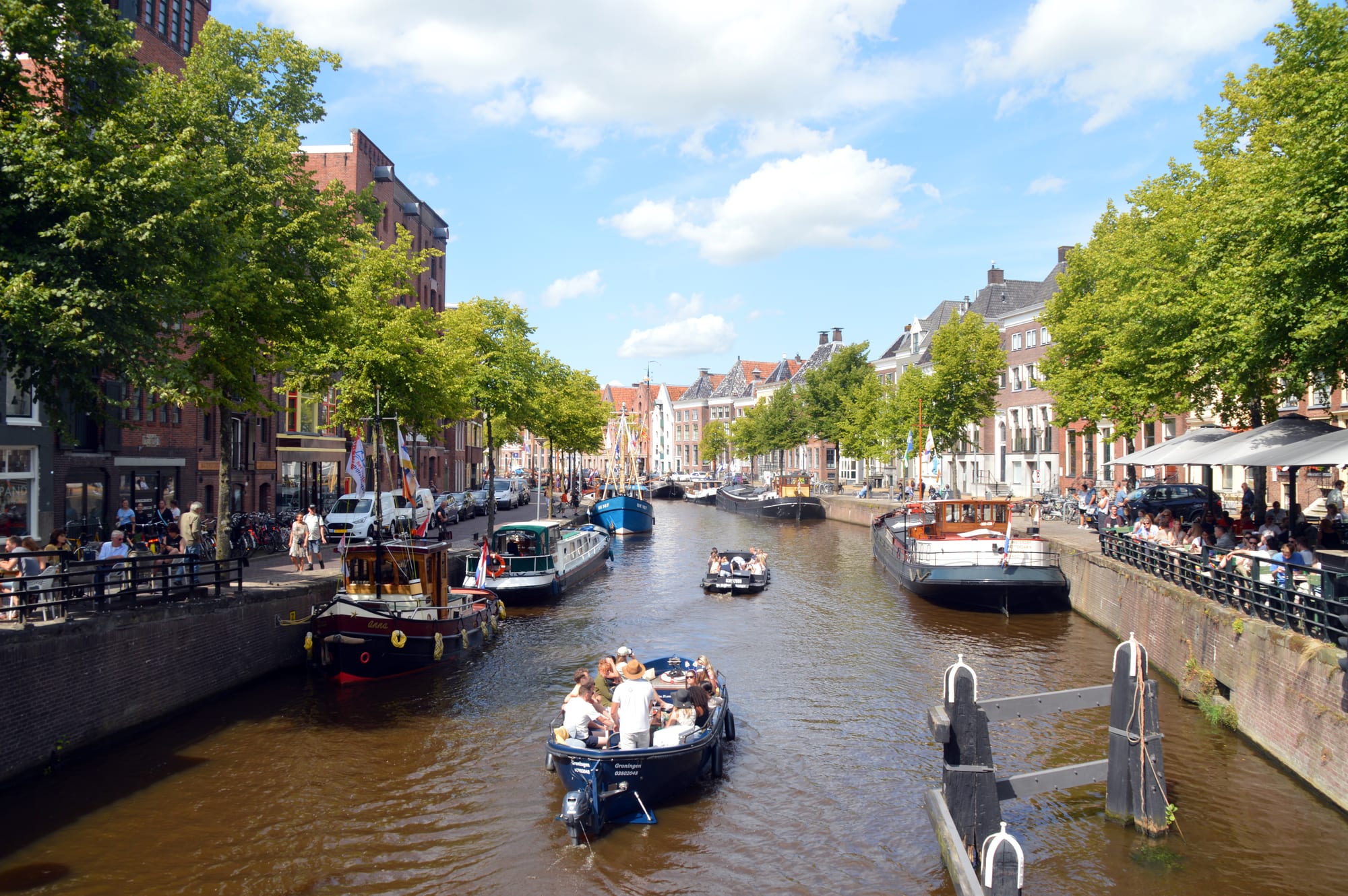
A canal lined with boats and old buildings along the Hoge der A in Groningen

The Northern Netherlands, Netherlands

Groningen

Boats on the canal along the Hoge der A in the centre of Groningen. (Roger Veringmeier / Wikimedia Commons · CC BY 4.0)

The 'capital of the north', a former Hanseatic city-state at the northern tip of the Hondsrug ridge that stayed largely self-governing until the late 18th century. Today it is the largest city in the northern Netherlands and its youngest: about a quarter of the population are students, most residents commute by bike, and the centre is ringed by canals.

Neighbourhoods

  • Binnenstad
    • First-time visitors
    • Nightlife
    • Close to public transport

    The canal-ringed centre around the two adjoining squares, the Grote Markt and the Vismarkt, with the Martinitoren, the Forum, the main shopping streets and the student bars of the Poelestraat and Peperstraat. Much of it is a pedestrian and cycle priority zone.

    Open in Maps
  • Hoge and Lage der A and the Noorderhaven
    • Historic district
    • Canals
    • Best for food

    The two streets along the A canal on the west side of the centre are lined with dozens of listed buildings, including medieval warehouses and a 17th-century brewery, and lead towards the Noorderhaven, where warehouses once stored colonial goods.

    Open in Maps
  • Around the Noorderplantsoen
    • Parks
    • Students
    • Quiet and residential

    The park laid out on the old ramparts just north of the centre, with residential streets around it. Students gather on its lawns on sunny days, and it hosts the Noorderzon festival every August.

    Open in Maps
  • Zernike Campus
    • Students
    • University

    The large college campus on the northern edge of the city, reached by a dedicated student express bus from the station — more a place to study than to stay, but the centre of the city's academic life.

    Open in Maps

Things to do

Famous landmarks

  • Martinitorenviewpoint

    The tallest church steeple in the city and its symbol, the bell tower of the Martinikerk, climbed by a spiral staircase of 260 steps past a carillon of 62 bells.

    Open in Maps
  • Martinikerklandmark

    The oldest church in Groningen, dedicated, like its tower, to St Martin of Tours, on the edge of the Grote Markt.

    Open in Maps
  • Der Aa-kerklandmark

    A former parish church rebuilt as a brick Gothic church between 1425 and 1495, whose tower, rebuilt in 1711 after a collapse, is a landmark of the skyline beside the Martinitoren.

    Open in Maps
  • Goudkantoorlandmark

    The decorated 'Gold Office' of 1635 near the Grote Markt, built for the provincial tax receiver; it survived the destruction of the square in 1945.

    Open in Maps
  • Forum Groningenviewpoint

    A cultural centre opened in 2019 beside the Nieuwe Markt with a library, art-house cinema, exhibitions and a freely accessible roof terrace with views over the city.

    Open in Maps

Museums

  • Groninger Museummuseum

    Modern and contemporary art in a postmodern building of 1994, with pavilions by Alessandro Mendini, Philippe Starck and Coop Himmelb(l)au, standing in the canal opposite the station.

    Open in Maps
  • Northern Maritime Museummuseum

    The Noordelijk Scheepvaartmuseum, the maritime museum of the northern Netherlands, in the city centre.

    Open in Maps

Parks and gardens

  • Prinsentuinpark

    A walled Renaissance-style garden behind the Prinsenhof, with a rose garden, herb garden, arbours and a sundial over the entrance.

    Open in Maps
  • Noorderplantsoenpark

    A long, narrow park curving around the old city on its former ramparts, with the old moats turned into ponds, and home to the Noorderzon festival in August.

    Open in Maps
  • Stadsparkpark

    A park of about 140 hectares on the south-west side of the city, designed by the landscape architect Leonard Springer.

    Open in Maps
  • Hortus Harenpark

    A botanical garden first created in 1626 in the city centre and moved to Haren in 1967; Haren has been part of the municipality since 2019.

    Open in Maps

Music, sport and nights out

  • Euroborgattraction

    The home ground of FC Groningen, opened in 2006, with a capacity of about 22,500.

    Open in Maps
  • Grote Markt and Vismarkt nightlifeneighborhood

    The squares and the Poelestraat and Peperstraat are crowded every night with students, and many bars stay open until the early morning.

    Open in Maps

Short trips from the city

  • Menkemaborgmuseum

    A moated manor house, or borg, at Uithuizen in the north of the province, a historic house museum since 1927.

    Open in Maps
  • Lauwersmeer National Parkpark

    Former sea inlet on the border with Friesland, known for its birdlife and dark night skies.

    Open in Maps
  • Bourtangeattraction

    A small star-fort village near the German border in the Westerwolde region, restored between 1967 and 1992 to its mid-18th-century state and now an open-air museum.

    Open in Maps

Seasonal events

  • Eurosonic NoorderslagJanuary

    A four-day music showcase festival and conference, with artists from all over Europe playing venues across the city.

  • NoorderzonAugust

    About eleven days of music, theatre, visual art and performance in the Noorderplantsoen, beginning in the third week of August.

  • Gronings Ontzet (Bommen Berend)28 August

    Music and fireworks marking the failure of the Bishop of Münster's siege of the city in 1672.

  • 4 Miles of GroningenOctober

    A road race through the city on the second Sunday of October, with more than 23,000 runners.

Eat and drink

Long-standing places and food districts in Groningen. Hours, ratings and directions come from your maps app, always current.

Groningen classics

  • Eierbal from a snack barrestaurant

    Groningen's version of the Dutch croquette: a ball-shaped croquette filled with veal and a whole egg, sold at snack bars across the city.

    Open in Maps
  • 't Pannekoekschiprestaurant

    An old masted sailing ship moored on the Schuitendiep canal and turned into a restaurant serving large Dutch pancakes.

    Open in Maps

Markets and food streets

  • Grote Markt and Vismarkt marketsmarket

    Markets fill both main squares on Tuesdays, Fridays and Saturdays, with street food and local producers selling cheese, meat, honey, fruit and vegetables.

    Open in Maps
  • Folkingestraatneighborhood

    A picturesque shopping street running south from the end of the Vismarkt, with specialty shops including one selling regional products such as Groningen sausage, mustard and cheese.

    Open in Maps
  • Zwanestraat and Grote Kromme Elleboogneighborhood

    Two streets of specialty shops for beer, herbs and spices, coffee and cooking equipment.

    Open in Maps

Experience Groningen

History

Groningen grew up at the northernmost point of the Hondsrug, a sandy ridge above the surrounding marshes. The area was settled long before the first written mention of the town in 1040, and it gained city rights in practice by 1245. In the 13th century it was already an important trade centre with a city wall, and as a Hanseatic city it belonged to the North German trading network. Its most powerful period came at the end of the 15th century, when it administered neighbouring Friesland and the Martinitoren was built; it could then be considered an independent city-state.

That autonomy ended in 1536, when Groningen accepted Charles V as its ruler. In 1594 Maurice of Nassau's Dutch and English forces besieged and captured it, and the city and province joined the Dutch Republic. The university was founded in 1614. In the 17th century Groningen was an important base for the Dutch West India Company, whose ships carried enslaved Africans to plantations in Brazil, Suriname and the Antilles, and warehouses along the Noorderhaven stored colonial goods. In 1672 the city withstood a siege by the Bishop of Münster, still celebrated every 28 August.

French rule followed, and from 1811 to 1813 the city was annexed to Napoleon's empire. In April 1945 the Battle of Groningen largely destroyed the Grote Markt, though the Martinitoren, the Goudkantoor and the city hall survived. The discovery of the vast Slochteren gas field in 1959 brought wealth to the country but, from 1991, earthquakes that damaged homes across the province; the government decided to end extraction by 1 October 2023. In 2019 the municipality merged with Haren and Ten Boer.

Culture & Customs

Groningen is known nationally as the "Metropolis of the North" and as Martinistad, after its tower. With about a quarter of residents studying at the University of Groningen, the second-oldest university in the country, or at the Hanze University of Applied Sciences, it is the youngest city in the Netherlands, and that shapes everything from the nightlife to the cultural calendar. The Grote Markt, Vismarkt, Poelestraat and Peperstraat are crowded nightly, and many bars stay open until five in the morning.

Music is a particular strength. Eurosonic Noorderslag brings bands and the European music industry every January, the Vera club, the Oosterpoort and Simplon host concerts year-round, and jazz cafés such as De Spieghel play live music. Summer brings Noorderzon to the Noorderplantsoen, Noorderlicht runs an international photography festival, and the Forum, opened in 2019, combines a library, cinema and exhibitions. Groningen also has a long chess tradition: the first major international tournament after the Second World War was held here in 1946.

The city's dialect, Gronings, became common across the surrounding countryside during its medieval dominance. Sport centres on FC Groningen and the basketball club Donar, seven-times national champions, and the 4 Miles of Groningen draws more than 23,000 runners each October.

Daily Life

The municipality had 244,807 inhabitants in January 2025, making it the sixth-largest in the Netherlands, and the metropolitan area about 557,000. More than 70 per cent of residents are non-religious, and the population is unusually young. The University of Groningen has about 31,000 students, 22 per cent of them international, and the Hanze more than 28,000.

Hotels and catering are a significant part of the city's economy, alongside business services and a growing mix of IT, life sciences, tourism, energy and environmental work. Gasunie and GasTerra, the insurer Menzis, the publisher Noordhoff and the Hooghoudt distillery are based here, and as of 2017 the Vierverlaten factory at Hoogkerk was the city's one remaining beet sugar plant. The aftermath of the gas earthquakes — the slow strengthening of houses and settlement of damage claims — remains a major issue in the wider province.

Daily life runs on the bicycle: around 57 per cent of residents cycle for their regular commute, and the centre has been remodelled so that cars cannot cross it directly. Q-Link buses tie the suburbs to the centre, and students crowd the morning buses to the Zernike campus.

Food

Groningen's best-known specialities are robust. Groninger worst is a sausage of raw minced pork that is air-dried, and specialty shops sell it alongside local mustard and cheese. At the snack bar the local choice is the eierbal, a ball-shaped croquette filled with veal and a whole egg, regarded as the Groningen version of the Dutch croquette; elsewhere snack bars sell the usual bitterballen and kroketten.

The weekly markets on the Grote Markt and the Vismarkt are the best place to see local produce: farmers and food producers sell cheese, meat, honey, fruit and vegetables, and there are street-food stalls on market days, Tuesday, Friday and Saturday. Folkingestraat, running south from the Vismarkt, has a specialty shop for local wine, sausages, mustard, cheese and sweets.

With so many students, cheap café-restaurants serving a dish of the day are everywhere, and an old sailing ship on the Schuitendiep canal serves Dutch pancakes. The Hooghoudt distillery is a Groningen firm, and the bars stock Dutch and Belgian beers in growing variety.

Planning tools

Budget

Groningen is one of the cheaper Dutch cities. Its huge student population keeps plenty of inexpensive cafés, café-restaurants and snack bars in business, hotels cost less than in the Randstad, and many of the sights — the canals, the squares, the parks and the Forum's roof terrace — are free.

Daily Budget Midrange
USD 150–270 (mid-range hotel, restaurant dinners, museum entries and regional trains)
Daily Budget Shoestring
USD 70–110 (hostel bed, snack-bar and market food, a hire bike)

Hire a bike for the stay: the centre is built around cycling, and a bike reaches the parks, campus and outskirts quickly.

Best Time to Visit

Late spring to early autumn for terraces, canal boats and the parks; August brings Noorderzon and the Bommen Berend fireworks. The city works year-round thanks to its students, and January's Eurosonic Noorderslag fills the venues in the depth of winter. Term time is livelier than the summer holidays.

Suggested Number of Days

Two days are enough for the compact centre and its museums. Allow three or four to venture into the surrounding countryside, the coast and the fortified villages of the province.

First Visit
2 days
With Surroundings
3–4 days

Transportation

Groningen is known as the World Cycling City: around 57 per cent of residents cycle for their regular commute, segregated cycle paths run everywhere, and the centre is a pedestrian priority zone that cars cannot cross directly. Buses, including the fast Q-Link lines, run from the main station through the centre to the suburbs and the Zernike campus, and local trains serve the Europapark and Noord stations.

Ride with the flow, signal turns and lock bikes well; never walk in the cycle lanes.

Airport & Station Connections

The main railway station, the Hoofdstation, has direct intercity trains via Zwolle to Utrecht and Rotterdam, and via Lelystad and Almere to Amsterdam South, Schiphol and The Hague. Regional lines run to Leeuwarden, Eemshaven, Veendam and towards Germany. Groningen Airport Eelde, about 9 kilometres south of the city, has a few holiday flights; most international visitors fly into Schiphol.

Walkability

The canal-ringed centre is compact and largely car-free, and the station, the Groninger Museum, the Grote Markt and the Noorderplantsoen are all within easy walking distance. The real hazard is the sheer number of cyclists, who move fast and expect pedestrians to keep out of their way.

Safety

The Netherlands is very safe, with low violent crime. Groningen sees little crime beyond bike theft, though the centre is busy and noisy late at night, when the bars around the Grote Markt and Poelestraat fill with students.

Use two good locks on a bike and keep belongings close in late-night crowds; only use licensed coffeeshops, never street sellers. Check current official travel advice before travelling.

Climate

Oceanic, like the rest of the Netherlands, but slightly colder in winter than the other big Dutch cities because of its north-easterly position, with north-westerly winds and gales off the North Sea. Rain falls year-round, and skies are often cloudy.

Summer
mild to warm — the average daytime high is around 22°C, and 30°C or more occurs only sporadically
Winter
cool — averages stay above freezing, but frost is common in easterly winds, nights of −10°C or lower are not unusual in cold spells, and snow falls often but rarely lies long

Local Customs

Groningers call their city simply Stad, "the city", and themselves Stadjers. The atmosphere is shaped by students, and nights out start and finish late. Tipping is not required; rounding up or adding 5–10 per cent for good service is generous.

Respect the pedestrian zones and cycle lanes, and keep noise down in residential streets on the way home at night.

Common Payment Methods

The currency is the euro. Mastercard and Visa cards are widely accepted, and a growing number of shops do not take cash at all, though some stores block credit cards issued in the EU, and a few have had trouble with cards issued outside the European Economic Area, so carry a second way to pay.