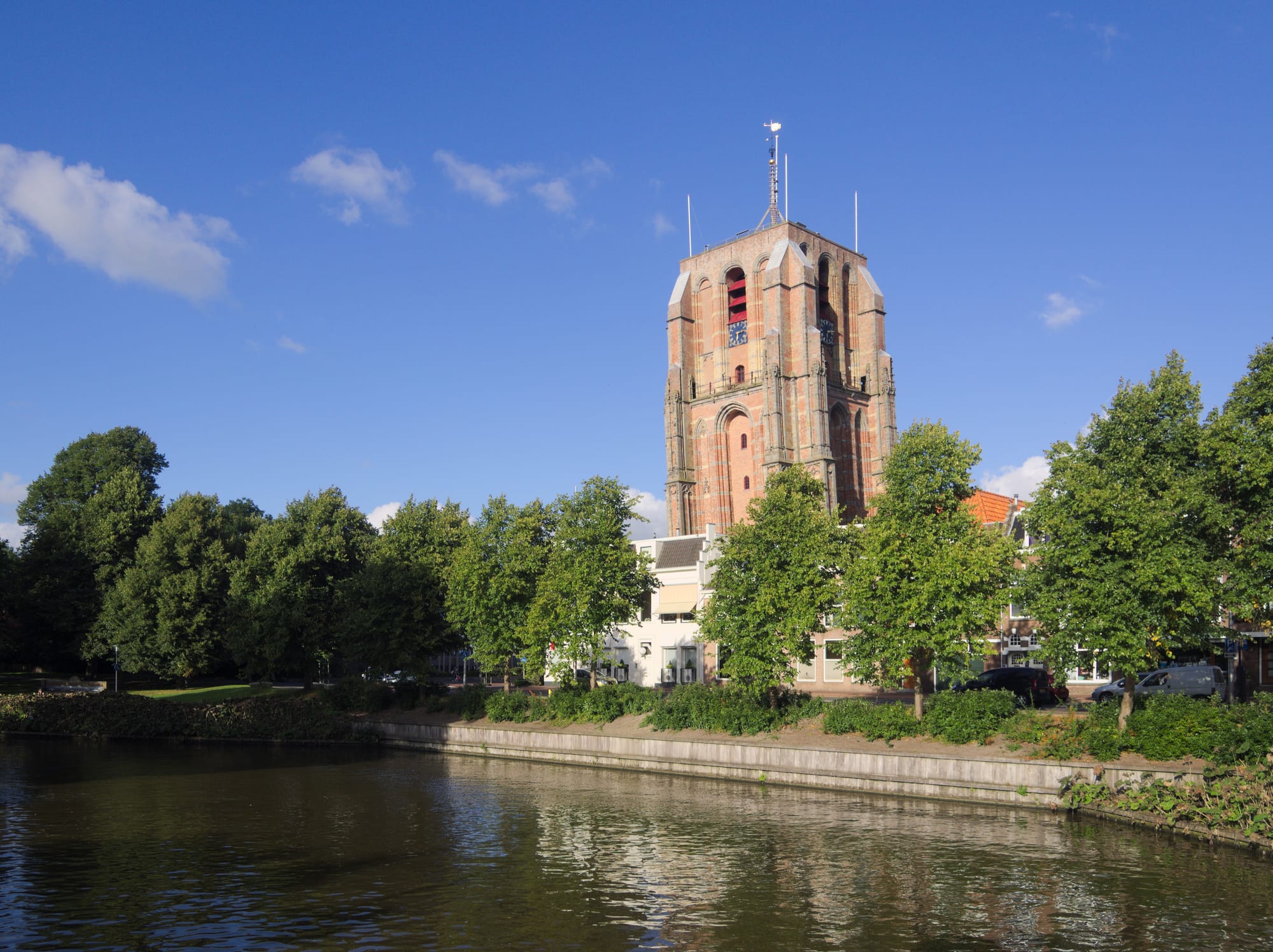
The leaning Oldehove tower in Leeuwarden, seen from a bridge

The Northern Netherlands, Netherlands

Leeuwarden

The leaning, unfinished Oldehove tower in Leeuwarden, seen from the Vrouwenpoortsbrug. (C messier / Wikimedia Commons · CC BY-SA 4.0)

The capital of Friesland, grown from three villages on terps beside a long-silted sea inlet into a trading town, the seat of the Frisian stadtholders and a royal residence. Today it is a compact canal-ringed city of about 127,000 people, known for its leaning Oldehove tower, the Fries Museum, the Frisian language and the Elfstedentocht skating race.

Neighbourhoods

  • Binnenstad
    • First-time visitors
    • Shopping
    • Close to public transport

    The compact medieval centre just north of the station, ringed by defensive canals. The Nieuwestad canal is the heart of the shopping streets, with the old weigh house, the Waag, beside it, and boats can be hired to explore the canals.

    Open in Maps
  • Oldehove and the Grote Kerkstraat
    • Historic district
    • Museums

    The north-western corner of the old town around the leaning Oldehove, where the oldest house remains in the city were found. The Grote Kerkstraat and Eewal, among the grandest streets in the city in its Golden Age, lead past the Princessehof museum, the Grote Kerk and the former stadtholders' palace.

    Open in Maps
  • Zaailand (Wilhelminaplein)
    • Museums
    • Markets

    The large square on the south side of the centre, remodelled in the 2010s, with the Fries Museum, the courthouse where the Frisian language protests of 1951 took place, and a market every Friday.

    Open in Maps
  • Huizum and the southern districts
    • Quiet and residential

    The former village of Huizum, now absorbed into the city, and the residential districts around it — ordinary streets away from the old centre.

    Open in Maps

Things to do

Famous landmarks

  • Oldehoveviewpoint

    An unfinished Late Gothic tower begun in 1529 to outdo Groningen's Martinitoren; it started leaning during construction, work stopped in 1532 at 39 metres, and its top stands 2 metres off centre. 183 steps lead to the top.

    Open in Maps
  • Grote or Jacobijnerkerklandmark

    Leeuwarden's oldest building, once the church of a Dominican monastery founded in 1245, with one of the finest-sounding Baroque organs in the Netherlands.

    Open in Maps
  • Stadhouderlijk Hoflandmark

    The former residence of the Frisian stadtholders and later of the Dutch royal family, which owned it until 1971.

    Open in Maps
  • Blokhuispoortattraction

    A former prison in the old town converted into a public library, hostel and restaurant.

    Open in Maps
  • Achmeatorenlandmark

    The tallest building in the city, an insurance company's 115-metre office tower opened in 2002.

    Open in Maps
  • Slauerhoffbruglandmark

    The 'flying drawbridge', a fully automatic bascule bridge whose two arms swing a section of road in and out of place.

    Open in Maps

Museums

  • Fries Museummuseum

    The museum of Frisian art, culture and history, in Hubert-Jan Henket's building on the Zaailand opened in 2013, with a room devoted to Mata Hari and the Frisian Resistance Museum as part of it.

    Open in Maps
  • Princessehof Ceramics Museummuseum

    The national ceramics museum, with tiles, pottery and ceramic sculpture in a small palace of 1693 — and the building where M. C. Escher was born in 1898, when it was split into three houses.

    Open in Maps
  • Tresoarmuseum

    The Frisian History and Literature Centre, whose name means 'treasure' in West Frisian, holding the province's archives.

    Open in Maps

Sport

  • Kooi Stadionattraction

    The home ground of the local football club, SC Cambuur.

    Open in Maps

Short trips from the city

  • Eise Eisinga Planetariummuseum

    In Franeker, one of the eleven Frisian cities, an 18th-century orrery built from 1774 to 1781, the oldest working orrery in the world.

    Open in Maps
  • Dokkumattraction

    A small fortified town in Friesland whose fortifications, the bolwerken, are well preserved.

    Open in Maps
  • Sneekattraction

    One of the eleven Frisian cities, in south-west Friesland close to the Sneekermeer, known for its canals, its Waterpoort gate and watersports.

    Open in Maps
  • Harlingenattraction

    The port town at the end of the Van Harinxma Canal from Leeuwarden, where ferries leave for Vlieland and Terschelling.

    Open in Maps

Seasonal events

  • Liberation flags15 April

    The city and the Royal Canadian Dragoons fly each other's flags on the anniversary of the Dragoons' advance into Leeuwarden in 1945.

  • Flower marketAscension Day, May or June

    A large flower market held in the city each year on Ascension Day.

  • Loop Leeuwardenevery year

    An annual road-running event with 5-kilometre, 10-kilometre and half-marathon races, first held in 1985.

Eat and drink

Long-standing places and food districts in Leeuwarden. Hours, ratings and directions come from your maps app, always current.

Frisian classics

  • Beerenburgcafe

    Jenever with added herbs, most popular in the northern provinces; a good local version is made in Leeuwarden by Boomsma and sold in almost every liquor store.

    Open in Maps
  • Frisian bakeriescafe

    Bakeries sell suikerbrood, a sweet bread with large lumps of sugar, usually flavoured with cinnamon, and Fryske dúmkes, small aniseed-and-hazelnut biscuits.

    Open in Maps

Markets and food streets

  • Friday market on the Wilhelminapleinmarket

    The weekly Friday market on the big square by the Fries Museum.

    Open in Maps
  • Nieuwestadneighborhood

    The canal at the heart of the shopping district, with cafés and restaurants on the streets around it and the Ruiterskwartier.

    Open in Maps

Experience Leeuwarden

History

Leeuwarden grew from three villages — Oldehove, Nijehove and Hoek — built on terps, artificial dwelling mounds, at the head of the Middelzee, a sea inlet; the oldest house remains, found near the Oldehove, date from the 2nd century AD. The name, of uncertain meaning, first appears around 825, and the second part, warden, refers to the terps. The town traded by sea until the inlet silted up in the 13th century, and city privileges are recorded from 1435. Bastions and a moat followed in 1481–1494, and in 1498 Albert of Saxony took the city after a nine-week siege to subdue a divided Friesland, making it the seat of the provincial court.

The population grew from about 5,000 around 1500 to 16,000 by 1650, and the Stadhouderlijk Hof was the residence of the Frisian stadtholders; William IV, in 1747, was the last to live there. A provincial mint struck Frisian coins from 1580 to 1752, and the Jewish community, first recorded in 1645, was one of the earliest in the Netherlands outside Amsterdam. The fortifications came down in the first half of the 19th century.

German occupation ended in April 1945, when the Royal Canadian Dragoons pushed into the heavily defended city on 15 April. On 16 November 1951, Kneppelfreed — "Baton Friday" — police used batons on Frisian language campaigners outside the courthouse, and the protests led to changes in national law in 1955 and 1956 allowing Frisians to speak their own language in court. Leeuwarden was European Capital of Culture in 2018 and has been a UNESCO City of Literature since 2019.

Culture & Customs

Frisian identity runs through the city. West Frisian is co-official in the province, the public broadcaster Omrop Fryslân works mainly in it, and Leeuwarden itself has three names in use — Dutch Leeuwarden, Frisian Ljouwert and the town dialect's Liwwadden — out of more than 200 recorded spellings. The 1951 language riot is remembered as a turning point in the struggle for Frisian rights.

The city is the start and finish of the Elfstedentocht, the skating tour of almost 200 kilometres through the eleven Frisian cities, held only when the ice is thick enough; it last took place in January 1997, and in 1986 the future King Willem-Alexander skated it under a pseudonym. The city also enters two traditional skûtsje sailing barges in the summer Skûtsjesilen races, and the Elfstedenhal has a 400-metre indoor skating oval.

Famous Leeuwarders include M. C. Escher, born in 1898 in a house now part of the Princessehof museum, and Mata Hari, born here in 1876, whose story has a room in the Fries Museum. For the 2018 Capital of Culture year the city commissioned eleven fountains for the eleven cities; Jaume Plensa's seven-metre fountain of two dreaming heads stands in front of the station. The music calendar includes Explore the North and Into the Grave, and SC Cambuur and the basketball club Aris carry local sporting loyalties.

Daily Life

The municipality had about 127,000 inhabitants in 2023, of whom about 96,000 lived in the city itself; the rest live in villages such as Stiens and Grou, and the municipality was enlarged in 2014 and 2018. Leeuwarden is the largest of the eleven Frisian cities and the main economic hub of the province.

The largest employers include the Medical Center Leeuwarden, the bank ING, the government's Central Judicial Collection Agency, the insurer Achmea, NHL Stenden University of Applied Sciences, the air base north-west of the city and the dairy group FrieslandCampina. The city has no university of its own, but campuses of the universities of Groningen and Wageningen and several colleges of applied science, with more than 20,000 students, and it is a centre for water technology research.

The pace is relaxed: shoppers fill the Nieuwestad and the surrounding streets, a cattle market is still held every week, the WTC Expo is the largest events centre in the north, and the green belt of De Groene Ster east of the city offers walking, golf and a zoo. In recent years the city has worked to clean up the water in its canals and the Potmarge river to make the centre more attractive.

Food

Frisian food is solid and sweet-toothed. Suikerbrood is a sweet bread packed with lumps of sugar and cinnamon, traditionally brought on a visit after a birth, and Fryske dúmkes are small aniseed-and-hazelnut biscuits. Frisian clove cheese, nagelkaas, is a firm cheese spiced with cloves and cumin, and the dairy group FrieslandCampina has a base in the city.

Beerenburg, jenever with added herbs, is most popular in the northern provinces; a good local version is made by Boomsma and sold in almost every liquor store in town. Beyond that the city eats in the national way — bread with cheese at lunch, bitterballen and kroketten from snack bars, and in winter stamppot with smoked sausage and thick pea soup.

A market fills the Wilhelminaplein every Friday. Frisian rye bread, baked for up to 20 hours, is dark and sweet, and spekdik, small pancakes with metworst and bacon, belongs to the same north-eastern tradition. Restaurants and cafés cluster around the Nieuwestad canal and the Ruiterskwartier, the heart of the shopping district.

Planning tools

Budget

Leeuwarden is one of the cheaper Dutch cities, with reasonably priced hotels and plenty of everyday cafés and snack bars. Museum entries are the main extra cost, and boat hire on the canals adds to a summer day.

Daily Budget Midrange
USD 150–270 (mid-range hotel, restaurant dinners, museum entries and a boat on the canals)
Daily Budget Shoestring
USD 70–110 (hostel bed, snack-bar and supermarket food, regional trains and buses)

Use the city as a base for the Frisian towns and islands: trains and buses fan out from the station to Harlingen, Franeker, Sneek and the ferry ports.

Best Time to Visit

May to September, when the canals are busy with boats, the terraces are open and the Frisian lakes and islands are within easy reach. The city works year-round for its museums, and in a hard winter all eyes turn to the ice in hope of an Elfstedentocht.

Suggested Number of Days

One or two days cover the compact centre and its museums. Allow three or four to add the historic Frisian towns, the lakes or a crossing to one of the Wadden Islands.

First Visit
1–2 days
With Surroundings
3–4 days

Transportation

The centre is small enough to walk, and the bike is the everyday way around. Buses from the station serve the city and the province, with routes connecting to the Ameland ferry at Holwerd and the Schiermonnikoog ferry at Lauwersoog, and a bus across the Afsluitdijk to Alkmaar. Regional trains run to Groningen, Harlingen and Stavoren.

Hire a small electric boat to see the city from its canals, and tap in and out with a contactless bank card on trains and buses.

Airport & Station Connections

Leeuwarden station, opened in 1863, is the terminus of the line from Zwolle. Direct trains from Schiphol take about 2 hours 15 minutes; from Amsterdam Centraal the trip takes about two and a half hours with a change at Lelystad or Almere, and Groningen is about 35 minutes away. The nearest airport is the small Groningen Airport Eelde. By car, Amsterdam is about 90 minutes away via the Afsluitdijk.

Walkability

Very walkable: the medieval centre begins just north of the station and is compact, with the Oldehove, the Fries Museum and the Princessehof close together. Many of the old canals were filled in long ago, but those that remain, around the Nieuwestad and the outer ring, make pleasant walks.

Safety

The Netherlands is very safe, with low violent crime. The main hazards for visitors are out in the province, on the Wadden Sea mudflats, which can only be walked at low tide and where several routes are dangerous without an experienced guide.

Lock bikes well, never cross the mudflats without a guide, and swim near lifeguard posts on the islands. Check current official travel advice before travelling.

Climate

Maritime and windy, like the rest of the north, with cloud and rain spread through the year and winds off the North Sea. Hard winters can freeze the Frisian canals and lakes thick enough for the Elfstedentocht, though it has been held only three times in the past 50 years.

Summer
mild — in nearby Groningen the average summer daytime high is around 22°C, and 30°C or more occurs only sporadically
Winter
cool and damp — in nearby Groningen winter averages stay above freezing, but frost is common in easterly winds and nights of −10°C or lower are not unusual in cold spells

Local Customs

Leeuwarden is the capital of Friesland, where West Frisian — Frysk — is an official language alongside Dutch, the city's Frisian name is Ljouwert, and locals also speak a town dialect, Stadsfries. Frisian identity, language and history matter to many people here. Tipping is not required; rounding up or adding 5–10 per cent for good service is generous.

Never walk or stand in a red-asphalt cycle lane, and remember that Frisian is a language in its own right, not a Dutch dialect.

Common Payment Methods

The currency is the euro. Mastercard and Visa cards are widely accepted, and a growing number of shops do not take cash at all, though some stores block credit cards issued in the EU, and a few have had trouble with cards issued outside the European Economic Area, so carry a second way to pay.