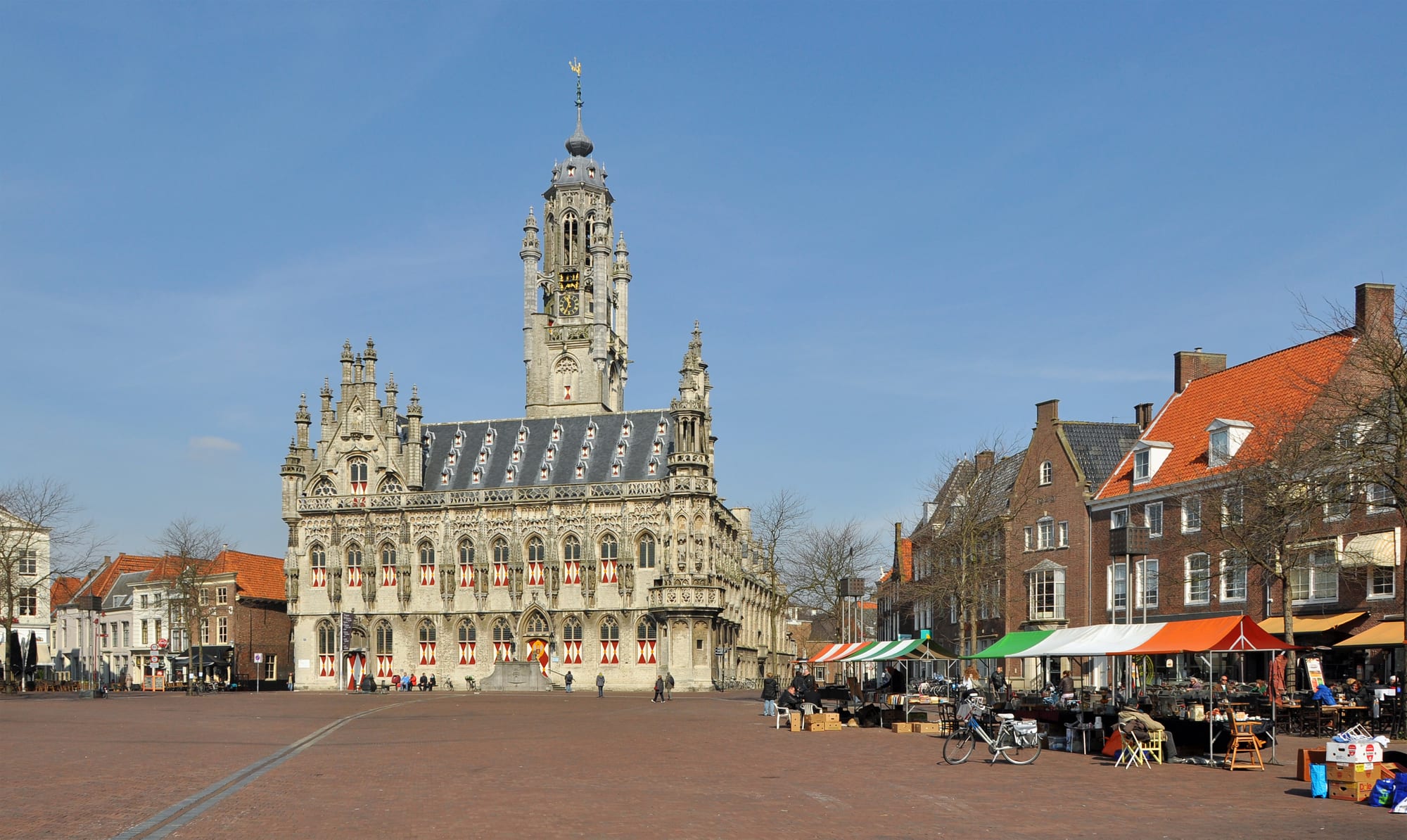
An ornate Gothic town hall with a tall tower and red-and-white shutters on a broad brick square with market stalls

The Southern Netherlands, Netherlands

Middelburg

The Gothic town hall on the Markt in Middelburg. (Marc Ryckaert / Wikimedia Commons · CC BY 4.0)

The capital of Zeeland, on the former island of Walcheren 10–15 km from the North Sea. Begun as a fort against Viking raids and grown rich on trade with England and Flanders and then on the Dutch East India Company, it lost much of its centre to fire in May 1940 and rebuilt it around a medieval abbey, a Gothic town hall and a ring of canals.

Neighbourhoods

  • The Markt and the shopping streets
    • First-time visitors
    • Shopping
    • Markets

    The large market square in front of the town hall, still used for the Thursday market, with a mostly pedestrianised shopping area around it. Lange Delft has the department stores, while Langeviele and its side streets hold boutiques, antique shops and galleries.

    Open in Maps
  • The abbey, the Dam and the Vlasmarkt
    • Historic district
    • Cafés and nightlife
    • Museums

    The quarter around the walled abbey complex and its tall tower, home to the provincial government and the Zeeuws Museum. Just beyond it, the Damplein and the Vlasmarkt are the town's main streets for bars and restaurants.

    Open in Maps
  • The canal ring
    • Walks
    • Quiet and residential
    • Cycling

    The star-shaped ring of canals from the old fortifications, lined with boats and cycle paths, with two surviving gates, the Koepoort and the Varkenspoort, and walking routes laid out on the old walls in the 1840s.

    Open in Maps
  • The station side
    • Close to public transport

    The area across the shipping canal south of the centre, around the railway station of 1872 and its modern bus station, a short walk over the canal from the old town.

    Open in Maps

Things to do

Famous landmarks

  • Middelburg Abbeylandmark

    A former Premonstratensian abbey founded in 1127 on the site of a Carolingian stronghold, with two Protestant churches, cloisters and courtyards, used for the government of Zeeland since the 1570s.

    Open in Maps
  • Lange Janviewpoint

    The abbey's church tower, almost 91 metres tall and the symbol of the town, which can be climbed for a view over Walcheren.

    Open in Maps
  • Middelburg Town Halllandmark

    One of the finest Gothic buildings in the Netherlands, built from 1452 to 1520 by the Keldermans family, with statues of Zeeland's counts and countesses on its facade; it now houses a university college.

    Open in Maps
  • Koepoortlandmark

    One of the two surviving gates of the old city, standing on the canal ring.

    Open in Maps

Museums

  • Zeeuws Museummuseum

    The museum of Zeeland in part of the abbey since 1972, covering the province's wealthy past, its overseas voyages, traditional costume and regional art.

    Open in Maps
  • Mini Mundiattraction

    A family amusement park in the Mortiere district, the former Miniatuur Walcheren model village, which moved here in 2009.

    Open in Maps

Short trips: coast and towns

  • Veereattraction

    A small old town of about 1,500 people on Walcheren, with cobbled streets and a canal full of boats, reachable by bike along the canal.

    Open in Maps
  • Vlissingenattraction

    The port town between the Scheldt and the North Sea, a VOC harbour in the 17th century, whose long seafront boulevard is the place to watch big ships pass close by.

    Open in Maps
  • Domburgbeach

    A seaside resort on the North Sea on the north-west coast of Walcheren, about 11 km from Middelburg.

    Open in Maps
  • Westkapellebeach

    A small town at the westernmost tip of Walcheren, surrounded by the sea on three sides.

    Open in Maps

Short trips: the Delta

  • Oosterscheldekeringlandmark

    The largest of the Delta Works, a storm surge barrier between Schouwen-Duiveland and Noord-Beveland built in response to the 1953 flood.

    Open in Maps
  • Neeltje Jansattraction

    The artificial island built for the construction of the barrier, now with a park of attractions and exhibitions and a nature reserve.

    Open in Maps
  • Zierikzeeattraction

    A small historic city on Schouwen-Duiveland, linked to the Oosterschelde by a canal.

    Open in Maps
  • Yersekeattraction

    A fishing village on the Oosterschelde known for its mussel and oyster farming, where visitors see the oyster pits, the harbours and a museum of the industry.

    Open in Maps

Seasonal events

  • King's Day27 April

    The national holiday, celebrated in the town with King's Night the evening before.

  • Jazz festivalWhitsun weekend, May or June

    A jazz festival held over the Pentecost weekend.

  • Mosselfeestenlate June

    The town's mussel festival.

  • Folklore daysJuly and August

    Two summer days devoted to Zeeland's folk traditions.

  • Middelburg WinterstadDecember

    The town's winter festivities in the run-up to Christmas.

Eat and drink

Long-standing places and food districts in Middelburg. Hours, ratings and directions come from your maps app, always current.

Zeeland classics

  • Zeeuwse boluscafe

    Zeeland's sweet spiral bun of Jewish origin, a soft yeast dough rolled in dark brown sugar and cinnamon that caramelises in the oven, eaten with coffee and often buttered underneath.

    Open in Maps
  • Bakker Sam Maljaarscafe

    A bakery on Langeviele that bakes and sells Zeeland specialities, including bolussen.

    Open in Maps
  • Zeeland musselsrestaurant

    Mussels from the Oosterschelde, where Yerseke is known for its mussel farming; the town holds its own mussel festival in late June.

    Open in Maps

Food streets and markets

  • Marktmarket

    The Thursday general market in front of the town hall, the largest market in Zeeland, with a fruit and vegetable market on Saturdays.

    Open in Maps
  • Vlasmarkt and the Damneighborhood

    Streets beside the abbey that are the town's best places to look for bars and restaurants, including beer cafés with long lists of Belgian brands.

    Open in Maps

Experience Middelburg

History

Middelburg probably dates from the late 8th or early 9th century, when it was one of three fortified towns built on Walcheren, then an island, to guard against Viking raids. A settlement grew up around today's Markt in the 10th century, and in 1127 Premonstratensian canons from Antwerp founded an abbey inside the old ring-shaped fort. The town received city rights in 1217 and became an important trading centre between England and the rising cities of Flanders, a trade Chaucer mentions in The Canterbury Tales.

In the Eighty Years' War Middelburg, unlike many other Zeeland towns, took the Spanish side, and the rebels took it only after a siege from 1572 to 1574. Monastic life ended, and the abbey became the seat of government for Zeeland. The Golden Age followed: the Zeeland chamber of the Dutch East India Company was the most powerful after Amsterdam's, and the population grew from about 7,000 in 1576 to about 27,000 a century later. The town was also deeply involved in the slave trade. Its spectacle-makers, among them Zacharias Janssen and Hans Lipperhey, are often credited with inventing the microscope and the telescope.

Decline set in after about 1660 as Rotterdam and Amsterdam drew trade away. On 17 May 1940 bombs and fire destroyed much of the old centre, including the town hall, the abbey and many old warehouses; whether German bombers or French artillery were responsible is still uncertain, and the city archives were lost. British troops liberated the town on 6 November 1944, and the destroyed buildings were rebuilt along pre-war lines as far as possible.

Culture & Customs

Middelburg's identity is that of a provincial capital with a merchant past. Over 1,100 national monuments stand in the centre, among the highest totals of any Dutch town, and the rebuilt abbey, town hall and canal houses are a point of local pride. Locals call the town hall tower Malle Betje, Crazy Beth, because its clock always runs a little behind the Lange Jan's. Zeeland's naval heroes Cornelis and Johan Evertsen lie in a marble tomb in the abbey's New Church.

The town has a long record of Jewish life: a Sephardic burial ground lies outside the old wall, an Ashkenazi one inside it, and the 17th-century synagogue, the third built in the Golden Age Netherlands, was restored in 1994; a plaque in the station remembers Zeeland's Jews deported from here. William of Orange considered founding the first Dutch university here in 1575 but chose Leiden, and Zeeland had none until University College Roosevelt opened in 2004 as an honours college of Utrecht University, named after the Roosevelt family, whose ancestry traces to Zeeland.

The year is busy with festivals: a jazz festival at Whitsun, a mussel festival in late June, two folklore days in summer, a funfair in August and the Winterstad season in December. Walcheren's traditional dress is now worn daily by only a handful of women, and parts of the province belong to the strict Protestant Bible Belt. Football clubs include Jong Ambon, whose players are mostly Ambonese.

Daily Life

The town itself had about 43,000 residents at the start of 2023, making it the largest city in Zeeland, and the whole municipality, which includes Arnemuiden and several villages, had about 50,000 in 2026. It is the seat of the provincial government, housed in the abbey, as well as the regional water board and Rijkswaterstaat's Zeeland office, which moved to new buildings near the station in the 2000s.

Government, education and services employ many people. University College Roosevelt teaches in the old town hall, and the HZ University of Applied Sciences has a campus here. Shopping is a draw for the whole region: Middelburg has the largest range of shops in Zeeland, the Thursday market on the Markt is the largest in Zeeland, and late-night shopping is on Thursdays.

Daily life is unhurried. People cycle along the canal ring, gather on the Markt on market days and head to the Walcheren beaches in summer, a short ride away. The winters have grown milder, and skating on the canals, once a favourite pastime, has become rare since about 2013. The climate is warming: the countryside just outside the town recorded 40.9°C in July 2019.

Food

Zeeland's own pastry is the bolus, a sweet bread of Jewish origin: a soft white yeast dough rolled in dark brown sugar and cinnamon and baked in a spiral, so that the sugar melts into a sticky, caramel-like coat. In some parts of the region the dough includes lemon zest, and it is usually eaten with coffee, often with butter spread on the flat underside. Bakeries across the town sell it, and local shops also sell babbelaars, butter sweets from Zeeland.

The sea supplies much of the rest. Yerseke, on the Oosterschelde, is known for its mussel and oyster farming, so prosperous that the village earned the nickname the Klondike of Zeeland and mussels the name black gold, and the town holds its own mussel festival in late June.

For a drink, the Markt and the Vlasmarkt are the centres of evening life, and beer cafés serve wide selections that include many Belgian brands. In mid-May the town also holds an abbey beer festival. On Saturdays the Markt holds a fruit and vegetable market.

Planning tools

Budget

Middelburg is cheaper than the Randstad cities, but Zeeland's coast charges high-season prices in July and August, when holiday rentals book out early. Bakeries and the markets keep lunch costs down.

Daily Budget Midrange
USD 150–280 (mid-range hotel, restaurant dinners, museum and tower tickets)
Daily Budget Shoestring
USD 75–110 (hostel or campsite, bakery and market food, trains, buses and a hire bike)

Book early for July and August; a hire bike reaches Veere, the beaches and the Delta Works dams without a car.

Best Time to Visit

May to September is the time for the beaches, cycling and café terraces, with July and August busiest on the coast and the town's summer festivals and folklore days in full swing. Spring and early autumn are quieter and good for cycling. Winter is mild and breezy, with the Winterstad festivities in December.

Suggested Number of Days

One or two days cover the town itself. With four or five, Middelburg works as a base for the Walcheren coast, the old towns nearby and the Delta Works. A beach holiday in summer naturally stretches the stay.

First Visit
1–2 days
With Surroundings
4–5 days

Transportation

The centre is easy to walk and very easy to cycle, and bikes are the usual way to reach Veere, the beaches and the villages of Walcheren. Buses leave from the bus station beside the railway station. Driving into the centre is possible despite the pedestrian zones, but parking is paid and scarce in the old town, with garages just outside it.

Watch for cyclists at all times and keep out of the red-asphalt bike lanes; on the Zeeland dams and dykes allow for strong headwinds when cycling.

Airport & Station Connections

Middelburg is on the railway between Roosendaal and Vlissingen, with intercity services twice an hour to Goes, Rotterdam, The Hague, Leiden, Haarlem and Amsterdam. Brussels Airport is about an hour and a quarter by car, and Amsterdam Schiphol about two hours. The A58 motorway passes the town on its way to Goes.

Walkability

Very good. The old centre inside the canal ring is compact and partly pedestrianised, and the Markt, the abbey, the shopping streets and the restaurant squares are a few minutes apart. The station is just across the shipping canal. Walks along the canal ring and the old walls are pleasant at any time of year.

Safety

The Netherlands is very safe, with low violent crime. Middelburg is a quiet provincial town.

Lock bikes with two good locks, and swim only at lifeguarded beaches away from the tidal channels. Check current official travel advice before travelling.

Climate

A temperate oceanic climate with few extremes: mild winters, cool to warm summers and rain spread evenly through the year. Lying 10–15 km from the coast, the town has somewhat colder winter nights and warmer summer days than the shore,. Frost and skating weather have become much rarer.

Summer
mild to warm — across the southern Netherlands summer days are typically 19–25°C, with occasional heatwaves
Winter
cool and breezy — across the southern Netherlands winter temperatures run from about 0 to 7°C, with mild winters near the coast

Local Customs

Prices in restaurants and bars include service, so tipping is not required, though rounding up or leaving 5–10 per cent for good service is appreciated. Parts of the province belong to the strict Protestant Bible Belt. Walcheren's traditional dress, with its lace cap and gold ornaments, is now worn daily by only a handful of women: 23 in a 2019 count.

Ask before photographing anyone in traditional dress, and dress modestly in the churches.

Common Payment Methods

The currency is the euro. Mastercard and Visa cards are widely accepted, and a growing number of shops do not take cash at all, though some stores block credit cards issued in the EU, and a few have had trouble with cards issued outside the European Economic Area, so carry a second way to pay.