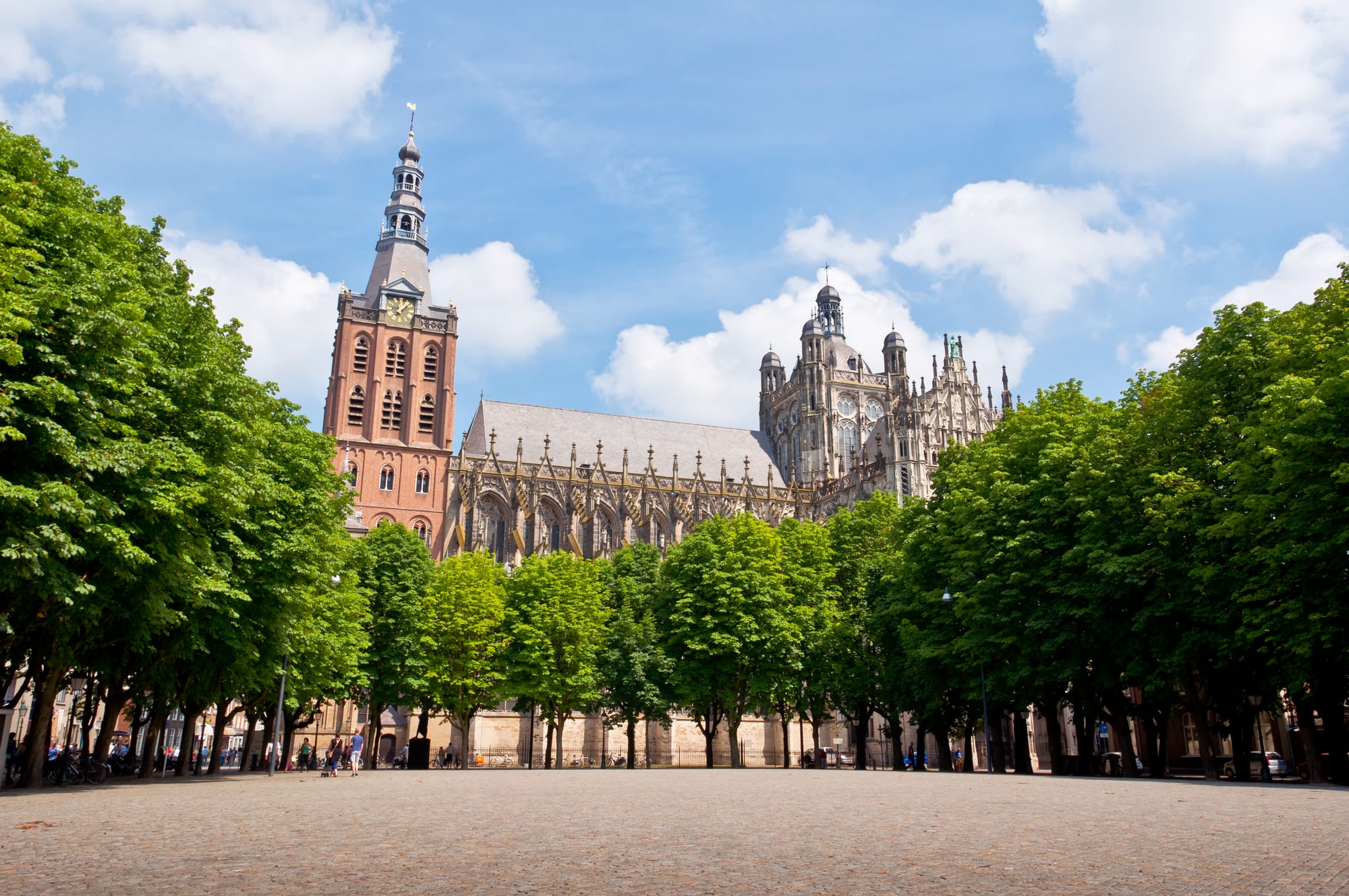
A large Gothic cathedral with a brick tower and pinnacled stone transept behind rows of green trees on a wide paved square

The Southern Netherlands, Netherlands

's-Hertogenbosch

St John's Cathedral seen across the Parade, the tree-lined square at its foot. (Donatas Dabravolskas / Wikimedia Commons · CC BY-SA 4.0)

The capital of North Brabant, known to most people as Den Bosch, founded by the Duke of Brabant on dunes in a marsh and granted city rights in 1185. Hieronymus Bosch lived and worked here, its fortress was nicknamed the Swamp Dragon, and today its walled centre keeps a Gothic cathedral, old ramparts and canals that flow beneath the houses.

Neighbourhoods

  • The old centre
    • First-time visitors
    • Shopping
    • Cafés and nightlife

    The walled town on its old sandy rise, with an irregular street plan shaped by the rivers that meet here. The Markt with the town hall and De Moriaan, the cathedral and the Parade, the museums and most restaurants and bars lie within a few minutes of each other.

    Open in Maps
  • The ramparts and the Bossche Broek
    • Walks and viewpoints
    • Nature
    • Historic district

    The southern edge of the centre, where an almost continuous line of walls and bastions looks out over the Bossche Broek, a polder that was never drained and is now a nature reserve stretching towards Vught. A walk along the walls passes old bastions and moats.

    Open in Maps
  • Hinthamerstraat and the east side
    • Museums
    • Best for food

    One of the old main streets of the centre, running east from the Markt past the Jheronimus Bosch Art Center and a string of cafés and restaurants towards Hintham.

    Open in Maps
  • Rosmalen
    • Quiet and residential
    • Sport

    A town east of the city, part of the municipality since 1996, with its own railway station and the grass-court tennis tournament held each June before Wimbledon.

    Open in Maps

Things to do

Famous landmarks

  • St John's Cathedrallandmark

    The Brabantine Gothic cathedral that dominates the centre, on the site of a parish church begun around 1220, known for the sculpted figures of craftsmen sitting along its arches and rims; a long restoration was completed in 2010.

    Open in Maps
  • De Moriaanlandmark

    A tower-like house on the Markt from the early 13th century, the oldest remaining brick house in the Netherlands, saved from demolition and restored from 1963 using a 16th-century painting of the cloth market as a guide.

    Open in Maps
  • Town halllandmark

    A 14th-century Gothic building on the Markt that was given a Dutch Baroque front after the city fell to the Dutch Republic in 1629.

    Open in Maps
  • Bolwoningenattraction

    A complex of fifty experimental spherical houses designed by Dries Kreijkamp.

    Open in Maps

Canals and fortifications

  • Binnendiezeattraction

    The medieval waterway, once 22 km long, that runs beneath houses and streets; the restored sixth of it can be seen on guided boat trips.

    Open in Maps
  • Citadellandmark

    A fortress built from 1637 to 1642 on the north-west side of the centre, the one part of the defences that still keeps its original height.

    Open in Maps
  • Kruithuislandmark

    A hexagonal gunpowder magazine near the citadel, built while the city was still part of the Spanish Netherlands and one of only a handful left in the country.

    Open in Maps
  • Bastiondermuseum

    A small museum dug into a bastion on the south side of the walls, showing a wrought-iron cannon and an older bastion enclosed within the present one.

    Open in Maps

Museums

  • Noordbrabants Museummuseum

    The provincial art museum, with an overview of the works Vincent van Gogh made in Brabant.

    Open in Maps
  • Design Museum Den Boschmuseum

    A museum of applied arts, especially ceramics and jewellery, next door to the Noordbrabants Museum.

    Open in Maps
  • Jheronimus Bosch Art Centermuseum

    A permanent retrospective of the life and work of Hieronymus Bosch, shown since 2007 in the former New St James Church.

    Open in Maps
  • Swan Brothers' Housemuseum

    A museum in the home of the Illustre Lieve Vrouwe Broederschap, a confraternity founded in the city in 1318.

    Open in Maps

Short trips from the city

  • Kamp Vughtmuseum

    At Vught, the site of a Nazi concentration camp opened in 1943 that held 31,000 prisoners, now a visitors' centre with exhibitions and a memorial.

    Open in Maps
  • Heusdenattraction

    A town between Waalwijk and 's-Hertogenbosch, at the heart of a municipality that also takes in the middle part of the Loonse en Drunense Duinen.

    Open in Maps
  • De Loonse en Drunense Duinen National Parkpark

    A national park of drifting sands, partly within the municipality of Heusden.

    Open in Maps
  • Eftelingattraction

    The large theme park at Kaatsheuvel, in the north of the province.

    Open in Maps

Seasonal events

  • Carnival in OeteldonkFebruary or March, the days before Lent

    For three days the city becomes the village of Oeteldonk, with the frog as its symbol, red, white and yellow as its colours, and residents dressed in the traditional boerenkiel smock with a farmer's bandana and scarf.

  • Rosmalen Grass Court ChampionshipsJune

    A combined men's and women's grass-court tennis tournament at Rosmalen, held two weeks before Wimbledon.

  • November MusicNovember

    A festival of contemporary music held in the city.

Eat and drink

Long-standing places and food districts in 's-Hertogenbosch. Hours, ratings and directions come from your maps app, always current.

Den Bosch classics

  • Bossche bolcafe

    The city's own pastry: a cream puff about 12 cm across, filled with whipped cream and coated in dark chocolate, usually eaten with coffee rather than as a dessert.

    Open in Maps
  • Jan de Grootcafe

    A bakery on the Stationsweg particularly known for its Bossche bollen, which it supplies to many of the town's cafés.

    Open in Maps
  • Brabant worstenbroodcafe

    North Brabant's savoury snack, a soft white bread roll baked around minced beef sausage.

    Open in Maps

Food streets and markets

  • Korte Putstraat and Lange Putstraatneighborhood

    Two streets in the centre with a broad choice of restaurants and outdoor terraces in summer.

    Open in Maps
  • Marktmarket

    The large market square, with the main general market on Saturdays, a smaller one on Wednesdays and an organic market on Fridays, ringed by café terraces.

    Open in Maps
  • The Paradeneighborhood

    The tree-lined square below the cathedral, with some of the city's most popular bars and clubs.

    Open in Maps

Experience 's-Hertogenbosch

History

The city's full name is a contraction of the old Dutch des Hertogen bosch, "the duke's forest". Henry I, Duke of Brabant, founded it on wooded dunes in the middle of a marsh, close to his family's estate at Orthen, and granted it city rights and trade privileges in 1185, the traditional date, although the first contemporary record is from 1196. Conceived as a fortress against Gelre and Holland, it was destroyed by them in 1203 but soon rebuilt, and in the late 14th century a much larger wall was raised. Until about 1520 the city flourished as the second-largest in what is now the Netherlands after Utrecht, and the home of the painter Hieronymus Bosch.

In the Eighty Years' War the city sided with the Catholic Habsburgs and held out against Maurice of Orange in 1601 and 1603. Its surrounding marshes made a normal siege impossible, earning it the name Moerasdraak, the Swamp Dragon, until in 1629 Frederick Henry diverted the rivers, built a 40 km dyke and pumped the land dry with mills. After three months the city surrendered, and the Republic treated it as occupied territory without political rights. Only under the Batavian Republic in 1795 did Catholics and Brabanders gain equal rights, and in 1815 the city became the capital of North Brabant.

Building outside the ramparts was forbidden until 1878, leading to overcrowding and the highest infant mortality in the kingdom. In the Second World War the Nazi camp at nearby Vught bore the city's German name, Herzogenbusch; the city was liberated by British troops in October 1944. Plans to fill in its canals were stopped when the government declared the centre a protected townscape.

Culture & Customs

Carnival defines the city's identity more than anything else. Its current form dates from 1881–1883, when citizens invented the legend of Oeteldonk: for three days the city takes that name, "donk" meaning a dry place in the marsh, and the frog of the marsh becomes its emblem. Everyone in Oeteldonk is a farmer or a young woman, a way of erasing class, and people wear the boerenkiel, a farmer's smock stitched with patches for each year's theme. The mayor hands authority to the Mayor of Oeteldonk, who receives Prince Carnival at the station on Sunday at 11:11, and unlike Rhineland princes this one is crowned for life.

Bosch remains the city's great name, celebrated at the Jheronimus Bosch Art Center and in the house of the medieval Swan Brothers' confraternity. The Noordbrabants Museum shows Van Gogh's Brabant years, and the European Ceramic Work Centre has invited artists, designers and architects to work with clay since 1991. Music runs from the chamber and experimental programmes of De Toonzaal and pop at W2 to Jazz in Duketown, the Boulevard theatre festival and November Music.

Roman Catholicism remains the largest religion, at a little over 40 per cent of residents, though far fewer attend Mass; Moroccan and Turkish communities have their own mosques. In sport the city is strongest in field hockey, where HC Den Bosch's women's team dominates, while FC Den Bosch, Ruud van Nistelrooy's first club, plays at De Vliert.

Daily Life

About 113,000 people lived in the city itself at the start of 2023, and the municipality, which includes Rosmalen, Empel, Engelen and other villages, had around 161,000, making it the fourth city of North Brabant. New housing has gone into developments such as Haverleij, a district with a golf course between Engelen and Bokhoven.

The city is a centre of industry, education, administration and culture. The provincial government sits here, the Jeroen Bosch Hospital is the largest employer with more than 4,000 staff, and companies such as Heineken and SAP have offices here. Students attend the HAS agricultural and food college, Avans, the AKV St. Joost art academy and the Jheronimus Academy of Data Science, run jointly by the universities of Eindhoven and Tilburg.

Daily life is shaped by the old centre's terraces and its markets, which fill the Markt several days a week. The city was named Fietsstad 2011, the country's top cycling city, mainly as encouragement, since bike use here was lower than elsewhere in the Netherlands. Flood control is a constant concern: when the Dommel dyke broke in 1995 the Bossche Broek flooded and the A2 motorway was closed, and since 2006 higher dykes and locks have allowed the polder to be flooded on purpose in an emergency.

Food

The Bossche bol is the city's emblem in pastry form: a large cream puff about 12 cm across, filled with whipped cream and coated almost entirely in dark chocolate fondant icing. Locals usually just call it a chocoladebol. It is usually eaten with coffee rather than as a dessert, and the Jan de Groot bakery near the station is particularly known for it, supplying many of the town's cafés.

North Brabant's savoury counterpart is the worstenbrood, a roll of soft white bread dough, not puff pastry, baked around minced beef sausage. It began as a way of preserving meat, was traditionally eaten at Christmas, especially after Midnight Mass, and at carnival, and was added to the Netherlands' list of intangible heritage in 2016.

Eating out is concentrated in the old centre, which has more than 350 restaurants, pubs and cafés, with the Korte Putstraat and Lange Putstraat particularly known for their range and their summer terraces. The Saturday market on the Markt sells food alongside other goods, and the Friday organic market brings mostly regional produce. Nights out centre on the bars of the Parade beside the cathedral.

Planning tools

Budget

Den Bosch is cheaper than Amsterdam and the Randstad, and Brabant's cities have good-value hotels. The centre has hundreds of restaurants, pubs and cafés across most price ranges. Room prices rise during carnival and the June tennis week.

Daily Budget Midrange
USD 150–280 (mid-range hotel, restaurant dinners, museum tickets and a Binnendieze boat trip)
Daily Budget Shoestring
USD 75–110 (hostel or budget room, bakery snacks and market food, trains and a hire bike)

Book months ahead for carnival; the walls, the Bossche Broek, the Parade and the cathedral exterior cost nothing.

Best Time to Visit

May to September is the season for café terraces, walks along the walls and boat trips on the Binnendieze. Carnival, in February or March, turns the city into Oeteldonk and is the busiest and liveliest time of year. Winter is cool and quieter, good for the museums.

Suggested Number of Days

One or two days cover the compact walled centre and its museums. Three or four allow time for the national park, the fortified towns nearby and the theme park. Carnival needs its own planning and earlier booking.

First Visit
1–2 days
With Surroundings
3–4 days

Transportation

The centre is small enough to walk. Arriva buses from the main station serve the city and most of its suburbs, and regional buses link it with Tilburg and Eindhoven. The city is flat and bike-friendly, and cycling is the easiest way to reach the outer districts and the countryside. The A2 motorway past the city is the country's most important north–south road.

Watch for cyclists at all times and keep out of the red-asphalt bike lanes; drive outside the morning and evening peaks.

Airport & Station Connections

The main railway station, on the line between Amsterdam and Eindhoven, has north–south trains about every ten minutes, and direct services to Utrecht, Schiphol, Nijmegen, Arnhem, Tilburg and Breda. Schiphol is roughly an hour and a half by train. Eindhoven Airport, with mostly low-fare European flights, is reached by bus to Eindhoven station and a train of under 20 minutes.

Walkability

Very good. The old centre is compact and enclosed by its ramparts, and the Markt, the cathedral, the museums and the restaurant streets are a few minutes apart. Streets are winding rather than gridded, so it is easy to get briefly lost.

Safety

The Netherlands is very safe, with low violent crime. Den Bosch is a generally safe city; the main exceptions are rowdy crowds on Thursday, Friday and Saturday nights and the heavy drinking of carnival week.

Lock bikes with two good locks, keep belongings close in carnival crowds, and never buy drugs from street dealers. Check current official travel advice before travelling.

Climate

An oceanic climate with mild differences between summer and winter and rain throughout the year.

Summer
mild to warm — across the southern Netherlands summer days are typically 19–25°C, occasionally over 30°C inland
Winter
cool and damp — across the southern Netherlands winter temperatures run from about 0 to 7°C, with some frost

Local Customs

Prices in restaurants and bars include service, so tipping is not required, though rounding up or leaving 5–10 per cent for good service is appreciated. Locals call the city Den Bosch, and the local dialect is a Brabantian variety close to colloquial Dutch. At carnival the city is Oeteldonk: the Rhineland greeting 'alaaf' used elsewhere is not the custom here and is not appreciated, and the frog is everywhere.

Wear at least a scarf in Oeteldonk's red, white and yellow to join in at carnival; keep quiet inside the cathedral during services.

Common Payment Methods

The currency is the euro. Mastercard and Visa cards are widely accepted, and a growing number of shops do not take cash at all, though some stores block credit cards issued in the EU, and a few have had trouble with cards issued outside the European Economic Area, so carry a second way to pay.