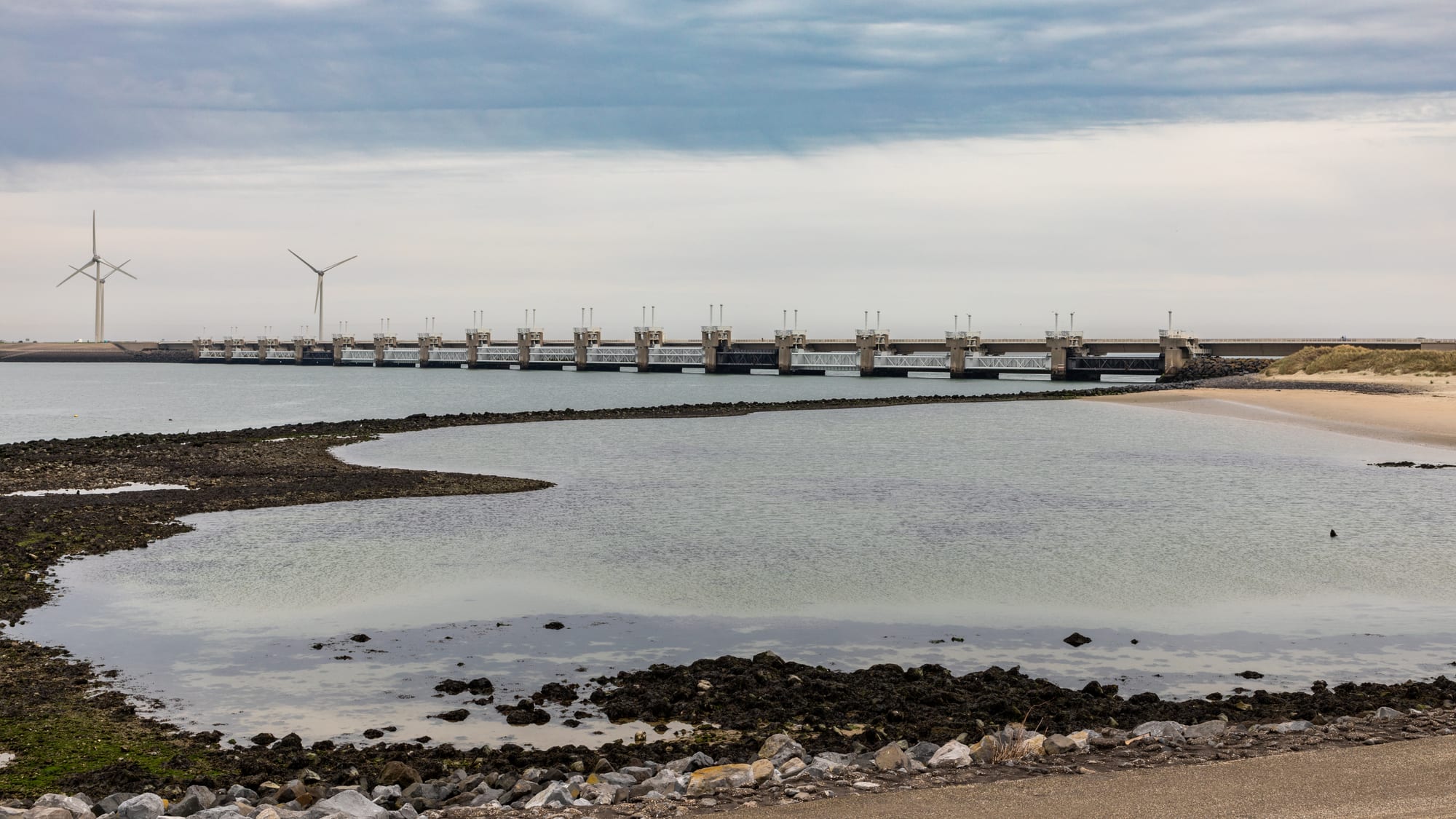
A long storm-surge barrier of concrete piers and steel gates crossing grey water, with sand, rocks and wind turbines

Netherlands

The Southern Netherlands

The Oosterscheldekering, the largest of the Delta Works barriers, on the Zeeland coast. (Dietmar Rabich / Wikimedia Commons · CC BY-SA 4.0)

The three southern provinces of Zeeland, North Brabant and Limburg — historically Catholic and closer in spirit to Flanders than to Holland, running from the islands and dams of the Scheldt delta through the industrial cities of Brabant to the hills and Roman-era city of Maastricht in the far south.

Explore The Southern Netherlands

History

Maastricht grew from a Roman settlement at a crossing of the Maas, and the tomb of Saint Servatius, the city's early bishop, made it a place of pilgrimage. Through the Middle Ages the south belonged to a patchwork of duchies — Brabant, Limburg, Guelders — and to the lands of the counts of Flanders and Holland, and its Catholic, Burgundian culture looked south towards Brussels and Liège. 's-Hertogenbosch received town rights in 1185 and became one of Brabant's great cities, and the painter Hieronymus Bosch worked there around 1500.

The Dutch Revolt split the region. Breda, the seat of the Nassau family, was taken and retaken, and its surrender to Spain in 1625 is the subject of Velázquez's painting. After 1648 Brabant and much of Limburg became "Generality Lands" ruled from The Hague with few rights, and Catholics were barred from public office for generations. Zeeland, by contrast, was at the heart of the Republic: Middelburg and Vlissingen sent out VOC ships and privateers, and the admiral Michiel de Ruyter was born in Vlissingen.

Limburg's status was settled only in 1839, when it was divided with Belgium. From the 1890s Philips turned Eindhoven from a group of villages into an industrial city, and coal mining around Heerlen and Kerkrade drew workers from across Europe until the mines closed in the 1960s and 1970s. In September 1944 Maastricht was among the first Dutch cities liberated. In 1953 a storm flood killed more than 1,800 people, most of them in Zeeland, leading to the Delta Works.

Culture & Customs

The south is known as "below the rivers", and people here see themselves as warmer, more sociable and fonder of food and drink than the Calvinist north — a Burgundian way of life rooted in Catholic tradition. Carnival is the proof: for the days before Lent, cities take on carnival names, such as Oeteldonk for 's-Hertogenbosch, and whole populations dress up, march behind brass bands and celebrate in the cafés.

Limburgish, a regional language with official recognition, is widely spoken in Limburg, and Brabant has its own soft dialects. Limburg's hill villages hold schutterij festivals of costumed marksmen's guilds, and processions honour local saints. Zeeland is different again: its islands were long isolated, parts of it belong to the strict Protestant Bible Belt, and older women on Walcheren and Zuid-Beveland still occasionally wear traditional dress with lace caps and gold ornaments.

Eindhoven's identity is technology and design, with Dutch Design Week and PSV football, while Maastricht's European outlook is reflected in the 1992 treaty signed there. Vincent van Gogh was born in Zundert and painted in Nuenen, both in Brabant.

Daily Life

About four million people live across the three provinces. North Brabant is the largest, with about 2.6 million: Eindhoven has around 240,000, Tilburg about 225,000, Breda about 185,000 and 's-Hertogenbosch, the capital, about 160,000. Limburg has about 1.1 million, with Maastricht, the capital, at around 120,000 and Venlo, Heerlen and Sittard-Geleen next. Zeeland has under 400,000 people, with Middelburg, Vlissingen, Goes and Terneuzen its main towns.

The Eindhoven region, branded Brainport, is one of Europe's leading technology clusters, built around Philips, the chip-machine maker ASML at Veldhoven and many suppliers. Tilburg and Venlo are logistics hubs, western Brabant and Venlo have large-scale horticulture, and Chemelot near Geleen is a major chemicals site. Zeeland lives on tourism, farming, shellfish, the port of Vlissingen and Terneuzen, and the Borssele nuclear plant.

Life runs on the terrace and the café as much as the office. Current issues include Eindhoven's shortage of housing and workers as the tech sector grows, the effect of intensive pig and poultry farming on Brabant's air and water, drug crime, and the decline of former mining towns in South Limburg.

Food

Limburg's pride is vlaai, a round, yeast-based fruit tart topped with cherries, apricots or plums, or with rice pudding, and sold by the slice. Zuurvlees, a sweet-sour beef stew with apple syrup and gingerbread, is eaten with chips, and Limburg's hills grow wine grapes around Maastricht; the Gulpener brewery is at Gulpen in South Limburg. Rommedoe, a strong soft cheese, belongs to the region along the Belgian border.

Brabant's snack is the worstenbroodje, a spiced sausage roll, and 's-Hertogenbosch sells the Bossche bol, a large ball of choux pastry filled with whipped cream and coated in chocolate. The Koningshoeven abbey near Tilburg brews La Trappe, a Trappist beer, and Brabant cafés serve Belgian-style beers too.

Zeeland eats from the Oosterschelde. Mussels from Yerseke are steamed and served with chips in season, and flat oysters and Pacific oysters are farmed nearby. Lamsoor, sea aster, and zeekraal, samphire, are gathered on the salt marshes, and the sweet treat is the Zeeuwse bolus, a spiral bun rolled in dark brown sugar and cinnamon.

Attractions & Natural Wonders

Maastricht's centre gathers the Vrijthof with the Basilica of Saint Servatius and St John's Church, the Onze Lieve Vrouwebasiliek, the Helpoort city gate and a Dominican church turned bookshop. The tunnels and caves under the Sint-Pietersberg and the Bonnefanten museum are close by, and South Limburg's Heuvelland rises through Valkenburg's castle ruin and caves to the Vaalserberg, the highest point of the European Netherlands, at the three-country point near Vaals. The American war cemetery at Margraten recalls the 1944 liberation.

In Brabant, 's-Hertogenbosch has St John's Cathedral, the Jheronimus Bosch Art Center and the Binnendieze canals; Eindhoven has the Van Abbemuseum, the Philips Museum and the Strijp-S design district; Breda has its castle, the Grote Kerk and the Begijnhof. The Efteling theme park at Kaatsheuvel, the drifting sands of the Loonse en Drunense Duinen National Park and the creeks of the Biesbosch complete the province.

Zeeland's coast runs from the beaches of Domburg and Westkapelle on Walcheren to Cadzand in Zeeland Flanders. Middelburg's abbey and town hall, Veere's harbour and Zierikzee's old port lie inland. The Delta Works cross the delta, above all the Oosterscheldekering, with Neeltje Jans beside it, and the Watersnoodmuseum in Ouwerkerk tells the story of the 1953 flood.

Cities in The Southern Netherlands

Planning basics

Budget

The south is generally cheaper than the Randstad. Brabant's cities have good-value hotels, and Limburg's hill country is full of family-run hotels and holiday parks. Maastricht is the most expensive city in the south, and Zeeland's beach resorts charge high-season prices in July and August, when rentals book out early. Carnival week pushes prices up everywhere.

Daily Budget Midrange
USD 160–300 (mid-range hotel, restaurant dinners, museum and attraction tickets)
Daily Budget Shoestring
USD 75–110 (hostel or campsite, snack bars and markets, regional trains and buses)

Book beds months ahead for carnival and for Zeeland in high summer; a hire bike covers most of the Zeeland coast and the Limburg valleys.

Safety

The south is safe for visitors. Brabant and Limburg have a problem with organised drug production, including synthetic-drug labs and waste dumping in rural areas, but it does not affect travellers. Carnival brings heavy drinking and crowds, bike theft is common in the cities, and the Zeeland beaches have strong currents near the sea inlets.

Swim only at lifeguarded beaches away from the tidal channels, and keep an eye on belongings in carnival crowds. Check current official travel advice before travelling.

Climate

The south is a little warmer than the rest of the country. Limburg and eastern Brabant have the warmest summers and the most frequent heatwaves, and the hills of South Limburg get more rain and occasional snow. Zeeland is among the sunniest parts of the Netherlands, with a breezy coast and mild winters.

Summer
warm, typically 19–25°C, occasionally over 30°C inland
Winter
cool and damp, 0–7°C, with frost and some snow in the Limburg hills

Transportation

Intercity trains run from Amsterdam and Rotterdam to Breda, 's-Hertogenbosch, Eindhoven and on to Maastricht, about two and a half hours from Amsterdam, and a separate line crosses Zeeland to Middelburg and Vlissingen. Eindhoven airport has European budget flights. Buses and bikes are the way to reach Zeeland's beaches and the Limburg villages, and a car helps in rural Zeeland Flanders, which connects to the rest of Zeeland by the Westerschelde tunnel and a foot and cycle ferry.

Cycle the Zeeland dams and the Maas valley rather than driving, and allow for steep climbs in South Limburg.

Best Time to Visit

May to September suits the Zeeland beaches, cycling and walking in the Limburg hills, with July and August busiest on the coast. Carnival, in the days before Ash Wednesday in February or March, is the south's great festival, above all in Maastricht, 's-Hertogenbosch and Breda. Autumn suits Maastricht's restaurants and the woods of the Heuvelland, and Eindhoven's Dutch Design Week and Glow light festival fall in October and November.