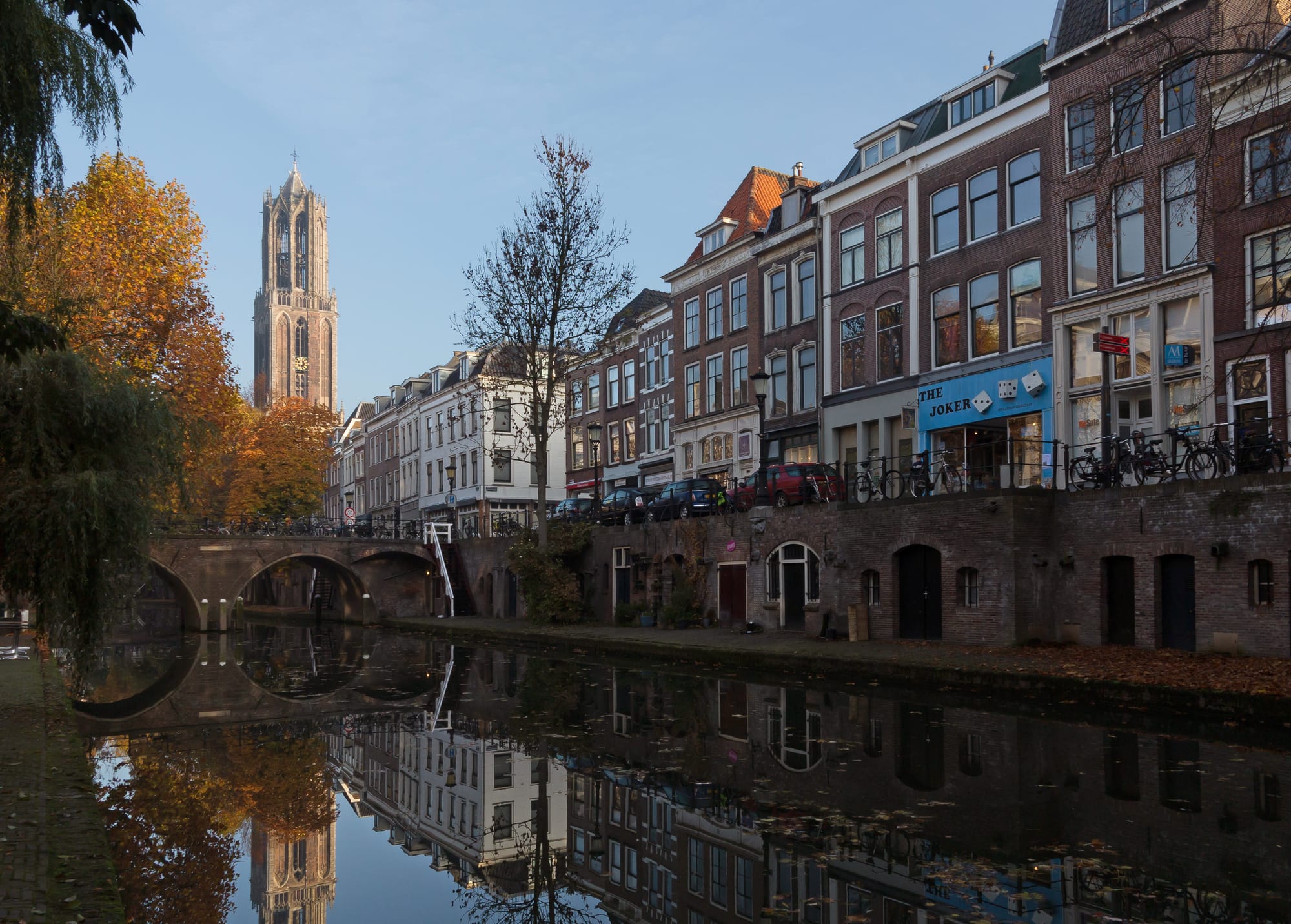
A Gothic church tower rising above autumn trees and brick houses beside a still canal with low wharves and an arched bridge

Netherlands

Utrecht, Gelderland & the East

The Dom Tower above the Oudegracht in Utrecht, with the city's wharf-level quays below the street. (Michielverbeek / Wikimedia Commons · CC BY-SA 4.0)

The centre and east of the Netherlands, from the cathedral city of Utrecht across the forests and heaths of the Veluwe and the great rivers to the Hanseatic towns of the IJssel, the lakes of Overijssel and the reclaimed land of Flevoland — higher, drier and more wooded than the coastal west.

Explore Utrecht, Gelderland & the East

History

The Rhine formed the northern frontier of the Roman Empire here, and the camp and town at Nijmegen, which grew into Ulpia Noviomagus, give the city its claim to be the oldest in the Netherlands. Utrecht grew from a Roman fort, and around 695 the Anglo-Saxon missionary Willibrord made it the seat of a bishop; the prince- bishops of Utrecht became powerful rulers, and the trading town of Dorestad, near modern Wijk bij Duurstede, was one of the great ports of the early Middle Ages.

Gelderland was a duchy that resisted Burgundian and Habsburg rule into the 16th century. Along the IJssel, Deventer, Zwolle, Kampen and Zutphen joined the Hanseatic League and prospered on river trade with the Baltic and the Rhineland, and Deventer was a centre of the Modern Devotion, the religious movement of Geert Grote. In 1579 the rebel provinces signed the Union of Utrecht, the founding pact of the Dutch Republic, and the Treaty of Utrecht of 1713 ended the War of the Spanish Succession.

In September 1944 the Allies' Operation Market Garden tried to seize the Rhine bridges; British paratroopers held the north end of the Arnhem bridge for several days before being overwhelmed, and Nijmegen was badly damaged. In May 1945 the German surrender in the Netherlands was negotiated at Wageningen. After the war the Zuiderzee reclamation created the Noordoostpolder and then Flevoland, which became the country's twelfth province in 1986, and Twente's textile industry, once the region's industrial core, collapsed from the 1960s.

Culture & Customs

The east feels different from the Holland provinces. Across Overijssel and the Achterhoek people speak dialects of Dutch Low Saxon, a regional language closer to the dialects across the German border, and a sense of rural, community-minded steadiness contrasts with the cosmopolitan Randstad. Utrecht, by contrast, is a young and student-heavy city, home of the country's largest university and of Miffy, the rabbit created by the illustrator Dick Bruna.

Religion varies sharply. A band of strict Reformed Protestant communities, the Bible Belt, crosses the Veluwe and reaches into Overijssel, where villages such as Staphorst are known for traditional dress and Sunday observance; the Achterhoek, eastern Twente and Nijmegen are more Catholic, and some towns there celebrate carnival. Flevoland, settled only from the 1940s onwards, has no deep local traditions and a population drawn from every part of the country.

The calendar includes Nijmegen's Four Days Marches in July, in which tens of thousands of walkers cover up to 50 kilometres a day, the Airborne commemorations at Arnhem and Oosterbeek every September, Deventer's Dickens festival before Christmas, and farm-based summer fairs across the east.

Daily Life

About five million people live across the four provinces. Utrecht has around 370,000 residents and Amersfoort about 160,000; in Gelderland, Nijmegen, Arnhem and Apeldoorn each have around 160,000–180,000. Enschede is the largest city in Overijssel, while Zwolle, with about 130,000, is its capital, and Deventer has around 100,000. Almere, founded only in the 1970s, has grown to over 200,000, and Lelystad is Flevoland's capital.

Utrecht's economy rests on services, the railways, which are headquartered there, and its university, while Wageningen is known internationally for food and agricultural science. The Veluwe lives on tourism, holiday parks and forestry; the Betuwe on fruit orchards; the Achterhoek and Twente on dairy farming and manufacturing; and Flevoland on large-scale arable farming and on commuters to Amsterdam and Utrecht.

The rhythm is calmer and more rural outside Utrecht, with family businesses, village sports clubs and long bike rides at weekends. Current issues include the nitrogen rules that restrict livestock farms near protected nature areas — a sharp question around the Veluwe — the spread of housing and logistics warehouses, and the rapid growth of Utrecht and Almere.

Food

Eastern cooking is farmhouse food. Gelderse rookworst, a smoked sausage, is eaten with stamppot and pea soup across the country, and the Achterhoek and Twente add hearty dishes of pork, bacon and potatoes. Krentenwegge, a long loaf of currant bread, is a Twente tradition given to families when a baby is born. The Betuwe's orchards supply apples, pears and cherries, and the town of Tiel is known for its jams.

Deventer koek is a dense spiced honey cake, made in the town for centuries, and Zwolle is known for its Zwolse balletjes, hard sweets in flavours such as peppermint and aniseed. The IJssel and the lakes supply smoked eel and river fish, sold in the old towns and at the harbours of the IJsselmeer. In Utrecht, the student city eats globally, with markets on the Vredenburg and a wide spread of cafés along the Oudegracht wharves.

Beer has deep roots in the east: Grolsch was founded in Groenlo in the Achterhoek and now brews in Enschede, and small breweries operate across the region. Flevoland's reclaimed clay grows potatoes, onions, sugar beet and tulip bulbs, and its farm shops sell produce straight from the polder.

Attractions & Natural Wonders

Utrecht's centre is built around the Dom Tower, the tallest church tower in the Netherlands, and the Oudegracht, whose two-level quays have cellars opening onto the water. The Centraal Museum, the Museum Speelklok and the Rietveld Schröder House, a UNESCO World Heritage Site, are close by, and the rebuilt castle of De Haar lies just outside the city. Amersfoort has a well-preserved medieval centre with the Koppelpoort water gate.

In Gelderland, De Hoge Veluwe National Park combines forest, heath and drifting sand with the Kröller-Müller Museum, whose Van Gogh collection and sculpture garden are among the country's finest, and the Jachthuis Sint Hubertus hunting lodge. Arnhem has the Netherlands Open Air Museum and the John Frost Bridge, with the Airborne Museum at Oosterbeek nearby; Nijmegen has Roman finds at the Valkhof Museum and old riverfront streets along the Waal. Apeldoorn's Het Loo palace and its formal gardens complete the Veluwe.

The IJssel towns — Deventer with its Lebuinuskerk and Bergkwartier, Zutphen, Kampen and Zwolle with its Peperbus tower — make a chain of Hanseatic centres. Further north, Giethoorn's canals and footbridges lead into the Weerribben-Wieden National Park. Across the water, the Flevoland polders hold Schokland, a former island and UNESCO World Heritage Site, the replica of the East Indiaman Batavia at Lelystad, and the Oostvaardersplassen wetland, grazed by Konik horses and red deer.

Cities in Utrecht, Gelderland & the East

Planning basics

Budget

The centre and east are cheaper than the Randstad coast. Utrecht is the exception, with prices close to Amsterdam's; Arnhem, Nijmegen, Deventer and Zwolle have good-value hotels, and the Veluwe is full of campsites, holiday parks and B&Bs. National park and museum tickets are the main extra costs.

Daily Budget Midrange
USD 160–290 (mid-range hotel or B&B, restaurant dinners, park and museum entries)
Daily Budget Shoestring
USD 75–110 (hostel or campsite, supermarket food, regional trains and a hire bike)

Buy the combined Hoge Veluwe and Kröller-Müller ticket and use the park's free white bicycles to get around.

Safety

The region is very safe. Bike theft around stations is the most common crime, Utrecht Centraal is busy and worth watching for pickpockets, and country roads through the forests carry fast traffic and crossing deer and wild boar. Ticks carrying Lyme disease are common in the Veluwe woods and heaths.

Check for ticks after walking in woodland or heath, and keep to the marked paths in the national parks. Check current official travel advice before travelling.

Climate

The east has a slightly more continental climate than the coast: summers are a little warmer and winters are colder, with more frost and a better chance of snow. The wind is gentler than on the coast.

Summer
warm, typically 18–25°C, occasionally above 30°C in heatwaves
Winter
cold and damp, -1–6°C, with more frost and snow than the west

Transportation

Utrecht Centraal is the hub of the national rail network, and intercity trains run on to Amersfoort, Arnhem, Nijmegen, Deventer and Zwolle; Almere and Lelystad are on the line across Flevoland. Buses reach the Hoge Veluwe entrances from Arnhem and Apeldoorn, and Giethoorn by bus from Steenwijk. This is excellent cycling country, with long-distance routes through the Veluwe and along the IJssel. A car helps in the Achterhoek and rural Twente.

Hire a bike at Arnhem or Apeldoorn station for the Veluwe, and in Giethoorn rent a whisper boat rather than walking the crowded paths.

Best Time to Visit

Late summer, when the Veluwe heather flowers purple, are the classic time for the national park; spring brings blossom to the fruit orchards of the Betuwe. July is busy in Nijmegen during the Four Days Marches, and summer fills Giethoorn's canals with boats, so early mornings and the shoulder seasons are quieter.