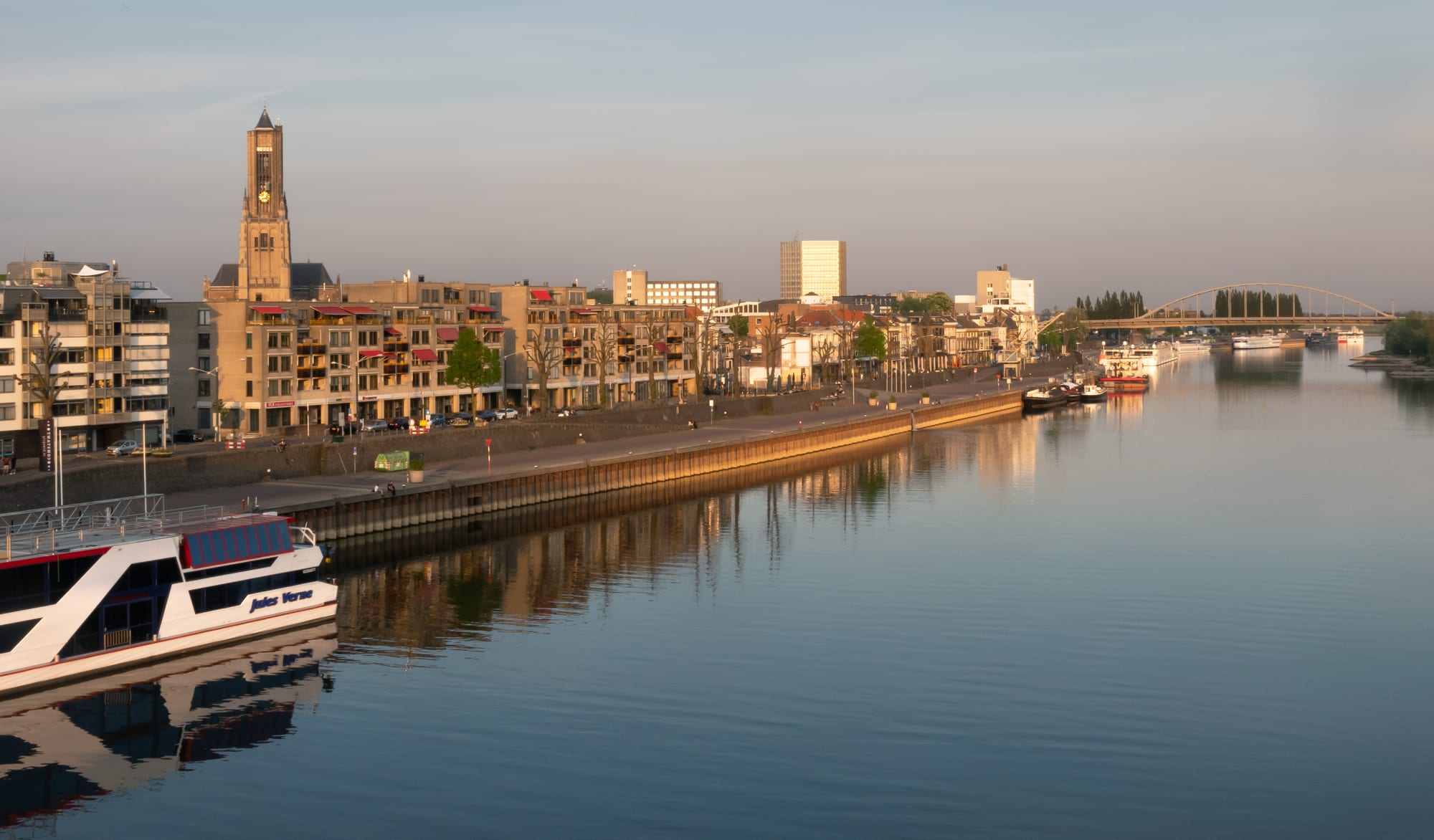
A calm river reflecting a quay of flats and a brick church tower in evening light, with an arched bridge in the distance

Utrecht, Gelderland & the East, Netherlands

Arnhem

The Rijnkade and the tower of St Eusebius' Church across the Lower Rhine at Arnhem, with the John Frost Bridge beyond. (Michielverbeek / Wikimedia Commons · CC BY-SA 4.0)

The capital of Gelderland, on the Lower Rhine near the German border, where the woods and heaths of the Veluwe come down to the river. Remembered worldwide for the airborne battle for its bridge in September 1944, it was rebuilt after the war and is now a green, hilly city of parks, museums and the gateway to the Hoge Veluwe.

Neighbourhoods

  • Centrum
    • First-time visitors
    • Nightlife
    • Close to public transport

    The rebuilt old town between the station and the river, around St Eusebius' Church and the Markt. The Korenmarkt and Varkensstraat hold grand cafés, clubs and big terraces, and the Rijnkade quay along the Rhine fills with outdoor tables in summer.

    Open in Maps
  • Klarendal and the Modekwartier
    • Shopping
    • Arts and design
    • Local life

    A former working-class district just north-east of the centre, renewed after the 1980s and now home to the Modekwartier (Fashion Quarter) — fashion shops, ateliers and lifestyle stores mixed with galleries, theatres, a book café and a brewery.

    Open in Maps
  • Spijkerkwartier
    • Historic district
    • Bars
    • Quiet and residential

    A residential district east of the centre, protected as a townscape and long home to many of the city's better-off residents, with large monumental townhouses.

    Open in Maps
  • Sonsbeek and the northern hills
    • Parks
    • Quiet and residential

    Arnhem climbs north into the wooded hills of the Veluwe — unusual terrain for a Dutch city — with the large Sonsbeek and Zijpendaal parks, well-to-do districts such as the Burgemeesterswijk, and the Open Air Museum and zoo on the edge of the woods.

    Open in Maps
  • Arnhem-Zuid
    • Families
    • Modern housing

    The newer half of the city across the Rhine, home to about 80,000 people in post-war and recent districts such as Malburgen and Schuytgraaf.

    Open in Maps

Things to do

Famous landmarks

  • John Frost Bridgelandmark

    The road bridge over the Lower Rhine that British paratroopers held at its north end in September 1944, now the third almost identical bridge on the site and named after their commander.

    Open in Maps
  • St Eusebius' Churchviewpoint

    The great Gothic church begun in 1452, whose tower collapsed after the 1944 fighting; the rebuilt tower has a lift and, since 2018, glass observation balconies at about 60 metres.

    Open in Maps
  • Sabelspoortlandmark

    The only surviving part of the medieval city walls, a gate near the Markt.

    Open in Maps

The 1944 battle

  • Airborne Museum Hartensteinmuseum

    In Oosterbeek, the villa that served as the headquarters of the British forces during the battle, now a museum of the fighting around Arnhem.

    Open in Maps
  • Arnhem Oosterbeek War Cemeterylandmark

    The Airborne Cemetery in Oosterbeek, established in 1945, holding 1,764 graves, most of them of men killed in the September landings.

    Open in Maps
  • Airborne at the Bridgemuseum

    A branch of the Airborne Museum on the Rijnkade, just west of the John Frost Bridge, telling the story of the fight for the bridge.

    Open in Maps

Museums and the zoo

  • Netherlands Open Air Museummuseum

    An open-air museum of everyday life, founded in 1912, with around forty buildings such as old houses, farms and factories from various parts of the Netherlands on about 44 hectares, and a heritage tram line.

    Open in Maps
  • Royal Burgers' Zooattraction

    One of the biggest zoos in the Netherlands, covering 45 hectares, with an underwater walkway and indoor desert, mangrove and rainforest halls.

    Open in Maps
  • Museum Arnhemmuseum

    The city's museum of modern and contemporary art, applied art and design.

    Open in Maps

Parks and the Veluwe

  • Park Sonsbeekpark

    Arnhem's best-known and most-used park, just north of the station, with a watermill, and the setting for the intermittent Sonsbeek sculpture exhibitions held since 1949.

    Open in Maps
  • De Hoge Veluwe National Parkpark

    Heath, woodland and sand dunes reaching into the north of the municipality, explored on the park's free bicycles.

    Open in Maps
  • Kröller-Müller Museummuseum

    A national art museum and sculpture garden inside the Hoge Veluwe at Otterlo, with the second-largest collection of Van Gogh paintings after the Van Gogh Museum.

    Open in Maps

Sport and nearby towns

  • GelreDomeattraction

    Vitesse's stadium, opened in 1998, with a retractable roof and a pitch that slides out of the building.

    Open in Maps
  • Nijmegenattraction

    Gelderland's largest city, on the Waal to the south and one of the oldest cities in the Netherlands, begun as a Roman camp, linked to Arnhem by a 17-kilometre cycle highway.

    Open in Maps

Seasonal events

  • Airborne CommemorationSeptember

    Ceremonies, walks and services in Arnhem and Oosterbeek from 17 to 26 September marking the battle of September 1944, including the Airborne March in Oosterbeek on the first Saturday of the month.

  • World Statues Festivalsummer

    The world championship of living statues, with around 250 performers from many countries standing in the city's streets.

  • Park Open and Sonsbeek Theater Avenuelate May to August

    Free Sunday-afternoon theatre, music and dance in Park Sonsbeek through the summer, closing in August with the four-day Sonsbeek Theater Avenue festival.

Eat and drink

Long-standing places and food districts in Arnhem. Hours, ratings and directions come from your maps app, always current.

Arnhem classics

  • Arnhemse meisjescafe

    The local biscuit, whose name means 'Arnhem girls', sold in the city's bakeries alongside Dutch treats such as stroopwafels.

    Open in Maps
  • 't Taphuyscafe

    A bar in the old post office building where drinkers pour their own from a choice of more than a hundred beers.

    Open in Maps

Food districts

  • Korenmarktneighborhood

    The old corn-market square at the heart of the nightlife, lined with grand cafés and pavement terraces.

    Open in Maps
  • Rijnkadeneighborhood

    The Rhine quay south of the centre, set out with terraces in the summer months.

    Open in Maps
  • Modekwartierneighborhood

    Klarendal's fashion quarter, where cafés, a book café and a small brewery sit among the boutiques.

    Open in Maps

Experience Arnhem

History

Arnhem grew up not on the Rhine but slightly higher, beside the Sint-Jansbeek stream, where the road between Nijmegen, Utrecht and Zutphen split; it was first mentioned in 893, and only a change in the river's course in 1530 brought the town to the water. Count Otto II of Guelders granted it city rights and fortified it in 1233, and it joined the Hanseatic League in 1443. Burgundy, the dukes of Guelders and Charles V fought over it until it joined the Union of Utrecht in 1579, and Dutch and English troops took it from Spanish forces in 1585.

The French occupied Arnhem in 1672–74 and again from 1795 to 1813. In the 19th century the town grew strongly and spread into the hills; of its medieval walls only the Sabelspoort survives. It became a genteel resort known as the "Little Hague of the East", favoured by wealthy former planters and sugar barons from the Indies, and it is still known for its parks.

On 17 September 1944 British airborne troops landed west of the city in Operation Market Garden to seize the Rhine bridges, with Polish paratroopers following. Only a force under Lieutenant Colonel John Frost reached the road bridge, holding the north end until it was overwhelmed on 21 September; the remaining forces withdrew on 26 September. The Germans then forcibly evacuated the population, and the city was liberated in April 1945. Rebuilding lasted until 1969. Arnhem hosted the 1980 Summer Paralympics, and in March 2025 a major fire destroyed some 25 historic buildings in the old centre.

Culture & Customs

The battle shapes Arnhem's place in the world's memory. It was dramatised in the 1946 film Theirs is the Glory and in A Bridge Too Far in 1977 — whose bridge scenes were shot in Deventer, since Arnhem had changed too much — and the rebuilt bridge was renamed after John Frost. Each September, from the 17th to the 26th, the Airborne commemorations in Arnhem and Oosterbeek bring walks and services.

The city is also a centre for art and design. ArtEZ Institute of the Arts trains designers and artists, the Modekwartier in Klarendal grew out of that fashion scene, and Park Sonsbeek has hosted the Sonsbeek sculpture exhibitions since 1949. The dance company Introdans is based here and is part of the national cultural infrastructure. Summer brings free Sunday performances in Sonsbeek, the Sonsbeek Theater Avenue and Hoogte 80 theatre festivals, and the World Statues Festival of living statues.

Sport matters too. Vitesse play at the GelreDome, a stadium with a sliding pitch built for Euro 2000, and won the national cup in 2016–17, while Papendal, the national Olympic training centre in the Veluwe woods outside the city, is the home base of the national Olympic committee. The local dialect is called Ernems.

Daily Life

About 172,000 people lived in the municipality in January 2026, around 80,000 of them south of the Rhine in Arnhem-Zuid. In 2024 just over a third of residents had at least one parent or grandparent born abroad. As the provincial capital, Arnhem is home to the Gelderland government, the Hogeschool van Arnhem en Nijmegen and ArtEZ, and the KEMA tower, a 140-metre television mast, is its tallest structure.

The city's districts differ sharply. The Burgemeesterswijk, the Spijkerkwartier and newer Schuytgraaf have long been the better-off areas, while Klarendal, Presikhaaf and Malburgen housed people on lower incomes. Klarendal saw a local uprising against drug nuisance in 1989; since then it has been renewed and partly gentrified, and is now socially mixed. The German border is only about 15 kilometres away, and some people who work in Arnhem live in villages just over it in Germany.

Getting around is shaped by the trolleybuses, unique in the Netherlands, and by cycle highways such as the 17-kilometre RijnWaalpad to Nijmegen.

Food

Arnhem's own speciality is the Arnhemse meisje, "Arnhem girl", a local biscuit sold in its bakeries, and stroopwafels are sold by many shops and stalls in the centre. Otherwise the city eats in the national way: bread with cheese at lunchtime, bitterballen and kroketten from snack bars, and in winter stamppot — mashed potato beaten with kale, sauerkraut or endive — with Gelderse rookworst, the smoked sausage of the province, and thick pea soup.

Eating out centres on the old town. The Korenmarkt, the former corn market, and the Varkensstraat are lined with grand cafés and big terraces, and the Rijnkade along the river sets out tables in summer. Restaurants also cluster around the Markt and the Eusebius church, and in the Modekwartier cafés and a small brewery sit among the boutiques.

Beer is a strong suit. In the old post office a bar lets drinkers pour their own from more than a hundred beers, and at least one brown bar serves Grolsch — brewed in Enschede, in the east of the country — in swing-top bottles alongside craft beers. The Open Air Museum demonstrates traditional beer brewing among its old workshops.

Planning tools

Budget

Arnhem is cheaper than the Randstad cities, with good-value hotels and plenty of mid-priced cafés in the centre. The main extra costs are the big attractions on the edge of town — the Hoge Veluwe and Kröller-Müller, the Open Air Museum and the zoo — which together can outweigh a night's accommodation.

Daily Budget Midrange
USD 160–280 (mid-range hotel, restaurant dinners, park and museum entries)
Daily Budget Shoestring
USD 75–110 (hostel or campsite, snack-bar and supermarket food, trolleybuses and a hire bike)

Buy the combined Hoge Veluwe and Kröller-Müller ticket and use the park's free bicycles.

Best Time to Visit

Late spring to early autumn, for the parks, the summer festivals and the Rhine terraces. Late summer brings purple heather to the Veluwe, and September the Airborne commemorations, when the town is busy. Winter is quiet and grey, with the museums to fall back on.

Suggested Number of Days

Two days are enough for a first look at the town and its surroundings. Allow three or four for a slower pace, a neighbouring city or longer bike rides through the woods and heaths to the north.

First Visit
2 days
With Surroundings
3–4 days

Transportation

Arnhem is the only Dutch city with trolleybuses, and a frequent network of them and ordinary buses runs from the station bus station across the city and to Oosterbeek. Cycling is easy apart from the hills to the north, with a 17-kilometre cycle highway, the RijnWaalpad, to Nijmegen.

Hire a bike at the station for the Veluwe, and tap in and out with a contactless bank card on buses and trains.

Airport & Station Connections

Arnhem Centraal, opened in 1845, has intercity trains to Utrecht, Amsterdam, Schiphol, Nijmegen and Zutphen, and ICE trains to Düsseldorf and Frankfurt. Düsseldorf Airport is reached by ICE to Düsseldorf Hauptbahnhof (around 70 minutes) and a local train on, or in around an hour and forty minutes on a direct hourly regional train. By road, Schiphol is around an hour to an hour and a quarter in normal traffic.

Walkability

The centre is compact: the station, Park Sonsbeek, the Korenmarkt and the Rijnkade are all a few minutes apart on foot. The Open Air Museum, the zoo and Oosterbeek are a bus or bike ride away, and the northern districts are hilly by Dutch standards.

Safety

The Netherlands is very safe, with low violent crime. In Arnhem bike theft around the station is the most common problem. Out in the Veluwe woods and heaths, ticks carrying Lyme disease are common, and forest roads carry fast traffic and crossing deer and wild boar.

Lock bikes with two good locks, check for ticks after walking in the woods, and keep to marked paths in the national park. Check current official travel advice before travelling.

Climate

An oceanic climate like the rest of the Netherlands, though Arnhem's position on the foothills of the Veluwe brings a little more rain. Away from the coast the difference in temperature between summer and winter, and between day and night, is larger than by the sea.

Summer
mild to warm — at the national weather station at De Bilt, in the centre of the country, days above 25°C usually come between May and September, and days above 30°C are rare
Winter
cool and damp, with nights below 0°C common from mid-November to late March, occasional days that stay below 0°C between December and February, and snow possible from November to April

Local Customs

Dutch manners are direct and informal, and plain speaking is taken as honesty rather than rudeness. September carries real emotional weight here: the battle and the liberation are remembered in ceremonies every September, and visitors are expected to be respectful at the war cemetery. Tipping is not required; rounding up or adding 5–10 per cent for good service is generous.

Never walk or stand in a red-asphalt cycle lane, and keep quiet and respectful at the Airborne Cemetery and memorials.

Common Payment Methods

The currency is the euro. Mastercard and Visa cards are widely accepted, and a growing number of shops do not take cash at all, though some stores block credit cards issued in the EU, and a few have had trouble with cards issued outside the European Economic Area, so carry a second way to pay.