💰 Budget
Giethoorn is a day-trip destination as much as a place to stay, and boat hire is the main cost after accommodation. Prices in the village centre reflect its popularity; nearby Steenwijk, Meppel and Zwolle, and the campsites and B&Bs of the surrounding countryside, are cheaper bases.
- Daily Budget Midrange
- USD 160–290 (B&B or guesthouse, restaurant meals, a few hours' boat hire)
- Daily Budget Shoestring
- USD 75–110 (campsite or hostel nearby, supermarket food, train and bus, a shared boat or a hire bike)
Hire a quiet electric whisper boat rather than walking the crowded paths, and come early in the morning or out of season to see the canals at their calmest.
📅 Best Time to Visit
Spring and early autumn, when the gardens are green, the boats are out and the crowds are thinner than in high summer, when the canals fill with boats. Winter is quiet and grey, though the village keeps its looks.
⏳ Suggested Number of Days
One day, or a long half-day, is enough for the village itself. Allow two or three to explore the surrounding national park by boat or bike and the small historic towns nearby.
- First Visit
- 1 day
- With Surroundings
- 2–3 days
🚆 Transportation
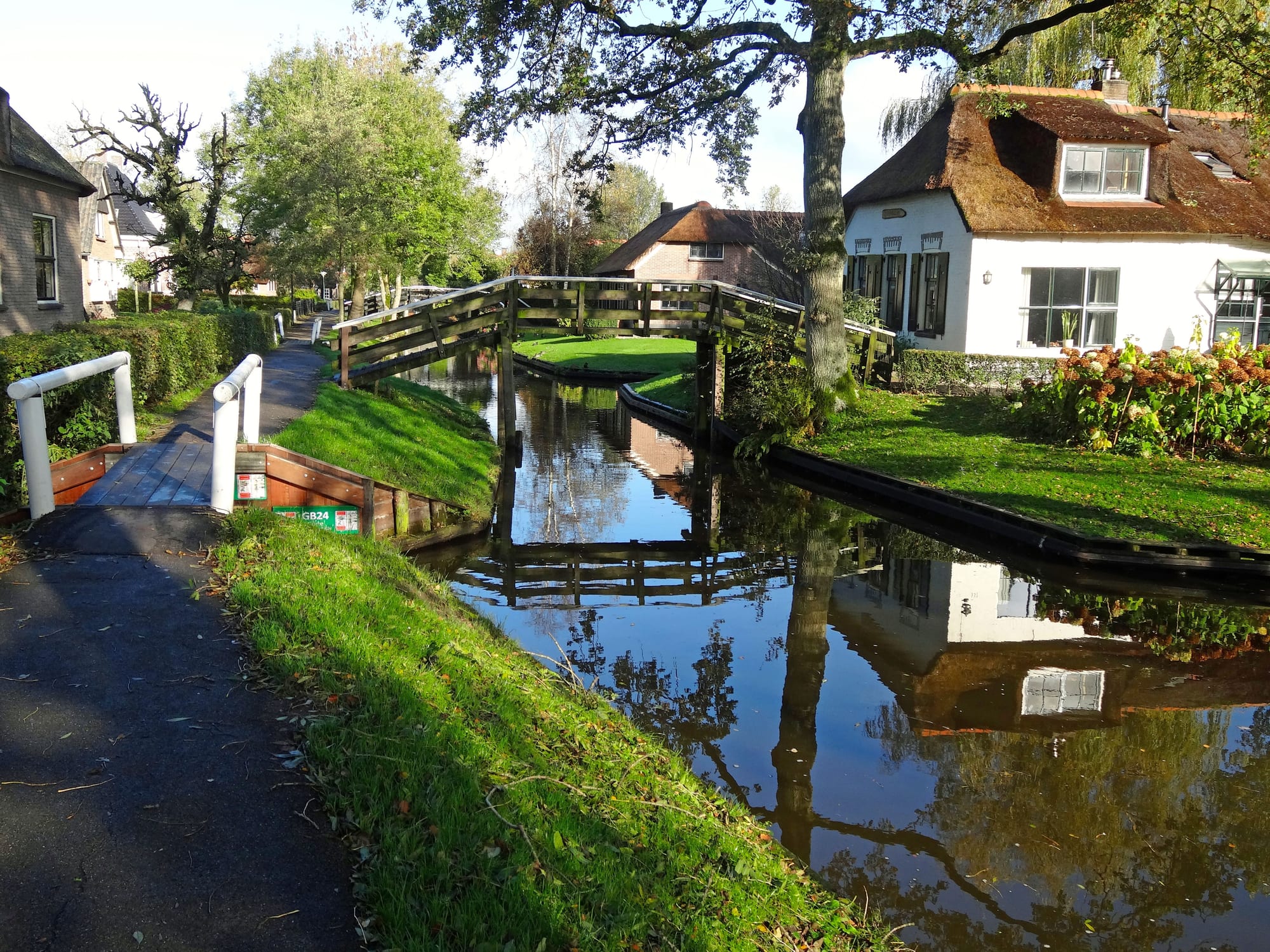
The old village has no roads for cars: transport runs on the canals, and a combined cycle and footpath runs from the Noordeinde to the Zuideinde. Boats of every kind can be hired — motor boats, quiet electric whisper boats and traditional punters, with or without a motor or a sail. Bus 70 links the village with Steenwijk and the surroundings, and marked cycle routes lead into the Weerribben and the Wieden.
Visitors' cars stay in the car parks on the edge of the village; boat hire is easy and needs no experience.
🛬 Airport & Station Connections
Giethoorn lies about 5 kilometres south-west of Steenwijk, the nearest railway station. From Amsterdam and Schiphol, trains run to Steenwijk, usually with a change at Lelystad onto the intercity to Leeuwarden, and bus 70 continues to the village, with extra buses in the high season. Drivers come via the A6 and park outside the old village.
🚶 Walkability
The village is long and thin, strung out along the Dorpsgracht, and the footpath beside it is pleasant to walk but narrow and very busy on summer days, shared with bikes. Many houses can only be reached over footbridges, and the lakes and park beyond are for boats and bikes.
🛡️ Safety
The Netherlands is very safe, with low violent crime. Giethoorn's practical concerns are crowds on the narrow paths in summer and the theft of bikes left unlocked.
Lock bikes, keep children close on the narrow canal-side paths, and remember the houses are private homes. Check current official travel advice before travelling.
🌦️ Climate
Temperate and maritime, as across the Netherlands, though away from the coast the difference in temperature between summer and winter, and between day and night, is larger than by the sea.
- Summer
- mild to warm — at the national weather station at De Bilt, in the centre of the country, days above 25°C usually come between May and September, and days above 30°C are rare
- Winter
- cool and damp, with nights below 0°C common from mid-November to late March, occasional days that stay below 0°C between December and February, and snow possible from November to April
🤝 Local Customs
Giethoorn is a lived-in village, and many of its thatched farmhouses are private homes whose gardens run down to the canals; residents value quiet and privacy. Dutch manners are direct and informal. Tipping is not required; rounding up or adding 5–10 per cent for good service is generous.
Stay off private lawns and footbridges, keep noise down on the water, and ask before photographing residents.
💳 Common Payment Methods
The currency is the euro. Mastercard and Visa cards are widely accepted, and a growing number of shops do not take cash at all, though some stores block credit cards issued in the EU, and a few have had trouble with cards issued outside the European Economic Area, so carry a second way to pay.