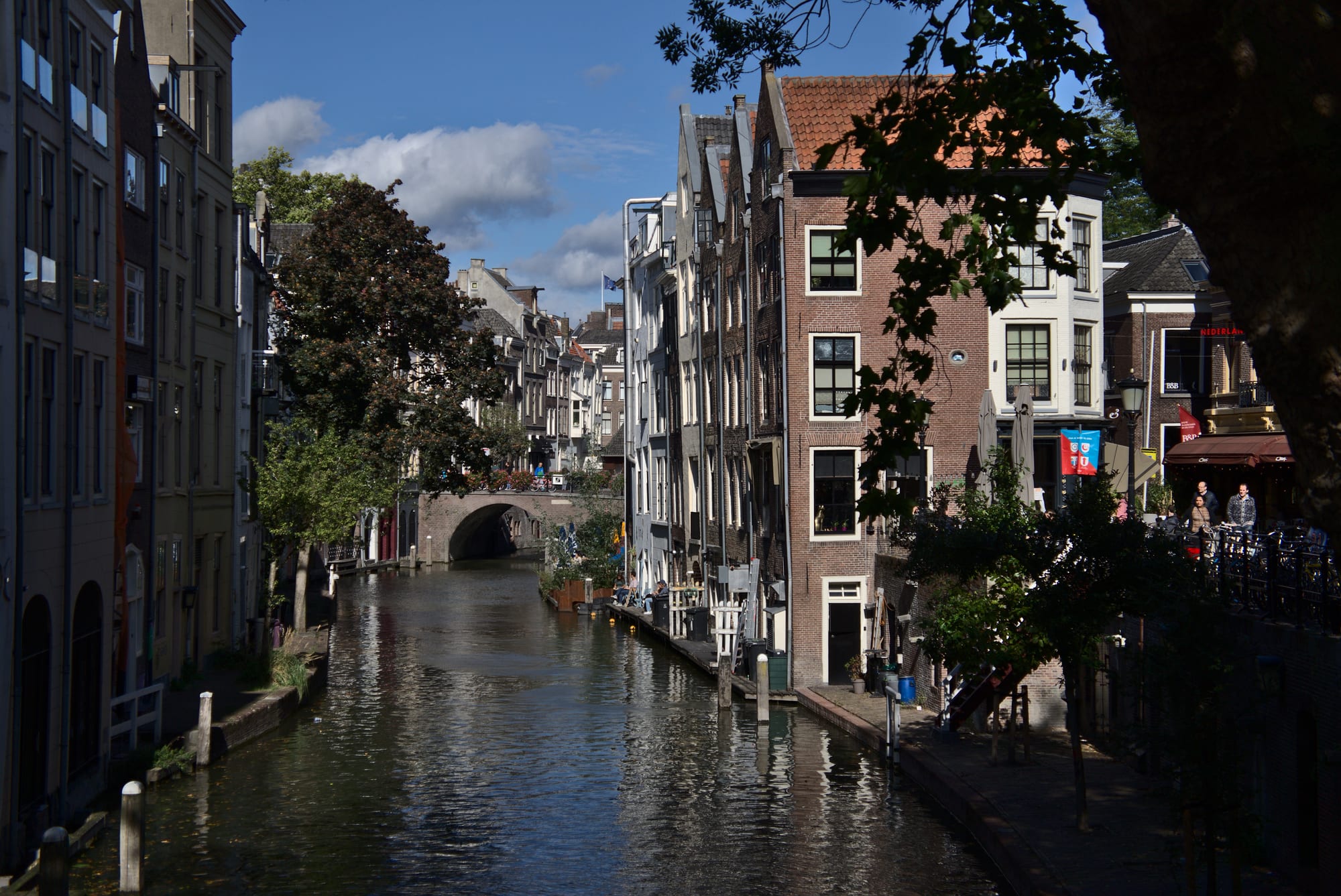
A narrow canal lined by houses on the Oudegracht in Utrecht

Utrecht, Gelderland & the East, Netherlands

Utrecht

Houses along the Oudegracht in the centre of Utrecht. (Robert von Oliva (naruciakk) / Wikimedia Commons · CC0)

The fourth-largest city of the Netherlands, in the centre of the country, grown from a Roman fort into the seat of medieval prince-bishops. Its old centre keeps the Dom Tower, the tallest church tower in the country, and canals with wharves and cellars below street level; today it is the hub of the national railways and a young university city.

Neighbourhoods

  • Binnenstad (the old centre)
    • First-time visitors
    • Historic district
    • Close to public transport

    The medieval city inside the ring of moats, built around the Dom Tower and Dom Square and cut through by the Oudegracht and Nieuwegracht. Shops, cafés and student bars fill the streets around the Neude and Janskerkhof, and Utrecht Centraal and the Hoog Catharijne mall sit on its western edge.

    Open in Maps
  • Museumkwartier
    • Museums
    • Best for food
    • Quiet streets

    The southern part of the old town, where the Centraal Museum, Museum Catharijneconvent and other collections stand in old and new buildings. Restaurants and bars spread along the canals, and in good weather people eat and drink outside by the Tolsteeg bridge.

    Open in Maps
  • Lombok
    • Best for food
    • Local life

    A late-19th-century workers' district west of the station, built between 1886 and 1920. Its main street, Kanaalstraat, is lined with mostly Turkish-run shops, Middle Eastern bakeries, rotisserie grills and greengrocers, and ends at an old-fashioned drawbridge.

    Open in Maps
  • Wittevrouwen and Oost
    • Quiet and residential
    • Parks

    Neighbourhoods of brick terraced houses laid out east of the old centre from the 1880s onwards, with the Wilhelminapark, the Rietveld Schröder House and the road to the Utrecht Science Park campus beyond.

    Open in Maps
  • Leidsche Rijn
    • Modern architecture
    • Families

    The large new district west of the Amsterdam–Rhine Canal, developed from around 2000 as an extension of the city, with its own station, shopping centre and new housing estates — useful mainly for seeing how the Dutch build suburbs today.

    Open in Maps

Things to do

Famous landmarks

  • Dom Towerlandmark

    At just over 112 metres the tallest church tower in the Netherlands and the symbol of the city, built in the 14th century and climbed on guided tours; a restoration ran from 2019 to 2024.

    Open in Maps
  • Dom Churchlandmark

    The Gothic choir and transept of the medieval cathedral of St Martin, the country's only pre-Reformation cathedral, cut off from its tower since a storm brought down the unfinished nave in 1674.

    Open in Maps
  • Oudegrachtlandmark

    The curving canal through the centre, partly following an old course of the Rhine, with medieval wharf cellars at water level beneath the street, many now converted into restaurants and cafés.

    Open in Maps
  • St Peter's Churchlandmark

    One of the city's oldest churches, a Romanesque building begun in 1039 just east of Dom Square.

    Open in Maps
  • Post Utrechtlandmark

    The former main post office on the Neude, completed in 1924 with a soaring brick hall, which has housed the city's public library since 2020.

    Open in Maps
  • Utrecht Centraaltransit hub

    The largest and busiest railway station in the country, whose bicycle parking on the east side is the largest in the world.

    Open in Maps

Museums

  • Railway Museummuseum

    The Dutch national railway museum, founded in 1927 and housed since 1954 in the former Maliebaan station, with historic locomotives and carriages.

    Open in Maps
  • Centraal Museummuseum

    The city's main museum, founded in 1838, with art, design and local history — including by far the largest collection of paintings by the Utrecht Mannerist Joachim Wtewael.

    Open in Maps
  • Museum Speelklokmuseum

    A museum of self-playing musical instruments — music boxes, clocks and street organs — set since 1984 in the medieval Buurkerk.

    Open in Maps
  • Museum Catharijneconventmuseum

    A museum of religious art and the history of Christian culture in the Netherlands, in the former convent of St Catherine.

    Open in Maps
  • Rietveld Schröder Housemuseum

    Gerrit Rietveld's house of 1924, built for Truus Schröder-Schräder and her children, a landmark of modern architecture and a UNESCO World Heritage Site.

    Open in Maps

Music and sport

  • TivoliVredenburgattraction

    A music complex by the station with five halls, each designed acoustically for a different kind of music, opened in 2014 around the old Vredenburg concert hall.

    Open in Maps
  • Stadion Galgenwaardattraction

    The home ground of FC Utrecht since 1970, on the east side of the city.

    Open in Maps

Short trips from the city

  • De Haar Castlelandmark

    The largest castle in the Netherlands, outside the city near the village of Haarzuilens, restored on a grand scale by Pierre Cuypers from 1892 to 1912.

    Open in Maps
  • Amersfoortattraction

    The province's second city, with a well-preserved medieval centre and the Koppelpoort water gate.

    Open in Maps

Seasonal events

  • Festival Oude MuziekAugust

    A ten-day festival of early European music, with concerts in churches and halls across the city.

  • Netherlands Film FestivalSeptember and October

    The national film festival, showing and awarding Dutch films in Utrecht each autumn.

  • Le Guess Who?November

    A festival of avant-garde, jazz, experimental and indie music spread across the city's venues.

Eat and drink

Long-standing places and food districts in Utrecht. Hours, ratings and directions come from your maps app, always current.

Food streets and markets

  • Kanaalstraatneighborhood

    Lombok's main street, known for rotisserie chicken, Moroccan-style breads from Middle Eastern bakeries and the cheapest fruit and vegetables in town.

    Open in Maps
  • Vredenburg marketmarket

    A large open-air market on the Vredenburg square on Wednesdays, Fridays and Saturdays.

    Open in Maps
  • Oudegracht wharvesneighborhood

    Restaurants and cafés in the old cellars along the canal, with tables on the quays at water level in summer.

    Open in Maps

Cafés and bars

  • Stadskasteel Oudaenrestaurant

    A 13th-century city castle on the Oudegracht turned restaurant, with its own brewery making local beers.

    Open in Maps
  • Café Belgiëcafe

    A Belgian beer café on the Oudegracht with a long list of beers.

    Open in Maps

Experience Utrecht

History

Utrecht began as a Roman fort, built around 50 CE on the Rhine frontier of the empire, at a crossing that gave it its Latin name, Traiectum. The Romans left after about 275. In 695 the missionary Willibrord was consecrated bishop of the Frisians, and his tenure is taken as the beginning of the bishopric of Utrecht; in 723 Charles Martel granted the fortress to the bishops, making Utrecht the leading centre of the Church in the northern Low Countries.

The town received city rights in 1122. As the main flow of the Rhine moved south, its old bed through the centre was canalised, and merchants built storage cellars on the wharves with the street and houses on top — the two-level canals that still define the city. Work on the Gothic cathedral began in 1254, and the Dom Tower rose between 1321 and 1382. In 1522 the Utrecht-born Adriaan Boeyens became Pope Adrian VI. Charles V took secular power in 1528.

In 1579 the northern provinces signed the Union of Utrecht, the founding pact of the Dutch Republic, and in 1713 the Treaty of Utrecht ended the War of the Spanish Succession. In between, a storm in 1674 brought down the unfinished nave of the cathedral, leaving the gap that is now Dom Square. The railway to Amsterdam opened in 1843, the walls came down and the city grew, becoming the hub of the Dutch railways. German forces held Utrecht until the surrender of 5 May 1945. Part of the moat, filled in for a motorway in the 1970s, was returned to water by 2020.

Culture & Customs

Utrecht's cultural life is second only to Amsterdam's in the Netherlands. The city hosts the Festival Oude Muziek, a festival of early European music, the Netherlands Film Festival and the experimental Le Guess Who?, and TivoliVredenburg puts classical, rock and jazz halls under one roof. UNESCO named Utrecht a City of Literature in 2017, and every Saturday a paviour adds one more letter to The Letters of Utrecht, an endless poem set into the cobbles beside the Oudegracht.

The illustrator Dick Bruna, creator of Miffy — Nijntje in Dutch — lived and worked here, and the Centraal Museum keeps a permanent display of his work. The church still shapes the city's identity: Utrecht is the seat of the Catholic archbishop who leads the Church in the Netherlands, of the archbishop of the Old Catholic Church, and of the offices of the main Protestant church. Rietveld's house of 1924 and the brick hall of the old post office show its place in modern architecture.

With the largest university in the country and a large college of applied sciences, the centre has a young, student atmosphere, with bars and clubs around the Janskerkhof. FC Utrecht play at Galgenwaard, rowing clubs train on the canals, and in 2015 the city hosted the Grand Départ of the Tour de France. Locals call their city the Domstad, after its tower.

Daily Life

About 378,000 people lived in the municipality in January 2026, and some 420,000 in the continuous built-up area that includes Nieuwegein, IJsselstein and Maarssen. The population is young, with many residents in their twenties, and more than half of households are single people. Most people live outside the old centre, in the ring of late-19th and early-20th-century districts such as Lombok and Wittevrouwen, in post-war neighbourhoods like Overvecht and Kanaleneiland, or in the new estates of Leidsche Rijn.

Industry is a small part of the economy. The city depends on large institutions: the national railway operator NS and the rail-infrastructure company ProRail have their headquarters here, as does Rabobank, along with the university and a games industry that has grown out of the first video-game courses in Europe. In 2025 Lonely Planet chose Utrecht as one of the 25 destinations in its Best in Travel 2026 guide.

Life runs on the bicycle: about 51 per cent of journeys within the city are made by bike, and the station's garage holds 12,500 bicycles. Traffic congestion and air quality are long-running concerns in a city that is still growing.

Food

Utrecht's food is less a set of local dishes than a reflection of its mixed population and its student life. Lombok's Kanaalstraat is the best-known food street, with Middle Eastern bakeries, rotisserie chicken and cheap greengrocers. The big open-air market on the Vredenburg square runs several days a week, with a flower market along the Oudegracht and a plant market on the Janskerkhof on Saturdays.

The canals give eating out its character. Along the Oudegracht the old wharf cellars, once warehouses, now hold restaurants and cafés, and in summer tables spread out onto the quays at water level, beside the passing boats and canoes. Stadskasteel Oudaen, a 13th-century city castle on the canal, brews its own beers, and beer cafés such as Café België keep long lists of beers.

The everyday Dutch staples are all here — bread with cheese at lunch, snack-bar bitterballen and kroketten, and in winter stamppot, mashed potato with kale or other vegetables served with smoked sausage. The terraces around the Neude, the Janskerkhof and Mariaplaats are the main places to sit with a drink.

Planning tools

Budget

Utrecht is one of the more expensive Dutch cities, with prices close to Amsterdam's, and hotel rooms are the main cost. Students keep plenty of cheap places to eat in business, Lombok's bakeries and grills are good value, and many sights, from the canals to the churches, cost nothing to see from outside.

Daily Budget Midrange
USD 170–300 (mid-range hotel, restaurant dinners, museum entries and trains)
Daily Budget Shoestring
USD 80–120 (hostel bed, bakery and market food, a hire bike and local buses)

Staying in Utrecht is a common way to see Amsterdam too, since direct trains between the two run frequently.

Best Time to Visit

Late spring to early autumn, when the wharf terraces are open and boats and canoes fill the canals; August brings the early music festival and autumn the film festival. Winter is grey and damp but quieter, with the museums and cafés to fall back on.

Suggested Number of Days

Two days cover the compact old centre and its main museums. Allow three or four to add the castle outside the city, nearby towns or a few days using the city as a rail base for the rest of the country.

First Visit
2 days
With Surroundings
3–4 days

Transportation

The centre is best on foot or by bike: about half of all journeys in the city are made by bicycle, on an extensive network of cycle paths. Local buses and the sneltram light rail run from Utrecht Centraal to the suburbs, Nieuwegein, IJsselstein and the Science Park campus, and sprinter trains serve several smaller stations around the city. Driving into the centre is slow and congested.

Tap in and out with a contactless bank card on trains, buses and trams, and park bikes in the guarded station garages rather than on the street.

Airport & Station Connections

Utrecht Centraal is the hub of the Dutch rail network, with frequent direct intercity trains, including at night, from Schiphol Airport and Amsterdam, each taking just over half an hour. International ICE trains to Germany call here on their way through Arnhem, and long-distance coaches leave from the station's west side or from Leidsche Rijn.

Walkability

The old centre is small and very walkable: the station, the Dom Tower, the Museumkwartier and the Neude are all within a short walk of each other, and steps lead down from the streets to the canal wharves. The outer districts and the castle are a bike or bus ride away. Watch for cyclists, who outnumber cars on many streets.

Safety

The Netherlands is very safe, with low violent crime. In Utrecht the main problem is bike theft, which is common in the city centre; as in any busy place, keep an eye on belongings around Utrecht Centraal and in the crowded centre.

Lock a bike with two good locks, keep bags closed in station crowds, and only use licensed coffeeshops, never street sellers. Check current official travel advice before travelling.

Climate

A temperate oceanic climate, as across the Netherlands: mild, damp and changeable, with rain spread through the year, cool summers and winters with some frost.

Summer
mild to warm — at the national weather station in nearby De Bilt, days above 25°C usually come between May and September, and days above 30°C are rare
Winter
cool and damp, with nights below 0°C common from mid-November to late March, and occasional days that stay below 0°C between December and February

Local Customs

Dutch manners are direct and informal, and plain speaking is read as honesty rather than rudeness. Utrecht is a young, student-heavy city, and terraces fill quickly on any sunny day. Tipping is not required: rounding up a small bill is fine, and 5–10 per cent is a generous reward for good service in a restaurant.

Never walk or stand in a red-asphalt cycle lane, and keep to the right on the narrow wharf paths along the canals.

Common Payment Methods

The currency is the euro. Mastercard and Visa cards are widely accepted, and a growing number of shops do not take cash at all, though some stores block credit cards issued in the EU, and a few have had trouble with cards issued outside the European Economic Area, so carry a second way to pay.