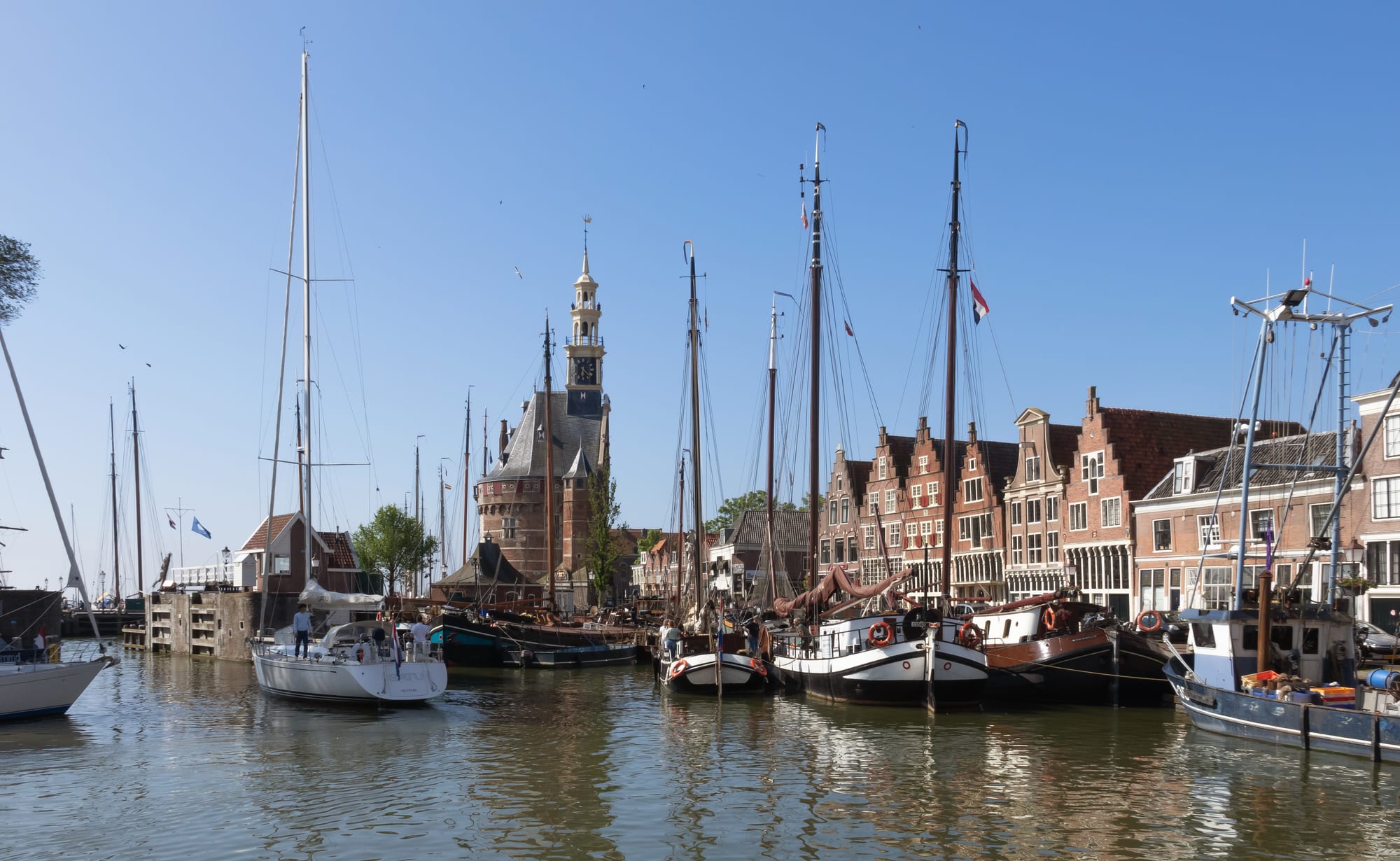
Old sailing barges and yachts moored in a calm harbour lined with gabled brick houses, with a brick tower topped by a white wooden spire under a clear blue sky

Netherlands

Amsterdam & North Holland

The old harbour of Hoorn, seen from the Oude Doelenkade with the Hoofdtoren behind, in North Holland. (Michielverbeek / Wikimedia Commons · CC BY-SA 4.0)

The peninsula between the North Sea and the IJsselmeer, running from Amsterdam and Haarlem up through the polders and old Zuiderzee ports to Den Helder and the island of Texel — the heartland of the Golden Age trading republic, with windmills, cheese towns and dunes within an hour of the capital.

Explore Amsterdam & North Holland

History

The land of North Holland was largely made by hand. Peat bogs behind the dunes were drained from the Middle Ages, and the inland lakes were pumped dry with windmills in the 17th century: the Beemster was reclaimed in 1612 and its geometric grid of fields and roads is now a UNESCO World Heritage Site. The Haarlemmermeer, a lake so large that storms drove its waves towards Amsterdam and Leiden, followed in the 1840s and 1850s with steam pumps, and Schiphol airport now sits on its bed.

Amsterdam began as a settlement at a dam on the Amstel in the 13th century and grew on the Baltic grain and timber trade. During the Dutch Revolt Haarlem fell to Spanish troops after a seven-month siege in 1573, but Alkmaar held out later that year, a turning point still remembered in the saying "at Alkmaar victory begins". After Antwerp fell to Spain in 1585, merchants and refugees poured north and Amsterdam became the richest city in Europe: the Dutch East India Company was founded in 1602, with chambers in Amsterdam, Hoorn and Enkhuizen, and the canal ring was laid out to house the new wealth.

The Zaan district became an early industrial landscape, with hundreds of wind-driven sawmills, oil mills and paper mills; Peter the Great of Russia came to Zaandam in 1697 to learn shipbuilding. The closure of the Zuiderzee by the Afsluitdijk in 1932 ended the fishing economy of the old ports, and the German occupation took a terrible toll on Amsterdam's Jewish community. On Texel, in April 1945, Georgian soldiers serving in the German army rose against their officers in one of the last battles in Europe.

Culture & Customs

North Holland is the Holland that most foreigners picture, and Amsterdam sets the tone: informal, outspoken, proudly liberal and a little sure of itself. The city's dialect and humour are known across the country, as is the rivalry with Rotterdam that plays out most loudly between Ajax and Feyenoord football fans. Amsterdam's Pride, with its boat parade along the Prinsengracht, and King's Day are the great public celebrations, and the Concertgebouw orchestra and the Rijksmuseum give it a heavyweight cultural life.

Outside the capital identities are older and more local. The area north of Alkmaar, historically West Friesland, keeps its own dialect and its own character, and the old Zuiderzee towns guard their past as ports. Volendam is a Catholic enclave in a historically Protestant province, known for its traditional dress — the women's tall pointed lace caps are among the most photographed costumes in the Netherlands — and for a strong local pop music scene. Marken, across the water, has a different costume and was an island until a causeway linked it to the mainland in 1957.

Craft and trade traditions linger in cheese weighing at Alkmaar and Edam, in mill-keeping on the Zaan, and in the flower trade: the auction at Aalsmeer, near Schiphol, is one of the largest flower markets in the world. Cycling and sailing on the lakes and the IJsselmeer are ordinary weekend habits.

Daily Life

North Holland has about three million people. Amsterdam has around 930,000 and its metropolitan area far more; Haarlem, the provincial capital, has about 165,000; Zaanstad and Alkmaar each hold over 100,000; Hoorn, Den Helder and the Gooi towns of Hilversum and Naarden are smaller. North of Alkmaar the landscape opens into farmland, bulb fields and small towns, and Texel has around 13,000 residents.

The economy is dominated by the Amsterdam region: finance, the headquarters of international companies, the tech sector, tourism and the creative industries, with Hilversum as the country's broadcasting centre. Schiphol is one of the largest employers, the port of Amsterdam handles fuel and bulk cargo, and the steelworks at IJmuiden, at the mouth of the North Sea Canal, is a major industrial site. Den Helder is the main base of the Royal Netherlands Navy.

Commuting by train and bike shapes the day, with lunch often a sandwich at the desk and dinner early, around six. The pressing issues are those of Amsterdam's success: a severe housing shortage, overtourism in the old centre and the city's efforts to curb it, and limits on flights at Schiphol for noise and climate reasons. Around IJmuiden, pollution from the steelworks is a long-running public argument.

Food

The province eats from the sea, the polder and the old spice trade. Herring is bought from stalls in Amsterdam and the coastal towns, raw with onions or on a roll as a broodje haring, and kibbeling — battered, fried chunks of white fish — is sold at harbours and markets. Volendam is famous for smoked eel (gerookte paling). Amsterdam's own speciality is ossenworst, a spiced raw beef sausage eaten in slices with mustard, and the city's brown cafés serve bitterballen with beer.

Cheese is central. Edam, the round cheese in its red wax coat, takes its name from the town, whose summer cheese market still runs; Beemster cheese comes from the reclaimed polder north of Amsterdam, and Alkmaar's market deals in the Gouda-type wheels of the region. Texel is known for its lamb, its sheep's cheese and its own brewery.

Amsterdam is the place to taste jenever, the juniper spirit, in old tasting rooms (proeflokalen) where the first sip is taken bending over a glass filled to the brim. Heineken began as an Amsterdam brewery, and its former brewery is now a visitor centre. The Zaan area gave the country its chocolate and biscuit industry and the first Albert Heijn grocery, opened in Oostzaan in 1887. Indonesian rijsttafel and Surinamese roti are everyday Amsterdam eating.

Attractions & Natural Wonders

Amsterdam holds the headline sights: the canal ring of the Herengracht, Keizersgracht and Prinsengracht, the Jordaan, the Rijksmuseum, the Van Gogh Museum and the Stedelijk on the Museumplein, the Anne Frank House, the Royal Palace on Dam Square, the Jewish Cultural Quarter and the Vondelpark. Haarlem, a short train ride away, has the Grote Kerk of St Bavo, the Frans Hals Museum, Teylers Museum, the oldest museum in the Netherlands, and a string of almshouse courtyards; the dunes of the Zuid-Kennemerland National Park and the beach at Zandvoort lie just to the west.

North of Amsterdam, the Zaanse Schans gathers working windmills, green wooden houses and craft workshops along the Zaan. The old Zuiderzee ports follow the shore: Volendam with its harbour and costume, Edam, the former island of Marken, Hoorn with its VOC-era harbour, and Enkhuizen, whose Zuiderzee Museum preserves the life of the fishing communities. Alkmaar's cheese market fills the Waagplein in front of the weigh house, and the Beemster polder and the fortress town of Naarden, with its star-shaped ramparts, show how the land was drained and defended. The Muiderslot, a moated castle at the mouth of the Vecht, is a short trip east of Amsterdam.

At the northern tip, the ferry from Den Helder crosses to Texel, whose Dunes of Texel National Park includes the tidal inlet of De Slufter, and whose Ecomare centre cares for seals. Its beaches, lighthouse and sheep-grazed fields make it a popular holiday island.

Cities in Amsterdam & North Holland

Planning basics

Budget

Amsterdam is the most expensive place in the Netherlands, with the highest hotel prices and a high tourist tax. The rest of the province costs noticeably less: Haarlem, Alkmaar and Hoorn have cheaper hotels and are short train rides from the capital. Texel is mid-priced but books out on summer weekends, when campsites and holiday cottages are the value option.

Daily Budget Midrange
USD 210–370 (mid-range hotel in Amsterdam or Haarlem, restaurant dinners, museum tickets)
Daily Budget Shoestring
USD 90–140 (hostel dorm, supermarket and snack-bar food, trains and a hire bike)

Sleep in Haarlem or Alkmaar rather than central Amsterdam, and book the Anne Frank House and the big museums online well ahead.

Safety

North Holland is safe. Pickpockets work Amsterdam Centraal, the Damrak, the red-light district and crowded trams, and bike theft is common everywhere. Street dealers in Amsterdam sell fake or dangerous drugs. On the coast and Texel, currents off the beaches can be strong, and the Wadden mudflats should be walked only with a licensed guide.

Keep bags closed and in front in central Amsterdam, stay out of the cycle lanes on foot, and swim only at lifeguarded beaches. Check current official travel advice before travelling.

Climate

Maritime and windy, as across the country, but the long North Sea coast and Texel get more sunshine and slightly milder winters than inland areas, and the wind is stronger. Amsterdam is a touch warmer than the countryside in summer. Rain can fall in any month, with autumn the wettest season.

Summer
mild, typically 17–23°C, breezy on the coast and islands
Winter
cool and damp, 1–7°C, with occasional frost and little snow

Transportation

Schiphol airport lies inside the province, a short train ride from Amsterdam Centraal. Frequent trains link Amsterdam with Haarlem, Zaandam, Alkmaar, Hoorn and Den Helder, and buses reach Volendam, Edam and Marken from the north side of Centraal station. Texel is reached by the car ferry from Den Helder, a short crossing, and is best explored by bike. Driving into central Amsterdam makes little sense: parking is scarce and very expensive.

Use trains and buses between towns and hire a bike on arrival.

Best Time to Visit

April and May bring the bulb fields in the north of the province and mild weather; King's Day on 27 April turns Amsterdam's canals into one long party. June to August suits Texel and the beaches at Zandvoort, and the Alkmaar cheese market runs in the spring and summer season. Late autumn and winter are grey but uncrowded, and the Amsterdam Light Festival lights the canals around Christmas.