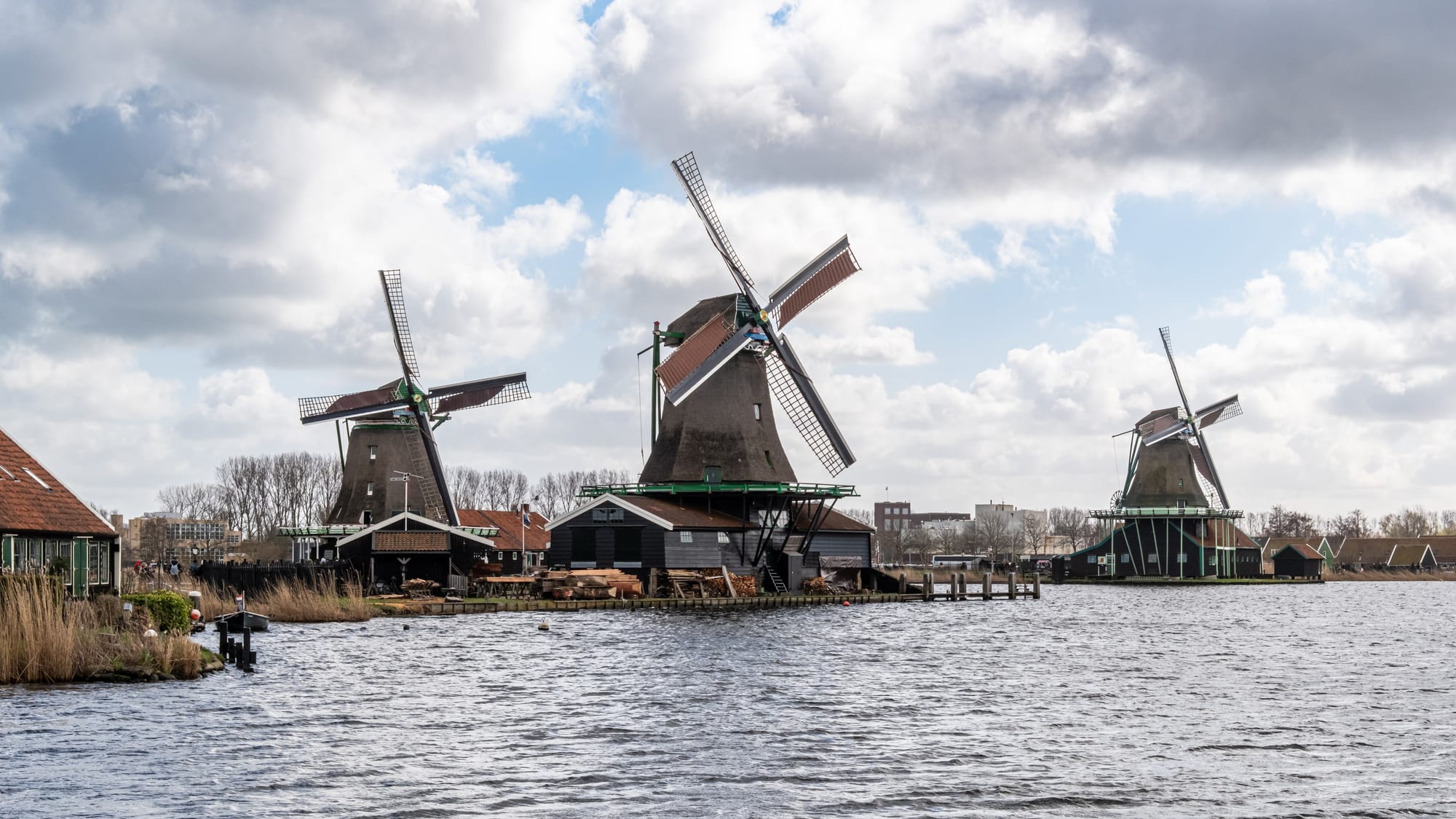
Three dark wooden windmills with red-brown sails standing on the bank of the choppy River Zaan under a cloudy sky

Amsterdam & North Holland, Netherlands

Zaanse Schans

The windmills De Zoeker, Het Jonge Schaap and De Kat on the River Zaan at the Zaanse Schans. (Dietmar Rabich / Wikimedia Commons · CC BY-SA 4.0)

A neighbourhood of Zaandam on the bank of the River Zaan, where historic windmills and green wooden houses from across the Zaan district were brought together from the 1960s to preserve them. Once a showcase of one of Europe's earliest industrial landscapes, it is now a lived-in protected village and an international tourist destination, with 2.6 million visitors in 2024.

Neighbourhoods

  • The Zaanse Schans
    • First-time visitors
    • Historic district
    • Windmills

    The relocated village itself, in the Kalverpolder on the east bank of the Zaan: a row of working industrial mills along the dyke, green-painted timber houses, small museums and craft workshops. Many of the houses are ordinary private homes, and the whole area is about a kilometre from end to end.

    Open in Maps
  • Zaandijk
    • Close to public transport
    • Quiet and residential

    The village on the opposite bank, between the railway station and the bridge to the Zaanse Schans. The Lagedijk, by the windmill De Bleeke Dood, is lined with old Zaan houses, and a local brewery stands along it.

    Open in Maps
  • Zaandam
    • Local life
    • Close to public transport

    The main town of the Zaan district, a short train ride to the south, with shops, restaurants and the small wooden house where Tsar Peter the Great stayed in 1697. It is the place to hire a bike for the area.

    Open in Maps

Things to do

Windmills

  • De Katlandmark

    The only remaining working windmill in the world that produces paint; originally an oil mill, its base still stands on its original site, and it is open to visitors.

    Open in Maps
  • De Zoekerlandmark

    An oil mill on the dyke along the Zaan, one of the row of working mills that give the site its skyline.

    Open in Maps
  • Het Jonge Schaaplandmark

    A replica of a sawmill of 1680 that once stood in the Zaan district, open to visitors.

    Open in Maps
  • De Gekroonde Poelenburglandmark

    A wind-driven sawmill of the kind that once cut timber for the Zaan's shipyards.

    Open in Maps
  • De Bleeke Doodlandmark

    A windmill by the bridge in Zaandijk, built in 1656, restored to working order in 2000 and still grinding corn.

    Open in Maps

Museums and workshops

  • Zaans Museummuseum

    The regional museum at the south end of the site, on the homes and industries of the Zaan district, with the Verkade Experience on the chocolate and biscuit maker.

    Open in Maps
  • Albert Heijn museum shopmuseum

    A small grocery museum showing how an early Albert Heijn shop was set up around 1900, with old coffee grinders, storage boxes and posters from the chain that grew into the largest supermarket company in the Netherlands.

    Open in Maps
  • Clog workshopattraction

    A wooden shoe workshop with a collection of old and new clogs and frequent demonstrations of clog-making by machine.

    Open in Maps

Short trips

  • Czar Peter Housemuseum

    In the centre of Zaandam, the house of 1632 where Peter the Great stayed in 1697 to learn about Dutch shipbuilding, now protected under a 19th-century cover and run by the Zaans Museum.

    Open in Maps
  • Amsterdamattraction

    The capital, about 18 minutes by train from Zaandijk, with its canal ring and great museums.

    Open in Maps

Eat and drink

Long-standing places and food districts in Zaanse Schans. Hours, ratings and directions come from your maps app, always current.

Zaanse Schans food

  • De Kraairestaurant

    A restaurant in one of the historic buildings brought to the site in the early 1970s.

    Open in Maps
  • Catharina Hoeve cheese farmmarket

    A cheese-making workshop with a shop selling a range of Dutch cheeses.

    Open in Maps
  • Brouwerij Hooprestaurant

    A brewery on the Lagedijk in Zaandijk, a short walk across the bridge.

    Open in Maps

Experience Zaanse Schans

History

The Zaan district north of Amsterdam was one of Europe's earliest industrial landscapes. Wind-driven mills lined the river — sawing timber for shipyards, pressing oil, grinding paint and spices — and Peter the Great of Russia came to Zaandam in 1697 to learn shipbuilding. The name of the Zaanse Schans recalls a sconce, an earthwork fort, that Diederik Sonoy, a governor serving William of Orange, built here in 1574 to hold back Spanish troops; the neighbourhood took the name in 1961.

As industry modernised, most of the old wooden buildings and mills disappeared. Concern for the district's heritage grew during the Second World War, and in 1946 a citizens' initiative, Zaans Schoon, was founded to preserve the old Gortershoek neighbourhood. After years of planning, wooden houses, warehouses and mills from across the Zaanstreek were moved to the Kalverpolder on low-loader trailers from the 1960s to the mid-1970s and restored. Only the bases of the mills De Kat and De Bonte Hen and the oil mill De Os stand on their original sites.

The houses were meant to be lived in, and they are, but the site drew more and more tourists and by 1976 it was an established visitor attraction. The Zaans Museum opened beside it in the 1990s, and the area became a protected village scene in 2010. Visitor numbers reached 2.6 million in 2024, and arguments over overtourism led to mediation and to a trial of entry charges for the attractions in 2024.

Culture & Customs

The Zaanse Schans preserves a particular style of building: wooden houses painted green, with white trim and gables, built along dykes and reached by small footbridges. The mills are its heart. Several still work — sawing wood, pressing oil, making paint — and De Kat is the only working windmill in the world that still produces paint. Craft workshops show clog-making, cheese-making and pewter casting, and small museums cover baking, clocks and the history of the grocery trade.

The Zaan was also the birthplace of a large part of the Dutch food industry. The Verkade chocolate and biscuit factory has its own pavilion at the Zaans Museum, and the first Albert Heijn grocery, the beginning of the country's biggest supermarket chain, opened in nearby Oostzaan in 1887; a re-creation of an early shop stands on the site.

For the people who live here, the site is a home, and tension between residents and the flow of visitors is part of its story. In 2019 the municipality proposed shifting from mass sightseeing towards a calmer, more cultural kind of visit.

Daily Life

The Zaanse Schans is a neighbourhood of Zaandam in the municipality of Zaanstad, and most of its wooden houses are ordinary homes. Daily life runs alongside a stream of visitors, many of them on day trips from Amsterdam or with international tour operators. The neighbourhood is a mix of inhabited homes, businesses, museums and windmills, and its outside area is free to walk around. Coaches arrive through the middle of the day, and the paths are quietest early and late.

Across the river, Zaandijk and the wider Zaan district have a long industrial past. Residents travel to Amsterdam by train in under 20 minutes.

The site's future is debated. The municipality said in 2019 that visitor numbers were causing problems for residents' quality of life and safety, and a mediator, Johan Remkes, was brought in to find a way forward. Zaanstad is studying the possibility of charging tourists an entrance fee, with the proceeds going to the maintenance and restoration of the historic buildings.

Food

The Zaan's food story is industrial. Mills here ground spices and pressed oil, and the spice mill De Huisman still stands on the site. Zaandam is the home of the chocolate and biscuit maker Verkade, remembered in the Verkade pavilion of the Zaans Museum, and the grocery trade that grew into Albert Heijn began in nearby Oostzaan.

Cheese is the main thing visitors taste: the Catharina Hoeve cheese workshop demonstrates cheese-making and sells a range of Dutch cheeses. De Kraai, a pancake house in a former granary, occupies one of the historic buildings moved to the site in the early 1970s. A typical Zaan treat is the duivekater, a round, sweet white bread, and the bakery museum In de Gecroonde Duyvekater sells duivekaters from two Zaan bakers, each made to a different recipe.

Across the bridge in Zaandijk, Brouwerij Hoop brews beer on the Lagedijk. A small distillery museum, De Tweekoppige Phoenix, stands on the site itself.

Planning tools

Budget

Walking around the outside area of the Zaanse Schans is free, and the costs are the entrance fees to the mills and museums, parking, food and the gift shops. Zaanstad is studying the possibility of an entrance fee for tourists, to pay for the upkeep of the historic buildings, so check before going. Many visitors come for the day from Amsterdam.

Daily Budget Midrange
USD 60–120 on top of accommodation (several mills and the Zaans Museum, a sit-down lunch, a boat or tour)
Daily Budget Shoestring
USD 30–60 on top of accommodation (train from Amsterdam, a mill or two, a picnic or pancakes)

Arrive early or late in the day to avoid the tour coaches, and keep some budget for the mills, which charge separately.

Best Time to Visit

Spring to early autumn, when the mills and workshops keep their longest hours and the river and polder are at their best; spring visits are often combined with the bulb fields. Coach tours make midday crowded. Winter is quiet but grey, and some mills open only on certain days.

Suggested Number of Days

Half a day is enough for the site itself. A full day allows time to walk or cycle through Zaandijk and the surrounding polder and to visit Zaandam as well.

First Visit
half a day
With Surroundings
1 day

Transportation

The site is small and best seen on foot. Bikes cannot be hired at the Zaanse Schans itself or at the nearest station, but can at the stations in Zaandam and Amsterdam, and cycling through the surrounding area is popular.

Stay on the paths: the houses are private homes, and residents ask visitors not to knock or walk into gardens.

Airport & Station Connections

Trains from Amsterdam Centraal reach Zaandijk Zaanse Schans station in about 18 minutes, followed by a 10–15 minute walk across the bridge over the Zaan. Buses from Amsterdam Centraal stop beside the main entrance in about 40–45 minutes, and a ferry runs from Centraal on some days of the week.

Walkability

Entirely walkable: the site is about a kilometre from end to end on flat paths and dykes, and the bridge to Zaandijk is at its edge. Expect crowds on the narrow paths at midday in summer.

Safety

The Netherlands is very safe, with low violent crime. At the Zaanse Schans the main risks are pickpockets in the crowds and slipping on wet boards and dyke paths; mill sails turn fast and close to the ground.

Keep well clear of turning mill sails and watch children near the water. Check current official travel advice before travelling.

Climate

Mild, cloudy and windy — the reason the Zaan was once full of windmills — with rain in every season.

Summer
moderately warm — in nearby Amsterdam the average daily high in August is about 22°C
Winter
cool, grey and damp; in nearby Amsterdam nights rarely fall below −5°C

Local Customs

The Zaanse Schans is a lived-in neighbourhood, not only a museum, and residents' privacy is a sensitive issue after years of growing visitor numbers. Tipping is not necessary, as service is included, though rounding up for good service is appreciated.

Do not knock on doors, look in windows or enter private gardens, and do not fly drones or block the paths for photographs.

Common Payment Methods

The currency is the euro. Mastercard and Visa cards are widely accepted, and a growing number of shops do not take cash at all, though some stores block credit cards issued in the EU, and a few have had trouble with cards issued outside the European Economic Area, so carry a second way to pay.