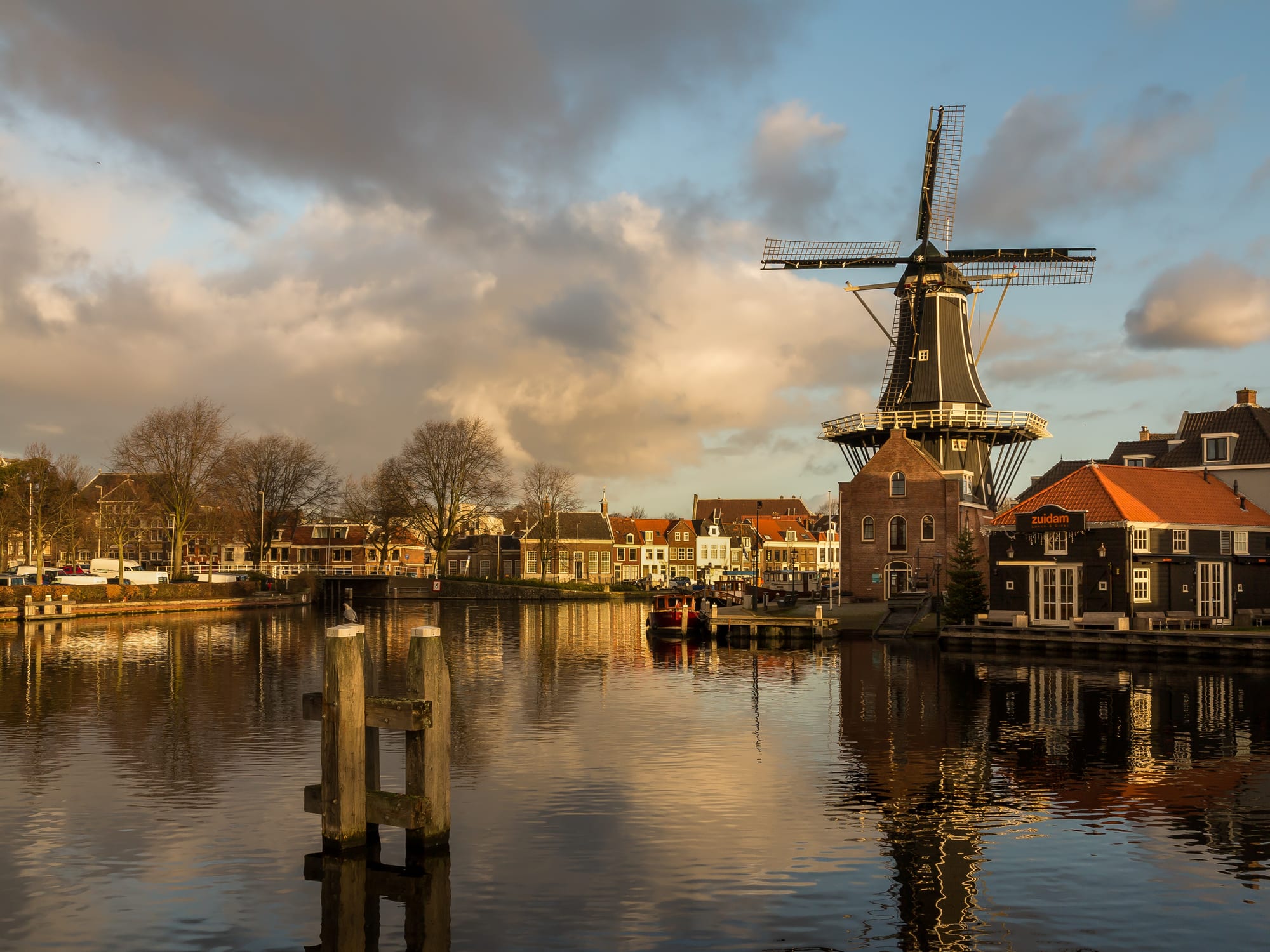
The tall dark windmill De Adriaan on a brick base beside the still River Spaarne, with gabled houses reflected in the water

Amsterdam & North Holland, Netherlands

Haarlem

The windmill De Adriaan on the River Spaarne in Haarlem. (Michielverbeek / Wikimedia Commons · CC BY-SA 4.0)

The capital of North Holland, on the River Spaarne about 20 km west of Amsterdam and close to the coastal dunes. A medieval town of brewers and weavers, it endured a famous Spanish siege, flourished with Frans Hals in the Golden Age and became the centre of the tulip trade; today it is a compact, lively city of canals, almshouse courtyards and museums.

Neighbourhoods

  • Old centre and the Grote Markt
    • First-time visitors
    • Historic district
    • Best for food

    The medieval core between the station and the Spaarne, centred on the Grote Markt with the great church, the town hall and the Vleeshal. Narrow shopping streets, almshouse courtyards, cafés and most of the museums are a few minutes' walk apart, and the square fills with terraces on summer days.

    Open in Maps
  • Along the Spaarne
    • Historic district
    • Walks
    • Museums

    The river curves along the east side of the old town, past Teylers Museum, the windmill De Adriaan and the old Amsterdamse Poort city gate. Boats moor along the quays, and summer pleasure boating is one of the city's tourist attractions.

    Open in Maps
  • Haarlemmerhout and the south
    • Quiet and residential
    • Parks

    The woodland park on the southern edge of the city, where 18th-century Amsterdam merchants built summer homes along the Spaarne. The neighbourhoods of the Haarlemmerhoutkwartier surround it, and it hosts festivals such as Bevrijdingspop.

    Open in Maps
  • Haarlem-Noord
    • Quiet and residential
    • Local life

    The residential districts north of the centre, most of which belonged to the municipality of Schoten until 1927, with an April funfair on the Zaanenlaan. It shows the everyday city beyond the tourist core.

    Open in Maps

Things to do

Famous landmarks

  • Grote Kerklandmark

    The huge Gothic church of St Bavo on the Grote Markt, Catholic until 1578 and Protestant since, which has dominated the city's skyline for centuries.

    Open in Maps
  • Cathedral of St Bavolandmark

    The large Catholic cathedral built between 1895 and 1930, confusingly named after the same saint as the much older church on the Grote Markt.

    Open in Maps
  • De Adriaanlandmark

    A windmill on the bank of the Spaarne, burnt down in 1932 and rebuilt in 2002, with a small museum inside.

    Open in Maps
  • Amsterdamse Poortlandmark

    The only surviving gate of Haarlem's old city defences, at the end of the old route from Amsterdam.

    Open in Maps
  • Vleeshallandmark

    The former meat hall on the Grote Markt, built in 1602–1603 and in use as a meat hall until 1840; its cellar holds the Archaeological Museum Haarlem.

    Open in Maps
  • Haarlem railway stationtransit hub

    On the line of the first train service in the Netherlands, which began here in 1839; the present station, built between 1906 and 1908, is a listed monument.

    Open in Maps

Museums

  • Teylers Museummuseum

    The oldest museum in the Netherlands, on the Spaarne, with fossils, scientific instruments and art.

    Open in Maps
  • Frans Hals Museummuseum

    The city's art museum in the 17th-century Oudemannenhuis, with more than a dozen paintings by Frans Hals and work by other old and modern artists.

    Open in Maps
  • Corrie ten Boom Housemuseum

    The house where the ten Boom family hid Jews and resistance workers during the German occupation until their arrest in February 1944.

    Open in Maps

Courtyards and parks

  • Hofje van Oorschotlandmark

    One of the city's many hofjes, almshouses built around a courtyard, on the Kruisstraat; it was built in 1770.

    Open in Maps
  • Haarlemmerhoutpark

    The oldest public park in the Netherlands, a woodland on the city's southern edge and the setting for festivals such as Bevrijdingspop.

    Open in Maps

Music and nights out

  • Philharmonieattraction

    The city's concert hall, near the Grote Markt.

    Open in Maps
  • Patronaatattraction

    A pop music hall, one of the larger of its kind in the Netherlands.

    Open in Maps

Short trips from the city

  • Zuid-Kennemerland National Parkpark

    Coastal dunes, forests on the dune fringes and beaches just west of the city.

    Open in Maps
  • Zandvoortbeach

    One of the country's major beach resorts, with a long sandy beach, reached by train from Haarlem.

    Open in Maps
  • Keukenhofpark

    One of the world's largest flower gardens, in Lisse south of the city, open to the public for about eight weeks from mid-March to mid-May.

    Open in Maps

Seasonal events

  • Bloemencorsomid-April

    The flower parade of floats decorated with flowers that travels through the bulb district from Noordwijk to Haarlem.

  • Bevrijdingspop5 May

    A music festival in the Haarlemmerhout celebrating the Dutch liberation from the Nazis.

  • Haarlem Jazz & Moreyearly

    An annual music festival on the Grote Markt, formerly known as Haarlem Jazzstad.

  • Haarlemmerhoutfestivalyearly

    An annual music and theatre festival in the Haarlemmerhout.

Eat and drink

Long-standing places and food districts in Haarlem. Hours, ratings and directions come from your maps app, always current.

Haarlem beer

  • Jopenkerkrestaurant

    A brewery opened in 2010 in a former church in the centre, brewing Jopen beers that revive old Haarlem recipes from the city's brewing past.

    Open in Maps
  • In den Uivercafe

    A bar on the Riviervischmarkt, between the Grote Markt and the Spaarne.

    Open in Maps

Food districts and markets

  • Grote Markt marketmarket

    A general market on the main square on Saturdays, with a textile market on Mondays.

    Open in Maps
  • Lange Veerstraat and the Botermarktneighborhood

    Streets and squares off the Grote Markt lined with cafés and restaurants, busiest on summer evenings.

    Open in Maps

Experience Haarlem

History

Haarlem grew up beside the Spaarne, on a major road running north and south through Holland. Count Willem II granted it city rights on 23 November 1245, and walls followed after a siege in 1270. By the end of the Middle Ages it was a flourishing city of textiles, shipyards and breweries — around 50 breweries worked here during the Spanish siege, drawing on clean water from the dunes.

That siege began in December 1572, early in the Dutch Revolt. After seven months, with the Haarlemmermeer lake blockaded by forces loyal to the Spanish king, the city surrendered on 13 July 1573, and many defenders were killed. Together with a great fire in 1576, the siege left about a third of the city destroyed. To recover, the council welcomed newcomers, largely from Flanders, who brought linen and silk weaving; the population grew from 18,000 in 1573 to around 40,000 in 1622, and painters such as Frans Hals, Jacob van Ruisdael and Jan Steen worked here. From the 1630s Haarlem was a centre of the tulip trade and stood at the heart of tulip mania.

As trade shifted to Amsterdam, Haarlem declined in the 18th century and became a retreat for wealthy Amsterdammers, who built summer homes along the Spaarne. In 1839 the first train service in the Netherlands opened between Haarlem and Amsterdam, and factories followed. During the German occupation the ten Boom family hid Jews and resistance workers until their arrest in 1944. After the war new housing went up in Schalkwijk, and Haarlem is now part of the Amsterdam metropolitan area.

Culture & Customs

Haarlem's culture is rooted in its Golden Age painters. The Frans Hals Museum holds the work of the city's most famous artist, and Teylers Museum on the Spaarne, the oldest museum in the Netherlands, preserves an 18th-century world of science and collecting. On the Grote Markt stands a statue of Laurens Janszoon Coster, whom local tradition long credited with inventing printing — most scholars point to Gutenberg, but Haarlem children learned about "Lau" well into the 20th century.

The city's nickname, Bloemenstad, or flower city, reflects centuries as the centre of the bulb-growing district, and an April flower parade still comes to the city. The Grote Markt is the city's stage: it hosts Haarlem Jazz & More, the culinary festival Haarlem Culinair and a funfair, while the Haarlemmerhout woodland holds Bevrijdingspop, a festival for the liberation from the Nazis, and a summer music and theatre festival. The Philharmonie concert hall, the Patronaat pop hall and the Toneelschuur theatre keep a busy calendar.

Haarlem gave its name to Harlem in New York, founded as Nieuw Haarlem by the Dutch colonial director Peter Stuyvesant in 1658. Its people are proud of a city that feels intimate next to Amsterdam, and life revolves around terraces, bikes and the river.

Daily Life

Haarlem had about 169,000 people at the start of 2026. It lies at the northern edge of the Randstad and is part of the Amsterdam metropolitan area, linked to the capital by frequent trains. The modern city has grown far beyond its medieval core, taking in the former municipality of Schoten in 1927 and spreading south into Schalkwijk, where many houses were built in the 1960s, and east into the Waarderpolder.

As the provincial capital, Haarlem is the seat of the government of North Holland, whose provincial house stands near the Haarlemmerhout. The old centre holds most of the city's listed monuments, and on Saturdays a general market fills the Grote Markt.

The rhythm is that of a comfortable Dutch city: commuting by bike and train, an early dinner, and evenings on the terraces around the square in summer. Boating on the Spaarne is a popular summer pastime, and the dunes and the beach at Zandvoort are a short ride away at weekends.

Food

Haarlem's food story is above all about beer. The city was a major brewer for centuries — about a hundred breweries worked here in 1620 — before the trade died out: by 1820 none were registered. In the 1990s a local society revived old recipes under the Jopen name, and in 2010 Jopen opened a brewery in a former church in the centre, the Jopenkerk; Uiltje Brewing followed in 2012 with craft beers.

Everyday eating follows the wider province. Herring is sold from fish stalls, usually with onions and pickles, and kibbeling, battered chunks of fish, traditionally cod, is a popular Dutch snack. Cheese, bread and snack-bar food such as bitterballen and kroketten fill the rest of the day.

A general market fills the Grote Markt on Saturdays, with a textile market on Mondays, and the streets around the square — the Lange Veerstraat, the Botermarkt and the Spekstraat — are lined with cafés, bars and restaurants. Haarlem Culinair, a culinary event, is held on the Grote Markt each year.

Planning tools

Budget

Haarlem is noticeably cheaper than Amsterdam for hotels, and many visitors stay here and take the train into the capital. Eating out is moderately priced by Dutch standards, and markets, bakeries and snack bars keep costs down.

Daily Budget Midrange
USD 190–330 (mid-range hotel, restaurant dinners, museum tickets, trains)
Daily Budget Shoestring
USD 85–135 (hostel or budget room, market and snack-bar food, trains and a hire bike)

The Grote Markt, the hofjes and the Spaarne quays cost nothing to see; museum tickets are the main extra.

Best Time to Visit

April and May bring the bulb fields south of the city, the flower parade and mild weather. June to August is warmest, with terraces on the Grote Markt, festivals and the beach at Zandvoort nearby. Winter is grey and damp but quiet.

Suggested Number of Days

The compact centre can be seen in a day or two. Three or four days allow time for the dunes and the coast, and the city also works well as a base for longer stays in the province.

First Visit
1–2 days
With Surroundings
3–4 days

Transportation

The centre is small enough to walk, and bikes are the local way of getting around. Buses link the districts and nearby towns. The station has frequent trains to Amsterdam, Leiden, The Hague and Zandvoort, and fares are paid by tapping in and out with a contactless card or OV-chipkaart.

Hire a bike for the dunes and the coast, and keep out of the cycle lanes on foot.

Airport & Station Connections

Trains from Amsterdam Centraal run about every 10 minutes, and trains also run south to Leiden and The Hague. Most international visitors fly into Amsterdam Airport Schiphol and continue by train or bus.

Walkability

Very walkable: the station, the Grote Markt, the museums and the Spaarne are all within a short walk of each other on flat streets. Watch for cyclists, and expect cobbles in the old centre.

Safety

The Netherlands is very safe, with low violent crime. Haarlem is a calm city; bike theft is the most common problem, and pickpockets work busy trains and stations.

Lock any bike securely and keep bags closed on crowded trains. Check current official travel advice before travelling.

Climate

Mild, cloudy and changeable under the influence of the North Sea, with rain spread through the year. The coast and the dunes are close by.

Summer
moderately warm — in nearby Amsterdam the average daily high in August is about 22°C
Winter
cool, grey and damp, with occasional frost; in nearby Amsterdam nights rarely fall below −5°C

Local Customs

Service charges are included in prices by law, so tipping is not necessary, though rounding up or 5–10 per cent for good service is appreciated. People are direct and informal. The hofjes are almshouses, and visitors are expected to keep quiet in their courtyards.

Keep voices down in the almshouse courtyards and respect any closing times posted at their gates; ask before photographing residents.

Common Payment Methods

The currency is the euro. Mastercard and Visa cards are widely accepted, and a growing number of shops do not take cash at all, though some stores block credit cards issued in the EU, and a few have had trouble with cards issued outside the European Economic Area, so carry a second way to pay.