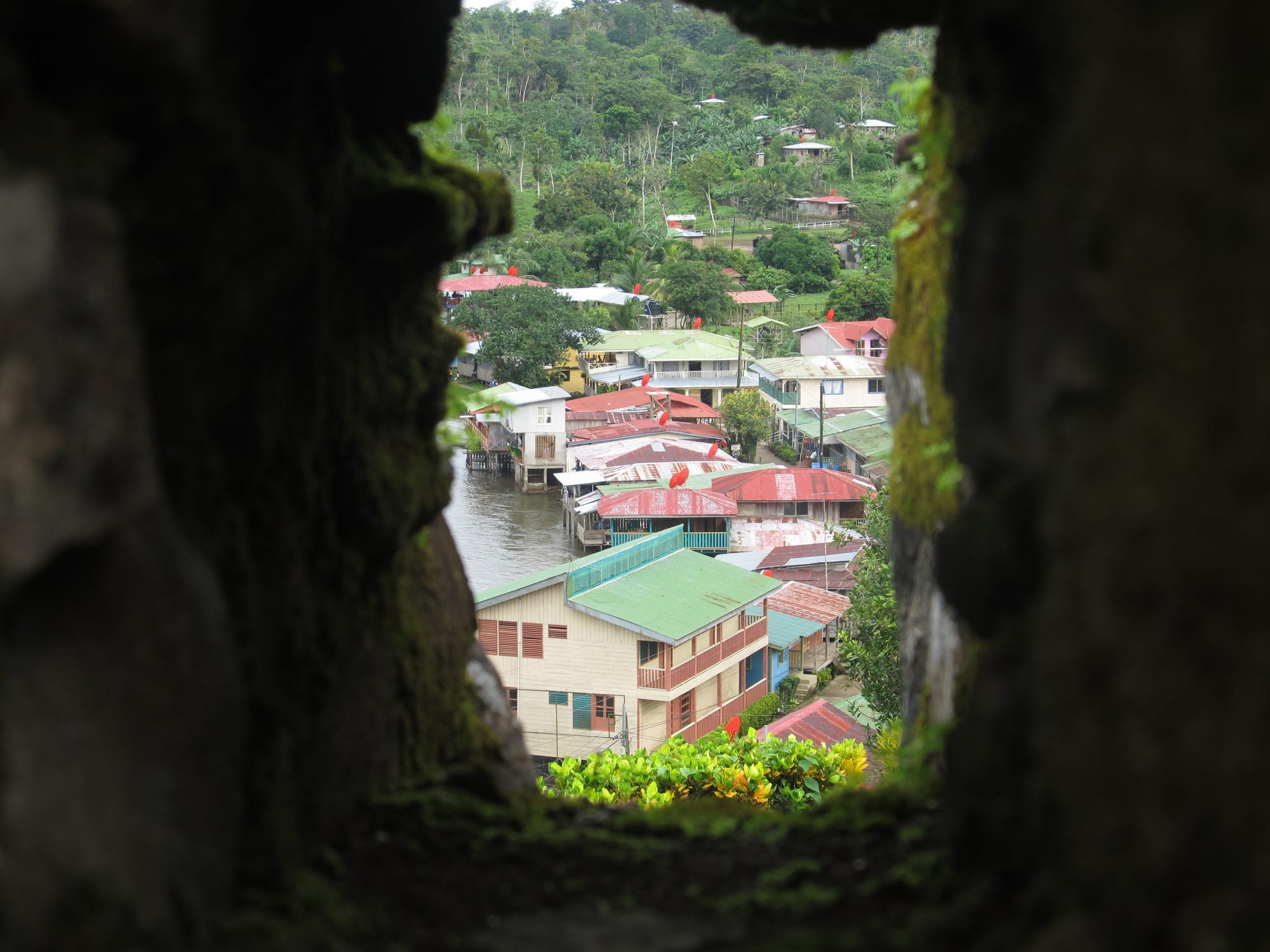
Wooden riverside houses with red and green tin roofs seen through a mossy opening in a stone wall

The Caribbean Coast, Nicaragua

El Castillo

The village of El Castillo seen from the fortress. (Stoschmidt / Wikimedia Commons · CC BY 3.0)

A car-free village on the south bank of the Río San Juan, about 6 km from the border with Costa Rica, built around a Spanish fortress of the 1670s at the Raudal del Diablo rapids. It grew up guarding the river route to Granada; today it is a quiet riverside stop and the gateway to the Indio Maíz Biological Reserve.

Neighbourhoods

  • The riverfront
    • First-time visitors
    • River views
    • No cars

    The village strung along the south bank of the river, where boats tie up and wooden houses line the water opposite the rapids. There are no cars; a single main path runs along the river, with small places to stay and eat beside it.

    Open in Maps
  • The fortress hill
    • History
    • Viewpoints

    The slope above the village, climbed by following the signs uphill from the main path, crowned by the 17th-century fortress. Behind it rises the hill still called Lomas de Nelson, from which British forces attacked in 1780.

    Open in Maps
  • Boca de Sábalos
    • Local life
    • Riverside lodges

    The largest village on this stretch of the river and the seat of the municipality, several kilometres upriver, named after the tarpon common in its waters. Some riverside lodges lie along the river nearby, with their own piers.

    Open in Maps

Things to do

Famous landmarks

  • Fortress of the Immaculate Conceptionlandmark

    The Spanish fortress completed in 1675 to block pirates from sailing up the river to Granada, now holding a museum and a library, with views over the rapids; it is on Nicaragua's tentative list for UNESCO World Heritage status.

    Open in Maps
  • Lomas de Nelsonviewpoint

    The hill behind the fortress, named after the young Horatio Nelson, who led British troops through the jungle to attack the fort from here in 1780.

    Open in Maps

The river

  • Raudal del Diablo and the San Juan rapidsattraction

    The rapids that made the site worth defending: Raudal del Castillo lies opposite the fortress, with Raudal del Diablo and Raudal del Toro, across from Boca de Sábalos, along the same stretch.

    Open in Maps
  • Kayaking on the Río San Juanattraction

    Kayaks can be hired in the village for paddles or guided trips on the river, which belongs entirely to Nicaragua though Costa Rica lines its southern bank a few kilometres downstream.

    Open in Maps

Short trips from the village

  • Indio Maíz Biological Reservepark

    One of the largest protected lowland rainforests in Central America, mostly closed to visitors; guided boat tours start at the Bartola River near El Castillo, with monkeys, poison dart frogs and abundant birdlife. Forest fires burned part of it in 2018.

    Open in Maps
  • San Carlosattraction

    The departmental capital where the river leaves Lake Nicaragua, starting point of the boats downriver and the place to stock up on supplies.

    Open in Maps

Eat and drink

Long-standing places and food districts in El Castillo. Hours, ratings and directions come from your maps app, always current.

El Castillo classics

  • River shrimprestaurant

    Camarones de río, the freshwater prawns of the San Juan, are the village speciality, cheap and popular, though fishing for them is closed for part of the year, usually from February to April.

    Open in Maps
  • Riverside eating placesneighborhood

    Small family restaurants along the main path by the river, serving river fish, rice and beans and fresh fruit drinks.

    Open in Maps

Experience El Castillo

History

The rapids of the Río San Juan were an obstacle from the first Spanish attempts to navigate the river in the 16th century, and they made this site the key to the route from the Caribbean to Lake Nicaragua and Granada. After pirate raids on Granada, Spanish authorities chose the Raudal de Santa Cruz, now the Raudal del Diablo, on the ruins of an earlier fort, and on 10 March 1673 began the Fortaleza de la Limpia Pura e Inmaculada Concepción. It was completed in 1675, and the village grew around it. Even so, the buccaneer William Dampier plundered and burned the settlement in 1685.

In the 18th century the fortress faced repeated attacks by Miskito and British forces. On 26 July 1762 a British and Miskito expedition from Jamaica laid siege to it, eleven days after the garrison commander had died. His 19-year-old daughter, Rafaela Herrera, became the hero of the six-day defence, which ended with the attackers withdrawing on 3 August; King Charles III later granted her a life pension. In 1780, during the San Juan Expedition, a British force including the 22-year-old Captain Horatio Nelson took the fortress by attacking from the hill behind it, still called Lomas de Nelson. Disease ravaged the British, who abandoned the fort in January 1781.

The fortress kept its strategic value until the late 18th century. In the 20th century the area produced bananas for export through Costa Rica, until disease ended the trade, and in 1995 the fortress was placed on Nicaragua's tentative list for World Heritage status.

Culture & Customs

The village's identity is bound up with its fortress. Rafaela Herrera is honoured as the local heroine, and the story of the defence of 1762 is part of the village's pride; the fortress itself now houses a museum and a library, where visitors can read with the sound of the river below. At the fortress the long contest between Spain and Britain over the river route can still be seen on the ground.

Life here is shaped by the river rather than by the Caribbean culture of the coast: El Castillo is a Spanish-speaking village in the department of Río San Juan, and the river is its street, its place of work and its link to the world, travelled by the boats that come and go from San Carlos.

The rainforest is the other half of local identity. The Indio Maíz Biological Reserve begins just downriver, and guiding visitors into it has become one of the village's livelihoods, alongside sport fishing for tarpon on this stretch of the river.

Daily Life

The village is part of the municipality of El Castillo, a large, remote area of rainforest, farms and river communities whose seat is Boca de Sábalos, upriver. The municipality has about 43,000 people, only around a fifth of whom live in urban areas; the village of El Castillo is a small part of that.

The area has long lived from the forest — logging of tropical hardwoods and the gathering of medicinal plants and other forest products — and from farming. Bananas were a major export from 1948 to 1951 and again from 1968 to 1970, shipped to Puerto Limón in Costa Rica, until the black sigatoka disease ended the trade. Today maize, beans, cacao, oranges and oil palm are grown, and ecotourism and sport fishing are growing.

Distance is the great problem. There are few roads, so getting to school, to a clinic or to market often means a boat, and many children of school age do not attend because of the distances involved. In the village itself life is quiet and car-free.

Food

Freshwater prawns, camarones de río, are what El Castillo is known for: cheap and popular, though fishing for them is closed for part of the year to protect the stock, usually from February to April. The municipality has only a handful of restaurants, and the river's catch goes straight to their tables. Fish from the San Juan, including the tarpon that gives Boca de Sábalos its name, are caught on this stretch of the river.

Beyond the river's produce, the cooking is that of rural Nicaragua: gallo pinto, rice and beans fried together, at almost every meal, with fried plantain, eggs, cheese and tortillas, and the Sunday nacatamal, a banana-leaf parcel of maize dough and pork. Bakeries and small shops across the municipality supply bread and basics.

Fresh fruit drinks are the thing to order; one of the village's cafés is proud of juices made without added water or sugar. Nicaraguan beer and rum are the evening drinks along the river.

Planning tools

Budget

El Castillo is one of the cheapest places on the Caribbean side of Nicaragua: simple rooms and meals cost little. The extra costs are the boat from San Carlos, guided trips into the reserve and kayak hire, and riverside lodges with all meals included cost more.

Daily Budget Midrange
USD 60–120 (riverside lodge with meals, a guided reserve trip, kayak hire)
Daily Budget Shoestring
USD 25–40 (simple guesthouse, local meals, the public boat)

As of 2012 the village had no cash machine; bring enough córdobas and small dollar notes before heading downriver.

Best Time to Visit

The village is wet all year, with heavy rainfall in most months; the drier stretch from about February to April brings the best conditions on the river, though river shrimp are usually off the menu then. Rain can fall at any time, so travel with waterproofs.

Suggested Number of Days

One or two nights is enough for the village itself. A guided trip into the rainforest reserve or a stay at a river lodge adds a day or two, and continuing downriver to the Caribbean takes much longer.

First Visit
1–2 days
With Surroundings
3–4 days

Transportation

The village has no cars and is easily walked. Everything else moves by boat: public boats run up and down the river between San Carlos and the villages, private lodges have their own piers, and boatmen will drop passengers at a lodge's landing if asked.

Wear a life jacket and keep luggage in waterproof bags; tell the boat captain in advance where to stop.

Airport & Station Connections

Public boats run downriver several times a day from San Carlos, at the south-eastern corner of Lake Nicaragua, which is reached by road or by lake ferry from Granada. The infrequent boat between San Carlos and San Juan de Nicaragua on the Caribbean also passes El Castillo and stops on request.

Walkability

El Castillo is entirely walkable: one main path runs along the river, and the fortress is a short, steep climb above it. There are no cars, and bicycles are rarely used. Paths turn muddy in the frequent rain.

Safety

Nicaragua has historically had lower violent crime than its northern neighbours, but the political situation is now the dominant concern, and it affects the Río San Juan as it does the rest of the country. The village itself is quiet; the practical risks are on the water, where overloaded boats and strong currents near the rapids are real dangers.

Travel with established boat operators, enter the reserve only with a licensed guide, and do not swim near the rapids. Check current official travel advice before travelling.

Climate

A tropical rainforest climate, wet throughout the year. The average temperature is about 25°C, and annual rainfall reaches 2,800–4,000 mm.

Summer
hot, humid and very wet, around the yearly average of about 25°C
Winter
still about 25°C on average and wet, a little drier from about February to April

Local Customs

El Castillo is a small, Spanish-speaking river village where life is calm and unhurried. The fortress and the story of Rafaela Herrera, the hero of its defence in 1762, are a source of local pride.

Dress modestly away from the river, ask before photographing people, and buy river shrimp only in season.

Common Payment Methods

The currency is the Nicaraguan córdoba; US dollars are often accepted for lodges and tours. As of 2012 the village had no cash machine, so cash for the whole stay should be brought in, and small notes are the most useful.