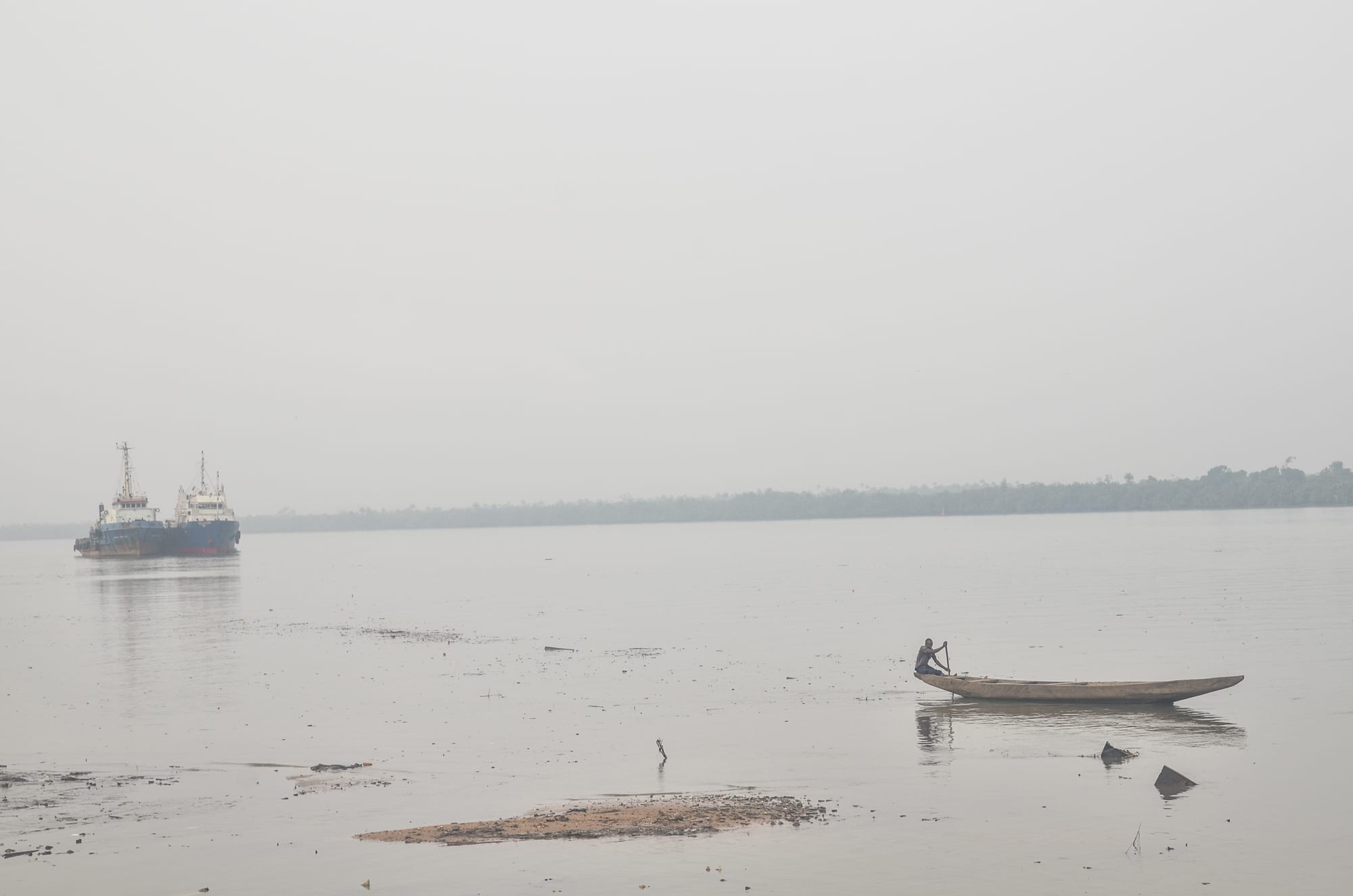
A wooden canoe with a single paddler on the wide grey Calabar River, a supply ship at anchor beyond and a low green shore in the haze

Calabar & the Niger Delta, Nigeria

Calabar

A canoe and an anchored ship on the Calabar River below the city's marina. (Teemages / Wikimedia Commons · CC BY-SA 4.0)

The capital of Cross River State, on a ridge above the Calabar River in Nigeria's south-eastern corner. Grown from the Efik trading towns that dealt first in enslaved people and then in palm oil, it became an early seat of British rule and is now known as one of the country's tidiest and calmest cities, and for the carnival that fills its streets each December.

Neighbourhoods

  • Calabar Municipality and the State Housing area
    • First-time visitors
    • Hotels
    • Quiet and residential

    The upper, newer half of the city, with the government offices, the university, wide tree-lined roads and most of the hotels. It is the part that gives Calabar its reputation for order and street lighting, and it is where visitors usually stay.

    Open in Maps
  • Calabar South and Duke Town
    • Historic district
    • Local life

    The old Efik town on the slope down to the river, the heart of the historic port and the seat of the Obong of Calabar. Streets of close-packed houses, churches and old trading buildings lead down towards the waterfront.

    Open in Maps
  • The Marina and the waterfront
    • Waterfront
    • Museums

    The riverside strip below the old town, where the jetties, the slave-history exhibits and a leisure complex face the water. Boats work the river, and the ground rises steeply back to the town above.

    Open in Maps
  • Big Qua Town
    • Local life
    • Traditional culture

    The centre of the Qua (Ejagham) community, one of Calabar's founding peoples alongside the Efik and Efut, with its own palace and annual festival and a more village-like feel inside the city.

    Open in Maps
  • Ikot Ansa and Ekorinim
    • Best for food
    • Residential

    Busy residential districts on the northern side of the city, with markets, small restaurants, bars and the everyday trade that serves the newer housing estates spreading outwards.

    Open in Maps

Things to do

Museums and history

  • Old Residency Museummuseum

    The national museum in the old colonial Residency, a house prefabricated in Britain and erected in 1884, covering Efik history, the slave and palm-oil trades and early colonial government.

    Open in Maps
  • Slave History Museummuseum

    A museum opened in 2011 on the Marina waterfront, in a former holding cell for captives, tracing the Atlantic slave trade through the Calabar ports, with exhibits on capture, the crossing and abolition.

    Open in Maps
  • Margaret Ekpo International Airporttransit hub

    The city's airport, inaugurated in 1983 and named after Margaret Ekpo, the Calabar-based politician and women's rights campaigner, a few kilometres from the centre.

    Open in Maps

Parks, animals and the river

  • Calabar Riverattraction

    The river below the old town, still working water for canoes, fishing boats and the port, with the Drill Ranch primate rescue centre and the marina along its banks.

    Open in Maps
  • Marina Resortattraction

    A riverside leisure complex below the old town, opened in 2007, with gardens, a waterfront, a cinema and the slave-history museum on the same site.

    Open in Maps
  • Ugepattraction

    A large Yakurr town in the Cross River interior, known for the Leboku new yam festival and its Yakö traditions.

    Open in Maps
  • University of Calabarattraction

    The federal university, a campus of the University of Nigeria until 1975, occupying a large green site on the western side of the city.

    Open in Maps

Markets and streets

  • Watt Marketmarket

    The main market of Calabar, established in 1901 and the largest in the state, a dense block of stalls selling food, cloth, periwinkles and household goods.

    Open in Maps

Short trips from the city

  • Creek Townattraction

    An older Efik town upriver, the town of King Eyo Honesty II and the Eyo ruling house in the 19th century, with mission-era churches and graves among quiet waterside streets.

    Open in Maps
  • Kwa Fallsattraction

    A waterfall in forested country on the Great Kwa River, which drains the eastern side of Calabar.

    Open in Maps
  • Tinapaattraction

    A business and leisure resort beside the Calabar River north of the city, opened in 2007 alongside a free trade zone; much of it has stood idle since, and parts were repaired in 2020.

    Open in Maps
  • Cross River National Parkpark

    Rainforest protected in two divisions, home to chimpanzees, drills and, in the Okwangwo division, the rare Cross River gorilla; the Oban division, gazetted in 1988, is the nearer half to the city.

    Open in Maps

Seasonal events

  • Calabar CarnivalDecember

    Costumed bands parade along a set route through the city over several days at the end of December, the best-known street carnival in Nigeria.

  • Calabar Christmas seasonDecember

    Weeks of concerts, street decorations, food fairs and events around the carnival, when hotels fill with visitors from across Nigeria and the diaspora.

  • Ekpe masquerade appearancesdry season and at festivals

    Masqueraders of the Ekpe leopard society, an initiatory men's society of the Cross River peoples with old law-enforcing and political roles, appear at the city's traditional celebrations.

  • Leboku new yam festivalmid-August to mid-September

    The three-week new yam festival of the Yakö (Yakurr) people at Ugep, in the centre of Cross River State, drawing people from Calabar for its days of ceremony.

Eat and drink

Long-standing places and food districts in Calabar. Hours, ratings and directions come from your maps app, always current.

Calabar classics

  • Afang and edikang ikong kitchensneighborhood

    Calabar's reputation in Nigerian cooking rests on these two soups, sold in small local restaurants across the city with pounded yam, garri or fufu.

    Open in Maps
  • Waterfront fish and periwinkle stallsmarket

    Fresh fish, prawns and periwinkles come up from the river and the creeks and are grilled or cooked into pepper soup near the waterfront.

    Open in Maps

Markets and food streets

  • Watt Marketmarket

    The city's central market, the place to see the vegetables, smoked fish and palm oil that the local soups are built on.

    Open in Maps
  • Marian Road eating placesneighborhood

    One of the main commercial roads of the upper city, lined with restaurants, grills, bakeries and bars.

    Open in Maps
  • Suya and pepper soup spotsneighborhood

    Evening grills set up along the main roads, selling spiced beef skewers, grilled fish and bowls of pepper soup.

    Open in Maps

Experience Calabar

History

Calabar began as a cluster of Efik settlements on the east bank of the Calabar River, founded by people who moved down from the Cross River and split into towns — Creek Town, Duke Town, Henshaw Town and others — each under its own ruling house. From the 17th century these towns grew rich as middlemen in the Atlantic slave trade, selling captives brought from the interior to European ships anchored in the river; the Bight of Biafra was one of the busiest stretches of the whole trade. Efik chiefs kept elaborate correspondence in English, and the diary of Antera Duke, written in the 1780s, survives as a rare African account of the period.

When the slave trade was suppressed, palm oil replaced it, and the delta earned its old name, the Oil Rivers. Scottish Presbyterians opened a mission in 1846, schools followed, and Mary Slessor arrived in 1876 and worked in the Cross River interior until her death in 1915. Britain made Calabar the administrative centre of the Oil Rivers and later the Niger Coast Protectorate, and the town was the seat of government for the Southern Nigeria protectorate before that role passed to Lagos in 1906.

The 20th century moved trade away: the railway went elsewhere, Port Harcourt took the shipping, and Calabar became a provincial capital. It was fought over during the civil war and taken by federal forces in 1967. It has been the state capital throughout, of Cross River State since the 1976 renaming, and from the late 1990s state governments have promoted it as a tourist city, laying out new roads, backing the carnival from 2004 and building the Tinapa complex north of town.

Culture & Customs

Calabar is an Efik city with Qua (Ejagham) and Efut communities alongside, and each keeps its own palace, festivals and history. The Obong of Calabar is the paramount Efik ruler, and the Ekpe or leopard society, an old institution that once enforced law and debt between trading houses, still initiates members and sends masqueraders through the streets on ceremonial days; the nsibidi symbols used by Ekpe and the related Mgbe society are an indigenous script of the old Cross River region.

The city is strongly Christian and mission-shaped. Presbyterian churches, schools named for missionaries and the graves in Duke Town record a long Scottish connection, and choral singing is taken seriously. Efik ceremonial dress — women in wrappers and beads, men in long shirts with hats and canes — appears at weddings and chieftaincy events, and the fattening room, a period of seclusion and instruction before marriage, survives as a much-reduced custom.

Since 2004 the carnival has become the city's defining event, with bands rehearsing for months and thousands of costumed dancers parading in late December before crowds that fill the streets. The whole of December is treated as a festival season. Calabar is also known within Nigeria for its relative order and cleanliness, a point of local pride, and for a slower, more ceremonious manner than Lagos or Port Harcourt.

Daily Life

Calabar's two local government areas held 371,022 people at the 2006 census and an estimated 571,500 in 2022, the built-up area spreading north along the roads towards Tinapa and Odukpani. It is a government and university city: the state administration, the University of Calabar, a teaching hospital, the seaport and a free trade zone are the main employers, alongside trade, transport and a hotel sector that exists largely for December.

Households live between the two halves of the city — the older, denser Calabar South running down to the river, and the newer estates on the plateau. Electricity is unreliable, generators are common, and water comes from boreholes in many compounds. Fishing families work the Calabar and Great Kwa rivers, and food arrives from the farms of the interior along roads that flood in the wet season.

The day begins early with markets and school runs, thins through the hot afternoon and picks up again in the evening around the grills and bars on the main roads. Unemployment among young people is high and many leave for Lagos, Abuja or abroad. The loss of the Bakassi peninsula to Cameroon, completed in 2008, cost the state territory and coastline and is still felt in the city, where many displaced families settled.

Food

Calabar is regarded across Nigeria as a centre of good cooking, and its two famous soups travel everywhere. Afang soup combines shredded wild afang leaves with soft waterleaf, palm oil, meat, dried fish and periwinkles; edikang ikong is made with fluted-pumpkin leaves and waterleaf in a rich, meaty base. Both are eaten with a swallow — pounded yam, garri, or fufu — taken by hand.

Beyond the soups, ekpang nkukwo is a laborious dish of grated cocoyam wrapped in cocoyam leaves and simmered in a spicy palm-oil broth, and edita ikpan and other Efik preparations appear at ceremonies. The rivers supply the kitchen: fish and prawn pepper soup, periwinkles picked from their shells with a pin, and crayfish ground into almost everything. Roasted plantain with pepper sauce, and yam porridge cooked with palm oil and vegetables, are everyday food.

Street eating follows the Nigerian pattern — akara bean fritters and pap in the morning, moin moin steamed bean pudding, suya skewers from evening grills — and Calabar's bakeries turn out bread that Nigerians buy to take home. Palm wine is tapped in the villages nearby and ogogoro, distilled from palm sap, is the traditional spirit; beer, malt drinks, zobo and chapman fill the bars.

Planning tools

Budget

Calabar is one of the better-value cities in southern Nigeria, cheaper than Port Harcourt or Abuja and with a wide range of hotels. Prices rise sharply through December, when the carnival and Christmas festival fill the city. Local food is inexpensive; the main extra costs are a car with a driver and any trip into Cross River's interior.

Daily Budget Midrange
USD 110–260 (comfortable hotel, restaurants, a car with driver)
Daily Budget Shoestring
USD 35–60 (simple hotel, local restaurants, shared taxis)

Book rooms months ahead for December, and arrange trips to the national park or the hills through an established local operator.

Best Time to Visit

November to February is the driest stretch and the liveliest: the Christmas festival runs through December and the carnival closes the year. The rains from about March to October are heavy and long, when forest tracks turn to mud, though the countryside is at its greenest.

Suggested Number of Days

The city's museums, old town and waterfront fit comfortably into two days. Four to six allow for the rivers, waterfalls and forests of Cross River State, where roads are slow. A visit in the carnival season needs extra time for crowds and traffic.

First Visit
2 days
With Surroundings
4–6 days

Transportation

Shared taxis and keke napep tricycles cover the city cheaply, and the layout — a long ridge between the Calabar and Great Kwa rivers — makes routes easy to follow. Hotels arrange cars with drivers for trips outside town. Boats run from the waterfront to Creek Town and the riverine settlements. Traffic is lighter than in other Nigerian cities except in the carnival weeks.

Agree taxi fares before setting off, keep road journeys into the interior to daylight hours, and arrange any boat trip through a reliable local contact.

Airport & Station Connections

Margaret Ekpo International Airport lies a few kilometres from the centre and has flights to Lagos and Abuja, which is how most visitors arrive. Buses run from Lagos, Abuja, Port Harcourt and Enugu to the motor parks in the city; Port Harcourt is several hours by road and Uyo considerably closer. The Cameroon border lies to the east.

Walkability

Calabar is more walkable than most Nigerian cities: the upper town has pavements, street lights and manageable traffic, and the old town and the waterfront can be explored on foot, although the slope down to the river is steep and the climb back hard in the heat. Longer distances between districts are covered by tricycle.

Safety

Calabar is generally regarded as one of the calmer cities in southern Nigeria, and the state capital area is policed heavily, particularly during the carnival. The wider region is uneven: governments advise against travel to the riverine parts of the Niger Delta, where kidnapping, armed militancy, oil-theft gangs and piracy occur. Petty theft, road accidents and malaria are the everyday risks, and crowds at carnival time invite pickpocketing.

Avoid the creeks and riverine areas unless on essential business with security arrangements, keep to daylight road travel and stay alert in Port Harcourt. Check current official travel advice before travelling.

Climate

One of the wettest places in Nigeria. Rain falls over a long season from about March to October, heaviest around July and September, and humidity stays high all year. The dry season from November to February is warm with light harmattan haze, and temperatures vary little from month to month.

Summer
very wet and humid, about 23–30°C, with long downpours
Winter
drier and warm, about 23–33°C, with some harmattan haze

Local Customs

Calabar is mainly Christian, with Presbyterian roots going back to the Scottish mission and a strong Catholic and Pentecostal presence, and Sundays are quiet until church lets out. The Obong of Calabar and the Efik ruling houses are treated with formality, and the Ekpe society remains an institution of the old town. English and Efik are both used, with Pidgin as the common language of the street.

Tipping is not expected but small amounts are welcome; dress modestly for churches and palace visits; ask before photographing people, masquerades, police or government buildings.

Common Payment Methods

The currency is the naira. Hotels and larger restaurants in the upper city take cards, but markets, taxis and small eateries are cash only. ATMs are common along the main roads, though foreign cards are unreliable and withdrawal limits low, so visitors usually bring US dollars to change at a bank or a licensed dealer.