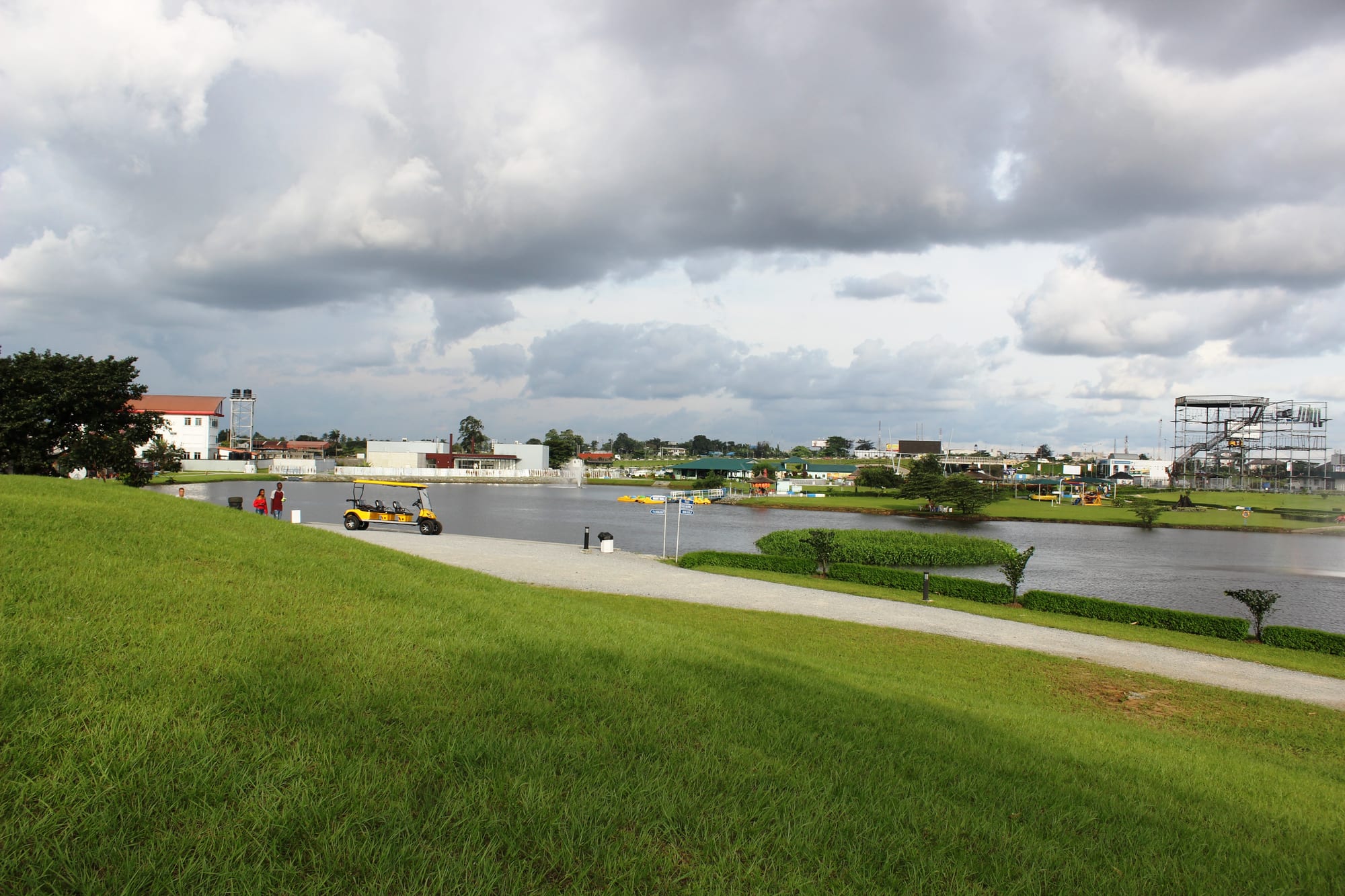
A mown grass slope and paved path beside an artificial lake in a city park, with low buildings and a cloudy sky beyond the water

Calabar & the Niger Delta, Nigeria

Port Harcourt

The artificial lake at the Port Harcourt Pleasure Park in the centre of the city. (Degini2 / Wikimedia Commons · CC BY-SA 4.0)

The capital of Rivers State and the largest city of the Niger Delta, built by the British from 1912 and named in 1913, on a creek off the Bonny River, to ship coal and palm produce. Oil made it Nigeria's energy capital, and behind its planned garden-city centre lie sprawling markets, industrial estates and a working port at the edge of the creeks.

Neighbourhoods

  • Old GRA
    • First-time visitors
    • Quiet and residential
    • Hotels

    The original government reservation laid out beside the centre, with wide shaded avenues, large compounds, embassies' liaison offices, restaurants and most of the city's better hotels. It is the greenest and calmest part of Port Harcourt and the reason for the garden-city name.

    Open in Maps
  • Town and the waterfront
    • Historic district
    • Local life

    The old colonial grid beside the port and the railway, running down to Borikiri and the creek-side settlements. Markets, churches, warehouses and the oldest streets in the city are here, densely built and busy all day.

    Open in Maps
  • Diobu and the Mile markets
    • Markets
    • Best for food
    • Local life

    The crowded district north-west of the centre, named for the mile posts along the Ikwerre Road, with Mile 1 and Mile 3 markets, street trading and cheap eating places. It is the everyday heart of the city.

    Open in Maps
  • Trans-Amadi
    • Business
    • Industry

    The industrial layout east of the centre, where the oil-service companies, workshops, yards and depots are concentrated, with offices, guesthouses and restaurants serving the industry among them.

    Open in Maps
  • New GRA and Rumuomasi
    • Quiet and residential
    • Modern developments

    Newer planned housing east of the old centre, with estates, schools and shopping developments, popular with professional families working in the oil business.

    Open in Maps
  • Rumuokoro and the Aba Road corridor
    • Close to transport
    • Nightlife

    The long northern axis out towards the airport, lined with malls, hotels, churches, bars and motor parks. Traffic is heavy, but it is the way in and out of the city and where much of the evening trade has moved.

    Open in Maps

Things to do

Parks and green space

  • Port Harcourt Pleasure Parkpark

    A landscaped park around an artificial lake on Aba Road, opened by the state government in 2017, with lawns, paths, a cinema and events.

    Open in Maps
  • Isaac Boro Parkpark

    The public park in Old GRA named after Isaac Boro, a pioneer of minority-rights activism, used for parades and state ceremonies and home to the city's baseball and softball.

    Open in Maps
  • Port Harcourt Tourist Beachbeach

    A white-sand urban beach created in 1988 on Kolabi Creek, east of the old township, on creek water rather than open sea.

    Open in Maps

City landmarks

  • Yakubu Gowon Stadiumattraction

    The city's main stadium in Elekahia, renamed in 2015 from Liberation Stadium, holding 16,000 and home to Rivers United.

    Open in Maps
  • University of Port Harcourtattraction

    The federal university north of the city at Choba, a large campus that brings students and research into the delta's oil and environmental questions.

    Open in Maps
  • Rivers State Universityattraction

    The state university in the Diobu area, formerly the Rivers State University of Science and Technology and long an engineering school serving the oil industry.

    Open in Maps
  • Port Harcourt International Airporttransit hub

    The city's airport at Omagwa, about 23 kilometres north of the centre, with domestic flights and, from a separate terminal, some international services.

    Open in Maps

Short trips from the city

  • Bonny Islandattraction

    An old delta trading state and the site of Nigeria's liquefied natural gas plant, with long beaches along its west and south sides that draw crowds for carnivals at the end of December.

    Open in Maps
  • Okrikaattraction

    An Ijaw fishing and trading town on an island in the creeks, linked by pipeline to the Port Harcourt refinery on the mainland, and organised in the old war-canoe houses of the delta.

    Open in Maps
  • Ogonilandattraction

    The districts east of Port Harcourt whose people campaigned against oil pollution in the 1990s; a United Nations assessment in 2011 led to the clean-up programme set up in 2012.

    Open in Maps
  • Oloibiriattraction

    The village in Bayelsa State where oil was found in commercial quantities in 1956, marking the start of Nigeria's oil industry.

    Open in Maps

Seasonal events

  • Carnival and Christmas seasonDecember

    The city fills with returning families, church conventions, concerts and street parties through December, and hotels and roads are at their busiest.

  • Canoe regattas in the creeksdry season, December to February

    Decorated war canoes and paddling crews from the delta communities race and parade at town festivals around Port Harcourt.

  • Bole FestivalAugust

    A food festival first held in 2016, built around roasted plantain with fish and pepper sauce, with hundreds of vendor stalls at the Yakubu Gowon Stadium.

Eat and drink

Long-standing places and food districts in Port Harcourt. Hours, ratings and directions come from your maps app, always current.

Port Harcourt classics

  • Bole standsneighborhood

    Roasted plantain served with grilled fish, palm oil and a fiery pepper sauce, cooked over drums of charcoal at roadsides across the city and the dish most associated with Port Harcourt.

    Open in Maps
  • Fish pepper soup placesneighborhood

    Catfish, prawns and periwinkles from the creeks go into peppery broths served in small bars in the evening, often with a side of yam.

    Open in Maps

Markets and food streets

  • Mile 1 and Mile 3 marketsmarket

    The city's main food markets in Diobu, where the creek fish, crayfish, palm oil and vegetables of delta cooking are sold.

    Open in Maps
  • Old GRA restaurantsneighborhood

    The quiet avenues of the reservation hold the widest choice of sit-down restaurants, from Nigerian kitchens to Lebanese and Chinese places serving the oil industry.

    Open in Maps
  • Aba Road and Rumuokoro eateriesneighborhood

    Grills, fast-food counters and bars strung along the northern corridor, busiest after work and at weekends.

    Open in Maps

Experience Port Harcourt

History

Port Harcourt is a 20th-century creation. In 1912 the British colonial administration built a port on a creek of the Bonny River as the ocean terminal for a railway to the coalfields at Enugu; in August 1913 the governor, Frederick Lugard, named it after Lewis Harcourt, then Secretary of State for the Colonies. The port grew as an outlet for coal, palm oil and palm kernels from the eastern provinces. The land was taken from Ikwerre and Diobu communities, a grievance that has never entirely faded.

The town was laid out on a grid beside the port, with a government reservation of wide, tree-lined roads that gave Port Harcourt its nickname, the Garden City. Migrants arrived from across eastern Nigeria to work the railway, the wharves and the trading firms. After oil was struck at Oloibiri in 1956, the first Nigerian shipload was exported through the city in 1958 and it became the industry's base: refineries, a petrochemical works, service companies and expatriate housing followed, and it expanded far beyond its planned core.

Port Harcourt was held by Biafra at the start of the civil war and taken by federal forces in 1968, and the conflict changed its population. In the decades after, oil wealth and its unequal distribution shaped everything. Protest over pollution and neglect in Ogoniland, a short drive east, led to the execution of the writer Ken Saro-Wiwa and eight others in 1995 — a case that drew worldwide condemnation — and militancy in the creeks in the 2000s brought attacks on pipelines and kidnappings until a federal amnesty in 2009. The city today is Nigeria's energy capital, prosperous in parts and hard-pressed in others.

Culture & Customs

Port Harcourt is a migrant city, and its culture is a delta and eastern Nigerian mixture rather than one people's. The Ikwerre are the indigenous community of the city's land; Ijaw, Ogoni, Ekpeye and Etche people come from the surrounding state; and Igbo, Efik, Urhobo, Yoruba and northern communities have been part of it for generations. Pidgin is the common tongue, and the Port Harcourt way of speaking it is recognised across the country.

Water runs through the traditions of the wider region: war canoes and regattas, masquerades that come from the rivers, and fishing festivals in the creek towns. In the city itself, church is the great weekly event, with large Pentecostal congregations and Anglican and Catholic parishes, and the gospel and highlife music scenes are strong. Port Harcourt has produced a notable share of Nigeria's hip-hop and Afrobeats performers, and the city's bars, lounges and beer parlours are central to its social life.

The oil industry gives the city its rhythm and its divisions: expatriate compounds and company estates on one side, unemployment and street hustle on the other, with a widely shared sense that the delta's wealth leaves it. Environmental activism, journalism and student politics are unusually prominent, and in 2014 the city held the title of UNESCO World Book Capital, the first in sub-Saharan Africa, on the strength of a local publishing and literary tradition.

Daily Life

Port Harcourt's urban population was put at about 3.8 million in 2025, spread across the city local government area, Obio-Akpor and the towns along the main roads. Growth has been outwards along the Aba, Ikwerre and East–West roads, swallowing former villages into a continuous built-up area.

Oil and gas underpin everything: refining, servicing, engineering, logistics and the offices of Nigerian and international companies at Trans-Amadi and along the main roads. Around that sit the markets, transport, construction and a vast informal economy. Wages in the industry are high and housing costs follow, while many households in Diobu and the waterfront settlements live on very little. Electricity from the grid is unreliable and generators run day and night.

Days begin early to beat the traffic, with markets trading from dawn, and end late over bole and drinks at roadside stands. The rains dominate half the year, flooding roads and homes, and soot from illegal refining and industrial burning has left visible black deposits on surfaces since late 2016, a persistent public grievance. Security — kidnapping, robbery and cult-gang violence — shapes daily decisions about where and when to travel.

Food

Port Harcourt's own dish is bole: plantain roasted black over charcoal, split and served with grilled fish, palm oil and a hot pepper sauce, sold from drums at roadsides all over the city and now celebrated at street-food events. It is eaten standing up, late in the day, and is the thing visitors are told to try first.

The rest is delta cooking. Fish, prawns, crabs and periwinkles from the creeks go into pepper soup, a clear, hot broth flavoured with uziza and other spices; native soup, thick with periwinkles and seafood, is the celebration dish. Banga, made from boiled palm-fruit pulp, comes with starch, a smooth cassava swallow coloured by palm oil, and afang and edikang ikong soups arrive from the east with Efik and Ibibio cooks. Ikwerre kitchens make onunu, pounded yam and ripe plantain beaten together with palm oil and eaten with fresh fish soup.

Everyday street eating runs to akara and pap in the morning, moin moin, roasted corn in season, suya grills at dusk and fried yam with pepper. Palm wine is tapped in the villages nearby, ogogoro is the traditional spirit, and beer, malt drinks, zobo and chapman fill the bars and lounges.

Planning tools

Budget

Port Harcourt is one of Nigeria's more expensive cities because its hotels, restaurants and transport are built around the oil industry and its expatriate workforce. Local food and shared transport remain cheap, but secure cars with drivers, which most visitors use, add up quickly, and any boat trip into the creeks is costly to arrange.

Daily Budget Midrange
USD 110–260 (business hotel, restaurants, a car with driver)
Daily Budget Shoestring
USD 35–60 (simple hotel, local restaurants, shared taxis)

Budget for a driver rather than self-driving, and agree the cost of any creek trip with a reliable operator before setting out.

Best Time to Visit

November to February is the driest and easiest time, and December is the busiest social season of the year. The rains from about March to October are very heavy, with flooding on the main roads from June to September and slow, waterlogged journeys across the delta.

Suggested Number of Days

The city is a working port rather than a sightseeing one, and a day or two covers its parks, markets and old town. Three to five days make sense for anyone travelling on into the delta, where journeys are slow and arrangements take time.

First Visit
1–2 days
With Surroundings
3–5 days

Transportation

Shared taxis and minibuses work the main corridors, keke napep tricycles handle short distances, and motorcycle taxis are restricted in much of the city. Most visitors and workers use hired cars with drivers or ride-hailing apps. Traffic on Aba Road and around the markets is severe at peak times, and heavy rain floods junctions. Boats leave the waterfront for the creek settlements.

Allow extra time for traffic and flooding, avoid travelling by road after dark, and arrange boat journeys only through trusted local contacts.

Airport & Station Connections

Port Harcourt International Airport at Omagwa is about 23 kilometres north of the centre, with frequent flights to Lagos and Abuja and some regional services; a smaller air-force-run airport lies closer to town. Long-distance buses connect Lagos, Aba, Owerri, Uyo and Calabar, and the seaport handles cargo rather than passengers.

Walkability

Old GRA is pleasant to walk in, with shade, pavements and light traffic, and the old town grid near the waterfront is compact. Elsewhere the city is built for vehicles: long distances, heavy traffic, broken pavements and open drains make walking unattractive, and few people walk between districts, especially after dark.

Safety

Port Harcourt and the surrounding delta have a serious security record: kidnapping for ransom, including of foreign oil workers, armed robbery and cult-gang violence are all present, and governments advise against travel to the riverine parts of the Niger Delta, where militancy, oil theft and piracy occur. Foreign companies operating here use security protocols as a matter of routine. Flooding, traffic accidents and malaria are the everyday risks.

Avoid the creeks and riverine areas unless on essential business with security arrangements, keep to daylight road travel and stay alert in Port Harcourt. Check current official travel advice before travelling.

Climate

One of the wettest cities in Nigeria, hot and humid throughout the year, with a long rainy season from about March to October and a short drier spell from December to February. Rainfall is very high from June to September, and low-lying roads flood. Skies are often overcast even between downpours.

Summer
very wet and humid, about 23–30°C, with prolonged heavy rain
Winter
drier and warm, about 22–33°C, with some harmattan haze

Local Customs

The city is mixed — Ikwerre, Ijaw, Ogoni, Igbo and people from every part of Nigeria — and Pidgin is the common language, spoken here with a particular flair. Most residents are Christian and churches are central to weekends. Chieftaincy titles are respected, dress for church and ceremonies is formal, and the oil industry gives the city a business-like, transactional manner.

Ask permission before photographing people, and never photograph oil installations, ports, bridges, military checkpoints or government buildings; carry identification and expect checkpoints on the roads.

Common Payment Methods

The currency is the naira. Hotels, malls and larger restaurants take cards, and bank transfers are widely used, but markets, taxis and roadside food are cash only. ATMs are common along Aba Road and in Old GRA, though foreign cards are unreliable and limits are low; most visitors change US dollars at a bank or licensed dealer.