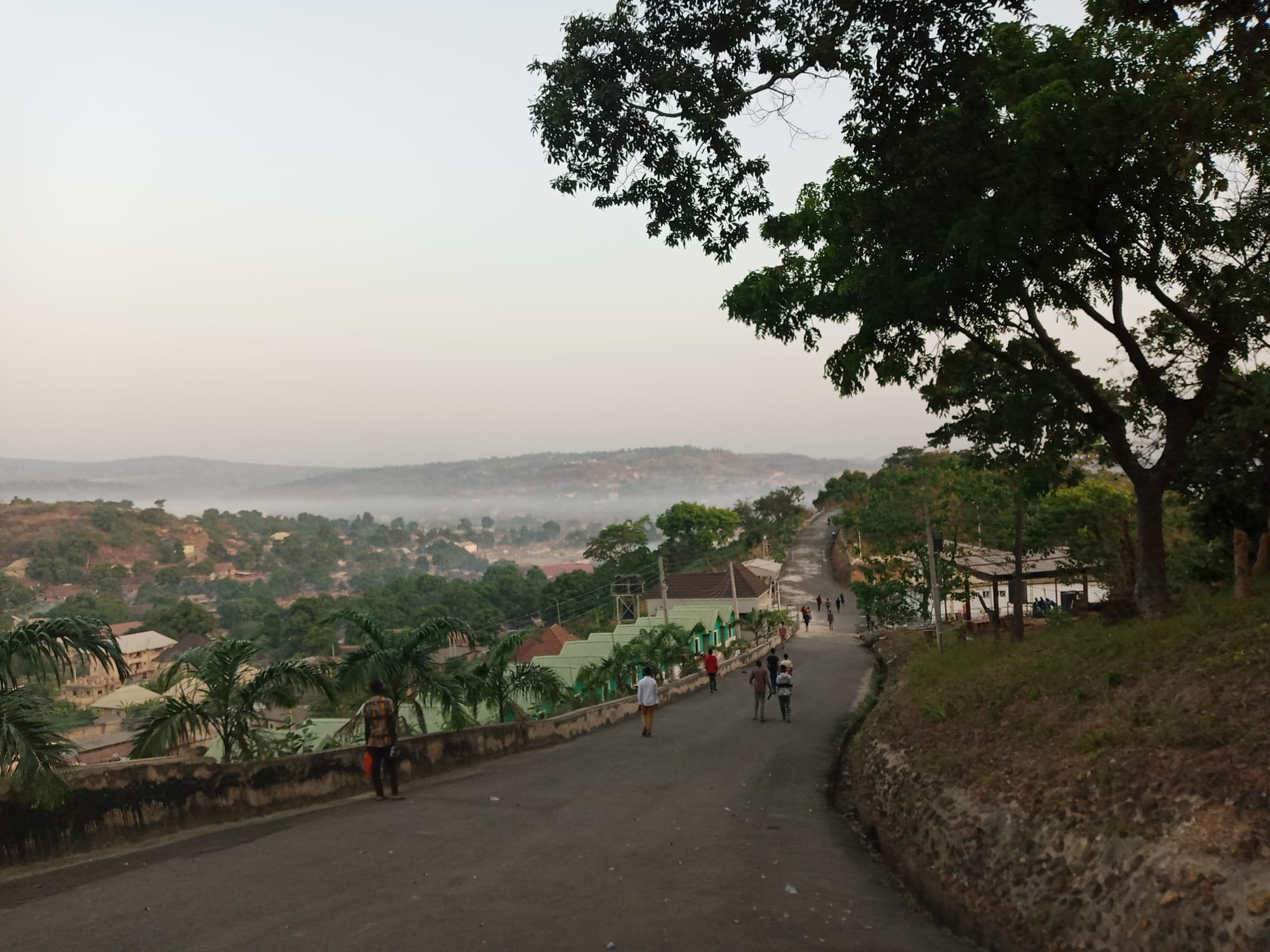
A road descending a green hillside above a hazy valley of scattered houses and palms, with low wooded hills stretching to the horizon

Enugu, Owerri & the Southeast, Nigeria

Enugu

A road on the escarpment above the Iva Valley on the edge of Enugu. (Chibyke1 / Wikimedia Commons · CC BY-SA 4.0)

The capital of Enugu State in Nigeria's Igbo southeast, built where the plain meets the Udi escarpment. Coal found here in 1909 created the city from nothing, and it became capital of the Eastern Region and, in 1967, of Biafra. Today it is an administrative and university city of hills, leafy old quarters and cooler air than the lowlands.

Neighbourhoods

  • Independence Layout
    • Quiet and residential
    • Government district

    A planned district of wide streets, large houses and government offices laid out after independence. The state secretariat and many hotels are here, and it is the calmest part of the city.

    Open in Maps
  • Ogui and the New Haven side
    • First-time visitors
    • Best for food
    • Nightlife

    The busy commercial middle of Enugu, with banks, shops, restaurants and bars along Ogui Road and through New Haven. Most of the city's evening life happens on these streets.

    Open in Maps
  • Coal Camp
    • Historic district
    • Local life

    The old workers' quarter built for the coal mines below the escarpment, now a dense area of workshops, mechanics and small markets. Its grid of low houses is the oldest part of the city.

    Open in Maps
  • GRA and Asata
    • Quiet and residential
    • Architecture

    The former colonial reservation and the streets beside it, shaded by old trees and lined with bungalows, clubs and schools — the greenest area and a short walk from the centre.

    Open in Maps
  • Ngwo and the escarpment
    • Views
    • Close to nature

    The hill villages above the city where the Milliken Hill road climbs the escarpment, with the pine plantation and cave nearby and wide views back over the rooftops.

    Open in Maps

Things to do

City landmarks

  • Michael Okpara Squarelandmark

    The city's main public square, named after the Eastern Region premier of the early 1960s and used for rallies, parades and state occasions.

    Open in Maps
  • Iva Valleylandmark

    The valley below the escarpment where the coal mines worked, and the site of the shooting of twenty-one striking miners by police in November 1949.

    Open in Maps
  • National Museum of Unitymuseum

    A branch of the national museums, on the northern side of the city, holding ethnographic and historical collections from across Nigeria.

    Open in Maps
  • Akanu Ibiam International Airporttransit hub

    The city's international airport, at Emene east of the centre, with flights to Lagos and Abuja and the gateway for most visitors to the southeast.

    Open in Maps

Hills, forest and water

  • Ngwo Pine Forestpark

    A plantation of tall pines on the escarpment above the city, with a path down to a cave and a small waterfall in the rock below.

    Open in Maps
  • Awhum Waterfallattraction

    A waterfall dropping over a rock face in the Udi hills north of the city, beside a monastery whose community treats the water as a place of pilgrimage.

    Open in Maps

Short trips from the city

  • Udiattraction

    The town on top of the escarpment west of Enugu, giving its name to the hills and to the coal seams that were worked below it.

    Open in Maps
  • Nsukkaattraction

    A hill town built around the University of Nigeria, the country's first indigenous university, with a long intellectual and literary tradition.

    Open in Maps
  • Ogbunike Cavesattraction

    A network of chambers, tunnels and streams in a forested valley, reached down a long flight of steps and treated as a sacred site.

    Open in Maps

Seasonal events

  • New yam festivalAugust and September

    The harvest festival held across Igbo communities, when the first yams are offered and eaten with masquerades, wrestling and feasting.

  • Mmanwu masqueradesdry season, November to January

    Masked figures representing ancestral spirits perform at village festivals and funerals through the dry months, sometimes gathered into a state festival in Enugu.

  • Christmas homecomingDecember

    The busiest weeks of the year, when families return from Lagos, Abuja and abroad for weddings, burials and village ceremonies and hotels fill.

Eat and drink

Long-standing places and food districts in Enugu. Hours, ratings and directions come from your maps app, always current.

Markets and food streets

  • Ogbete Main Marketmarket

    The city's central market, selling yams, palm oil, ugba, dried fish and vegetables, with cooked-food sellers along its edges.

    Open in Maps
  • Ogui Roadneighborhood

    The main run of restaurants, bakeries and bars in the city, serving rice and stew, swallow with soup and grilled fish into the evening.

    Open in Maps
  • New Havenneighborhood

    Lounges, bars and suya spots where nkwobi and isi ewu are the standard order with a bottle of beer or palm wine.

    Open in Maps

Local specialities

  • Okpa sellersmarket

    Steamed pudding of Bambara nut flour and palm oil, wrapped in leaves and sold from trays and buckets in the morning — the breakfast most associated with Enugu.

    Open in Maps
  • Abacha stallsmarket

    Shredded dried cassava dressed with palm oil, ugba oil-bean slices, fish and vegetables, served cold at roadside stalls and bars.

    Open in Maps

Experience Enugu

History

Enugu exists because of coal. In 1909 a British survey party looking for minerals found coal seams in the escarpment near the village of Enugwu-Ngwo, from whose name, the Igbo for "hill top", the new town took its own. Mining began a few years later, a railway was built to Port Harcourt to carry the coal to the coast, and a settlement grew around the pit heads at the foot of the hills — the quarter still called Coal Camp. It was one of the few Nigerian cities created by industry rather than by an older kingdom or market.

The mines shaped its politics as well. In November 1949 police shot twenty-one striking miners at the Iva Valley pit, an event that hardened nationalist feeling across the country. Enugu became the capital of the Eastern Region, and the seat of regional government under premiers Nnamdi Azikiwe and Michael Okpara, growing with offices, schools and a broadcasting service.

In May 1967 the Eastern Region seceded as Biafra with Enugu as its capital; federal forces took the city in October of that year, and the Biafran government moved on through Umuahia and Owerri until the war ended in January 1970. Rebuilding was slow, and the coal industry never recovered its importance. Enugu became capital of the smaller Enugu State on its creation in 1991, and has grown since on government, trade, education and services rather than on mining.

Culture & Customs

Enugu is an Igbo city, and Igbo is spoken everywhere alongside English and Pidgin. Social life follows the patterns of the wider southeast: kola nut broken for guests, titles that carry real prestige, the new yam festival after the harvest, and mmanwu masquerades that appear at festivals and funerals in the dry season, sometimes gathered into a festival in the city itself.

Christianity is the dominant faith, mainly Catholic and Anglican with a growing Pentecostal presence, and Sunday services fill the churches and the roads around them. Weddings run in stages, with the traditional ceremony and bride-price negotiations as important as the church service, and burials in ancestral villages are large events that draw families home from across the world.

As a former regional capital with a large civil service and several universities and colleges nearby, Enugu has a reputation for education and for administration rather than for trade, which belongs to Onitsha and Aba. Highlife music, played at weddings and in the lounges of New Haven and Ogui, is the city's soundtrack, and Nollywood has long used Enugu as a production base. December, when the diaspora returns, is when all of this is most visible.

Daily Life

The city's three local government areas had an estimated 876,000 people in 2024, and the built-up area has spread along the roads to Abakaliki, Onitsha and the airport. Almost everyone is Igbo, and the city draws students, civil servants and traders from across the southeast.

Government is the biggest employer — the state secretariat, the courts, hospitals and schools — alongside trade in Ogbete and the smaller markets, transport, building and a modest industrial estate at Emene. The coal mines are long past their working days, though the seams under the hills are still discussed as a possible source of power. Film production, hotels and hospitality add more.

The city is hilly and green by Nigerian standards, and its older quarters have a settled, unhurried feel, with mornings starting early at the markets and church compounds busy through the week. Power cuts are frequent and generators standard. Everyday life is affected by insecurity in the wider region, including sit-at-home orders on some Mondays that shut shops and transport, and by the cost of food and fuel since 2023.

Food

Enugu's own breakfast is okpa, a firm steamed pudding made from Bambara nut flour with palm oil and pepper, wrapped in leaves and sold warm from trays in the morning — so closely tied to the city that it is often called okpa Enugu. The other local favourite is abacha, sometimes called African salad: shredded dried cassava tossed with palm oil, ugba slices of fermented oil bean, garden egg leaves, fish and pepper, eaten cold.

Main meals are soups with a swallow — pounded yam, fufu from cassava or garri. Ofe onugbu, bitterleaf soup thickened with cocoyam, and ofe oha, made with the tender leaves of the oha tree, are the Igbo classics; ofe nsala, a light white pepper soup without palm oil, is usually made with catfish. Egusi from melon seeds and ogbono soups are eaten here as across the south.

Bar food is a serious business. Nkwobi, cow foot in a thick spiced palm-oil sauce, and isi ewu, goat's head prepared the same way, are shared over drinks in the evening, with suya grills on the roadside. Roasted yam with palm oil and pepper sauce, and roasted or boiled corn with fresh coconut in season, are sold in the streets. Palm wine, tapped fresh and sold by the bottle, is the traditional drink, alongside beer, malt drinks and zobo made from hibiscus.

Planning tools

Budget

Enugu is considerably cheaper than Lagos or Abuja. Hotels are reasonably priced, restaurants and markets are inexpensive, and shared taxis and keke tricycles cost very little. Prices climb in December, when the region's diaspora returns and rooms across the city fill.

Daily Budget Midrange
USD 90–210 (good hotel in Enugu or Owerri, restaurants, a car with driver)
Daily Budget Shoestring
USD 25–45 (guesthouse, local canteens, shared taxis and keke tricycles)

Rooms should be booked well ahead for late December, when demand across the southeast is at its highest.

Best Time to Visit

November to February, the dry season, is the most comfortable, with harmattan haze, cooler nights on the hills and the festivals, weddings and homecomings that peak at Christmas. New yam festivals follow the harvest in August and September. The rains run from about April to October and make hill paths slippery.

Suggested Number of Days

One or two days cover the city itself. Three or four allow the escarpment and the countryside north and west, which is where most of the interest lies. Sit-at-home days can remove a day from a plan, so a margin helps.

First Visit
1–2 days
With Surroundings
3–4 days

Transportation

Shared taxis, minibuses and keke napep tricycles cover the city cheaply, and okada motorbikes run shorter routes on the outskirts. App-based taxis operate but are less widespread than in Lagos. The hills make some districts steep, and a hired car with a driver is the usual way to reach the waterfall and the villages on the escarpment.

Fares in shared taxis are agreed before setting off, and a driver hired for a day is the practical way to reach sights outside the city.

Airport & Station Connections

Akanu Ibiam International Airport at Emene, east of the centre, has flights from Lagos and Abuja and is the usual way in. By road, Onitsha is about 110 km west, Owerri around 150 km south-west and Abuja a long day's drive north; long-distance buses run from every major city.

Walkability

The central streets around Ogui Road and the market are walkable, and the old reservation area is pleasant on foot under its trees, but the city spreads across hills with patchy pavements, open drains and heavy traffic on the main roads. Reaching the escarpment or the villages outside the city needs a vehicle.

Safety

Security in the southeast has worsened since about 2020, with attacks on police stations and officials, kidnapping for ransom and sit-at-home orders on some Mondays that close shops, markets and transport. Some foreign governments advise against travel to parts of the zone. Armed robbery and road crime are further risks, especially after dark.

Check for sit-at-home days before travelling, move only in daylight with a trusted local driver, and avoid political gatherings. Check current official travel advice before travelling.

Climate

Hot and humid, with a long rainy season from about April to October and a dry season from November to March, when harmattan haze settles over the hills. The escarpment keeps Enugu a little cooler than the surrounding lowlands, particularly at night.

Summer
rainy and humid, about 23–30°C, with frequent heavy downpours
Winter
dry, about 20–34°C, hazy by day and cool at night during the harmattan

Local Customs

Igbo hospitality begins with the breaking of kola nut, offered to guests with a prayer by the eldest man present, and it should be accepted with both hands. Elders and titled men are greeted first and by title. Christianity is strong, Sunday mornings are given to church, and dress in town is generally neat and modest.

Ask before photographing people, shrines or masquerades, greet elders before starting any conversation, and accept kola nut when it is offered even if only touched.

Common Payment Methods

The currency is the naira. Hotels, supermarkets and larger restaurants take cards through POS terminals and bank transfers are widely used, but markets, transport and small canteens want cash. Foreign cards are accepted less reliably than in Lagos, so carry naira or US dollars to change.